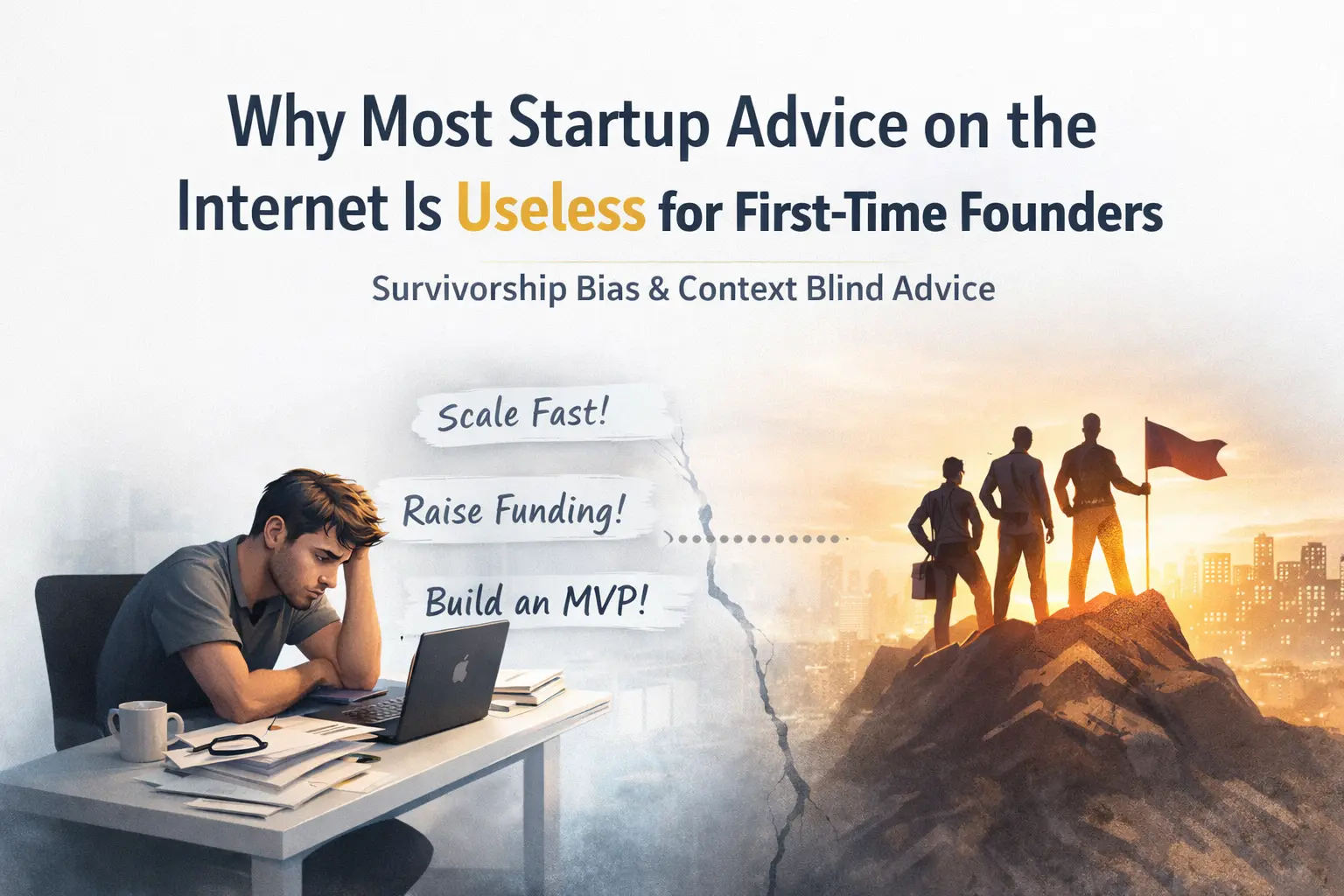

Core Insight: Startup advice is often survivorship-biased and context-blind.
Why It Matters: First-time founders consume massive amounts of content but still feel lost, overwhelmed, and uncertain about what actually applies to their situation.
The Internet’s Startup Advice Problem No One Talks About
If you search “how to build a startup” today, you will find millions of blog posts, threads, podcasts, and videos promising a blueprint to success. From viral Twitter threads by unicorn founders to polished YouTube “startup systems,” the message is consistent: follow these steps, and you can win too.
Yet, most first-time founders don’t feel empowered after consuming this content. They feel more confused.
They build more features. They pivot more often. They chase growth metrics they don’t understand. And they constantly wonder if they are “doing it wrong.”
The problem isn’t a lack of advice. The problem is the type of advice that dominates the internet.
The Survivorship Bias Trap
Most popular startup advice comes from people who already “made it.”
They built a unicorn.
They exited.
They raised millions.
Their stories dominate blogs, podcasts, and conference stages. But what you rarely hear about are the thousands of startups that followed similar strategies and failed quietly.
This is called survivorship bias — learning only from the winners and ignoring the invisible majority who tried the same approach and didn’t succeed.
Real-World Example: Airbnb’s Origin Story
Airbnb’s founders famously sold cereal boxes during the 2008 U.S. election to survive. This story is now used as motivation for “hustle culture” in startup content.
But here’s what most advice leaves out:
- They were in Silicon Valley, surrounded by early-stage investors.
- They had access to Y Combinator, one of the most powerful startup networks in the world.
- The timing aligned with the rise of social platforms and online trust systems.
Telling a first-time founder in a small market to “just hustle like Airbnb” ignores context, geography, capital access, and timing — factors that often matter more than effort alone.
Context Is Everything — But Most Advice Ignores It
Startup advice is usually presented as universal. It rarely is.
What works for:
- A Stanford graduate in San Francisco
- With venture capital access
- Building a SaaS product for enterprises
Will not work the same way for:
- A solo founder in Canada or India
- Bootstrapping a local marketplace
- Targeting small businesses or consumers
Yet both founders are told to:
- “Scale fast”
- “Raise funding early”
- “Hire aggressively”
- “Focus on growth at all costs”
These strategies can destroy a bootstrapped or early-revenue business that actually needs profitability, stability, and operational discipline first.
The “Follow This Playbook” Illusion
Many viral startup posts promise a step-by-step formula:
- Validate your idea
- Build an MVP
- Launch on Product Hunt
- Raise a seed round
- Scale with paid ads
This looks clean. Reality is not.
Real-World Example: Basecamp (37signals)
Basecamp grew into a profitable, globally recognized company without following the traditional Silicon Valley playbook. They:
- Avoided venture capital
- Focused on sustainable growth
- Built slowly and intentionally
- Prioritized profitability over scale
If a first-time founder followed mainstream internet advice, Basecamp’s strategy would be labeled “playing too small.” Yet it created a long-term, stable, multi-million-dollar business.
Why First-Time Founders Feel Overwhelmed
Most founders aren’t confused because they lack motivation. They are overwhelmed because they are exposed to too many conflicting strategies at once.
One expert says:
“Launch fast and break things.”
Another says:
“Don’t launch until your product is perfect.”
One says:
“Never build without customers.”
Another says:
“Build first, find customers later.”
All of them are successful. All of them are right — in their context.
The first-time founder is left trying to combine all these approaches into one impossible strategy.
The Hidden Variable: Timing
Timing is rarely emphasized in online startup advice because it’s hard to package into a motivational post.
But it matters more than most tactics.
Real-World Example: Dropbox
Dropbox didn’t just succeed because of a great product. It launched when:
- Internet speeds were improving globally
- Cloud storage was becoming mainstream
- Consumers were starting to use multiple devices
If the same product launched five years earlier, the market might not have been ready. Five years later, the market would have been saturated.
Most startup advice ignores this entirely and focuses only on execution.
The Confidence Bias of Successful Founders
Once someone succeeds, their past decisions often start to look “inevitable” in hindsight.
They say things like:
“I always knew this would work.”
In reality, many of them were guessing, testing, and reacting in real time.
Their advice is often framed as strategy, but it was originally experimentation.
First-time founders who treat these stories as fixed formulas often become risk-averse instead of adaptive.
What First-Time Founders Actually Need Instead
Rather than chasing universal advice, new founders benefit more from building decision-making systems.
Here’s a practical framework:
1. Filter Advice by Business Model
SaaS, marketplaces, e-commerce, and local services all grow differently. Only listen to people who built something structurally similar to what you are building.
2. Match Advice to Your Stage
What works at $0 revenue can break a company at $100,000 monthly revenue, and vice versa.
3. Prioritize Learning Over Imitation
Use stories as inspiration, not instructions.
4. Track Your Own Data
Your users, conversion rates, churn, and feedback are more valuable than any viral thread.
A Better Way to Learn from Successful Entrepreneurs
Instead of asking:
“What did they do?”
Ask:
“What constraints did they have?”
- Money
- Time
- Market size
- Team size
- Geography
- Regulation
These constraints shape decisions more than ambition or intelligence ever will.
The Internet Isn’t Useless — But It’s Not a Mentor
Online startup content works best as:
- A source of perspective
- A way to see what’s possible
- A place to learn vocabulary and frameworks
It fails when it replaces:
- Customer conversations
- Financial discipline
- Market research
- Real-world testing
Final Thought: Build Your Own Playbook
Every successful startup eventually becomes a case study. But before that, it was an experiment.
The most valuable skill for a first-time founder is not following advice. It is learning how to decide what applies and what doesn’t.
Because the real advantage isn’t knowing what worked for someone else.
It’s discovering what works for you, in your market, at your moment in time.