
One of the biggest myths in startup culture is that the first step to building a company is building a product.
It is not.
The first step is proving that a real problem exists and that people are willing to act to solve it. Code does not validate demand—behavior does. In fact, for early-stage founders, writing code too early is often the most expensive way to learn the wrong lesson.
The smartest founders validate before they build. And they do it using tools far simpler than an MVP.
The Core Insight: MVPs Are Overrated at Day Zero
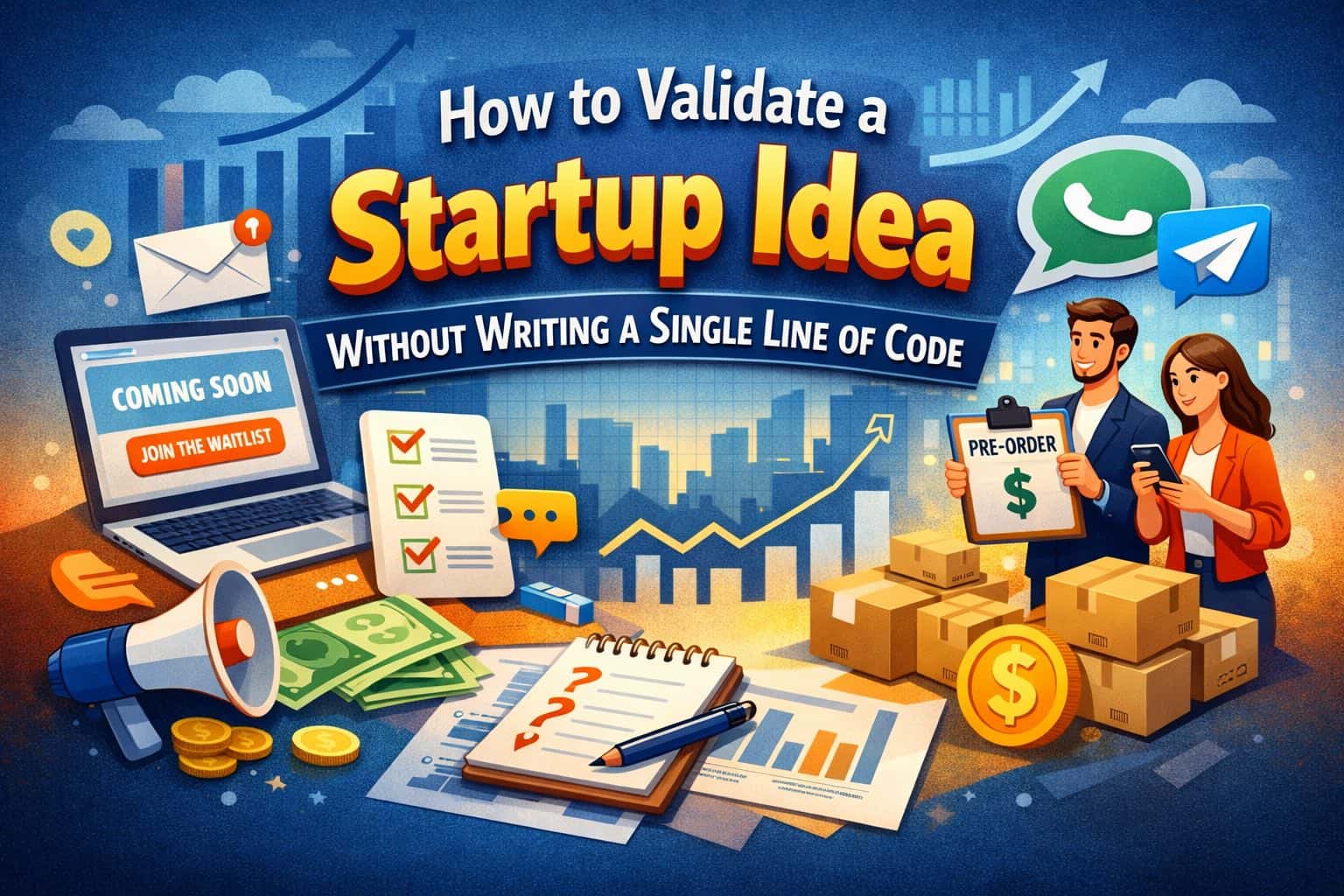
For early validation, landing pages, waitlists, WhatsApp groups, and pre-orders consistently outperform MVPs.
Why? Because they test the only thing that matters early on:
Will someone care enough to take action?
An MVP still requires design, development, time, and emotional investment. Validation tools test demand without those costs.
Why Early Validation Matters More Than Speed
Founders usually rush into development because:
- They want to feel productive
- They fear someone else will build it first
- They assume “build it and they will come”
In reality, most startups fail not because of poor execution, but because they built something nobody truly needed.
Validating early:
- Saves months of development time
- Preserves capital
- Reduces founder burnout
- Prevents emotional attachment to a bad idea
Most importantly, it gives you clarity—not opinions.
1. The Landing Page Test (Demand Without Product)
A single landing page can validate more than weeks of coding.
What it should include:
- One clear problem statement
- One clear promise or solution
- One strong call to action
Examples of calls to action:
- “Join the waitlist”
- “Get early access”
- “Notify me when this launches”
What you are testing:
- Do people understand the problem?
- Does the value proposition resonate?
- Are they willing to give you their email?
If people won’t leave an email, they won’t download an app later.
Rule of thumb:
If you cannot convert interest on a landing page, an MVP will not fix that.
2. Waitlists: Measuring Intent, Not Curiosity
A waitlist is not about vanity metrics. It is about intent.
A small, highly engaged waitlist is far more valuable than thousands of passive signups.
What to track:
- How people found you
- Drop-off rates
- Replies to follow-up emails
- Willingness to be contacted
You can also segment:
- “Early adopters”
- “Paying users”
- “Just browsing”
This tells you who actually matters.
3. WhatsApp or Telegram Groups: Live Market Research
If your idea is about community, collaboration, learning, or conversation—a WhatsApp group is already your MVP.
Why this works:
- Zero build cost
- Direct access to users
- Real conversations, not surveys
- Instant feedback
Create a group around the problem, not the product.
Observe:
- What people complain about
- What they ask repeatedly
- What solutions they already use
- What they are willing to pay for
If people actively engage, help each other, and stay—there is demand.
4. Pre-Orders: The Ultimate Validation Signal
Nothing validates a startup idea like someone paying before the product exists.
Even a symbolic price is enough.
How to do it:
- Offer early access
- Offer discounted lifetime pricing
- Offer founding member benefits
You are not testing payment infrastructure.
You are testing belief.
If people pay, you have crossed the most difficult barrier in startups: trust.
5. Conversations Beat Surveys Every Time
Founders often rely on surveys. Surveys collect opinions. Conversations reveal truth.
Talk to users directly:
- Ask how they solve the problem today
- Ask what they have already tried
- Ask what failure costs them (time, money, stress)
People lie in surveys. They don’t lie about their past behavior.
A Critical Reminder: Every Entrepreneur’s Journey Is Different
There is no single “correct” startup path.
Some founders build first and validate later.
Some pivot after launch.
Some succeed by accident.
However, for most early-stage founders, validating before building is the ideal and least risky path.
It minimizes regret, reduces sunk cost bias, and allows you to make decisions based on data—not hope.
The Real Goal of Validation
Validation is not about proving your idea is perfect.
It is about answering three questions honestly:
- Is this a real problem?
- Do people care enough to act?
- Are they willing to pay or commit?
If the answer to any of these is “no,” that is not failure—that is clarity.
And clarity is far cheaper than code.
Final Thought
Writing code feels productive. Validation is productive.
Before you build software, build certainty.
The best startups are not the ones that launch fastest.
They are the ones that learn fastest—before it becomes expensive.