
For years, Canada has marketed itself as a rising global tech power. World-class universities. Strong immigration pathways. AI leadership. Deep engineering talent. And yet, beneath the headlines, the capital stack tells a more sobering story.
A recent report from National Angel Capital Organization (NACO) and Startup Genome — covered by BetaKit — puts hard numbers behind a quiet structural issue: Canada has an early-stage funding gap that has compounded over decades.
As someone who has tracked Canadian startup ecosystems through cycles of hype and contraction, I find this report less surprising than clarifying. It doesn’t reveal a sudden collapse. It reveals a long, slow erosion.
The Core Problem: Capital Is Thinner at the Beginning
The report focuses on pre-seed, seed, and Series A funding — the stages where companies are fragile, experimental, and capital efficiency matters most.
Compared to leading U.S. ecosystems, Canadian startups face:
- An estimated US $141 million annual shortfall at pre-seed and seed
- An additional US $181 million gap at Series A
- Smaller average seed round sizes
- A lower seed-to-Series A capital ratio than top U.S. tech hubs
Those numbers may not sound catastrophic in isolation. But startup ecosystems behave like compounding machines. A small funding gap at the earliest stage doesn’t stay small. It multiplies downstream.
Less seed capital means:
- Fewer companies reaching product-market fit
- Slower hiring
- Reduced traction before Series A
- Weaker negotiating leverage with global investors
The result isn’t dramatic failure. It’s something more dangerous: under-performance.
The $66 Billion Signal
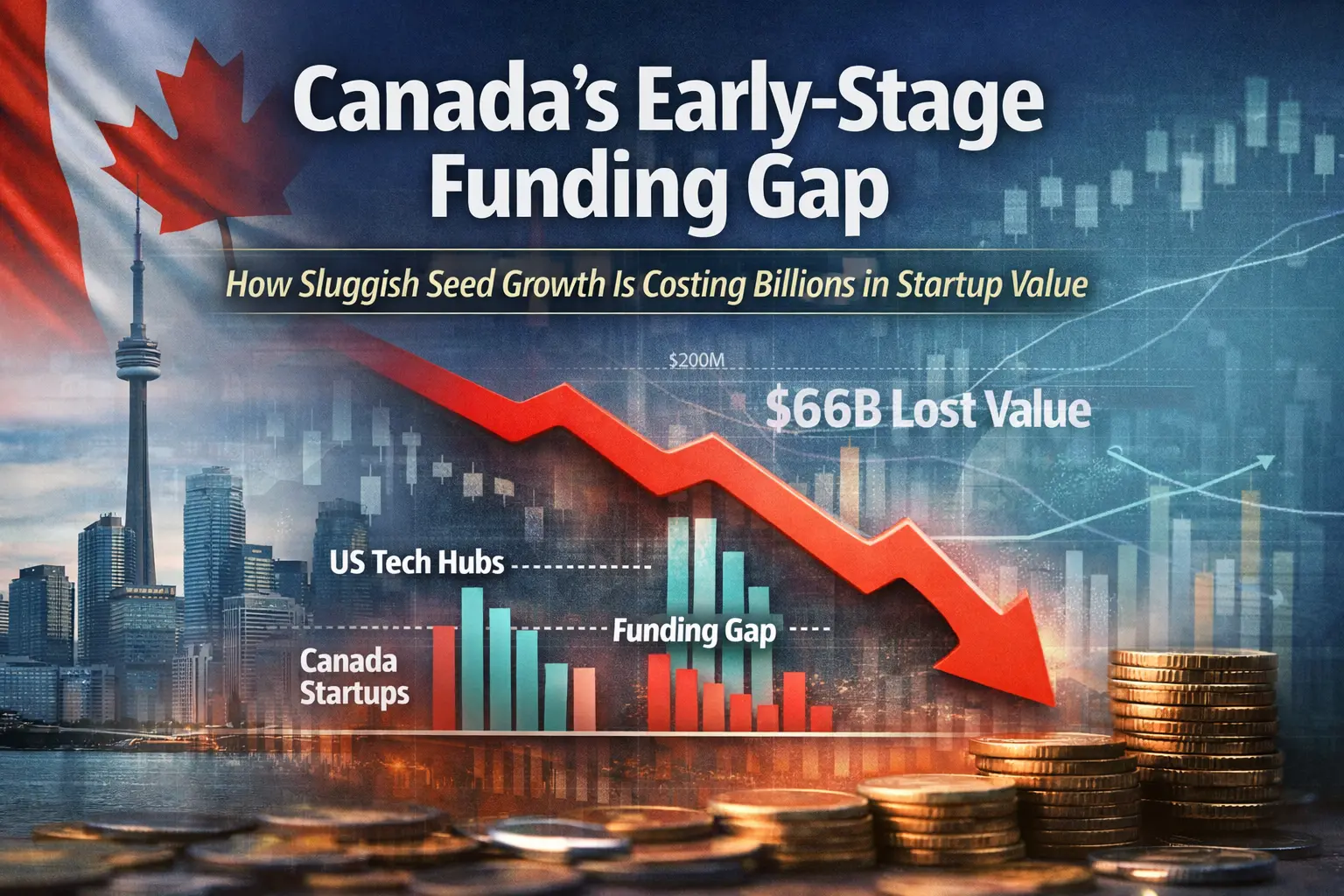
Perhaps the most striking figure in the analysis is this: between 2019 and 2024, Canada’s major ecosystems — including Toronto-Waterloo, Montréal, and Vancouver — saw an estimated US $66 billion decline in ecosystem value relative to global growth trends.
That doesn’t mean $66B vanished from bank accounts. It reflects lost relative share — fewer exits, fewer mega rounds, fewer scaling breakouts compared to global peers.
In venture ecosystems, relative positioning matters more than absolute numbers. Capital flows to velocity. If growth slows, attention shifts elsewhere.
And growth has slowed.
Canadian ecosystems reportedly grew at roughly 2.2% annually, compared to 13–17% in countries like the UK and France over comparable periods.
In venture terms, that’s not just a gap. It’s divergence.
Why Early-Stage Gaps Matter More Than Late-Stage Gaps
Canada does not lack late-stage capital entirely. The country has produced strong institutional funds and pension-backed investors. It has produced unicorns. It has global AI credibility.
But ecosystems are not built at Series C. They are built at pre-seed.
When early capital is thinner:
- Angels write fewer cheques.
- Accelerators lack sufficient follow-on funding.
- Founders optimize for capital scarcity instead of speed.
- Global funds hesitate to build consistent Canadian pipelines.
The report suggests structural weaknesses:
- Smaller angel syndicates
- Less coordinated early-stage funding infrastructure
- Limited density of risk-tolerant capital
These are systemic constraints, not temporary downturn effects.
The Psychological Effect on Founders
There’s another layer that doesn’t always show up in data models: founder psychology.
In ecosystems where seed rounds are larger and more abundant, founders think bigger earlier. They hire faster. They expand markets sooner. They attract talent with confidence.
In tighter capital environments, founders become conservative by necessity. They stretch runway. They defer expansion. They delay risk.
Prudence can be admirable. But ecosystems thrive on velocity.
This Is Not a Talent Problem
Canada continues to produce top-tier technical talent. Its universities rank globally. Immigration policies have historically supported skilled workers. AI research hubs remain internationally respected.
The funding gap is not about capability. It’s about capital density and coordination.
In many ways, this makes the issue more frustrating — and more fixable.
What the Report Implies
The recommendations are pragmatic:
- Strengthen angel networks and syndication
- Increase coordinated seed-stage support
- Pair accelerators with funding, not just programming
- Expand public-private capital matching mechanisms
None of these are radical ideas. But execution and scale matter.
If Canada wants to remain competitive in frontier sectors — AI, climate tech, deep tech — the earliest stage must be structurally reinforced.
Because every breakout company that never receives its first meaningful cheque never becomes a unicorn, never hires 500 people, never exits at scale.
And that’s where value quietly disappears.
The Bigger Question
The real issue isn’t whether Canada has a funding gap.
It’s whether the country treats it as cyclical — or structural.
If it’s cyclical, patience will solve it.
If it’s structural, patience will compound the loss.
The data suggests the latter.
Canada doesn’t need more hype. It needs thicker capital at the foundation.
Because in venture ecosystems, growth is not lost in dramatic crashes. It’s lost in small early constraints that echo for decades.