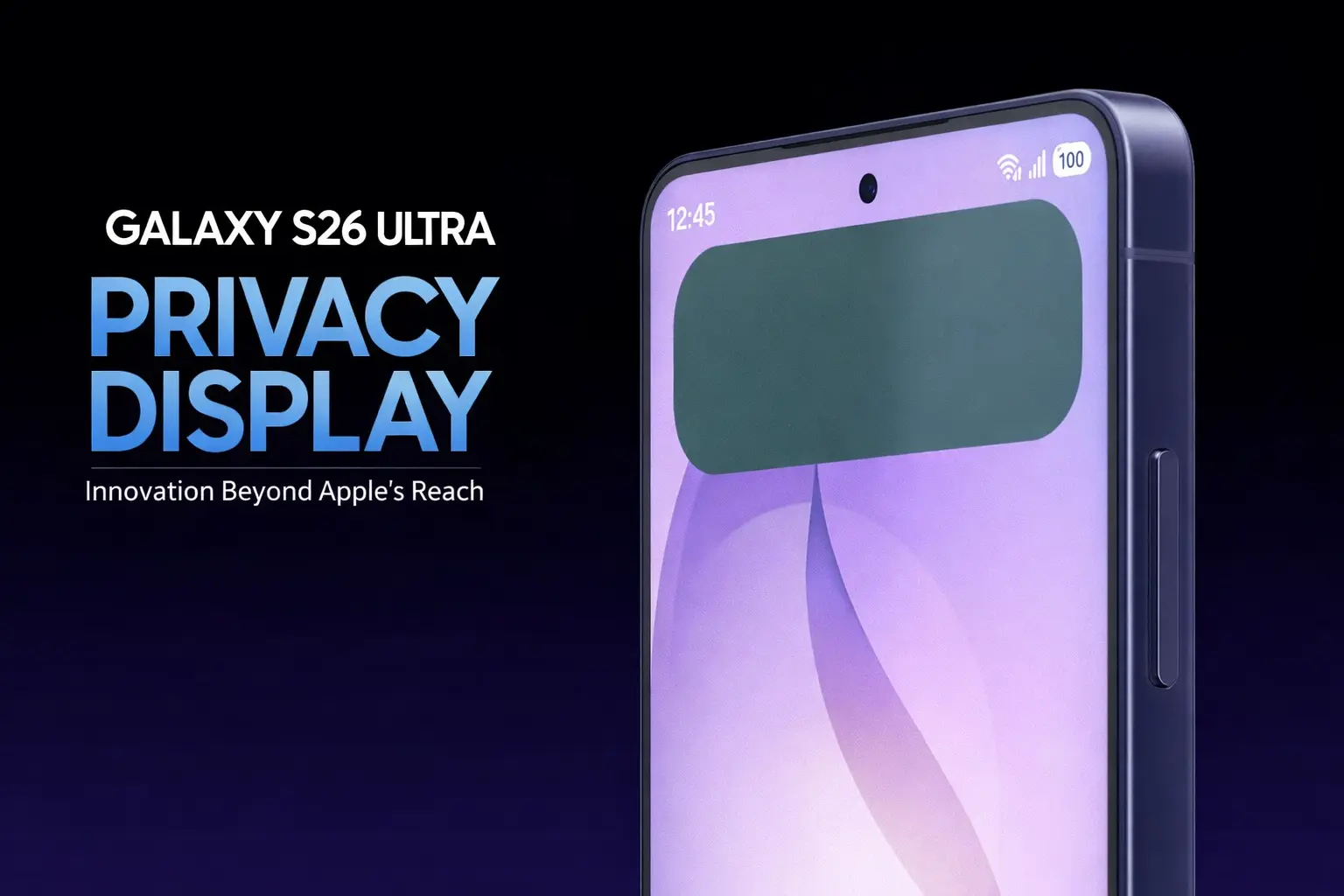

Samsung’s latest flagship, the Samsung Galaxy S26 Ultra, is arguably one of the most technically ambitious smartphones ever released — largely due to its groundbreaking Privacy Display technology. While other smartphone makers continue incremental upgrades, Samsung has pushed the boundaries of hardware and software integration in a way we haven’t seen before.
What Is the Privacy Display? A Breakthrough in Screen Technology
The Galaxy S26 Ultra introduces a display feature that limits visibility at the hardware level — meaning the screen itself restricts viewing angles so that only the person directly in front of it can see what’s being shown. This isn’t a simple tint effect or a software blur: it’s a pixel-level privacy solution built into the OLED panel.
Unlike traditional privacy screen protectors or app-based filters that darken the entire screen, Samsung’s implementation is selective and intelligent. It can blackout only specific areas of the display — such as secure notifications, sensitive app content, or payment information — while leaving the rest of the screen fully visible. That’s a major technical achievement, especially on a large flagship display.
Hardware Meets Software — Seamless Integration With Android
What makes the Privacy Display particularly impressive — and arguably superior compared to other approaches — is how deeply Samsung has woven it into the Android operating system and core app experience:
- System-wide support: Privacy Display works inside standard Samsung apps like Messages, Gallery, and Notes.
- Third-party compatibility: Installed apps — from banking apps to social media — automatically inherit Privacy Display support without requiring developer updates.
- Context-aware activation: The system intelligently triggers privacy coverage only when needed, not as a blanket blackout.
This level of integration shows that Samsung didn’t just add a new screen mode — they redesigned how display privacy functions from the silicon level up through the user interface.
Why Privacy Display Is a True Innovation
Smartphones have offered privacy tools before — dark modes, sensitive content blur, app-specific hide features — but never with hardware working in tandem with software to this depth. The S26 Ultra’s technology:
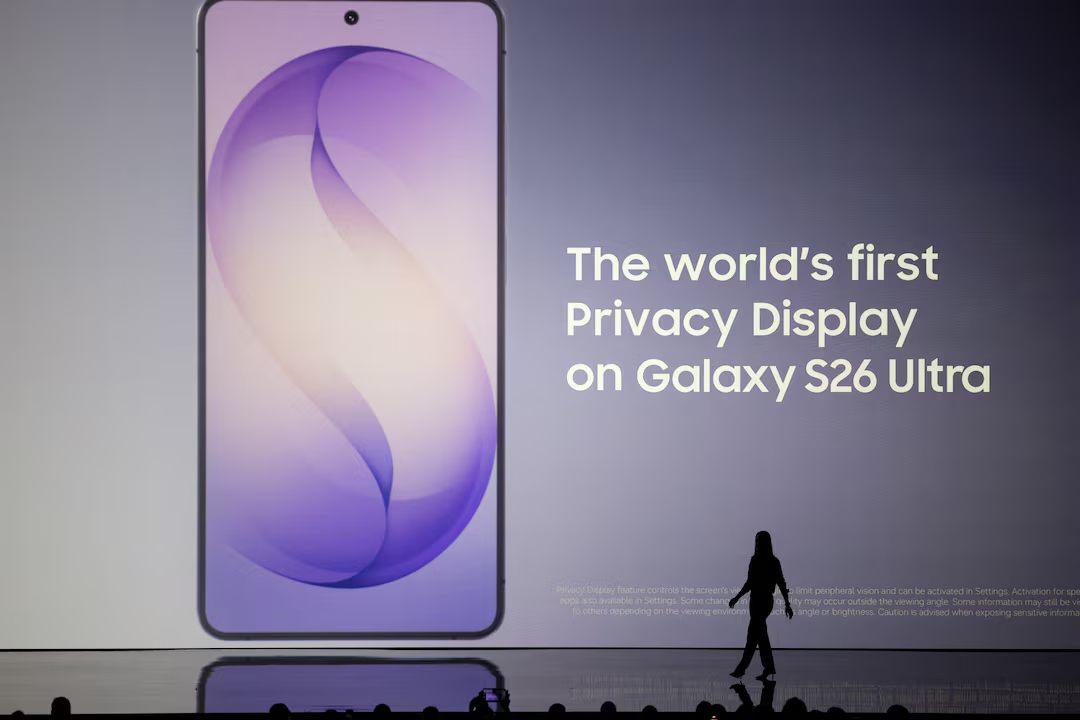
- Enhances security without compromising usability
- Reduces visual exposure in public spaces
- Integrates without developer friction
- Operates intelligently based on context and permissions
In practical terms: you can be in a crowded coffee shop, glance at your phone with sensitive info displayed, and rest assured that people beside you can’t see what you’re doing — all without turning your entire screen into a dim, unreadable panel.
Comparing Samsung’s Approach to Apple’s Strategy
Apple frequently highlights its hardware-software synergy as a core advantage, emphasizing “end-to-end control” of the user experience. That tight integration of silicon, software, and services has been a key part of Apple’s positioning for years.
However, the Galaxy S26 Ultra’s Privacy Display challenges that narrative. Samsung has demonstrated that deep integration on Android — a platform that is by design far more open and flexible than iOS — can produce real innovation at the hardware level. This is not a minor user-interface tweak; this is a feature that changes how everyday interactions with a smartphone behave in public.
While Apple’s recent iPhone models often focus on incremental updates — camera refinements, processor bumps, and UX refinements — Samsung has delivered a new class of display innovation that fundamentally influences privacy and security for end users.
Conclusion: A High-Water Mark for Smartphone Innovation
The Samsung Galaxy S26 Ultra is more than just another flagship — it’s a statement. The Privacy Display isn’t a buzzword feature — it’s a real technological advancement that many users have been wanting but never received from any major smartphone maker before.
This innovation underscores a broader truth in the industry: true progress often comes from bold hardware + software integration, not just iterative annual updates. Samsung’s approach here isn’t just competitive — it raises the bar for what flagship devices should offer in 2026 and beyond.