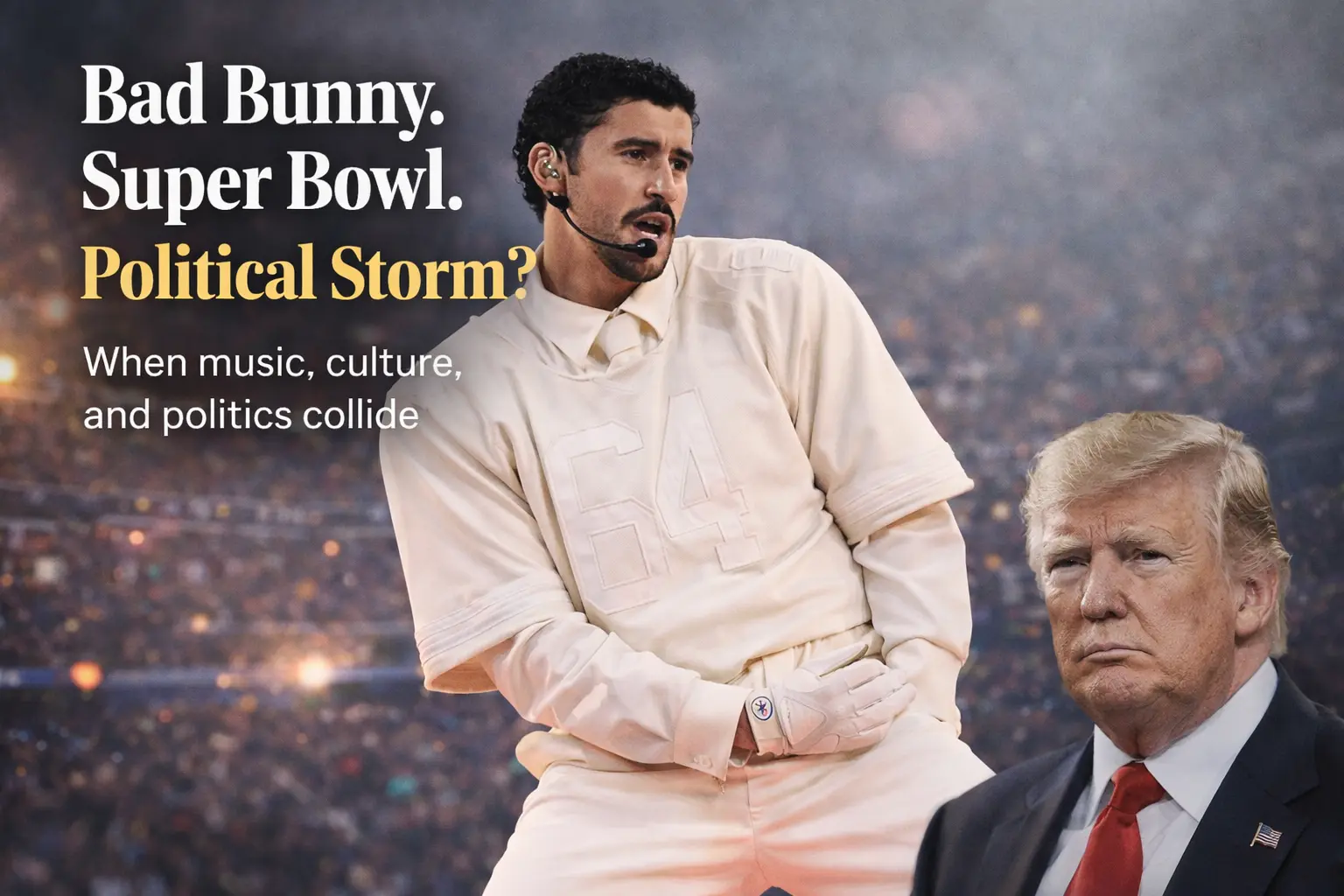

On February 8, 2026, what had been years in the making unfolded on one of the world’s most-watched broadcast stages: the Super Bowl LX halftime show at Levi’s Stadium in Santa Clara, California. Headlining the Apple Music-sponsored spectacle was Puerto Rican artist Bad Bunny, whose artistic vision, cultural specificity, and political history turned what is usually a showcase of pop spectacle into a flashpoint of national conversation.
Bad Bunny: From Puerto Rico to Global Stage
Benito Antonio Martínez Ocasio — professionally known as Bad Bunny — is among the most influential musicians of his generation. With a career defined by boundary-breaking commercial success and cultural impact, he has topped global streaming charts multiple times and reshaped how Latin music is integrated into mainstream pop. (Wikipedia)
In February 2026, Bad Bunny achieved a landmark that reverberated far beyond the music industry when his album Debí Tirar Más Fotos became the first Spanish-language record to win the Grammy Award for Album of the Year — a milestone that placed him in music history as a trailblazer for non-English language artists. (Wikipedia)
Political Voice and Public Statements
Bad Bunny’s rise has not been limited to music alone. He has increasingly used his platform to address social concerns — especially those connected to immigration and identity.
At the 2026 Grammy Awards, in a moment that captured global attention, he delivered a statement directed at the U.S. immigration enforcement agency ICE:
“Before I say thanks to God, I’m gonna say: ICE out! We’re not savage, we’re not animals, we’re not aliens — we are humans and we are Americans.” (TIME)
That line — intertwined with the award acceptance — underscored his belief that cultural contributions from Latinx and immigrant communities are essential to the nation’s identity.
A Halftime Show Unlike Any Other
The Super Bowl halftime show has long been a cultural milestone: a platform where music, spectacle, commerce, and national identity intersect. In 2026, Bad Bunny’s performance was historic in several ways:
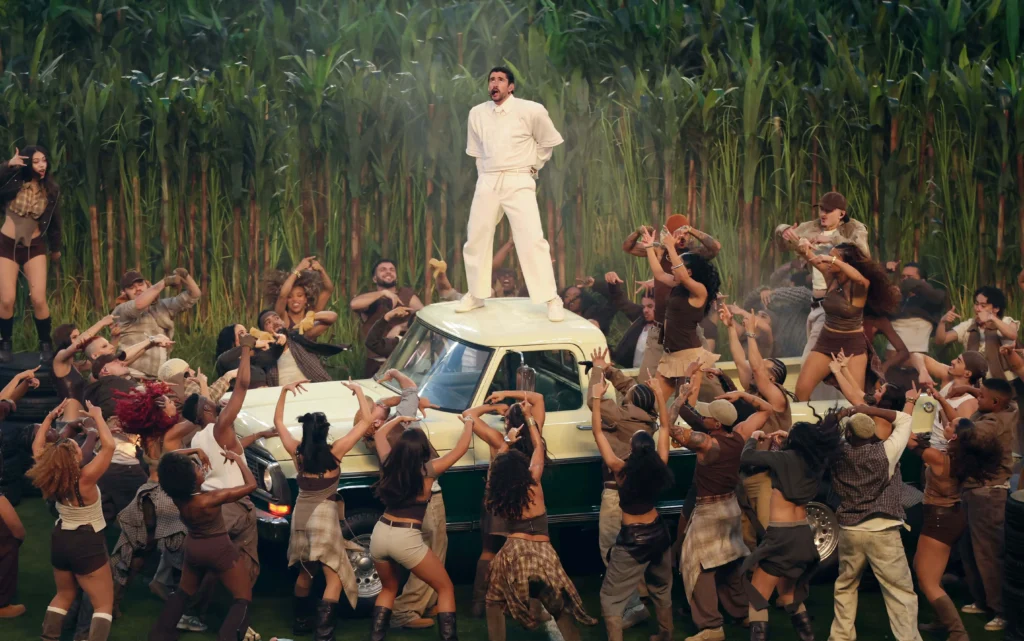
- He became the first Latino solo artist to headline the halftime show and the first to perform almost entirely in Spanish. (Wikipedia)
- The show was produced with elaborate staging, a blend of music and theatrical design that drew on Puerto Rican cultural motifs and narratives while celebrating community and joy.
- Among the visual highlights was a real, legally binding wedding ceremony staged live within the performance — a moment that drew global attention and symbolized celebration and inclusiveness. (Good Morning America)
- Guest appearances included celebrated artists and personalities such as Lady Gaga, Ricky Martin, Cardi B, Jessica Alba, Pedro Pascal and more, who joined in performances that ranged from salsa reinterpretations to collaborative renditions of Bad Bunny’s chart-topping hits. (Good Morning America)
- The show closed with an explosive fireworks display and a unifying message about connection and shared humanity.
The performance drew over 128 million viewers, making it one of the most-watched halftime shows in the event’s history and a defining cultural moment of the year. (The Tulane Hullabaloo)
Political Backlash and National Debate
Given Bad Bunny’s history of vocal commentary on immigration policy, political reaction was predictable — and pointed.
At multiple points leading up to and following the Super Bowl, former U.S. President Donald Trump publicly criticized both the choice of Bad Bunny and the halftime performance itself.
During an earlier commentary in 2025, before the Super Bowl was scheduled, Trump questioned the decision to select Bad Bunny, saying of the artist: “I’ve never heard of him… I don’t know why they’re doing it. It’s absolutely ridiculous.”(The Express Tribune)
Once the show concluded, Trump took to his social media platform Truth Social to offer a withering assessment of the performance:
“The Super Bowl Halftime Show is absolutely terrible, one of the worst, EVER… It’s an affront to the Greatness of America, and doesn’t represent our standards of Success, Creativity, or Excellence.” (AS USA)
His critique centered not only on artistic taste but also on the language of performance and perceived political messaging.
Beyond One Man’s Opinion: A Broader Cultural Conversation
Trump’s comments were not an isolated reaction; they reflected a broader cultural tension over the role of popular entertainment in national discourse:
- Some commentators accused the show of prioritizing political messaging over traditional entertainment values, arguing that sports should be a neutral space. (The Fulcrum)
- Other voices expressed discomfort with a high-profile event featuring an almost entirely non-English set, regarding it as emblematic of shifting cultural norms. (New York Post)
- Meanwhile, several public figures who had criticized Bad Bunny were scrutinized for contradictory personal behavior, such as sharing his music privately — a dynamic that sparked commentary on cultural identity and generational divides. (People.com)
Supporters of the performance, including many cultural and political observers, framed the show as a celebration of diversity and inclusivity, pointing to the artist’s record-breaking streaming success and global popularity as evidence of music’s evolving landscape. (The Ringer)
The Legacy of the Show
What distinguishes the Bad Bunny Super Bowl halftime event from many before it is the way it became more than a performance — it became a symbolic moment in contemporary American cultural politics.
Critics saw what they described as a political agenda. Supporters saw representation, community, and celebration. Viewers around the world saw a halftime show that reflected the cultural tapestry of the 21st century — not as a concession to any political faction, but as a reflection of where global entertainment, identity, and American popular culture are increasingly intertwined.
In an era where sports and society frequently intersect, the conversation around Bad Bunny’s Super Bowl performance underscores the ongoing evolution of what it means to represent a nation — on a stage, in music, and in public life. (CBS News)