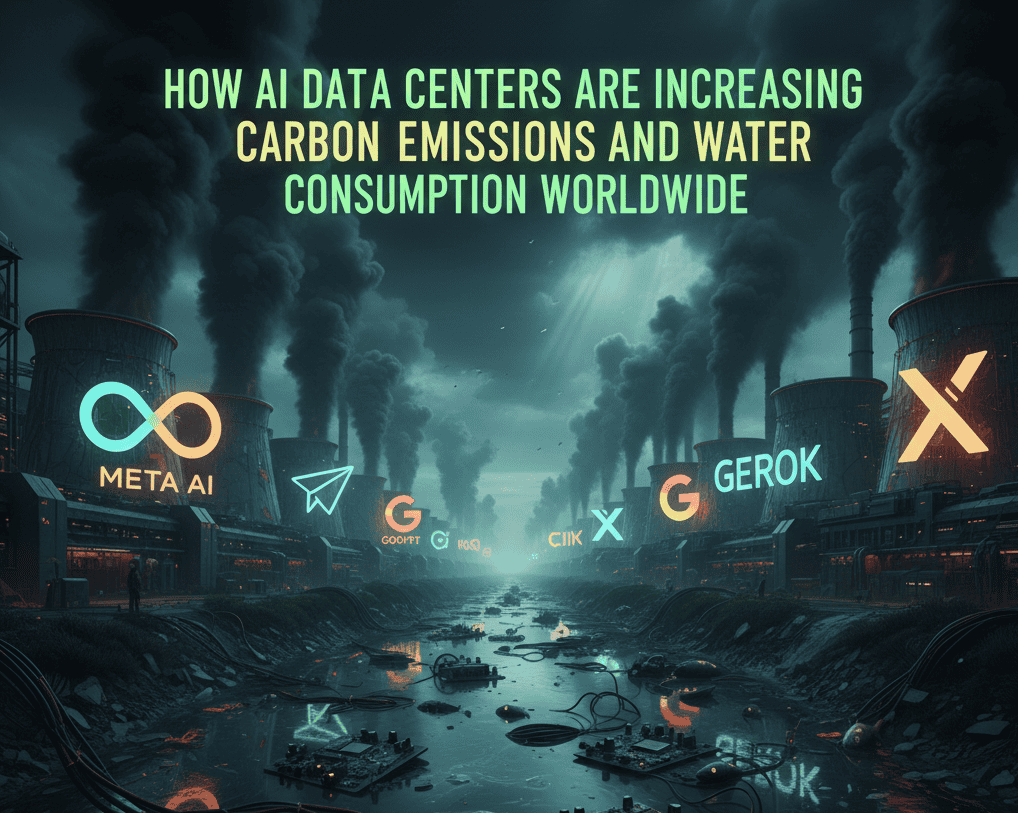

Artificial Intelligence (AI) systems are transforming industries—from healthcare and finance to logistics and climate modeling. Behind these advantages lies a rapidly expanding infrastructure footprint: energy consumption, carbon emissions, and water usage associated with the data centers powering AI workloads. Recent research and industry estimates have captured global attention, quoting figures such as hundreds of billions of liters of water used and carbon emissions comparable to major cities. But how accurate are these claims, what do the data actually show, and what are the implications for the future?
AI’s Energy and Carbon Footprint: What the Data Shows
Electricity Consumption
AI inference and training primarily run on massive data centers filled with high-performance processors. According to the International Energy Agency (IEA), data centers in the United States consumed approximately 183 terawatt-hours (TWh) of electricity in 2024, representing more than 4 percent of U.S. electricity use—roughly equivalent to Pakistan’s national electricity demand. Projections by 2030 estimate this could grow to 426 TWh, driven largely by AI workloads. Pew Research Center
Globally, data centers’ electricity demand has been estimated between 240–340 TWh annually, approximately 1–1.3 percent of global electricity consumption, with expectations to double in the coming years. Madison Air
Carbon Emissions
Attribution of emissions specifically to AI remains difficult due to a lack of detailed corporate disclosures. However, a peer-reviewed study published in Patterns estimates AI-driven data center emissions for 2025 could fall between 32.6 and 79.7 million metric tons of CO₂. At the higher end, this range broadly overlaps with the annual emissions of major cities like New York City. CRBC News
Industry estimates vary: overall global data centers may emit 220–300 million metric tons of CO₂ annually, with AI-specific infrastructure contributing a growing share of this total. Projections suggest that by 2030 emissions related to AI workloads could rise significantly as computational demands expand. All About AI
It’s important to note that global data centers, including those hosting AI, currently contribute between about 1–3 percent of global greenhouse gas emissions, depending on accounting methods and regional energy mixes. mint
Water Usage: Cooling and Power Generation
Data centers must maintain optimal temperatures for dense racks of CPUs and GPUs. This often requires elaborate cooling systems involving water. Studies estimate that AI data centers could consume between 312.5 and 764.6 billion liters of water annually, including both direct use in cooling infrastructure and indirect use for electricity generation. CRBC News
U.S. data centers consumed an estimated 17 billion gallons (about 64 billion liters) of water in 2023, with hyperscale facilities (those that house the largest AI workloads) accounting for a disproportionate share. surfercloud.com
Further projections indicate that global AI data center water use could grow elevenfold by 2028, potentially exceeding 1 trillion liters annually—an illustration of how rapid AI expansion places new demands on finite water resources. The Times of India
Why These Numbers Are Hard to Pin Down
Despite attention-grabbing figures, researchers themselves caution that many estimates involve significant uncertainty:
- Tech companies rarely disclose AI-specific energy and water data, making direct measurement difficult. CRBC News
- Some studies include indirect water usage from power plants and electricity transmission losses, while others report only direct on-site consumption, leading to divergent totals.
- Regional energy mixes (coal vs. renewables) dramatically influence carbon intensity of electricity used by data centers.
As such, many cited statistics are intended as indicative of scale rather than precise audited metrics.
Future Outlook: Risks and Opportunities
1. Increased Demand and Infrastructure Expansion
AI’s exponential growth—driven by larger models and broader deployment—suggests that energy and water demands will continue to rise. Projections by some analyses suggest that by 2030, AI data centers alone could consume a noticeably larger share of global energy and significant water volumes, particularly if current cooling technologies remain dominant. All About AI
2. Renewable Energy Integration
Many major cloud providers are aggressively investing in renewable energy procurement to offset emissions. However, using renewable electricity affects carbon accounting but does not reduce water usage inherent in cooling systems or entirely eliminate indirect emissions from the broader supply chain.
3. Technological Innovation
Emerging cooling technologies (e.g., liquid cooling, heat reuse systems) and architectural changes in AI models (more efficient architectures, sparse computing) could dramatically reduce energy intensity and water dependence over time.
4. Policy and Regulatory Response
Governments and climate policy bodies globally are increasingly discussing AI’s environmental footprint. For example, at major climate negotiations, stakeholders emphasized the need to balance AI’s utility with sustainability goals, proposing transparency requirements and energy efficiency standards for AI infrastructure. AP News
Conclusion: Navigating AI’s Environmental Future
AI’s environmental footprint is real, measurable, and growing, particularly in terms of data center energy use and associated carbon emissions and water consumption. However, widely circulated analogies comparing AI to entire cities or global bottled water consumption, while attention-grabbing, are derived from estimates with wide confidence ranges rather than precise measurement.
The future impact of AI on climate and water resources hinges on:
- Corporate transparency on environmental data
- Continued investment in renewable energy and efficient cooling
- Policy frameworks that align technological growth with climate targets
AI’s transformative potential must be balanced with responsible resource management to ensure sustainable innovation over the decades ahead.