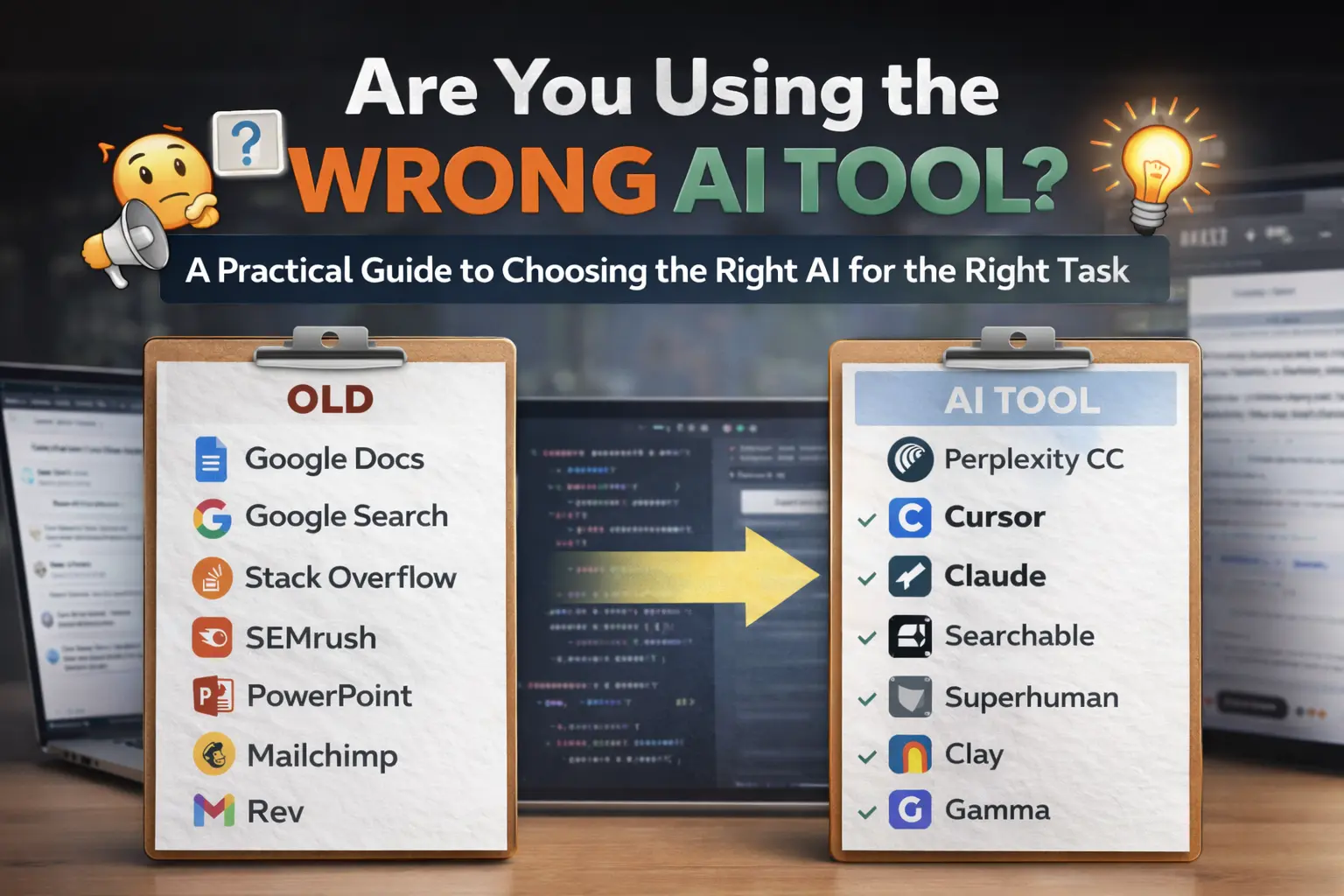

Artificial intelligence tools have exploded in the last two years. From writing assistants to AI-powered coding IDEs, research copilots, and automated outreach platforms—there’s a tool for almost everything.
Yet many professionals, founders, and marketers are still using traditional tools for AI-native tasks.
The result?
- Slower workflows
- Fragmented productivity
- Lower output quality
- Missed competitive advantage
This guide breaks down which AI tools to use for specific tasks—writing, research, coding, SEO, pitch decks, outreach, email, and productivity—so you can build a smarter AI stack.
1. Writing: From Documents to AI Thinking Partners
Traditional Tool:
- Google Docs
AI-Native Tools:
- Claude
- Gamma (for structured content & presentations)
Modern writing isn’t just typing—it’s ideation, structuring, refining, and contextual reasoning.
Claude excels at:
- Long-form blog posts
- Strategic thinking
- Editing and rewriting
- Analytical breakdowns
- Policy and research-backed writing
Unlike static document editors, AI-first writing tools help you:
- Generate outlines
- Improve clarity
- Optimize tone
- Refine arguments
When to use AI writing tools:
- Blog content
- Founder letters
- Strategy memos
- Technical documentation
- Research summaries
Use Google Docs for formatting and collaboration. Use AI for thinking and drafting.
2. Research: From Search Engines to AI Research Assistants
Traditional Tool:
- Google Search
AI-Native Tool:
- Perplexity (Comet)
Search engines give links. AI research tools give synthesized answers with citations.
AI research copilots:
- Summarize multiple sources instantly
- Provide contextual analysis
- Compare viewpoints
- Save hours of browsing
Use AI research tools when:
- Writing reports
- Conducting market research
- Validating startup ideas
- Analyzing competitors
- Understanding emerging tech trends
Search engines are still useful—but AI tools compress 60 minutes of reading into 5 minutes.
3. Coding: From Forums to AI Pair Programmers
Traditional Tool:
- Stack Overflow
AI-Native Tools:
- Cursor
- Claude Code
Modern development workflows increasingly rely on AI pair programmers.
AI coding tools can:
- Generate boilerplate code
- Debug errors
- Refactor large files
- Explain legacy systems
- Write documentation
Cursor and similar AI IDEs:
- Understand entire codebases
- Apply edits across files
- Assist with architecture decisions
Instead of copying snippets from forums, developers can now:
- Describe the feature
- Get working implementation
- Iterate instantly
For startups building MVPs, AI coding assistants can reduce development time significantly.
4. SEO, AEO, and GEO: From Keyword Tools to AI Strategy Engines
Traditional Tool:
- SEMrush
AI-Enhanced Approach:
- AI writing tools + research assistants
SEO has evolved into:
- SEO (Search Engine Optimization)
- AEO (Answer Engine Optimization)
- GEO (Generative Engine Optimization)
Today, content must rank in:
- Google search
- AI answer engines
- Conversational assistants
AI helps:
- Identify semantic clusters
- Optimize structure
- Generate schema-ready content
- Write for AI summarization
Traditional keyword tools still matter—but AI enables:
- Intent-based content strategy
- Competitive content gap analysis
- Scalable blog production
5. Pitch Decks: From Slides to AI Presentation Builders
Traditional Tool:
- PowerPoint
AI Tool:
- Gamma
Pitch decks are not about slides—they’re about storytelling.
AI presentation tools:
- Auto-generate structured decks
- Suggest layouts
- Improve narrative flow
- Convert text into visual slides
Founders can:
- Draft content in AI
- Instantly turn it into structured slides
- Iterate messaging quickly
This dramatically reduces preparation time for:
- Investor pitches
- Client proposals
- Internal presentations
6. Outreach & Lead Generation: From Manual Emails to AI Automation
Traditional Tool:
- Mailchimp
AI Tool:
- Clay
Modern outreach requires:
- Personalization at scale
- Data enrichment
- Intelligent segmentation
AI outreach platforms:
- Enrich prospect data
- Generate custom messages
- Trigger personalized workflows
Instead of blasting generic campaigns, you can:
- Reference company news
- Mention hiring activity
- Tailor messages dynamically
For founders, agencies, and B2B startups, AI outreach improves response rates significantly.
7. Speech to Text: From Manual Transcription to AI Accuracy
Traditional Tool:
- Rev
AI Tool:
- Willow AI (and similar AI transcription tools)
AI transcription tools now:
- Convert speech instantly
- Detect speakers
- Generate summaries
- Extract action items
Use cases:
- Podcast transcription
- Meeting notes
- Interviews
- Research recordings
This removes manual effort and speeds up documentation workflows.
8. Email: From Inbox Management to AI Superhuman Workflow
Traditional Tool:
- Gmail
AI Tool:
- Superhuman (AI-powered email workflow)
AI-powered email platforms:
- Draft replies automatically
- Summarize threads
- Suggest follow-ups
- Prioritize messages
Instead of managing email manually, you:
- Process inbox faster
- Reduce cognitive load
- Maintain professional tone consistently
For executives and founders, this is a major productivity multiplier.
9. Productivity: From Task Boards to AI Copilots
Traditional Tool:
- Trello
AI Integration:
- Claude + AI workflow systems
Task boards track work.
AI helps define what work should be done.
AI productivity copilots can:
- Turn ideas into task lists
- Break projects into milestones
- Identify bottlenecks
- Suggest process improvements
The future of productivity is not just tracking tasks—it’s intelligent execution guidance.
How to Build the Right AI Stack (Founder Framework)
Instead of replacing every tool, build a hybrid stack:
Core Thinking Layer
- Claude (strategy, writing, analysis)
Research Layer
- AI research assistant
Execution Layer
- AI coding assistant
- AI presentation builder
- AI outreach platform
Optimization Layer
- SEO tools + AI content refinement
The goal is not tool accumulation.
The goal is workflow compression.
When NOT to Switch to AI Tools
AI tools are powerful, but:
- Regulated industries may require human review
- Legal and compliance documents need expert validation
- Brand voice should still be strategically defined
Use AI as a copilot—not a replacement for expertise.
Final Thoughts: The Real Competitive Advantage
The real question isn’t:
“Which AI tool is best?”
It’s:
“Am I using the right tool for the right task?”
Professionals who combine:
- AI for thinking
- AI for automation
- Human judgment for strategy
will outperform those relying purely on traditional workflows.
AI isn’t replacing tools.
It’s replacing inefficiency.