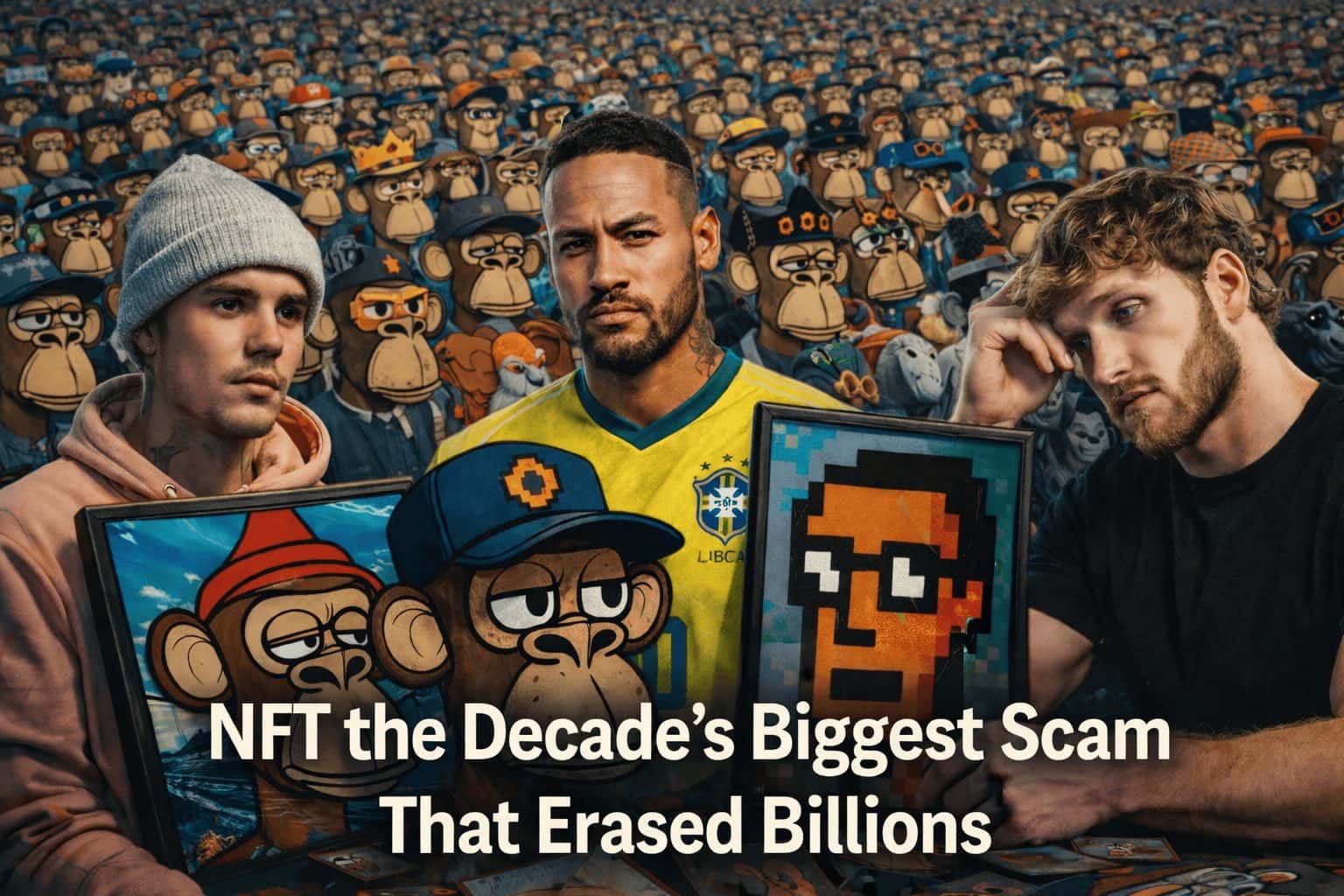

In the early 2020s, non-fungible tokens (NFTs) were marketed as the future of digital ownership—a revolutionary blend of art, blockchain technology, and financial innovation. What followed instead was one of the most aggressive hype cycles in modern tech history. Promoted through celebrity endorsements, social media pressure, and engineered scarcity, NFTs drew millions of buyers into what increasingly resembles a large-scale speculative fraud ecosystem rather than a sustainable investment class.
Once celebrated as “digital gold,” NFTs have now become symbols of financial excess, misinformation, and unchecked fraud. Assets that sold for millions of dollars now trade for pennies—or not at all. The crash has wiped out billions in value and exposed systemic failures that regulators, investors, and technologists can no longer ignore.
This article examines how the NFT market crossed the line from innovation into widespread financial abuse, highlights real cases of investor losses, and outlines the critical lessons needed to avoid repeating the same mistakes in emerging sectors such as AI tokens and metaverse assets.
The Rise of NFTs: How Scarcity Narratives and FOMO Enabled Mass Participation
NFTs gained momentum during the 2021 crypto bull market, capitalizing on blockchain’s promise of verifiable ownership. Digital images—often simple JPEGs—were tokenized and sold as “unique” assets, despite being freely viewable and replicable online.
The core sales pitch was scarcity. Limited mints, exclusive communities, and time-pressured drops triggered intense fear of missing out (FOMO). Influencers and celebrities amplified this urgency, normalizing six-figure purchases and portraying NFTs as a shortcut to wealth.
Trading volume surged from under $100 million in 2019 to approximately $25 billion in 2021. For many participants, NFTs were not purchased for artistic appreciation or utility—but for rapid resale. The market increasingly resembled a speculative loop: buy now, sell to someone else later at a higher price.
This structure made the ecosystem highly vulnerable to manipulation, misinformation, and outright fraud.
The Crash: NFT Market Statistics That Signal Systemic Failure
By 2024–2025, the NFT market experienced a severe collapse. Monthly trading volumes fell by more than 80% from peak levels. Market research suggests that the overwhelming majority of NFTs now have negligible or zero resale value, primarily due to oversupply and evaporating demand.
Key indicators of the collapse include:
- NFT sales dropping sharply year-over-year in 2025
- Average NFT prices falling below $100
- Token supply expanding into the billions, eliminating any real scarcity
- Art NFT volumes collapsing by over 90% from 2021 highs
These numbers point not to a temporary downturn, but to a market correction exposing fundamental flaws. The collapse revealed how much of the NFT economy was sustained by hype rather than economic substance.
When Speculation Turned Into Fraud: Real-World Losses

The NFT crash was not merely a market downturn—it exposed patterns consistent with financial fraud.
High-profile cases brought mainstream attention:
- Justin Bieber purchased a Bored Ape NFT for over $1 million; its value later declined by more than 90%.
- Neymar Jr. and other athletes invested heavily in NFT projects that have since collapsed.
- Logan Paul acknowledged multi-million-dollar NFT losses and faced backlash over failed projects he promoted.
Beyond celebrities, countless retail investors lost savings to rug pulls, fake roadmaps, abandoned Discord communities, and manipulated floor prices. Many projects disappeared entirely after minting, leaving buyers with illiquid assets and no legal recourse.
While not all NFTs were fraudulent, fraud became pervasive enough to define public perception of the entire sector.
What Went Wrong: Structural Flaws and Fraud Enablers
The NFT ecosystem failed due to a combination of design flaws and weak oversight:
- No intrinsic value: Most NFTs generated no cash flow, rights, or enforceable ownership.
- Ease of fraud: Anonymous creators, unregulated platforms, and irreversible transactions enabled abuse.
- Artificial scarcity: Scarcity was manufactured, not natural.
- Celebrity-driven misinformation: Paid promotions often omitted risks.
- Regulatory absence: Minimal consumer protection allowed bad actors to flourish.
As liquidity declined, the system collapsed—exposing a structure that, in many cases, relied on continuous new buyers to sustain prices. This dynamic closely mirrors historical speculative bubbles and borderline Ponzi-style mechanisms.
Lessons for the Next Wave: Avoiding Future Tech-Driven Fraud
The NFT collapse provides essential guidance for evaluating future high-growth narratives, including AI investment tokens, decentralized platforms, and virtual economies.
Key principles:
- Demand real utility: If an asset does not solve a tangible problem, question its value.
- Reject urgency: Pressure tactics are a hallmark of fraud.
- Verify promoters: Paid endorsements are not validation.
- Understand exit liquidity: If resale depends entirely on hype, risk is extreme.
- Diversify and limit exposure: Speculative assets should never dominate a portfolio.
Education and skepticism remain the strongest defenses against financial fraud disguised as innovation.
Conclusion: A Defining Fraud Lesson of the Digital Era
The NFT collapse marks a turning point in how digital assets are perceived. What began as a technological experiment became, for many, a costly lesson in speculation, misinformation, and fraud.
While blockchain technology may still evolve, the first NFT boom will be remembered not for democratizing ownership—but for exposing how quickly innovation can be distorted by greed. As new tech trends emerge, the NFT era serves as a warning: when hype replaces fundamentals, fraud inevitably follows.