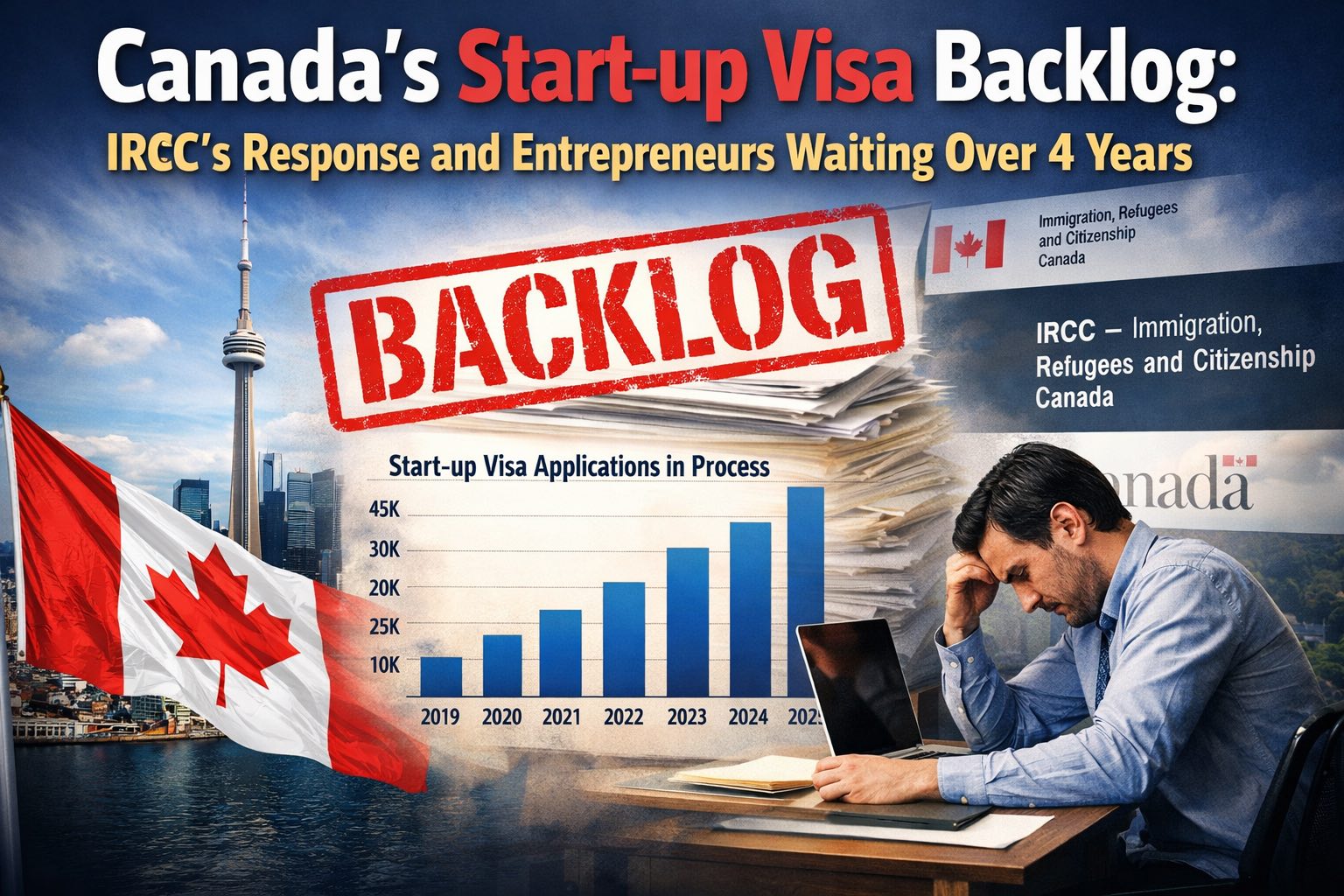

In our earlier coverage on ImFounder analyzing Canada’s immigration policy updates for 2025–2026, we highlighted how tightening immigration targets, housing pressures, and administrative capacity constraints were fundamentally reshaping Canada’s approach to economic immigration. That analysis pointed to early warning signs within the Start-up Visa (SUV) Program, where processing delays were already extending far beyond the program’s original intent. Since then, the situation has escalated. Thousands of startup founders — many of whom applied as early as 2020–2021 — have now been waiting four years or more for permanent residence decisions. As IRCC moves to halt new intake and restructure entrepreneur immigration, the SUV backlog has become one of the most visible examples of systemic strain within Canada’s immigration system.
What the Start-up Visa Program Was Meant to Achieve
Canada’s Start-up Visa Program was designed to attract high-growth, innovation-driven entrepreneurs by offering a direct pathway to permanent residence. The core premise was simple: if a founder could secure backing from a designated Canadian organization — such as a venture capital fund, angel investor group, or approved incubator — Canada would welcome them as long-term contributors to the economy.
At launch, the SUV was promoted as:
- A fast and predictable immigration pathway
- A mechanism to attract global innovation and job creation
- A competitive alternative to entrepreneur visas in the U.S. and Europe
In practice, however, processing realities diverged sharply from policy goals.
The Backlog Crisis: How Bad Is It?
By late 2025, the Start-up Visa backlog had reached a scale that IRCC itself implicitly acknowledged was unsustainable.
Key facts:
- Tens of thousands of applications remain in the processing inventory
- Estimated wait times exceeded 8–10 years for newer applicants
- Founders who applied between 2020 and 2022 are still awaiting final decisions
- Many applicants exhausted temporary status, forcing business shutdowns or exits from Canada
For entrepreneurs, the backlog is not just an administrative delay — it directly affects:
- Business continuity
- Investor confidence
- Hiring and scaling plans
- Personal and family stability
Visualizing the SUV Backlog Growth (Text-Based Graph)
Below is a publisher-safe graph representation you can easily convert into a visual chart for your CMS:
Estimated Start-up Visa Backlog Growth (2019–2025)

Applications in Process
45k |                                ██████████████
40k |                            █████████████
35k |                        ████████████
30k |                    ██████████
25k |                █████████
20k |            ████████
15k |        ██████
10k |    ████
 5k | ██
     ------------------------------------------------
       2019  2020  2021  2022  2023  2024  2025
Interpretation:
Demand grew steadily year over year, while IRCC’s processing capacity and annual admission targets remained constrained — leading to compounding delays.
Why the Backlog Happened
The SUV backlog is the result of structural misalignment, not a single policy failure.
1. Demand Far Outpaced Processing Capacity
Canada aggressively marketed the SUV internationally, but processing resources did not scale proportionally. Each successful startup application also includes multiple family members, further increasing workload.
2. Fixed Immigration Levels Plan
IRCC is bound by annual immigration admission targets, meaning even approved cases cannot move faster than quota limits allow.
3. Inconsistent Quality of Applications
Over time, the program attracted:
- Genuine high-growth startups
- Marginal or immigration-motivated applications
This forced IRCC to apply stricter scrutiny, slowing processing further.
4. Policy Tightening Mid-Stream
Caps on designated organizations and prioritization rules were introduced after the backlog had already formed, limiting their immediate impact.
What IRCC Is Actually Doing to Reduce the SUV Backlog
Contrary to perceptions of inaction, IRCC has taken several concrete steps — though none provide immediate relief for those already waiting.
1. Stopping New Intake
- New Start-up Visa applications officially closed on December 31, 2025
- Optional SUV work permits stopped earlier, except for extensions
Purpose: Prevent backlog growth while clearing existing files
2. Capping Designated Organizations
- Each designated organization is limited to a maximum number of supported applications per year
- Applies through 2026
Purpose: Control future inventory and improve application quality
3. Priority Processing Rules
IRCC now prioritizes:
- Startups backed by Canadian venture capital or angel investors
- Founders supported by approved Canadian tech incubators
Purpose: Focus limited capacity on higher economic-impact cases
4. Digital Processing Modernization
Under IRCC’s departmental plans:
- Case management systems are being modernized
- Workflow automation is being expanded
Purpose: Long-term efficiency, not short-term backlog elimination
Why Founders Are Still Waiting After Four Years
Even with reforms, existing applicants face delays because:
- Annual admission caps limit how many approvals can be finalized
- Security, medical, and background checks remain sequential
- Older files are processed alongside newer prioritized cases
In effect, the system is clearing inventory slowly while preventing new inflows, not accelerating approvals dramatically.
The End of SUV — and What Replaces It
IRCC has confirmed that Canada will introduce a new entrepreneur immigration pilot in 2026. While details are pending, policy signals suggest:
- More selective intake
- Stronger alignment with Canadian economic needs
- Possibly a work-permit-first model tied to measurable performance
The SUV backlog experience is shaping this redesign.
What This Means for Entrepreneurs Today
If You Applied Before the Closure
- Your application remains valid
- Processing will continue, but timelines remain uncertain
- Work permit options are now limited
If You Were Planning to Apply
- The SUV pathway is no longer available
- Alternative routes (C11 work permits, provincial entrepreneur streams) are now more realistic
Conclusion: A System Reset, Not a Resolution
The Start-up Visa backlog highlights a core reality of Canadian immigration policy: ambition must align with administrative capacity. While IRCC’s actions — intake suspension, caps, and prioritization — are designed to restore balance, they do little to ease the immediate hardship faced by founders who have already waited four years or more.
For Canada, the challenge now is credibility. Future entrepreneur pathways will be judged not by intent, but by speed, predictability, and fairness — lessons learned the hard way through the SUV backlog.