
Canada’s federal Start-Up Visa (SUV) Program, launched to attract high-potential immigrant entrepreneurs, has now effectively closed to new applications, marking a significant shift in Canada’s approach to business immigration. As of December 31, 2025 (11:59 p.m.), Immigration, Refugees and Citizenship Canada (IRCC) stopped accepting new permanent residence applications under the SUV. Only applicants holding a valid 2025 commitment certificate from a designated organization may still apply, but that exception expires June 30, 2026. All other applications are no longer being received. (Canada)
IRCC also confirmed that as of December 19, 2025, it will no longer accept new applications for the SUV’s optional open work permit, which many founders used to work in Canada while their PR was in process. (Canada)
What the SUV Program Was Designed to Do
The SUV was intended as a federal permanent residency route for immigrant founders who can:
- Establish a qualifying business in Canada;
- Secure a letter of support and commitment certificate from an approved designated organization (venture capital, angel investor group, or incubator);
- Demonstrate adequate language ability and settlement funds. (Canada)
The program’s rigorous support requirement meant entrepreneurs needed backing from Canadian investors or incubators, a filter meant to ensure quality but one that also slowed down the overall process. (Canada)
Why IRCC Closed the Program
The official snapshot from IRCC reveals a strategic pause rather than a permanent termination of entrepreneur immigration:
📌 1. Large Application Backlog and Slow Processing
Although Canada.ca does not publish precise backlog figures, multiple government releases and immigration reporting indicate that the SUV and other business pathways built up considerable inventories and long processing times before and during 2025. To address this, IRCC decided to halt new intake so it could focus on reducing the inventory and delivering timely decisions within immigration targets. (Canada)
📌 2. Rebalancing Immigration Levels
The closure is part of a broader effort by the Government of Canada to support “sustainable immigration levels” and manage the number of temporary residents transitioning to permanent status. This aligns with the 2026–2028 Immigration Levels Plan, which prioritizes economic objectives and labor market needs. (Canada)
📌 3. Redesigning Entrepreneur Pathways
IRCC has stated that these measures are intended to “set the foundation” for a new, targeted pilot program for immigrant entrepreneurs, with details to be released in 2026. This suggests a shift toward more focused, outcome-driven routes that may replace the SUV in future. (Canada)
Why the Waiting Has Been Long
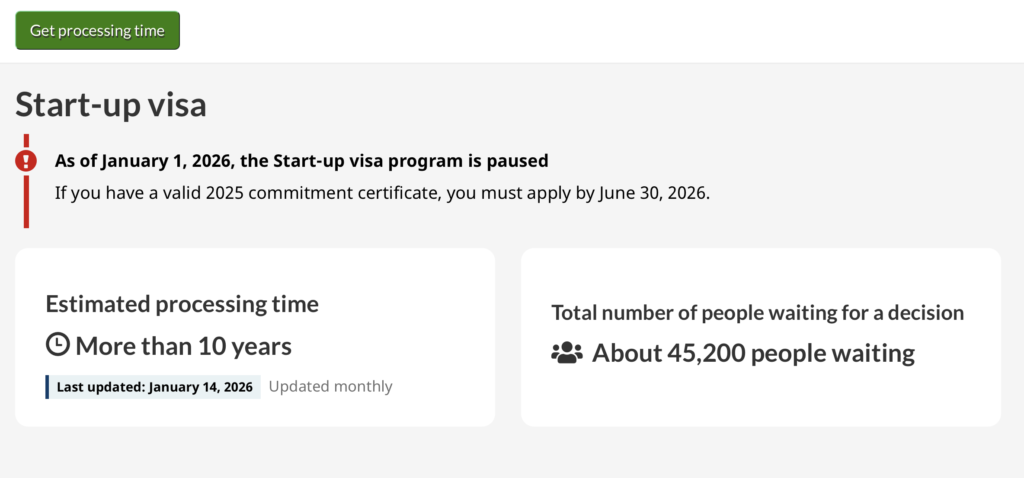
Although not detailed step by step on Canada.ca, the official changes reflect the reality that SUV and other business streams had accumulated significant inventories and were contributing to prolonged processing times. Pausing new applications itself is an acknowledgment that the system was overburdened. IRCC’s official notice explicitly mentions redirecting resources “to address the large inventory of applications for Canada’s business programs.” (Canada)
Current Alternatives for Entrepreneur Immigration in Canada (Official)
With the Start-Up Visa closed, entrepreneurs must pursue other immigration pathways. The Government of Canada website lists several alternatives — most notably Provincial Nominee Programs (PNPs) and other business-oriented paths.
1. Provincial Nominee Program (PNP)
(Active and widely used alternative)
The Provincial Nominee Program allows provinces and territories to nominate immigrants — including entrepreneurs — based on regional economic needs. Each jurisdiction sets its own requirements, and many have entrepreneur, investor, or business streams. (Canada)
How it Works
- Choose a province/territory that offers a business/entrepreneur stream.
- Apply for nomination under that stream (meeting the province’s investment, business plan, net worth, and management requirements).
- After nomination, apply to IRCC for permanent residence through the Provincial Nominee Class application forms (e.g., through the Permanent Residence Online Application Portal). (Canada)
Key Points
- Each province’s streams vary significantly in investment required, net worth thresholds, and performance plans.
- Some provinces (e.g., British Columbia, Alberta, Nova Scotia) have active entrepreneur streams that may lead to nomination faster than the old SUV. (CIC News)
2. Quebec Business Immigration Streams
Quebec is a special case — its immigration system is administered separately by the Government of Quebec (though federally approved). Quebec’s entrepreneur options, including business owner, investor, and self-employed streams, remain open and operate independently of the federal SUV closure. (For detailed criteria, refer to the Government of Quebec’s immigration site.)
Note: This is referenced on Canada’s official site as a possible route under “Immigrant entrepreneurs” but requires checking Quebec sources for specifics. (Canada)
3. Self-Employed Persons Program
Although officially listed on Canada.ca, this program is currently paused — meaning no new applications are being accepted as IRCC assesses backlog and program viability. (Canada)
4. Work Permit to Permanent Residence Strategies
While not a direct PR route like the SUV was, entrepreneurs often enter Canada on work permits and then transition to PR through other economic streams (e.g., Express Entry, PNP with employer ties).
- Work permits in Canada (temporary) can be explored through IRCC’s work permit categories including employer-specific or open work permits. (IRCC Canada)
- Some entrepreneurs use C-11 significant benefit work permits or other employer-linked pathways to work in Canada first before pursuing permanent residence (details on specific work permit categories are outlined on the Canada.ca work permits page). (IRCC Canada)
How to Apply: Official Steps
1. For Provincial Nominee Programs (Entrepreneur Routes)
- Visit the province’s official immigrant nominee page to check business stream details (each province’s requirements differ). (Canada)
- If eligible, submit your provincial nomination application and required business plan, net worth proof, language scores, etc. (Canada)
- After nomination, complete the Permanent Residence application under the Provincial Nominee Class through the IRCC portal (IMM P7000 guide and forms). (Canada)
2. For Quebec Business Immigration
- Visit the Government of Quebec immigration site and follow their published business immigration process. (Quebec has its own application and criteria separate from federal PNPs.) (Canada)
3. For Other Work Permit Strategies
- Determine the appropriate work permit category on Canada.ca’s work permit pages. (IRCC Canada)
- Apply for a temporary work permit using the applicable application route (employer-specific or open permit).
🇨🇦 Canada Provincial Entrepreneur Immigration Streams — 2026 Comparison
| Province / Stream | Typical Minimum Net Worth | Minimum Business Investment | Key Eligibility Requirements | How It Works |
|---|---|---|---|---|
| British Columbia – Entrepreneur Immigration (Base) | ~CAD $600,000 | ~CAD $200,000 | Business experience (owner/manager), language (CLB 4), active investment in new or existing business | Apply to BC PNP, negotiate Performance Agreement → work permit → operate business → nomination for PR nomination |
| British Columbia – Entrepreneur Immigration (Regional) | ~CAD $300,000 | ~CAD $100,000 | Same as above but must locate business in a small community outside Metro Vancouver, complete community exploratory visit | Lower thresholds with regional settlement commitment |
| British Columbia – Strategic Projects | — | ~CAD $500,000+ | For foreign companies expanding to BC; job creation & business plan | Company itself sponsors key staff; supportive path for larger foreign operations to setup branch |
| Alberta – Rural Entrepreneur / Graduate Entrepreneur Stream | ~CAD $300,000–$500,000 | ~CAD $100,000–$200,000 | Rural/region focus, business ownership experience, sometimes linked to Alberta study | Apply expression of interest to AAIP → business establishment → nomination |
| Manitoba – Entrepreneur / Business Investor (varies) | ~CAD $500,000 | ~CAD $150,000–$250,000 | Business experience, exploratory visit often required | Provincial application leading to performance agreement and nomination |
| Nova Scotia – Entrepreneur Stream | ~CAD $600,000($400k might apply outside HRM) | ~CAD $150,000($100k outside HRM) | 3 yrs management/ownership OR 5 yrs senior management; active role in business | Submit expression of interest → invitation → work permit → business operation → PR nomination |
| New Brunswick – NB Business Immigration Stream | ~CAD $500,000 | ~CAD $150,000 | Business ownership or senior management experience | Nomination based on business plan and investment commitment |
| Prince Edward Island – Business Impact Category (Work Permit) | ~CAD $600,000 | ~CAD $150,000 | Business experience or senior management, settlement plans | Work permit → operate business → PR option after condition fulfillment |
| Newfoundland & Labrador – International Entrepreneur | ~CAD $600,000 | ~CAD $200,000 | Business owner/management experience, purchase/new business | Temporary work permit → business operation → provincial nomination |
| Northwest Territories – Business Stream | ~CAD $250,000–$500,000 | ~CAD $100,000–$250,000 | Business ownership or management experience, language skills | Nomination based on EOI, territorial endorsement |
| Yukon – Yukon Business Nominee Program | ~CAD $500,000 | ~CAD $300,000 | Business or managerial experience, business plan | Work permit then business operation → nomination |
What’s Next: The 2026 Targeted Entrepreneur Pilot
IRCC has confirmed that the SUV closure is intended to facilitate a transition to a new, targeted pilot for immigrant entrepreneurs that is expected to be launched in 2026. Exact details, eligibility criteria, investment or sector focus, and processing targets are not yet published. The federal government has stated the pilot will be part of its broader Talent Attraction Strategy under the 2026–2028 Immigration Levels Plan, and more information will be communicated when available. (Canada)
Conclusion
Canada’s federal Start-Up Visa Program is no longer open to new permanent residence applications and will be fully closed to new commitment certificates after December 31, 2025, with a limited filing window for 2025 certificates until June 30, 2026. (Canada) The closure reflects IRCC’s efforts to manage backlog, rebalance immigration levels, and redesign entrepreneur pathways. For ambitious founders seeking to build a business and settle in Canada today, Provincial Nominee Programs, Quebec’s business streams, and selective work permit routes remain the primary alternatives with official application processes available through Canada.ca. (Canada)