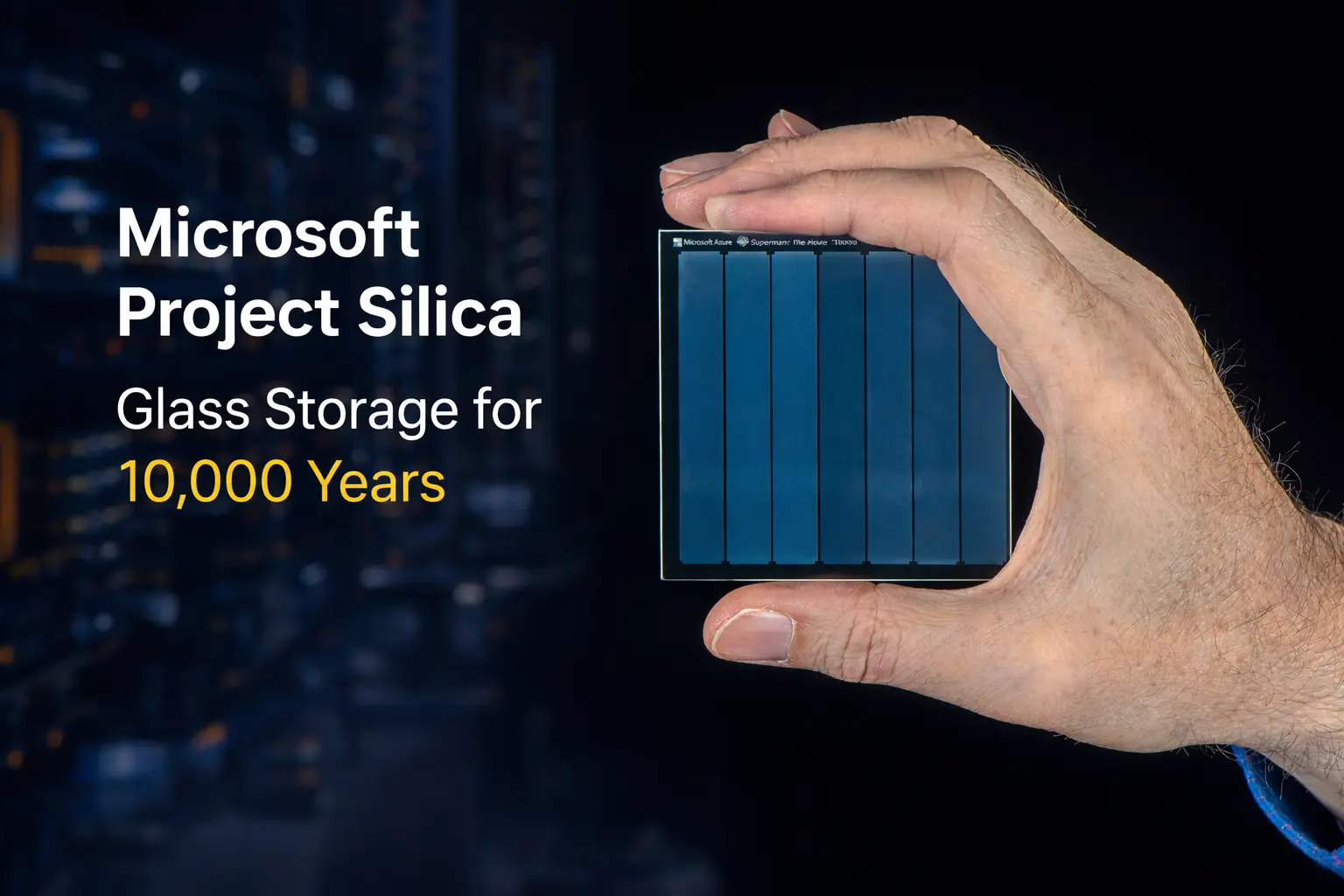

For most of the digital era, storing data has meant relying on technologies that are fundamentally temporary. Hard drives fail, solid-state drives wear out, and even enterprise magnetic tapes degrade over time. Yet the information being stored—from scientific research and cultural archives to legal records—often needs to survive for decades or even centuries.
Inside Microsoft’s research labs, engineers have been experimenting with a radically different idea: storing digital information inside glass.
The initiative, known as Project Silica, explores whether data could be written into small glass plates using ultrafast lasers and preserved for thousands of years without electricity, maintenance, or environmental control.
If the concept proves commercially viable, it could redefine the way hyperscale cloud platforms—such as Microsoft Azure—store humanity’s long-term digital memory.
Why the World Needs a New Kind of Storage
The modern digital infrastructure was not designed for permanence.
Typical storage systems have relatively short lifespans:
- Hard drives typically last 5–10 years
- Solid-state drives degrade with repeated writes
- Magnetic tapes, still widely used for archival storage, generally require replacement every 20–30 years
For cloud providers and institutions managing massive archives, this creates an ongoing operational challenge. Data must be periodically copied and migrated to newer hardware, a process that consumes energy, time, and significant financial resources.
Microsoft researchers describe this cycle as “data refresh.”
At the scale of global cloud infrastructure, refresh operations happen constantly. Warehouses filled with tape cartridges and storage arrays must be maintained, powered, cooled, and replaced.
The central question behind Project Silica is straightforward:
What if archival data could be written once—and preserved for millennia without intervention?
Storing Data Inside Glass
The core concept behind Project Silica is deceptively simple. Instead of storing information magnetically or electrically, the system physically encodes digital data inside glass.
The material used is highly durable quartz or borosilicate glass, similar to the material used in laboratory equipment or heat-resistant cookware.
Unlike magnetic storage, which relies on delicate electronic states, glass offers extraordinary physical stability. It can withstand:
- extreme heat
- electromagnetic radiation
- water exposure
- environmental degradation.
These characteristics make glass an attractive medium for long-term archival storage.
How the Technology Actually Works
Project Silica uses a combination of laser physics, optical microscopy, and machine learning to store and retrieve information.
Writing Data With Femtosecond Lasers
To write data, researchers use femtosecond lasers, devices capable of emitting pulses lasting only a quadrillionth of a second.
These pulses are focused into the interior of a glass plate. Each pulse alters the glass structure at a microscopic scale, creating a tiny data point known as a voxel—short for “volume pixel.”
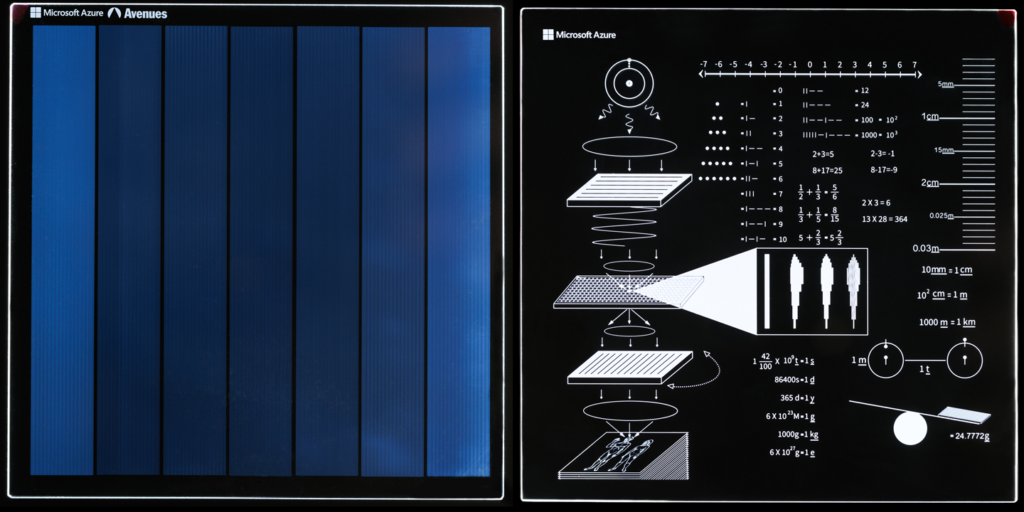
Unlike traditional bits stored on a flat surface, voxels exist inside the three-dimensional volume of the glass.
Each voxel can encode information through several properties:
- its orientation
- its size
- its precise location
- the way it interacts with polarized light.
By carefully controlling these characteristics, researchers can encode large amounts of data across hundreds of layers within a single glass tile.
Three-Dimensional Storage Density
Because the system writes data throughout the thickness of the material, storage becomes three-dimensional rather than planar.
A small glass plate roughly 2 millimeters thick can store multiple terabytes of data. In demonstrations by Microsoft researchers, a single plate was capable of holding the entire 1978 Superman film, a symbolic proof-of-concept illustrating the technology’s archival potential.
While current capacity figures are still evolving, the density is already comparable to existing long-term storage systems.
Reading the Data
Retrieving information from glass requires a specialized optical system.
Instead of electronic sensors, the reading process relies on:
- high-resolution cameras
- polarization-sensitive microscopes
- machine-learning algorithms trained to decode voxel patterns.
When light passes through the glass plate, the microscopic voxel structures affect how the light behaves. These patterns are captured by the imaging system and interpreted by software that reconstructs the original binary data.
Importantly, reading the data does not alter the medium, making it effectively immune to wear.
A Storage Medium That Requires No Power
One of the most compelling aspects of Project Silica is that the glass itself requires no electricity to preserve data.
Once information is written into the material, the plate can simply be stored on a shelf. No cooling, spinning disks, or active electronics are required.
This opens the possibility of passive archival libraries in which glass plates sit in storage vaults for centuries.
For cloud providers managing massive long-term archives, the potential energy savings could be substantial.
The Real Target: Cloud-Scale Archives
Despite its futuristic appeal, Project Silica is not intended to replace everyday storage technologies like SSDs or hard drives.
Instead, Microsoft is targeting a very specific layer of the storage stack: cold archival storage.
This category includes data that is rarely accessed but must be preserved indefinitely, such as:
- national archives
- scientific research datasets
- legal compliance records
- film and media libraries
- cultural heritage collections.
These types of archives are currently dominated by magnetic tape systems, which remain the most economical long-term storage technology today.
Project Silica aims to provide an alternative that is far more durable and potentially more sustainable.
The Cost Challenge
Despite its promise, glass storage remains a research-stage technology.
Writing data into glass currently requires high-precision femtosecond laser equipment, which is both complex and expensive. Reading the data also requires specialized optical hardware and advanced decoding algorithms.
To improve scalability, Microsoft researchers have been experimenting with borosilicate glass, a cheaper and more widely available material compared with traditional fused silica.
This shift could significantly reduce manufacturing costs if the technology moves toward commercial deployment.
Even so, industry analysts expect the first practical use cases—if they emerge—to appear inside large cloud data centers rather than consumer devices.
Will Consumers Ever Use Glass Storage?
For individual users, the most likely scenario is indirect access.
Instead of buying glass storage devices, people might eventually store long-term archives through cloud platforms powered by technologies like Project Silica.
For example, a future archival service could allow users to permanently store:
- family photos
- historical documents
- scientific records
- cultural works
with guarantees of centuries-scale durability.
In this sense, glass storage could become an invisible layer of the digital infrastructure rather than a consumer gadget.
Preserving the Digital Future
The deeper vision behind Project Silica extends beyond cloud economics.
Human civilization is now producing vast quantities of digital knowledge—scientific discoveries, art, literature, and cultural records that may need to survive for centuries.
Yet most modern storage technologies are designed for decades at best.
Glass storage proposes a different philosophy: designing digital media capable of surviving thousands of years, potentially outlasting the data centers that created them.
If Microsoft’s research succeeds, future historians may one day recover entire digital archives from something remarkably simple:
a thin piece of glass sitting quietly on a shelf.