

The government is making headlines. Founders are still making do.
The press releases sound impressive.
In November 2025, Prime Minister Mark Carney’s government tabled a federal budget branded “Canada Strong” — that committed $925.6 million over five years to support sovereign AI infrastructure, on top of a total of $2 billion in AI investments over five years already announced under the Sovereign AI Compute Strategy. Microsoft followed with a splashy announcement of $19 billion CAD in total investments between 2023 and 2027, including more than $7.5 billion CAD in the next two years — building data centres and “digital sovereignty” infrastructure for Canadian soil.
On paper, Canada looks like an AI powerhouse in the making.
On the ground, the story is very different.
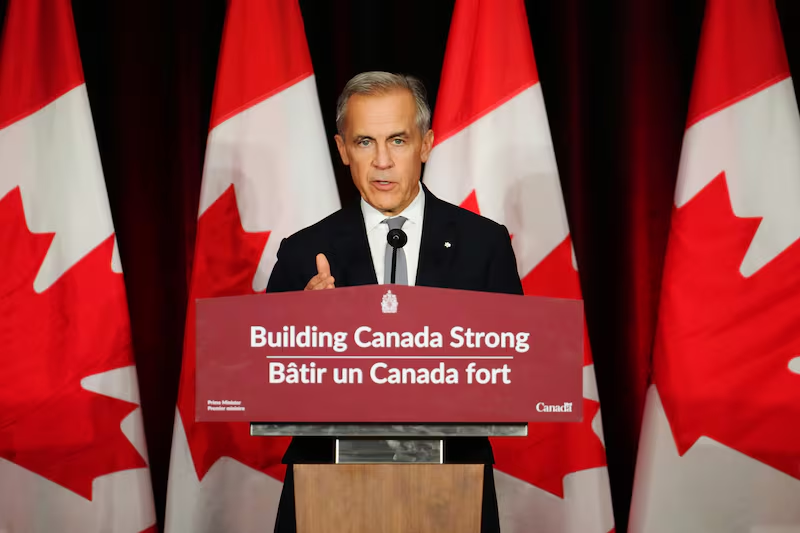
For the founders actually trying to build AI companies in Canada right now — the entrepreneurs raising seed rounds, hiring engineers, and navigating the immigration system the gap between government announcements and lived reality in 2026 is wider than it has ever been. While Ottawa funds data centres and sovereign cloud infrastructure, the people supposed to fill those data centres with innovation are running out of runway, losing access to global capital, and watching their immigration pathways close one by one.
This is not a success story. It’s a warning.
The $2 Billion That Won’t Reach Your Inbox
Let’s start with the money. Canada’s AI investment plan, at its core, is an infrastructure play. The $700 million AI Compute Challenge targets experienced industry players for ambitious projects such as state-of-the-art data centres. The sovereign compute program envisions a system of Canadian-owned compute infrastructure, ensuring access for Canadian researchers and private R&D — but much of the necessary infrastructure will take years to develop.
Read that last part again: years to develop.
For a founder trying to make payroll next quarter, or a team of three building an AI product in a Toronto co-working space, this money is effectively invisible. It does not flow to them. It flows to the infrastructure incumbents — established firms with the capacity to build $500-million data centres.
The Conference Board of Canada, in its analysis of Budget 2025, was direct about this limitation: the innovation agenda in the 2025 budget is incremental at most, leveraging and rebranding programs such as the Venture “and Growth” Capital Catalyst Initiative. Though it introduces new strategic vehicles for investment in key emerging technology sectors, like quantum, AI, and life sciences, it lacks an overall strategic direction to nurture homegrown firms and ecosystems.
Translation: the headlines are bigger than the help.
The Seed-Stage Crisis Nobody in Ottawa Is Talking About
The most urgent crisis for Canadian AI founders is not compute access. It is capital — specifically, the absence of it at the earliest stages of company building.
A joint report by the National Angel Capital Association (NACO) and Startup Genome, released earlier this year and analyzing roughly 65,000 funding rounds across seven Canadian ecosystems, put a specific dollar figure on the damage: Canadian startups are missing out on $141 million USD annually at the pre-seed and seed stage, and $181 million at the Series A level compared to similar startups in comparable US cities.
The structural problem is a lopsided funding ratio. In Canada, only 34 percent of total early-stage funding goes to seed rounds, while that percentage should be closer to 40 percent — it’s 39 percent in top US ecosystems. The downstream consequences are severe: seed rounds in Canada are 37 to 40 percent smaller than in Tier-1 US cities. Smaller seed rounds mean slower growth, which means fewer founders reach Series A, which means fewer Canadian companies scale.
The Globe and Mail reported in March 2026 a comparison that should make every Canadian policymaker wince: Silicon Valley venture firm Andreessen Horowitz raised $15 billion across five new funds in the first nine days of January 2026. That dwarfs the $2.1 billion raised by all Canadian venture capital firms combined throughout all of 2025.
One American firm. Nine days. Ten times Canada’s entire annual VC output.
Janet Bannister, founder and managing partner at Staircase Ventures, put the human cost plainly: “I can’t tell you how many awesome founders say I’m moving because it’s easier to raise capital there.”
This is Canada’s real AI problem. Not compute. Not cloud sovereignty. Capital flight.
The $750 Million That Doesn’t Have a Plan Yet
To be fair, Budget 2025 did acknowledge the early-stage funding gap. The government committed a forthcoming $750 million strategy to address early growth-stage funding gaps for scaling Canadian businesses, ensuring that homegrown IP and innovations are commercialized from within Canada. It also allocated $1 billion over three years for the Business Development Bank of Canada to launch the Venture and Growth Capital Catalyst Initiative.
But here is the problem: as of March 2026, the federal government pledged $750 million toward early-stage VC funding in Budget 2025, but a clear plan for how this will be deployed has yet to be released.
The money was announced. The mechanism was not. For founders raising right now, a promise without a pipeline is not capital. It is a press release.
Y Combinator Just Told Canada What It Actually Thinks
Nothing illustrated Canada’s structural dysfunction for AI founders more starkly than what happened in January 2026.

Y Combinator — the accelerator behind Airbnb, Dropbox, Coinbase, and thousands of other breakout companies — quietly updated its standard deal terms to exclude Canada as an acceptable country for company incorporation. Under the revised terms, Canadian-domiciled startups must reincorporate in the United States, the Cayman Islands, or Singapore to participate in its flagship accelerator program.
The immediate impact was visible: none of the 99 startups in YC’s winter 2026 cohort are listed as being headquartered in Canada.
YC eventually reversed course after significant public backlash — the sudden U-turn followed strong reaction to Y Combinator’s decision — but the damage to perception was done. The world’s most prestigious accelerator had, however briefly, decided Canada was not worth the legal complexity. That is not a sign of a healthy founder ecosystem.
As we reported at IMFounder in our coverage of the YC policy shift, this moment reveals a deeper pattern: Canadian founders increasingly face pressure to relocate or reincorporate in the US simply to access global capital networks.
The Immigration Door Just Closed on Immigrant Founders
Canada’s pitch to the world’s best entrepreneurs has long been: come build here. The Start-Up Visa program was the centerpiece of that promise — a pathway that allowed foreign founders backed by Canadian investors or incubators to obtain permanent residency while building their companies.
That program is now effectively dead.
As of December 19, 2025, IRCC is no longer accepting new applications. The program is closed to all other applications. The closure was triggered by a backlog that had spiralled out of control: processing times stood at 37 months, then deteriorated to over ten years merely six months later despite government intervention. A program with a decade-long wait time is not a program — it is a deterrent.

A replacement pilot is promised for 2026, but the new program is expected to be more selective, with stricter eligibility criteria and a stronger focus on proven business potential — prioritising experienced founders, high-growth ventures and applicants with clear economic impact.
That sounds reasonable until you consider what it means for the pre-revenue founder with a brilliant idea who simply needs a stable immigration status to build without fear. Those founders — historically the backbone of startup ecosystems — are being filtered out.
As we covered in depth at IMFounder, this collapse has been years in the making. Why Canada’s Start-Up Visa Program Closed: A Turning Point for Entrepreneur Immigration explores the full timeline of how mismanagement turned a world-class program into a bureaucratic disaster.
The Brain Drain Is Already Happening
The consequences of these failures are not theoretical. They are measurable and accelerating.
Data from The Globe and Mail shows that only 32.4 percent of startups founded by Canadians that raised $1 million or more were incorporated in Canada. Nearly seven in ten high-potential Canadian founders are building their companies outside Canada — most of them in the United States.
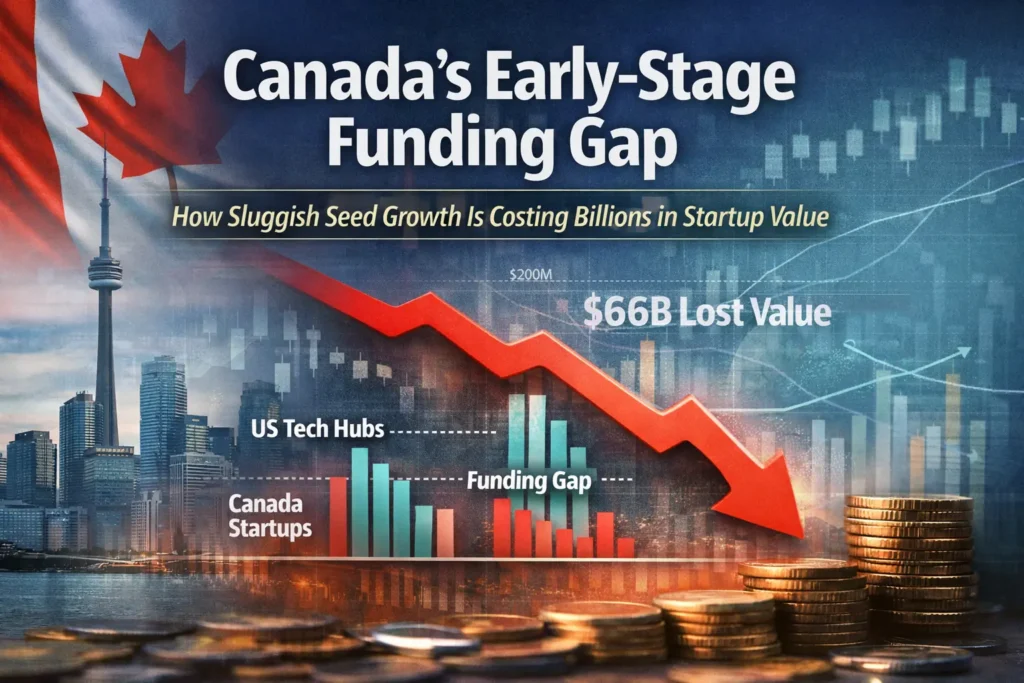
As we reported in our coverage of Canada’s early-stage funding gap: Sluggish Growth, Lost Value: What Canada’s Early-Stage Funding Gap Really Means — the numbers tell a consistent story. Founders are not leaving because they want to. They are leaving because staying is structurally irrational.
The math is simple. Some of the most motivated founders just move to Silicon Valley in search of capital. Leaders Fund found that just over 30 percent of Canadian-led high-potential startups created in 2024 were headquartered in Canada, while almost half were located in the US.
Canada is not losing its founders to disinterest. It is losing them to design.
What Actually Needs to Change
The government’s AI investment plan is not without merit. Sovereign compute infrastructure matters for the long term. SR&ED tax credits — offering a 35 percent refundable credit on up to $3 million CAD of qualified R&D expenditures for Canadian-controlled private corporations — genuinely help founders extend runway. These are real tools.
But they are not sufficient. Three specific, urgent changes are needed:
Deploy the $750 million seed capital — now, with a mechanism. A pledge without a deployment plan is not policy. IRCC and BDC must publish a specific framework for how early-stage capital reaches pre-seed and seed-stage founders within the next 90 days, not by year-end.
Rebuild the Start-Up Visa as a fast-track, not a filter. The new pilot program cannot repeat the processing-time disaster of the old one. Canada should look to comparable programs in the UK — specifically the Innovator Founder Visa, which includes clear milestones and defined timelines — as a model. The replacement program must be accessible to first-time founders, not just those with existing revenue.
Match the seed size gap directly. A government fund-of-funds that specifically targets seed-stage rounds — bringing the Canadian average closer to the 40 percent benchmark that top US ecosystems maintain — would do more to fix the AI founder pipeline than any data centre announcement.
Canada’s Minister of Artificial Intelligence, Evan Solomon, has acknowledged the country has “an adoption problem” with AI. That is a careful understatement. The real problem is a founder problem — and no amount of sovereign cloud infrastructure will fix it if the founders who would use that infrastructure have already moved to San Francisco.
The Bottom Line
Canada is spending billions to become an AI nation. It is simultaneously shutting the immigration doors on the world’s best AI founders, watching its seed-stage capital market fall further behind the US, and failing to deploy the emergency funding it has already announced.
The data centres will be built. The compute will come online. But if the founders who should be building on that infrastructure have relocated, reincorporated, or simply given up — the infrastructure becomes a very expensive monument to a missed opportunity.
Ottawa is not short on AI ambition. It is short on urgency about the people who make AI companies actually happen.
Related reading on IMFounder:
- Grants for AI-Based Companies in Canada (2026): The Complete Guide
- How to Get Funding & Grants for Your Startup in Canada
- Why Canada’s Start-Up Visa Program Closed: A Turning Point for Entrepreneur Immigration
- Sluggish Growth, Lost Value: What Canada’s Early-Stage Funding Gap Really Means
- Canada’s Start-Up Visa Program Backlog: How IRCC Is Responding as Founders Wait Over Four Years
- Y Combinator’s Canada Policy Shift: How It Impacts Canadian Startup Funding in 2026
Sources:
- Bennett Jones LLP — Canada’s AI Efforts in 2025: A Year in Review (December 2025)
- Conference Board of Canada — The Future is Now: Innovation in Budget 2025 (November 2025)
- BetaKit / NACO & Startup Genome — Sluggish Growth, Lost Value: Canada’s Early-Stage Funding Gap(February 2026)
- The Globe and Mail — Canada is bleeding startups (March 2026)
- IRCC — Update on Immigration Measures for Entrepreneurs (December 19, 2025)
- The Logic — Y Combinator is no longer investing in Canadian startups (January 2026)
- CBC News — Federal budget dedicates over $1B to boost Canadian AI (November 2025)
- Microsoft On the Issues — Microsoft Deepens Its Commitment to Canada with Landmark $19B AI Investment(December 2025)