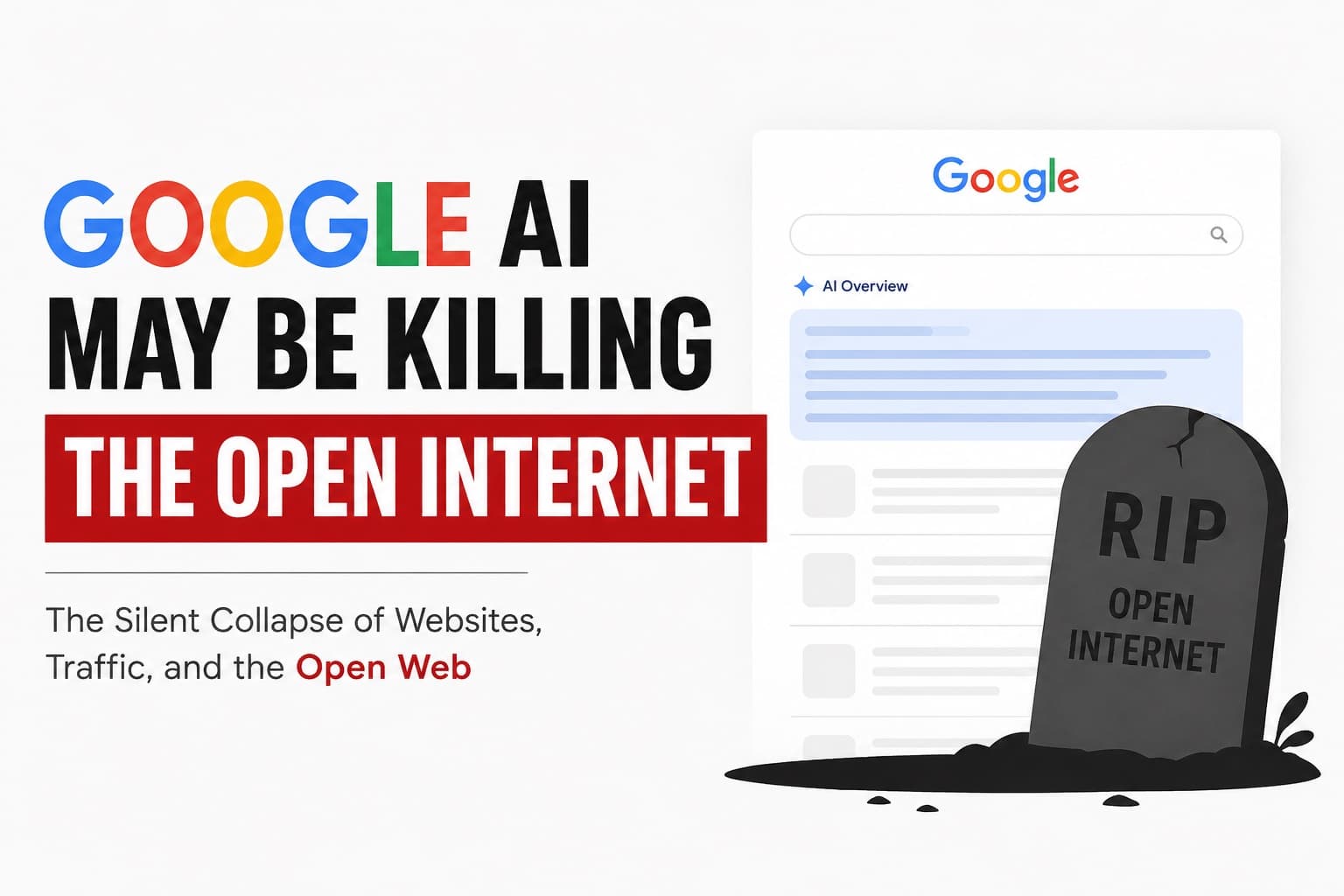

The Silent Collapse of the Open Internet Has Already Started
For nearly two decades, the internet worked on a simple deal:
Creators, bloggers, journalists, founders, and publishers created content.
Google indexed it.
Users clicked links.
Websites earned traffic, attention, ad revenue, subscribers, and customers.
That system built the modern internet.
But in 2026, that model is rapidly collapsing.
With the rise of AI-generated answers, AI Overviews, zero-click search results, and conversational search experiences, users increasingly get answers directly from Google without ever visiting the original website.
The result?
Millions of websites are quietly losing traffic.
Some founders still think this is just another SEO update. It is not.
This may be one of the biggest shifts in internet history.
What Are Google AI Overviews?
Google’s AI Overviews use generative AI to summarize answers directly inside search results.
Instead of showing users 10 blue links, Google now often provides:
- AI-generated summaries
- Direct recommendations
- Product comparisons
- Step-by-step answers
- AI-generated explanations
In many cases, users no longer need to click a website.
That changes everything.
The Rise of “Zero-Click Internet”
The modern web is becoming a “zero-click ecosystem.”
Users:
- ask a question,
- get an AI summary,
- leave.
No blog visit.
No ad impressions.
No newsletter signup.
No product discovery.
For publishers and startups dependent on organic traffic, this is catastrophic.
Many websites are already reporting major declines in search traffic since AI summaries expanded globally.
Smaller publishers are getting hit hardest because they lack:
- brand recognition,
- direct audiences,
- community loyalty,
- alternative traffic channels.
The internet is slowly shifting from:
“Search and discover”
to
“Ask and receive.”
And Google controls the gateway.
Why This Is Dangerous for Founders
Most startup founders still depend heavily on:
- SEO traffic,
- Google Discover,
- search rankings,
- informational content,
- affiliate marketing,
- organic lead generation.
But AI search changes the economics completely.
If AI gives users answers instantly:
- informational blogs lose value,
- comparison sites lose clicks,
- tutorial websites lose traffic,
- media businesses lose ad revenue.
Even high-quality content creators may struggle because AI systems summarize their work before users ever reach them.
This creates a dangerous future where:
- platforms win,
- aggregators win,
- AI companies win,
- original creators lose leverage.
The Internet Is Becoming Platform-Dependent Again
Ironically, the web may be returning to a closed ecosystem.
For years, founders were told:
“Own your website.”
Now the reality is shifting toward:
- platform algorithms,
- AI feeds,
- recommendation engines,
- social ecosystems,
- creator-driven communities.
Direct traffic is becoming more valuable than search traffic.
That means:
- newsletters matter more,
- communities matter more,
- brand identity matters more,
- audience trust matters more.
The winners of the next internet era may not be the best SEO experts.
They may be the people with the strongest communities.
SEO Is Not Dead — But It Is Mutating
Search engine optimization still matters.
But traditional SEO strategies are becoming weaker.
In the past:
- ranking #1 meant massive traffic.
Now:
- even ranking #1 may generate fewer clicks because AI answers appear first.
This forces founders to rethink content strategy entirely.
Future-proof SEO may involve:
- unique research,
- strong opinions,
- original reporting,
- community engagement,
- video content,
- podcasts,
- interactive tools,
- founder-led brands.
Generic content is becoming commoditized by AI.
Originality is becoming the new moat.
Why Independent Media Could Collapse
Small media companies are especially vulnerable.
Many independent publishers already operate on thin margins. If search traffic drops significantly:
- advertising revenue falls,
- sponsorship value declines,
- growth slows,
- layoffs increase,
- publications disappear.
This could reduce diversity across the internet.
Fewer independent websites means:
- fewer perspectives,
- less investigative reporting,
- more centralized information control.
That is a much bigger issue than SEO.
It changes how knowledge itself is distributed online.
The AI Web Creates a Massive Attribution Problem
Another growing controversy is attribution.
AI systems often summarize content from publishers without sending proportional traffic back to original creators.
Publishers argue:
- AI models benefit from their work,
- but creators receive little compensation.
This debate is becoming increasingly intense across:
- journalism,
- education,
- blogging,
- research,
- publishing.
The internet economy was built on links.
AI-generated answers weaken that foundation.
What Smart Founders Should Do Now
The founders who survive this shift will adapt early.
1. Build Direct Audience Channels
Do not depend only on Google traffic.
Build:
- email lists,
- Discord communities,
- private groups,
- loyal followers,
- social audiences.
2. Become a Brand, Not Just a Website
People remember personalities and trusted brands.
Generic AI-generated websites will struggle.
Human trust becomes more valuable.
3. Focus on Original Insights
AI can summarize existing information.
It struggles with:
- firsthand experience,
- investigative work,
- unique opinions,
- deep expertise,
- founder stories.
That is where opportunity still exists.
4. Diversify Traffic Sources
Relying entirely on SEO is now risky.
Smart founders are investing in:
- YouTube,
- TikTok,
- LinkedIn,
- Reddit,
- newsletters,
- communities,
- partnerships.
The Next Internet Will Reward Trust
The internet is not dying.
But it is transforming rapidly.
The era of easy SEO traffic may be ending.
The next phase of the internet may belong to:
- trusted creators,
- authentic communities,
- founder-led media,
- strong brands,
- unique experiences.
AI can generate answers.
But trust is harder to automate.
And that may become the most valuable asset online.
Final Thoughts
Google’s AI revolution is incredibly powerful and useful for users.
But it also raises a massive question:
If AI platforms consume the internet’s knowledge without fairly rewarding creators, who will keep creating?
The answer to that question could shape the future of the open internet itself.
And founders who understand this shift early may have a major advantage over everyone still chasing old SEO playbooks.
Related Articles on IMFounder
- ByteDance’s DeerFlow and the Rise of AI Employees
- ChatGPT Agent vs Claude: The Explosive New AI Leader
- AI Isn’t Coming for Factory Jobs — It’s Coming for Office Jobs
- The Stadium Economy Was Rewritten Without Labor: How AI Is Automating Stadium Jobs Away
- 7 Explosive AI Updates in May 2026 That Will Shock Every Founder
- ChatGPT Agent vs Claude — The Explosive New AI Leader
- ChatGPT Image Generation Update — New ChatGPT Image Generation update brings improved realism, editing, and workflow advantages
- Claude Design is quietly becoming one of the most talked-about AI features — The New AI Interface Builder