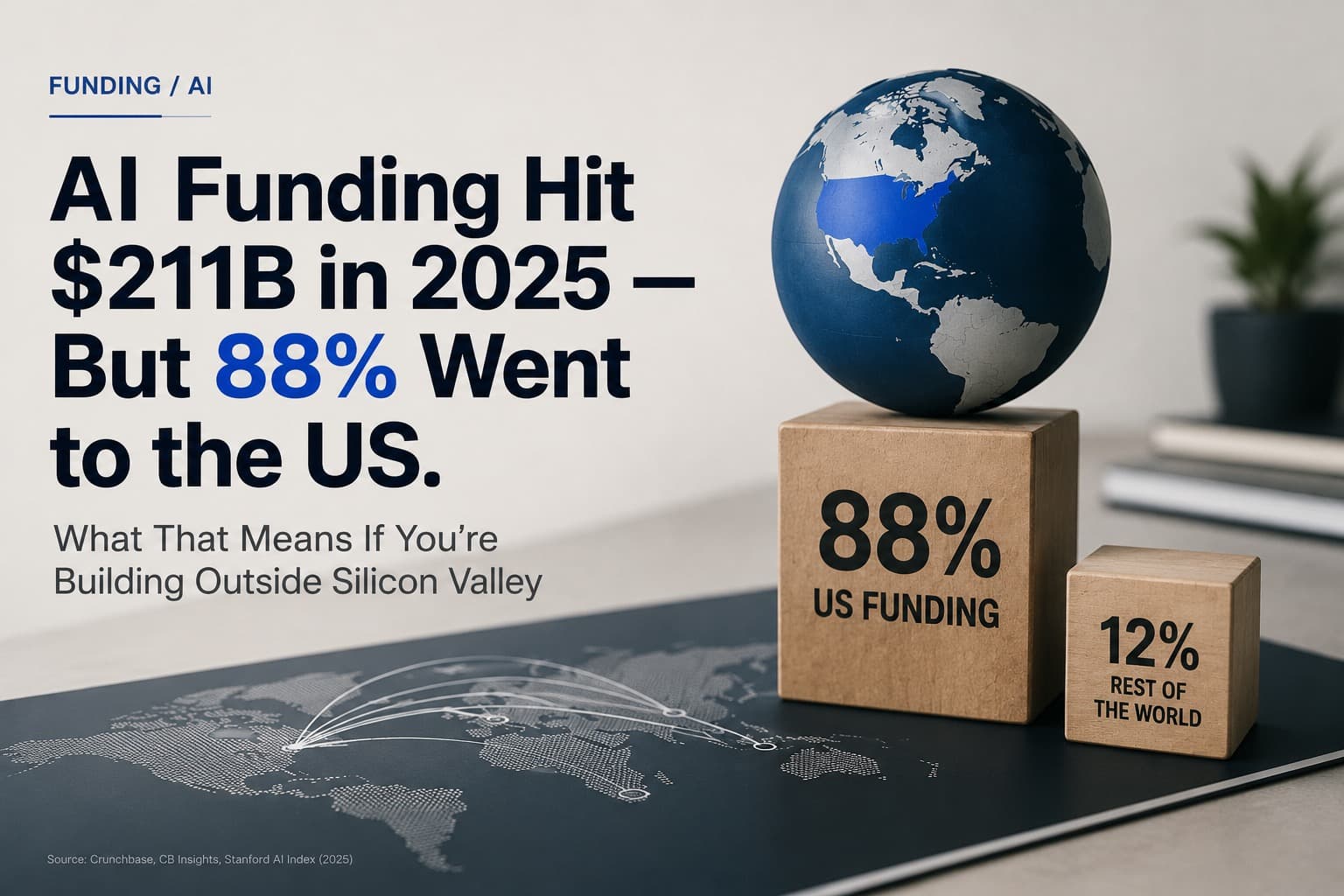

Artificial intelligence has become the defining investment theme of this decade. Every week seemed to bring another headline announcing a billion-dollar funding round, a new AI unicorn, or a strategic investment from one of the world’s largest technology companies. By the end of 2025, private AI companies had collectively raised an estimated £211 billion (approximately US$211 billion) worldwide, making it one of the strongest years ever for venture capital investment in a single technology sector.
At first glance, these numbers paint a picture of an industry overflowing with opportunity. Yet beneath the headlines lies a much more important story—one that every founder should understand before pitching investors or building their next AI product.
While AI funding reached unprecedented levels, approximately 88% of global private AI investment was concentrated in U.S.-based companies, according to industry analyses of venture funding trends. The overwhelming majority of this capital flowed into a relatively small group of companies developing frontier AI models, AI infrastructure, cloud computing platforms and defence-related technologies.
This isn’t just another venture capital statistic. It represents a structural shift in how investors allocate capital, how startups compete and where the next generation of opportunities will emerge.
For founders outside Silicon Valley, the question is no longer “Can we compete with OpenAI?” The better question is “Where can we create value that the AI giants cannot?”
The Record-Breaking Year That Wasn’t Equal
The AI funding boom of 2025 wasn’t driven by thousands of startups raising modest seed rounds. Instead, it was characterised by an unprecedented concentration of capital into a handful of companies building foundational AI infrastructure.
| Company | Estimated Funding Activity (2025) | Primary Focus |
|---|---|---|
| OpenAI | Multi-billion-dollar investment | Foundation models & AGI |
| xAI | Multi-billion-dollar funding rounds | Frontier AI models |
| Anthropic | Strategic investments from major technology companies | Enterprise AI |
| Scale AI | Large strategic funding | AI data infrastructure |
| Defence AI startups | Significant government-backed investment | National security & defence |
Source: Public funding announcements and industry reports throughout 2025.
Rather than spreading capital across hundreds of early-stage startups, investors increasingly concentrated their bets on companies capable of defining the next generation of artificial intelligence. This represents one of the most concentrated investment cycles in modern venture capital history.
Several factors explain this behaviour.
Training advanced foundation models requires enormous computing infrastructure, specialised AI chips, world-class research talent and access to vast datasets. Developing these systems often costs billions before generating meaningful revenue. Only a handful of companies possess the technical expertise and financial backing required to compete at this level.
As a result, venture capital firms, sovereign wealth funds and strategic investors have increasingly preferred writing larger cheques into proven market leaders rather than distributing smaller investments across dozens of emerging startups.
AI Funding by Region
| Region | Estimated Share of Global AI Funding |
|---|---|
| United States | 88% |
| Europe | 6% |
| Asia-Pacific (excluding China) | 3% |
| Canada | 1% |
| Other Markets | 2% |
Founder Insight: AI is becoming a winner-takes-most market at the infrastructure layer—but not necessarily at the application layer.
Why Investors Keep Choosing the United States
Many founders assume this concentration is simply a result of Silicon Valley’s reputation. The reality is more nuanced.
The United States possesses a unique combination of venture capital depth, research institutions, cloud infrastructure, experienced founders and access to the world’s largest technology companies. Companies like Microsoft, Amazon, Google and NVIDIA continue to invest billions into AI infrastructure, creating an ecosystem that is difficult for other regions to replicate.
Government priorities have also shifted. Artificial intelligence is increasingly viewed as a strategic national capability rather than merely another software industry. From defence and cybersecurity to healthcare and scientific research, AI has become central to economic competitiveness. This has encouraged both public and private investors to back companies capable of advancing national AI capabilities.
At the same time, the cost of building frontier AI models has increased dramatically. Training large language models requires thousands of GPUs, specialised engineering teams and continuous infrastructure investment. For investors, backing an established leader often appears less risky than financing dozens of smaller competitors.
Venture Capital Has Entered a New Era
The venture capital playbook has changed.
A decade ago, investors diversified risk by making dozens of relatively small investments across multiple sectors. Today’s AI landscape looks different.
Instead of funding fifty startups with £10 million each, many funds are willing to invest billions into just a handful of companies they believe can dominate entire markets.
This concentration creates a challenging environment for early-stage founders seeking funding. Investors now expect stronger evidence of product-market fit, earlier revenue generation and a clearer competitive advantage before committing capital.
In other words, raising funding has become more difficult—but building a valuable company has not.
The Two AI Economies
One of the biggest mistakes founders make is believing that all AI companies compete in the same market.
In reality, the industry has split into two distinct economies.
| Infrastructure AI | Application AI |
|---|---|
| Foundation models | Industry-specific software |
| GPU infrastructure | Workflow automation |
| Cloud computing | Customer support |
| AI research | Healthcare |
| Massive capital requirements | Legal technology |
| Winner-takes-most dynamics | Thousands of niche opportunities |
The first economy is dominated by companies building the underlying technology powering modern artificial intelligence. These businesses require extraordinary amounts of capital, specialised talent and long development cycles.
The second economy focuses on solving practical business problems using existing AI models.
This distinction matters because the second economy remains wide open.
Why Global Founders Should Ignore the OpenAI Race
Every technological revolution follows a familiar pattern.
The first wave builds infrastructure.
The second wave builds businesses.
During the internet revolution, Cisco built networking equipment. Amazon, Google, Shopify and Airbnb created entirely new industries using that infrastructure.
Artificial intelligence is following the same path.
Today’s AI giants are building the digital infrastructure of tomorrow. Thousands of future startups will generate enormous value without ever training a frontier model.
Most businesses don’t need another large language model. They need software that reduces costs, improves productivity and solves industry-specific problems.
Whether it’s helping hospitals reduce administrative workloads, enabling manufacturers to predict equipment failures or assisting accountants with compliance, the opportunity lies in applying AI—not reinventing it.
The Biggest Myth in Artificial Intelligence
Many founders still believe investors are searching for the next OpenAI.
Most aren’t.
Professional investors understand that only a handful of companies will ever compete at the frontier model level. Instead, they’re increasingly looking for startups that combine AI with deep industry expertise.
Successful AI businesses rarely win because they possess the smartest algorithm. They win because they understand customers better than competitors.
Stripe didn’t invent online payments.
Shopify didn’t invent ecommerce.
Figma didn’t invent design software.
Each succeeded by building better products around existing technologies.
The same principle applies to AI.
Your competitive advantage isn’t the model.
It’s the customer relationships, proprietary workflows, domain expertise, distribution network and unique datasets that competitors cannot easily replicate.
Five Lessons Every Founder Should Remember
1. Don’t compete with foundation models.
Competing directly against companies raising billions is rarely an efficient use of resources. Build on top of existing platforms instead.
2. Solve expensive problems.
Businesses pay for measurable outcomes, not impressive demonstrations. Focus on reducing costs, increasing productivity or improving revenue.
3. Own your distribution.
Technology becomes commoditised faster than customer relationships. Distribution remains one of the strongest competitive advantages.
4. Build a proprietary data advantage.
Models improve over time, but unique customer data and industry insights become increasingly valuable.
5. Revenue still matters.
Artificial intelligence may be transforming software, but investors continue to prioritise recurring revenue, customer retention and sustainable unit economics.
What This Means for Canada, Europe and Emerging Markets
For founders outside Silicon Valley, the funding gap shouldn’t be viewed as a disadvantage—it should be viewed as a signal.
Large AI companies naturally focus on building technologies with global reach. That leaves countless regional industries underserved.
Healthcare regulations differ across countries.
Financial compliance varies between markets.
Manufacturing processes, languages and government requirements all create opportunities for specialised AI applications that global platforms often overlook.
Founders who deeply understand local industries frequently possess an advantage that no frontier model can replicate.
The Next Wave of AI Unicorns Won’t All Come From Silicon Valley
The infrastructure race is already crowded.
The application economy is only beginning.
History suggests that platform revolutions create far more winners in the application layer than in the infrastructure layer. The companies building on top of today’s AI models will likely define the next decade of entrepreneurship.
Rather than asking whether your startup can build a better large language model, ask a more important question:
What problem can you solve so effectively that customers will happily pay for it, regardless of which AI model powers your product?
That question is where enduring businesses are built.
Final Thoughts
Artificial intelligence attracted extraordinary levels of investment in 2025, but the headline figure of US$211 billion tells only part of the story. The far more significant trend is the concentration of capital into a relatively small group of U.S.-based companies building foundational AI infrastructure.
For entrepreneurs, this shouldn’t be interpreted as a warning—it should be understood as a strategic roadmap.
Every major technology revolution begins with infrastructure before expanding into thousands of specialised applications. The internet followed this pattern. Cloud computing followed this pattern. Smartphones followed this pattern.
Artificial intelligence is unlikely to be any different.
The companies raising billions today are building the rails. The companies creating lasting value over the next decade will be the ones using those rails to solve meaningful problems across every industry.
For founders outside Silicon Valley, success won’t come from competing with OpenAI or xAI. It will come from understanding customers better than anyone else and delivering solutions that businesses cannot afford to ignore.
In the AI era, geography may influence where capital flows—but execution will determine who builds the next generation of great companies.
Related Articles on IMFounder
- 5 Powerful Startups You Can Launch With Only $1,000
- The Complete Guide to Starting an AI Startup in Canada
- Startup Funding Canada Just Got Easier: The Powerful New Playbook
- Women Entrepreneurship in North America: Grants, Funding, and Support for Women Entrepreneurs
- Top Incubators and Accelerators to Know in 2026 in Canada and the United States
- 20 AI Startup Ideas That Could Make You Rich in the Next Decade