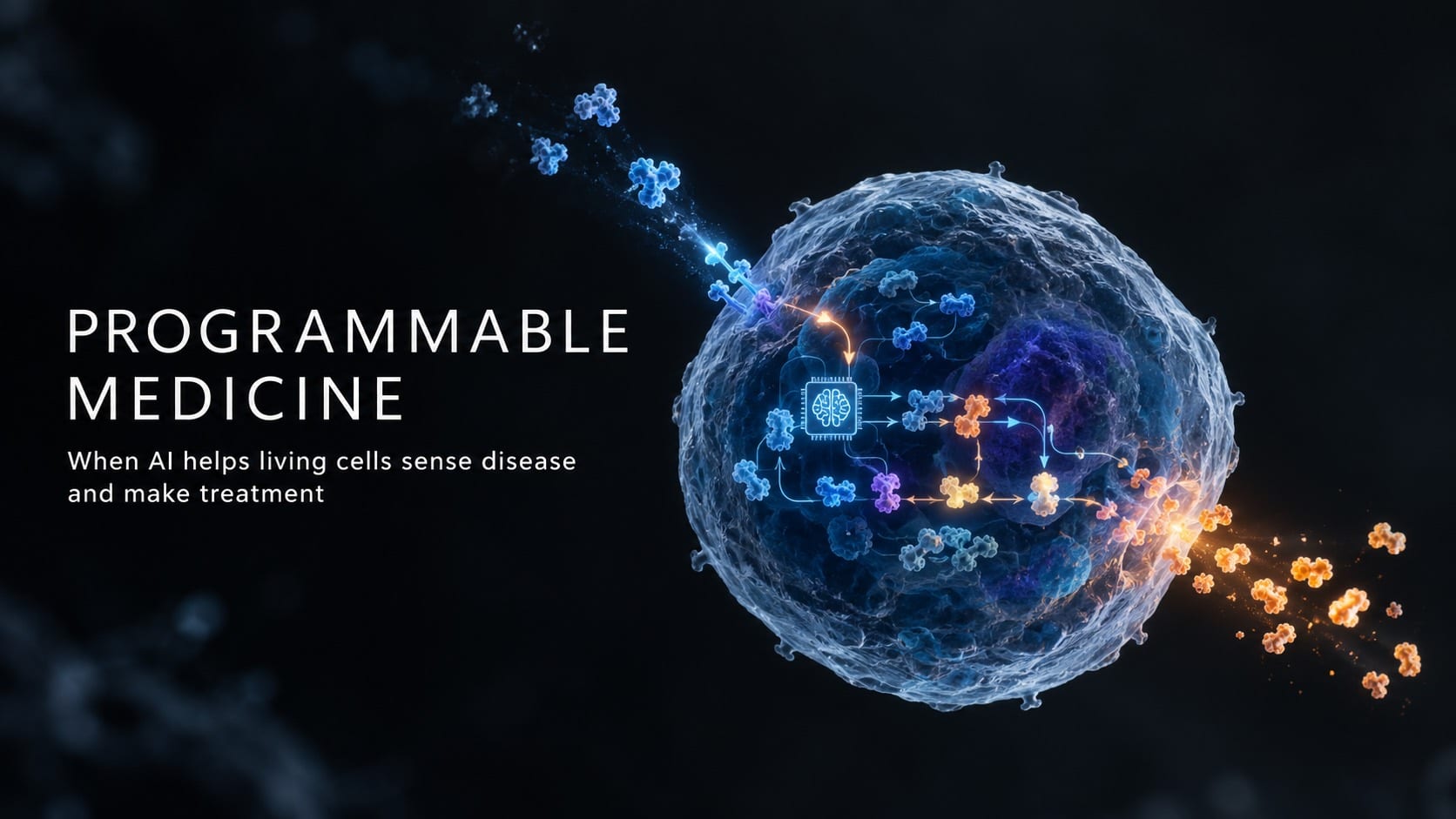

The next generation of medicine may not be a pill or an injection. Scientists are engineering cells that can sense disease, process biological signals and manufacture treatment inside the body—and AI is beginning to help write the instructions.
Modern medicine is built largely around passive therapeutics. A patient swallows a pill, receives an injection or undergoes an infusion containing a molecule designed to produce a biological effect. The drug may circulate throughout the body even when the disease occupies one small region, its concentration rises and falls according to metabolism, and physicians compensate by adjusting dose, timing and delivery. It is an extraordinarily successful model of medicine, but the medicine itself generally cannot look around, determine whether treatment is needed and alter its behavior accordingly.
Living therapeutics change that architecture. Researchers are engineering human cells and bacteria to function less like conventional drugs and more like biological machines capable of sensing their environment, processing signals and producing therapeutic molecules when specific conditions are detected. A major 2026 review in Nature Reviews Genetics describes next-generation programmable cell therapies as systems capable of responding to disease-specific cues in real time through synthetic gene circuits. Another review published this month goes one step further, examining how artificial intelligence could accelerate the design of the receptors, regulatory DNA and genetic circuits needed to turn human and bacterial cells into living drug-delivery vehicles. (Nature)
This is not medicine merely becoming personalized. It is medicine becoming programmable.
Read the 2026 review on AI and living drug-delivery systems
“The next generation of medicine may not carry the drug into your body. It may carry the biological instructions for manufacturing the drug after it gets there.”
Scientists Are Giving Cells Something Resembling Logic
The basic concept comes from synthetic biology, a field that treats biological components as systems that can be engineered into new functions. Researchers can construct synthetic gene circuits containing sensors, regulatory elements and outputs. A cell can detect a molecular signal associated with disease, process that input through an engineered biological circuit and trigger a predefined response such as producing a protein, releasing a therapeutic molecule or destroying a target cell.
The analogy to computer programming is imperfect but useful. A conventional drug essentially arrives with one primary instruction: interact with a biological target. A programmable cell can potentially behave more like an if-then system. If disease signal A appears, activate response B. If signals A and C appear together, produce treatment. If the disease signal disappears, reduce or terminate the response.
Cancer immunotherapy has already demonstrated that engineered cells can become real medicine. CAR-T therapy modifies a patient’s T cells so they recognize particular targets on cancer cells, transforming immune cells into therapeutic agents. Next-generation research is attempting to make those systems substantially more sophisticated by giving cells multi-input logic, controllable activation and the ability to release therapeutic proteins locally. Researchers are also extending programmable approaches beyond T cells into other immune cells, stem cells and microorganisms. (Nature)
The objective is not simply a stronger drug. It is a therapy capable of making limited biological decisions after administration.
“A pill cannot ask whether disease is present before releasing itself. An engineered cell potentially can.”
Then AI Enters the Design Process
Building these cellular systems remains enormously difficult because biology is not clean software. Genetic circuits interact with existing cellular machinery, proteins fold unpredictably, receptors can respond to unintended molecules and engineered cells can evolve. A circuit that behaves perfectly in one environment may perform differently inside a living organism.
Artificial intelligence is being brought into precisely those design bottlenecks. The 2026 review in Advanced Drug Delivery Reviews identifies several areas where AI could contribute to living therapeutics, including designing synthetic receptors against new targets, generating regulatory elements with more predictable behavior and helping assemble programmable gene-circuit architectures. (ScienceDirect)
Researchers have separately demonstrated generative computational approaches for designing synthetic gene circuits around desired functional and evolutionary properties. A March 2026 study in npj Systems Biology and Applications explored generative circuit design as a way to navigate the enormous number of possible biological configurations more efficiently. The challenge is analogous to other generative-design problems: humans can construct biological circuits manually, but the search space becomes overwhelming as the number of components and desired behaviors grows. (Nature)
AI does not eliminate biological experimentation. It changes which experiments researchers choose to run. Models can help search combinations before scientists physically construct them, predict how biological parts may behave and prioritize designs most likely to produce the desired therapeutic response.
The same transition is occurring across other industries IMFounder has been tracking. In our recent investigation into AI and programmable food, computational systems were beginning to move product development from repeated physical experimentation toward prediction, fabrication, measurement and reformulation. Living medicine pushes that logic into a much higher-stakes environment: instead of programming the material humans eat, scientists are beginning to program biological material intended to operate inside them.
Editor: insert IMFounder internal link to “AI Is Rewriting the Molecular Architecture of What We Eat.”
“AI is not merely discovering the next drug. It is beginning to help design the biological machine that decides when the drug should exist.”
Harvard Just Put Living Medicine Inside an Implant
One of the clearest demonstrations of where this technology is heading appeared in Science in May 2026.
Researchers at Harvard’s Wyss Institute and John A. Paulson School of Engineering and Applied Sciences developed what they call an Implantable Living Material, or ILM. Instead of loading a conventional implant with a finite reservoir of antibiotics, researchers encapsulated genetically engineered E. coli inside a specially designed polyvinyl alcohol hydrogel. The bacteria remained alive inside the material and were programmed with a synthetic gene circuit capable of detecting a chemical signal produced by Pseudomonas aeruginosa, an important pathogen associated with implant infections. (PubMed)
When the engineered bacteria detected that pathogen signal, part of the bacterial population self-destructed and released a synthetic antibacterial protein targeting P. aeruginosa. Surviving engineered bacteria could then repopulate the system, preparing it for another sensing-and-response cycle. The researchers tethered the living material to an orthopedic device implanted near the femur of mice and showed that it reduced pathogen burden in a prosthetic-joint infection model. (Wyss Institute)
The crucial engineering achievement was containment. Living bacteria can reproduce, and putting genetically modified microorganisms inside a patient introduces an obvious problem: what happens if they escape? The Harvard team designed the hydrogel to be simultaneously stiff enough to resist pressure from bacterial proliferation and tough enough to withstand external mechanical stress. The researchers reported complete bacterial containment for as long as six months under their experimental conditions. (PubMed)
This remains preclinical research in mice, not an approved implant available to patients. That boundary matters. But conceptually, the device crossed an extraordinary threshold: the therapeutic system contained living organisms capable of detecting a disease-associated signal and autonomously releasing treatment.
See Harvard’s Implantable Living Materials research and demonstration
“The implant wasn’t simply carrying medicine. It contained living organisms programmed to recognize when medicine was needed.”
The Drug Factory Could Eventually Live Inside the Patient
The Harvard experiment illustrates why living therapeutics are so attractive. Conventional drugs must frequently be manufactured outside the patient, packaged, transported, administered and repeatedly replenished. Their dosage is determined using measurements taken before treatment and adjusted after physicians observe how the patient responds.
A living therapeutic could theoretically collapse several of those steps. Engineered cells could reside near a disease site, monitor local biological conditions and manufacture therapeutic molecules in response. Instead of flooding the entire body with a drug to ensure enough reaches one target, treatment could potentially be produced where it is needed.
That could matter enormously in diseases where systemic toxicity limits treatment. Cancer provides an obvious example. Powerful immune activators can attack tumors, but releasing those molecules throughout the body can create dangerous toxicity. Synthetic gene circuits are being developed so engineered immune cells activate therapeutic functions only when combinations of tumor-associated signals are present. Researchers describe logic-gated approaches designed to improve specificity by requiring cells to process multiple biological inputs before triggering their response. (ScienceDirect)
The distinction is fundamental. Traditional medicine asks: What drug should we give this patient? Programmable medicine adds another question: Can we engineer something inside the patient that determines when, where and how much treatment to produce?
“Medicine has spent centuries perfecting drug delivery. Living therapeutics could turn the patient’s body into part of the delivery system.”
But Living Medicine Can Do Something Pills Cannot: Change
The same property that makes living therapeutics powerful also makes them dangerous.
Cells reproduce. They respond to environmental pressure. They mutate. They interact with biological systems researchers do not completely understand. A conventional molecule eventually degrades and leaves the body. A living therapeutic can potentially persist, multiply or evolve.
That changes the safety problem completely.
Researchers developing programmable cell therapies are therefore working on containment systems, kill switches, external control mechanisms and circuits designed to restrict where and when engineered cells operate. The Harvard hydrogel addresses physical containment by trapping bacteria while allowing smaller therapeutic molecules to escape. Other synthetic-biology approaches attempt biological containment by engineering microorganisms that depend on specific nutrients or genetic conditions unavailable outside controlled environments.
Neither strategy makes living medicine risk-free. Evolution does not respect engineering diagrams. Genetic circuits can lose function, cells can behave differently in complex biological environments and immune systems can attack engineered cells. Manufacturing consistency is also difficult when the therapeutic product is alive.
The regulatory system must consequently evaluate something more complex than whether a chemical compound has the expected concentration and purity. Regulators may increasingly confront therapies whose behavior changes according to biological context.
“A conventional drug can fail chemically. A living drug can fail biologically—and biology has its own agenda.”
AI Makes the Design Faster, but It Also Makes the Black Box Deeper
Adding artificial intelligence introduces another layer of uncertainty. If AI helps generate a synthetic receptor, regulatory sequence or gene circuit, researchers still have to establish why that design behaves as predicted, whether it remains stable and what unintended interactions might occur.
This is where the story connects directly with IMFounder’s investigation into AI embryo selection. In reproductive medicine, the issue was whether clinicians should rely on an algorithmic ranking when the machine’s internal reasoning may be difficult to interpret. Programmable medicine creates a related but more physical version of that problem: what happens when an opaque computational system contributes to designing biological logic that will later operate inside a patient?
Editor: insert IMFounder internal link to “AI Is Entering the IVF Lab—and Quietly Getting a Vote on Who Gets Born.”
A model-generated circuit cannot receive the same trust as a model-generated paragraph or image. Every component must still be physically constructed, experimentally validated and tested under conditions that expose failure modes. AI can accelerate the search for biological designs, but medicine cannot outsource verification to prediction.
The 2026 review on AI and living drug delivery is explicit about the opportunity while also identifying major challenges, including the availability of high-quality datasets, the complexity of cellular systems and the need for experimental validation. (ScienceDirect)
“When AI generates bad software, engineers can patch the code. When AI helps generate biological code, the patch may already be alive.”
There Is Another Question Nobody Can Avoid: Can the Therapy Be Turned Off?
This may become the defining requirement for programmable medicine.
A conventional infusion can be stopped. A pill regimen can be discontinued. An implant can sometimes be removed. Engineered cells distributed throughout the body create a more complicated control problem, particularly if they survive for long periods.
Researchers are therefore developing systems that respond to externally administered molecules, temperature, light and other triggers, alongside biological circuits capable of programmed self-destruction. The long-term vision is a therapeutic architecture with both autonomy and override: cells can respond locally to disease but clinicians retain some method of shutting the system down.
That sounds straightforward until autonomy becomes one of the therapy’s primary advantages. The more independently the system monitors disease and regulates treatment, the less frequently a physician needs to intervene. But every layer of autonomous decision-making creates another biological state that has to be anticipated during development.
The central challenge is therefore not merely making cells intelligent enough to treat disease.
It is making them predictable enough to trust.
“The most important feature of a programmable living drug may eventually be the biological equivalent of an OFF switch.”
Watch: Living Therapeutics Actually Respond to Disease Signals
Harvard’s Wyss Institute published a visual demonstration of the Implantable Living Materials system showing engineered E. coli detecting a diffusible signal produced by pathogenic bacteria, triggering self-destruction and releasing a fluorescent payload before surviving cells repopulate the system for another cycle. It is one of the clearest visual explanations of what “sense-and-respond” medicine actually means. (Wyss Institute)
Watch Harvard Wyss Institute’s living-therapeutics demonstration
We Are Moving From Manufacturing Drugs to Manufacturing Therapeutic Behavior
The most consequential shift here is not bacteria, CAR-T cells, hydrogels or even artificial intelligence individually. It is the convergence of all of them.
Synthetic biology provides biological components that can be assembled into circuits. Cell engineering provides living platforms capable of carrying those circuits. Biomaterials can physically contain and protect engineered organisms. Sensors and molecular biology provide disease signals the cells can recognize. Artificial intelligence can search enormous design spaces for receptors, regulatory sequences and circuit architectures humans might otherwise struggle to discover.
Put those capabilities together and medicine begins moving beyond designing what a drug is toward designing what a therapy does over time.
A future therapeutic cell could potentially enter the body, remain inactive while the patient is healthy, detect a disease-associated molecular signature, process several biological signals, manufacture a therapeutic protein locally, stop production when the signal disappears and reactivate if the disease returns.
No conventional pill behaves like that.
Neither does any approved living therapeutic yet operate with the full sophistication of that vision. CAR-T therapies demonstrate the clinical power of engineered cells, while systems such as Harvard’s bacterial implant remain preclinical. AI-assisted design of living drug systems is still emerging. The gap between laboratory possibility and safe, scalable medicine remains enormous. (Nature)
But the direction is now visible.
Medicine is beginning to acquire something software has had for decades: conditional behavior.
“The pharmaceutical industry was built around manufacturing molecules. The next one may manufacture instructions for living things.”
The implications reach far beyond drug delivery. If scientists become increasingly capable of programming cells to sense, compute and respond, the therapeutic unit itself changes. Instead of periodically forcing chemistry into the body and hoping enough reaches the correct location at the correct concentration, medicine could increasingly deploy biological systems capable of participating in treatment.
Artificial intelligence accelerates that possibility because biology contains a design space too large for humans to navigate manually. There are too many proteins, receptors, regulatory sequences, signaling pathways and circuit combinations to test through brute-force experimentation. AI can narrow that space.
But narrowing possibilities is not the same as understanding consequences.
The safest future for programmable medicine will require an unusual balance: machines powerful enough to help humans design biological systems we could never design alone, paired with validation strict enough to prevent us from confusing computational confidence with biological control.
The future prescription may therefore look nothing like a prescription.
It could be a cell.
It could be a microorganism sealed inside an implant.
It could remain inside the body for months, waiting.
And when it detects the biological signature it was engineered to recognize, it could manufacture the medicine itself.
“We spent the last century teaching medicine how to target disease. We may spend the next one teaching living cells how to recognize disease and decide when to fight it.”
Sources
Nature Reviews Genetics — Next-generation programmable cell therapies for precision medicine