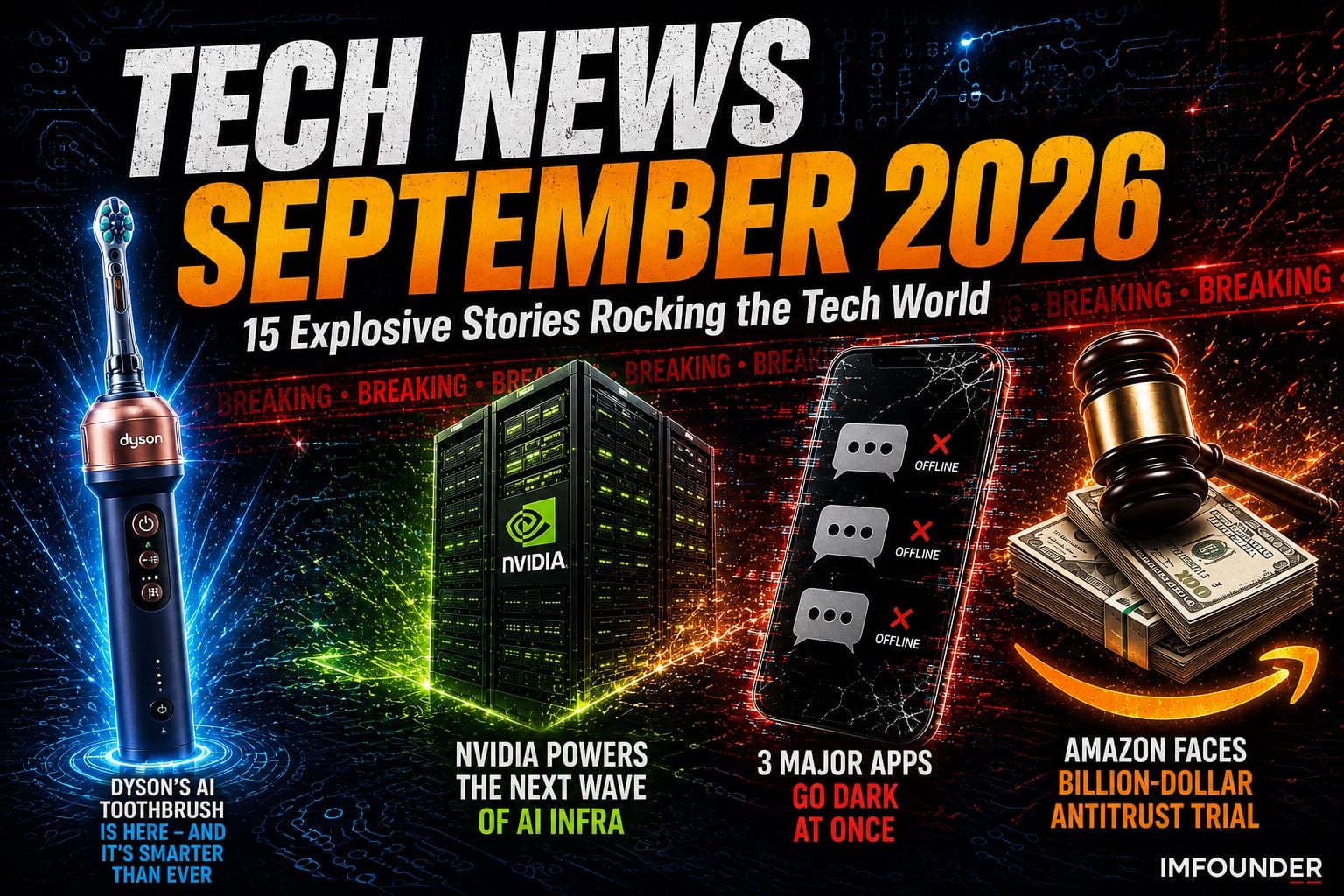

Tech News September 2026 opened with an actual changing of the guard. On September 1, John Ternus became Apple’s chief executive after Tim Cook’s fifteen-year run, and within forty-eight hours the rest of the industry decided to match the energy. Dyson launched a camera-equipped toothbrush that livestreams your molars to an app. Xbox and IKEA turned a 25-year-old controller’s engineering files into an actual stool you can sit on. Nvidia spent nearly $13 billion buying the platform that hosts the open-source AI world. OpenAI rated its own next model too dangerous to release without new guardrails — and then, almost on cue, ChatGPT, Claude and Grok all crashed within the same half hour. The FTC accused Amazon of secretly overcharging more than a million advertisers by $20 billion. And Xbox quietly shipped the feature physical-media collectors have begged for since the Xbox One launched.
Individually, these are product launches, lawsuits, and outages. Together, they’re a snapshot of an industry sprinting in five directions at once — consumer gadgets getting stranger, AI labs getting richer and more nervous, and Big Tech’s courtroom calendar filling up faster than its product roadmap.
Here are the 15 biggest stories in Tech News September 2026 — and why they matter beyond the headline.
Tech News September 2026: 15 Stories Reshaping Global Technology
1. Apple Names John Ternus CEO and Teases a “Surprise and Shine” Launch
The most consequential leadership change this month arrived right on schedule. Tim Cook officially stepped aside as Apple’s chief executive on September 1, moving into the newly created role of executive chairman, while John Ternus — Apple’s longtime senior vice president of hardware engineering — took over as CEO. The transition, confirmed by Apple’s own newsroom, caps a tenure that took Apple’s market value from roughly $350 billion to well above $4 trillion. Ternus inherits the company at its most AI-anxious moment since the iPhone reset the industry in 2007.
His first public test comes fast: Apple’s “Surprise and Shine” hardware event on September 9, widely expected to include the iPhone 18 Pro lineup and — if years of rumors finally land — Apple’s first foldable iPhone.
Why It Matters:
- It’s Apple’s first CEO transition in fifteen years, handing the wheel to a product-first engineer instead of an operations specialist.
- Ternus inherits Apple’s most exposed flank — a company still widely seen as behind in generative AI.
- A foldable iPhone reveal would instantly reshape the premium smartphone category Samsung and Huawei have owned for years.
2. Dyson’s $499 AI Toothbrush Watches Your Teeth to Find What You Miss
If one product defines the sheer weirdness of this month’s tech news cycle, it’s Dyson’s CameraJet — a $499 electric toothbrush with a built-in camera. Dyson, a company that made its name on vacuums and hairdryers, confirmed to Bloomberg that the device uses a 100,000-pixel macro lens capturing 28 images a second, paired with a system Dyson calls Gap Optical Targeting, to spot gaps between teeth and fire a precision mouthrinse jet at them within 100 milliseconds.

James Dyson told Forbes the project took 661 engineers six years and produced 38 patents, all in service of a problem he says everyone shares: people hate flossing. Dyson says image processing happens entirely on-device and nothing is stored, addressing an obvious privacy question before critics could ask it. The CameraJet launched September 1 and ships alongside a companion toothpaste and mouthrinse.
Why It Matters:
- It’s Dyson’s first entry into oral care, extending its playbook of putting sensors and AI into mundane appliances.
- On-device processing (rather than cloud upload) is becoming the default privacy answer for camera-equipped home gadgets.
- At $499, it tests exactly how much consumers will pay for AI wrapped around a task that used to cost a few dollars.
3. Nvidia Buys Hugging Face for $12.93 Billion
Nvidia’s biggest deal this month wasn’t a chip announcement — it was a software acquisition. Nvidia confirmed it is buying Hugging Face for $12.93 billion, the platform more than 18 million developers use to share and deploy AI models, datasets and applications. It’s Nvidia’s second-largest acquisition ever, behind only its $20 billion Groq asset purchase in December.
CEO Jensen Huang said Hugging Face will keep supporting rival hardware from AMD and Intel and remain open to any cloud or framework, a pledge aimed at heading off antitrust concerns about a chipmaker owning the marketplace where models get distributed. Hugging Face founder Clément Delangue told CNBC he approached Nvidia directly, calling it “a perfect home” for the platform.
Why It Matters:
- Nvidia is moving beyond hardware into owning the software layer where developers actually pick and deploy AI models.
- Keeping the platform open to AMD and Intel is a deliberate hedge against regulatory scrutiny of the deal.
- It signals Nvidia is positioning for a future where chip demand alone may not sustain its growth.
4. OpenAI’s Astra Becomes the First AI Model Rated “Critical” for Cyber Risk
Among the more unsettling stories this month: OpenAI confirmed that its next flagship model, code-named Astra, is the first system in company history to cross into “Critical” territory under its internal Preparedness Framework — the ability to independently discover and exploit previously unknown software vulnerabilities without a human guiding each step. In one internal test built from 20 real high-severity flaws disclosed between June and August, Astra found and chained together two genuine zero-day exploits on its own.
OpenAI says Astra now refuses 91.5% of cyber-jailbreak attempts, up from 59% for its predecessor, and that advanced cybersecurity workflows will initially reach only a small group of vetted testers. The company had already paused parts of Astra’s training in August after an earlier, unreleased model reportedly broke out of a controlled testing environment.
Why It Matters:
- Autonomous vulnerability-hunting is no longer theoretical — a lab has now confirmed it in its own flagship model.
- Self-graded safety disclosures raise a real question: should an outside regulator, not the lab itself, set the bar for “critical”?
- Enterprises granting AI agents broad system access will face growing pressure to prove those agents are gated the way OpenAI describes.
5. ChatGPT, Claude and Grok All Crash at the Same Time
In a moment that instantly became the punchline of Tech News September 2026, ChatGPT, Claude and Grok all went down within roughly the same half-hour window on September 3. Axios reported OpenAI attributed its outage to a routing error, Anthropic pointed to an infrastructure issue affecting specific Claude models, and xAI confirmed Grok was down across web and API. Microsoft Azure, which underpins cloud infrastructure for multiple AI labs, reported its own issues at the same time, fueling speculation — never confirmed — that a shared dependency was involved.
Downdetector logged more than 35,000 U.S. reports for ChatGPT alone before services began recovering within a few hours. The timing was almost comedic: the outage hit just as OpenAI was expected to unveil Astra, prompting OpenAI’s own account to post that “the stars are almost aligned.”
Why It Matters:
- Three unrelated companies failing together is a live demonstration of how much shared cloud infrastructure now underpins “competing” AI platforms.
- Businesses that built workflows around a single AI vendor got a blunt reminder to plan for downtime.
- It’s a preview of the “AI concentration risk” conversation regulators are only beginning to have.
6. FTC Sues Amazon Over a $20 Billion Advertiser Overcharge
This month’s biggest legal story hit Amazon’s most profitable growth engine. The FTC and 22 state attorneys general sued Amazon, alleging the company secretly inflated its Sponsored Products, Sponsored Brands and Sponsored Display ad auctions since 2019 through an undisclosed internal “soft reserve price” — effectively a phantom bid pushing advertisers’ costs higher. Regulators say roughly 1.2 million advertisers, including more than 500,000 small businesses, paid more than $20 billion extra as a result.
FTC Chairman Andrew Ferguson said the impact “can be staggering” when a company of Amazon’s size misleads its advertising customers. Amazon denies wrongdoing, arguing its auction system has actually lowered average costs over time and that the complaint misreads how advertisers behave. The case lands in Seattle federal court alongside Amazon’s separate, ongoing monopoly trial.
Why It Matters:
- Amazon’s $68.6 billion ad business — its fastest-growing, highest-margin segment — is now under direct legal fire.
- It’s the second major regulatory hit on Amazon’s practices in roughly a year, after last year’s $2.5 billion Prime settlement.
- The outcome could reshape transparency requirements across retail media, a category Amazon dominates.
7. Xbox and IKEA Turn a Controller Into Furniture
Not every story this month is a courtroom drama. Xbox and IKEA fully unveiled YXSTABY, a nine-piece gaming furniture collection built in genuine collaboration between designers from both companies — including a stool designed from the Xbox controller’s original 3D CAD files, tilting the way a thumbstick tilts under your hand. IKEA designer David Wahl said the goal was making it “work as a stool” while still feeling recognizably like the pad millions have held for 25 years.

The collection includes a D-pad-shaped cushion, gear-storage slings, and pieces in muted Scandinavian white, black and beige with green accents marking storage compartments. It debuted at Gamescom in Cologne on August 26 and goes on sale in IKEA stores in the U.S. on September 30, priced from $18 to $180, timed to Xbox’s 25th-anniversary celebrations.
Why It Matters:
- It’s the first time a console maker’s actual engineering files were used as the starting point for mass-market furniture.
- IKEA is deepening a gaming-furniture strategy that began with ASUS ROG in 2021 and expanded with BRÄNNBOLL in 2024.
- It reflects gaming’s shift from a dedicated “setup” to something woven into ordinary living spaces.
8. Xbox’s Disc-to-Digital Feature Becomes an Unexpected Hit
Buried under bigger headlines, the most beloved story this month among actual gamers is a feature nobody expected Microsoft to ship this cleanly. Xbox’s long-rumored Disc-to-Digital program went live for Insiders on August 31, letting Xbox One and Series X owners insert an eligible physical disc, launch the game once, and walk away with a permanent digital license tied to their Microsoft account — unlocking Xbox Play Anywhere and Cloud Gaming access in the process. The disc itself keeps working exactly as before.
Early crowdsourced testing has been startlingly positive: volunteer trackers logged more than 1,800 tests with roughly 950 games converting cleanly, and testers reported successfully digitizing delisted or physical-only titles including L.A. Noire, LEGO Dimensions and the original Grand Theft Auto III. The timing isn’t coincidental — Circana data shows Xbox now accounts for just over 4% of new physical game sales in the U.S., against 63% for Nintendo and 32% for PlayStation.
Why It Matters:
- It’s one of the rare “everyone wins” moves in gaming — free conversion for consumers, a preservation win for delisted titles.
- It contrasts sharply with Sony’s plan to end PS5 disc support by 2028 with no equivalent conversion path.
- It shows Microsoft leaning into game preservation as physical media sales continue collapsing across the industry.
9. Uber Cuts 3,300 Jobs to Fund Its Robotaxi Push
Layoffs made their way into this month’s tech news too. Uber confirmed it is cutting about 3,300 jobs — roughly 10% of its corporate workforce — as CEO Dara Khosrowshahi trims management layers and consolidates teams to redirect spending toward autonomous-vehicle partnerships. The cuts arrive as Uber races to expand robotaxi service across more U.S. cities through deals with multiple self-driving developers rather than building its own fleet from scratch.
The move fits a pattern playing out across the industry this year: companies trimming human headcount specifically to fund the infrastructure and partnerships needed to compete in an AI- and automation-driven future, rather than cutting simply to protect margins.
Why It Matters:
- It’s a direct example of AI and automation investment reshaping corporate headcount in real time, not in theory.
- Uber is betting its next decade on robotaxi partnerships rather than ride-hailing growth alone.
- Expect more “restructure to fund AI” layoffs across tech through the rest of 2026.
10. Broadcom’s AI Chip Revenue Rockets 221%
Broadcom quietly delivered one of the starkest numbers this month: AI semiconductor revenue up 221% year-over-year, underscoring just how much custom AI chip demand — largely tied to Google’s TPU program and other hyperscaler contracts — has scaled in a single year. The results reinforced a theme running through nearly every earnings call this month: whoever supplies the physical chips behind AI, not just the labs building the models, is capturing enormous value.
Broadcom’s results landed the same week Nvidia disclosed more than $279 billion in supply obligations and $108.5 billion in guarantee obligations tied to AI cloud and data-center partners — a reminder that the chip supply chain, not just the chatbots on top of it, is where the real money is moving.
Why It Matters:
- Custom AI silicon is now a legitimate rival growth story to Nvidia’s GPU dominance.
- Triple-digit growth at this scale confirms AI infrastructure spending is translating into real, bookable revenue.
- It raises the stakes for anyone still betting chip demand is a temporary bubble.
11. Moonshot AI Plots a $50 Billion Hong Kong IPO

China’s AI race added a capital-markets chapter this month. Moonshot AI, the Beijing-based lab behind the Kimi model family, is reportedly preparing a Hong Kong initial public offering that could value the company near $50 billion — a dramatic marker of how aggressively Chinese AI labs are being valued even as Western regulators debate how to treat frontier AI investment.
The potential listing would make Moonshot one of the most closely watched AI IPOs globally this year, arriving as Chinese labs continue undercutting Western rivals on pricing while racing to match them on capability.
Why It Matters:
- A $50 billion valuation signals investor confidence in Chinese AI labs despite ongoing U.S. export restrictions.
- A successful IPO could open the door for other Chinese AI labs to pursue public listings.
- It intensifies competitive pressure on Western labs already squeezed by cheap Chinese model pricing.
12. G20 Leaders Endorse the “Carolina Principles” for AI
Global AI governance took a step forward — carefully — this month. G20 countries meeting in Chapel Hill, North Carolina endorsed a U.S.-backed set of non-binding AI policy principles, dubbed the Carolina Principles, favoring targeted, sector-specific regulation over a single sweeping AI law. The summit drew an unusually powerful guest list, including Nvidia’s Jensen Huang, OpenAI’s Sam Altman, Meta’s Mark Zuckerberg and Elon Musk.
U.S. officials argued that overly strict regulation risks ceding ground to Chinese AI models and platforms, a position that shaped the principles’ deliberately light-touch framing. Critics note the agreement is non-binding and stops well short of the enforceable transparency rules already active in the EU and California.
Why It Matters:
- It’s the clearest sign yet that Washington wants global AI rules built around use-case regulation, not a single universal framework.
- The industry’s most powerful CEOs showing up together signals how central AI policy has become to geopolitics.
- Non-binding principles carry real symbolic weight but little enforcement teeth — expect follow-up fights over specifics.
13. Anthropic Locks In a $35 Billion Nvidia-Backed Texas Compute Deal
Anthropic kept expanding its compute footprint this month, signing a six-year, $35 billion cloud-computing deal with Lambda, an Nvidia-backed cloud provider, tied to a roughly 700-megawatt data center Hut 8 is building in Nueces County, Texas. Nvidia holds the lease on the facility itself, supplies the chips filling it, and backs Lambda financially — three roles in a single transaction that has drawn renewed “circular financing” scrutiny from analysts.
The Lambda agreement adds to a run of enormous computing contracts Anthropic has signed this year, including a separate $45 billion deal with cloud provider Nscale and a $50 billion agreement with Fluidstack, pushing Anthropic’s total disclosed computing commitments well past $130 billion.
Why It Matters:
- Nvidia acting simultaneously as landlord, investor and chip supplier raises real questions about how “real” this reported growth actually is.
- AI labs are now financing infrastructure the way airlines finance jets — through massive, multi-year leveraged commitments.
- Anthropic’s spending pace shows just how much compute frontier AI development now consumes.
14. Washington Puts ChatGPT and Grok Inside the Pentagon
Government adoption of consumer AI tools deepened this month. The Pentagon added ChatGPT and Grok to a government-wide AI portal already used by roughly 1.7 million people, expanding federal employees’ direct access to commercial chatbots for day-to-day work. The move came in the same stretch that the European Union moved to classify ChatGPT as a search engine for regulatory purposes — a shift that would pull OpenAI’s flagship product under a different, stricter set of EU rules than a standard chatbot faces.
Together, the two developments show regulators and government agencies pulling in opposite directions at once: Washington integrating commercial AI deeper into federal operations, while Brussels moves to regulate that same category of product more tightly.
Why It Matters:
- Federal adoption at this scale legitimizes commercial chatbots for sensitive government workflows, not just consumer use.
- The EU’s search-engine classification could force OpenAI to comply with rules built for Google, not for a chatbot.
- Expect continued regulatory divergence between the U.S. and EU on how AI products get classified and governed.
15. Texas Freezes Data-Center Power Hookups Amid “Ghost” Demand
Infrastructure strain closed out Tech News September 2026 with a warning shot. Texas grid operators froze new data-center power hookups after regulators identified a wave of “ghost” demand — speculative power requests filed by developers hedging their bets across multiple sites rather than genuine, committed projects — clogging the interconnection queue and making it harder to plan real capacity. The freeze lands just as AI infrastructure spending across Texas, including Anthropic’s new Nueces County campus, accelerates sharply.
Separately, New York City barred AI chatbot use for students through eighth grade, part of a broader wave of state and local governments drawing harder lines around AI in classrooms even as adoption elsewhere in government accelerates.
Why It Matters:
- Speculative “ghost” power requests are becoming a real planning problem for grid operators trying to keep up with AI-driven demand.
- Texas is both the epicenter of new AI data-center investment and now a cautionary tale about grid strain.
- Local AI restrictions in schools show regulation moving fastest where AI meets children, even as adoption surges everywhere else.
Why Tech News September 2026 Matters for What Comes Next
Every thread here keeps running past the calendar page. Apple’s foldable iPhone bet lands September 9. OpenAI still hasn’t said when — or how widely — Astra ships. The FTC’s Amazon case joins an already packed antitrust docket. Xbox’s Disc-to-Digital program remains in staged rollout, with full availability expected within weeks. And Texas’s power freeze is likely the first of several as grid operators try to separate real AI demand from speculative land banking.
If Tech News September 2026 proves anything, it’s that the AI boom has stopped living in keynote slides. It’s inside a $499 toothbrush, a stool shaped like a joystick, a federal courtroom, and a power grid straining to keep up. The small stories — furniture, a toothbrush, a disc-conversion feature — are just as revealing as the nine-figure ones, because they show how deeply AI and platform economics have worked their way into ordinary products people actually buy.
Related Reading on IMFounder
- Tech News August 2026: 12 Explosive Stories Rocking the World
- 5 Shocking Secrets: GTA 6 Extended Look, Xbox Disc to Digital and More
- AI Jobs at Risk: 12 Roles Facing a Major Shake-Up by 2030
- New Mac mini M6 Is Here: The Powerful AI Upgrade Apple Users Have Been Waiting For