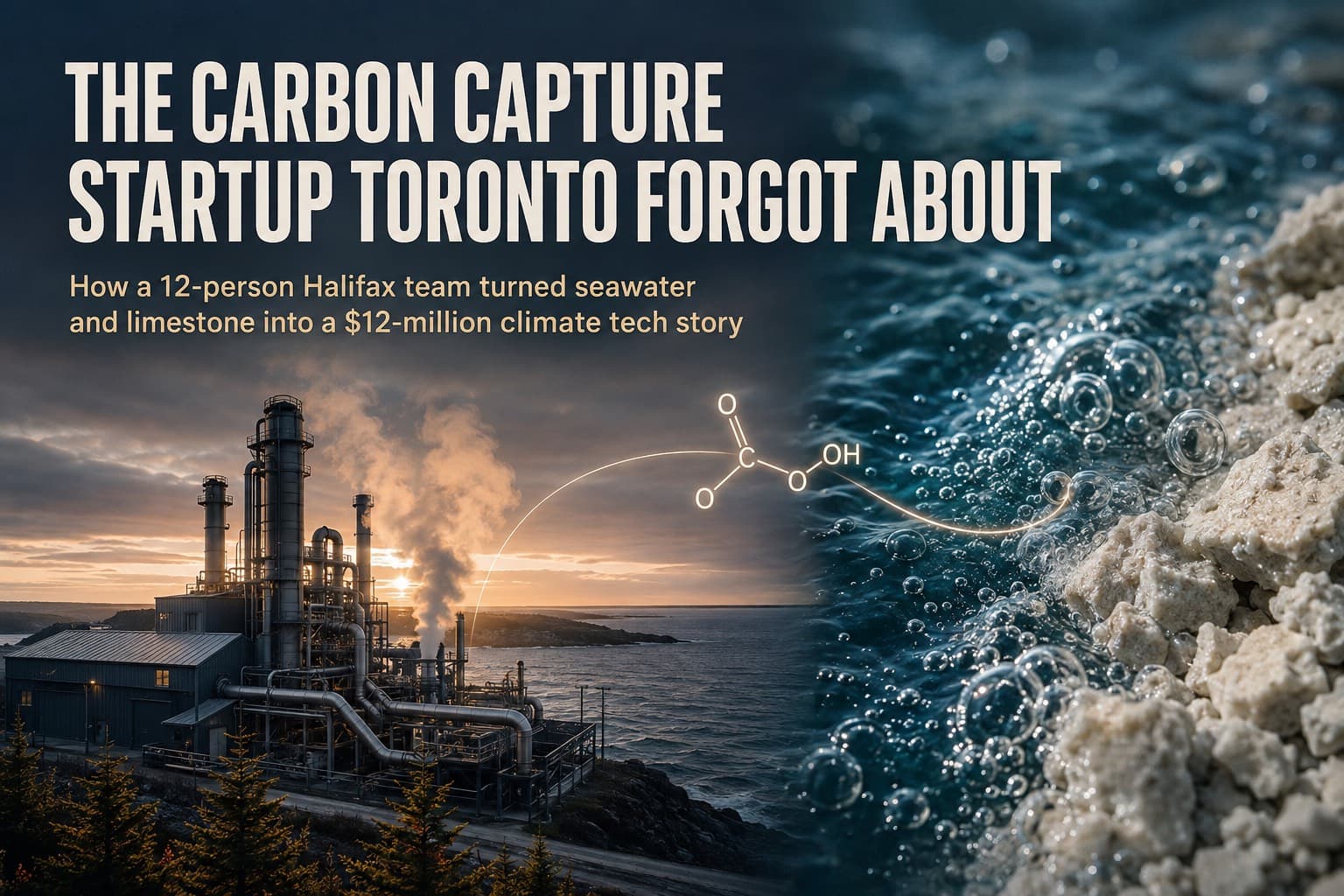

While Toronto and Montreal chase the next AI headline, a 12-person crew on Nova Scotia’s coast just closed a $4-million seed round to prove that permanent carbon removal doesn’t need a pipeline — just limestone, seawater, and a harbour nobody else wanted.
pHathom Technologies is not a household name yet, and that’s exactly what makes it worth writing about. In a Canadian startup landscape where “climate tech funding” headlines almost always trace back to Toronto or Montreal, a small, technically dense company working out of Halifax, Nova Scotia has quietly assembled more than $12 million in committed capital, landed a corporate backer that literally sells limestone for a living, and signed a carbon-removal purchase agreement with one of the most selective buyers in the industry. Most people in the venture world still haven’t heard of it. That’s the story.
In February 2026, pHathom Technologies closed a $4 million (CAD) seed round, capping a fundraising run that began quietly in 2024 and has now positioned the company as one of the more credible names in a carbon-removal sector that is still working hard to prove it isn’t vaporware.
What Happened: The pHathom Technologies Seed Round, Explained
The round was led by Propeller Ventures, a Boston-based investor, with participation from the New Brunswick Innovation Foundation (NBIF), Invest Nova Scotia, and — notably — Carmeuse Ventures, the corporate venture arm of a Belgian industrial group that has been producing limestone and lime products since the 1860s. That last name on the cap table isn’t decorative. pHathom’s entire process runs on limestone, so having one of the world’s largest limestone producers as a strategic investor is the kind of alignment that tends to matter more than the dollar amount.
Structurally, the raise was completed as a simple agreement for future equity (SAFE), closed across multiple tranches, with the final close landing in January 2026 ahead of the public announcement in early February. Layer in a $16-million (CAD) project through Canada’s Ocean Supercluster, a grant from NorthX, and an earlier $250,000 NBIF-backed angel round, and pHathom’s total committed capital — a mix of roughly $8 million in non-dilutive funding and the new $4 million in equity — now sits north of $12 million. For a company that’s only been operating since January 2024, that’s a fast climb.
The Founders: Why a Geochemist and a Halifax Investor Bet on Bicarbonate
Every good investor-banker profile starts with the same question: who is actually running this thing, and why should you believe them?
Dr. Kimberly Gilbert, pHathom’s co-founder and CEO, is an American geochemist and chemical engineer who earned her BSE in chemical engineering and her PhD in geochemistry — focused on the molecular chemistry of carbon capture and sequestration — at the University of Texas at Austin. Before pHathom existed, Gilbert was employee number one at the Carbon to Sea Initiative, a roughly $50-million non-profit dedicated to funding and de-risking ocean alkalinity enhancement research. That role put her at the center of the ocean carbon-dioxide-removal research community years before “OAE” became a buzzword in climate circles, and it’s where she built the technical and scientific relationships that pHathom now leans on.
Her co-founder, Andrew Ray, is the company’s chief operating officer and the Halifax half of the partnership. Ray previously worked at Innovacorp, Nova Scotia’s provincial venture capital agency (since folded into Nova Scotia Business Inc.), giving him a front-row seat to how early-stage Atlantic Canadian companies actually get funded. Gilbert and Ray connected in 2023 — she brought technical chemistry depth, he brought regional business fluency — and founded pHathom Technologies together in January 2024. The company’s name is a small piece of local color: a play on the pH scale and on Three Fathoms Harbour, the Nova Scotia community where Ray lives.
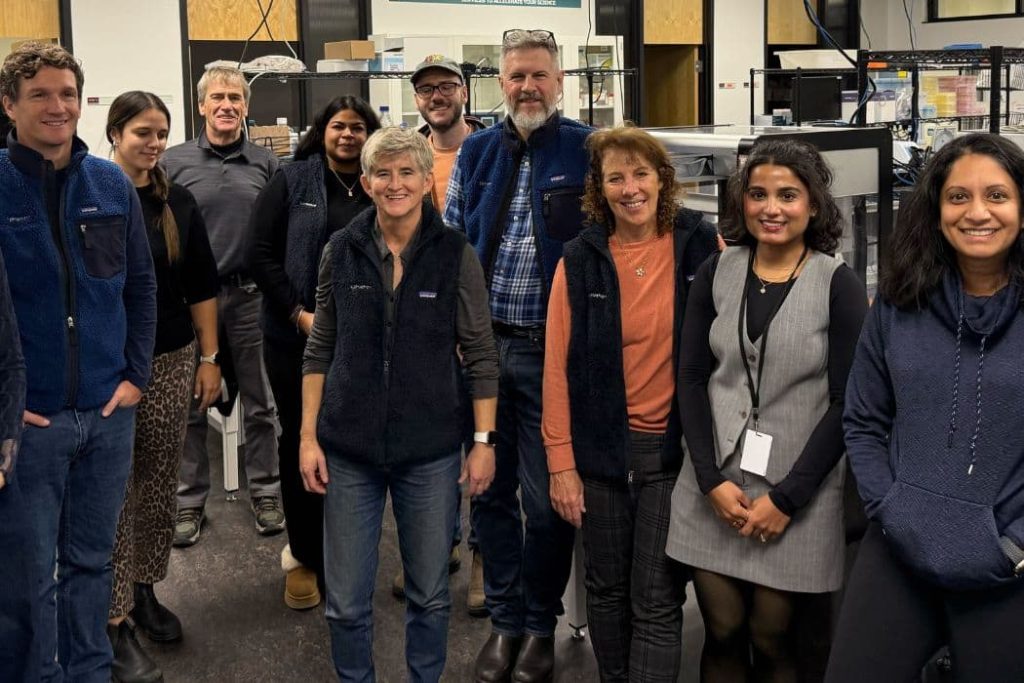
Gilbert has been candid about why she chose Halifax over more obvious startup hubs, describing Atlantic Canada as a genuine center of excellence for marine carbon-dioxide-removal science. It’s a detail that captures something real: this isn’t a Toronto team that outsourced R&D to a cheaper city. It’s a founding team that picked Halifax on the merits.
The Problem pHathom Technologies Is Actually Solving
Strip away the chemistry jargon and pHathom Technologies is answering a fairly blunt question: what do you do with the carbon dioxide coming out of biomass power plants that already exist and aren’t going anywhere?
Biomass — burning wood waste, pulping liquid, and other organic material for power — is a meaningful part of the electricity mix in parts of Canada. It made up roughly four percent of Nova Scotia’s electricity generation as of 2021, and just over one percent of national generation, according to federal energy data. That CO2 is often classified as biogenic, meaning it came from recently grown plant matter rather than fossil sources, but it’s still a real emissions stream that needs somewhere to go if a facility wants to claim a genuinely low-carbon footprint.
The conventional carbon-capture playbook — pipelines, long-distance CO2 transport, and geological injection deep underground — works reasonably well in places like Alberta, where the geology cooperates. It works far less well along a coastline, where suitable underground storage is scarce or nonexistent. That’s the specific gap pHathom Technologies is built to fill: durable, verifiable carbon storage for coastal facilities that will never have access to an underground reservoir.
How the Technology Actually Works
pHathom calls its process Carbon Neutralization and Ocean Storage, or CNOS, and the mechanism is closer to accelerated geology than it is to conventional carbon capture.
Flue gas from a biomass facility is captured before it reaches the atmosphere and routed into what the company calls a weathering reactor, where it’s dissolved into seawater alongside a limestone slurry. Inside that reactor, the CO2 reacts with the limestone to form calcium bicarbonate — a chemically neutral compound that already exists naturally in seawater. The company describes the process as mimicking, and dramatically accelerating, the same rock-weathering reaction that has regulated the planet’s carbon cycle for millions of years. Once the treated water is returned to the ocean, that carbon is no longer CO2; it’s dissolved bicarbonate, chemically stable for potentially tens of thousands of years or longer, without measurably shifting local seawater chemistry.
The appeal to industrial partners is structural as much as scientific: because the reactor bolts directly onto existing coastal infrastructure, there’s no pipeline to build, no long-distance transport contract to negotiate, and no geological injection site to permit. Worth noting: BetaKit issued a correction clarifying that pHathom is not “marine-based” removal in the open-ocean sense — it’s shore-based industrial carbon conversion, run on land, using the ocean purely as the final storage sink. That distinction matters when comparing it to ocean-alkalinity peers like fellow Nova Scotia startup Planetary Technologies.
The Traction: Team, Customers, and Early Stats
For entrepreneurs sizing up whether this is a real business or a well-funded science project, the operating numbers matter more than the press release.
- Team size: 12 people as of the seed close, with plans to add roughly 10 more over the following two years.
- Composition: pHathom describes itself as a women-led venture with a technical team that is 57 percent female — an unusually specific and verifiable diversity stat for a deep-tech startup this early.
- Customer validation: pHathom was selected by Frontier, the Shopify-backed advance market commitment for carbon removal, for a prepurchase of credits worth roughly US$500,000 — a meaningful signal, since Frontier’s diligence process is famously rigorous and doesn’t hand out prepurchases to unproven technology.
- Recognition: pHathom was named a 2025 Foresight 50 honouree by cleantech accelerator Foresight Canada and won Startup of the Year at Foresight’s inaugural Atlantic Canadian Cleantech Awards.
- Pilot pipeline: A summer 2026 pilot at the Huntsman Marine Science Centre will independently verify ocean safety across 13 marine species — a scientific step most early-stage climate startups skip, or can’t afford. A second, larger pilot is planned for 2027 at a Nova Scotia community college, targeting a biomass boiler that produces between 2,000 and 3,000 tonnes of CO2 annually, with the goal of capturing and converting roughly half of that volume in year one.
- Unit economics: According to CEO Kimberly Gilbert, current carbon-dioxide-removal pricing sits around US$250 per tonne industry-wide; pHathom’s stated target is to bring its own cost down to roughly US$100 per tonne as it scales — a number that, if achieved, would put it meaningfully ahead of much of the durable-CDR field on price.
- Revenue model: pHathom intends to sell into both voluntary and regulatory carbon markets, while sharing a portion of carbon-credit revenue back with the biomass facility operators it partners with — an incentive structure designed to also prove the sustainability of those operators’ own biomass sourcing.
- Scale ambition: A commercial-scale unit removing roughly 10 tonnes of CO2 per day is targeted for 2028–2029, with full commercial deployment by 2030 and a stated ambition to remove one million tonnes of CO2 annually by the early 2030s.
A Series A round is expected to be raised in mid-to-late 2026, according to Gilbert, and the company has already flagged Finland, Sweden, and the United States as markets where its coastal-biomass model could translate well beyond Atlantic Canada.
The Real Angle: Atlantic Canada’s Climate Tech Blind Spot
Here’s the part of the pHathom Technologies story that deserves more attention than it’s gotten: this is happening in a region that Canadian tech media routinely treats as an afterthought.
Toronto owns the fintech and AI narrative. Montreal owns AI research and gaming. Vancouver has cleantech pockets. Atlantic Canada, by comparison, rarely gets covered as a serious technology region at all — despite the fact that Halifax now hosts multiple credible ocean carbon-dioxide-removal companies, including pHathom and Planetary Technologies, both of which have struck deals with Frontier. That’s not a coincidence; it’s a coastline advantage that inland tech hubs simply cannot replicate. You cannot run a shore-based bicarbonate reactor in downtown Toronto.
There’s also a policy tailwind worth noting. Gilbert has pointed to Prime Minister Mark Carney’s public framing of Canada as a prospective clean-energy superpower as validation for building exactly this kind of infrastructure-adjacent climate business in this specific place. Whether or not that federal narrative fully materializes into funding programs, the regional ecosystem — NBIF, Invest Nova Scotia, the Ocean Supercluster, Foresight Canada — is already functioning as a genuine, if under-covered, capital stack for climate founders who don’t want to relocate to build something real.
What Entrepreneurs and Investors Should Actually Take From This
A few honest takeaways, investor-banker hat on:
Non-dilutive capital is doing real work here. Roughly two-thirds of pHathom’s $12-million-plus in committed capital is non-dilutive government and supercluster funding rather than equity. Founders in capital-intensive climate tech should study that structure, not just the headline seed number.
Strategic investors beat generic ones in deep tech. Carmeuse Ventures isn’t just a check; it’s a limestone supply chain and an industrial-decarbonization relationship in one investor. Founders building anything physical should hunt for that alignment before chasing the biggest name on the term sheet.
Advance market commitments are the credibility signal that matters now. A Frontier prepurchase functions less like revenue and more like a technical due-diligence stamp from one of carbon removal’s toughest buyers — arguably worth more than a press-release-friendly funding number.
Location can be a moat, not a limitation. pHathom chose Halifax because the coastline, research institutions, and regional funding bodies made the economics work better than a bigger city could — a lesson for any founder building something tied to geography or natural resources rather than pure software.
What’s Next for pHathom Technologies
The immediate roadmap is concrete rather than aspirational: the Huntsman Marine Science Centre pilot this summer, the community-college-scale deployment in 2027, a Series A conversation later in 2026, and a push toward commercial-scale units by the end of the decade. None of it is guaranteed — durable carbon removal is still an unproven asset class at true scale, and pHathom’s own targets stretch out to 2028–2030. But for a company that didn’t exist before January 2024, the combination of strategic capital, an advance-purchase customer, and a technically credible founding team gives pHathom Technologies a more grounded shot than most companies get this early in the carbon-removal race.
Frequently Asked Questions About pHathom Technologies
What does pHathom Technologies do? It captures biogenic CO2 from coastal biomass and industrial facilities and converts it into stable calcium bicarbonate using seawater and limestone, then returns it to the ocean for verifiable storage.
How much funding has pHathom Technologies raised? A $4 million (CAD) seed round closed in February 2026, bringing total committed capital — including non-dilutive government funding — past $12 million.
Who founded pHathom Technologies? Dr. Kimberly Gilbert (CEO), a geochemist and chemical engineer, and Andrew Ray (COO), a former Innovacorp investor, founded the company in January 2024.
Where is pHathom Technologies based? Halifax, Nova Scotia, with a founding team spanning Atlantic Canada and Austin, Texas.
Is pHathom’s carbon removal method scientifically verified? Independent verification is underway, including a 2026 Huntsman Marine Science Centre study on 13 marine species, and Frontier has already selected pHathom for an advance carbon-removal purchase.
Related Articles on IMFounder
- 10 AI Startup Ideas You Can Launch With Zero Dollars in 2026
- 5 Powerful Startups You Can Launch With Only $1,000
- Pitch Investors in 2026: 7 Proven Secrets That Actually Get Startups Funded
- BioCompute Anagha Rajesh: The 24-Year-Old Who Fled India’s Broken Startup Dream
- The Complete Guide to Starting an AI Startup in Canada (2026 Edition)
- How Successful Entrepreneurs Spend Their Sundays: Powerful Habits That Build Extraordinary Companies
- How Zhong Shanshan Built a $70 Billion Empire Selling Bottled Water
- Matthew Gallagher Medvi: The Explosive Startup Built With ChatGPT That Hit $401M
Sources and further reading: BetaKit, Business Wire, SustainableBiz Canada, Foresight Canada, Canada’s Ocean Supercluster, Frontier Climate, Carmeuse Ventures.