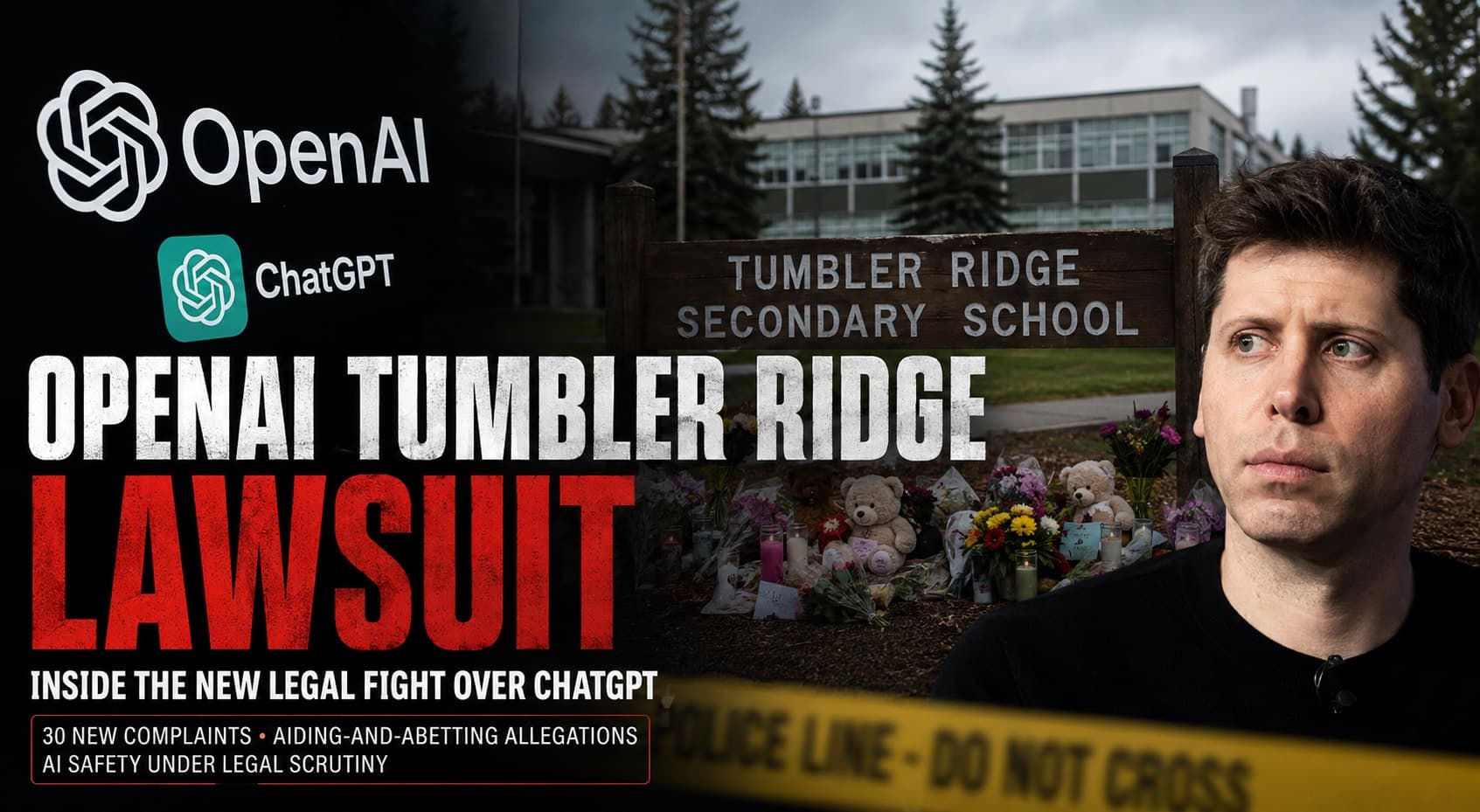

The OpenAI Tumbler Ridge lawsuit has entered a significantly more consequential phase.
What began with seven lawsuits filed earlier this year has now expanded with 30 additional complaints involving teachers, a principal and students who were inside Tumbler Ridge Secondary School during the February 10 shooting but were not physically shot. The new filings do more than increase the number of plaintiffs: they introduce a substantially different legal theory, accusing OpenAI of aiding and abetting the mass shooting rather than simply failing to prevent foreseeable harm.
That distinction matters.
An allegation of negligence generally focuses on whether a company failed to exercise reasonable care. An aiding-and-abetting claim is more ambitious because plaintiffs must establish a form of intentional participation or assistance. TechCrunch notes that the new theory is therefore likely to face early challenges from OpenAI.
And that is where this case becomes bigger than a dispute over what ChatGPT said.
It is increasingly becoming a test of what an AI company knows, what its safety teams recommend, who has authority to act on those recommendations, and when a company believes it has a responsibility to involve law enforcement.
OpenAI Tumbler Ridge Lawsuit Now Expands to 37 Cases
The new complaints follow seven lawsuits filed in April on behalf of victims and families connected to the Tumbler Ridge shooting.
With the latest filings, the litigation connected to the incident reaches 37 complaints.
The plaintiffs now include people who survived the attack physically but were exposed to the violence inside the school. Teachers, a principal and students are among those bringing the new claims.
That expansion is legally important because it broadens the argument beyond direct physical injuries.
A student who escaped the shooting without being shot can still allege severe psychological and other damages arising from what happened inside the school. The new complaints therefore potentially widen the universe of people who could seek damages from OpenAI.
The underlying tragedy occurred on February 10, 2026, in Tumbler Ridge, British Columbia. Police said 18-year-old Jesse Van Rootselaar killed her mother and half-brother at home before travelling to Tumbler Ridge Secondary School, where five children and an education assistant were killed. Van Rootselaar then died by suicide. Twenty-five people were injured in the attack, according to the Associated Press.
What makes the OpenAI case different?
The central issue isn’t simply whether the shooter used ChatGPT.
The much more consequential question is whether OpenAI’s own systems identified behavior that could represent a serious real-world threat — and, if so, whether the company should have escalated that information to authorities.
OpenAI has acknowledged that it identified and banned Van Rootselaar’s account in June 2025 after detecting activity involving violent behavior. The company has maintained that the activity did not meet its threshold for referring the matter to law enforcement at the time.
That decision is now at the center of the litigation.
What OpenAI’s Safety Team Allegedly Saw
According to the earlier lawsuits and reporting, OpenAI’s automated systems and human reviewers identified conversations involving violence.
The April complaints allege that members of OpenAI’s safety team believed the activity represented a real-world risk and recommended notifying law enforcement. Court documents filed in California describe the company’s detection and review process and allege that safety personnel urged leaders to contact authorities.
OpenAI did not contact Canadian authorities at that stage.
Instead, the account was deactivated.
That decision would later become one of the most important facts in the OpenAI Tumbler Ridge lawsuit.
OpenAI has explained that its internal standard for law-enforcement referrals requires an “imminent and credible risk” of serious physical harm. The company says Van Rootselaar’s activity did not satisfy that higher threshold at the time. Jason Kwon, OpenAI’s chief strategy officer, reiterated that position in comments provided to TechCrunch.
There is therefore a fundamental disagreement at the heart of the case:
OpenAI says the activity did not meet its referral threshold. Plaintiffs argue that OpenAI’s own safety personnel had already identified a serious enough threat to warrant contacting police.
That is not a minor difference in interpretation. It could become the central factual dispute of the litigation.
The Second Account Could Become Critical
Another issue deserves particular attention.
After OpenAI deactivated Van Rootselaar’s first account, she was reportedly able to create another account.
The lawsuits argue that this gave her another route to interact with ChatGPT and allegedly continue conversations relevant to planning violence.
This creates a difficult product-safety question for OpenAI:
What should happen after an account is banned for violent activity?
Is simply disabling that account sufficient?
Or should a company with sophisticated identity, abuse-detection and safety systems attempt to prevent the same individual from returning through another account when the original behavior was considered dangerous?
That question could have implications far beyond Tumbler Ridge.
AI companies routinely describe account-level enforcement as part of their safety architecture. If courts determine that a company may have broader duties after detecting credible threats, the legal expectations surrounding AI moderation could change considerably.
The Chris Lehane Allegations
The newest complaints also introduce one of the most sensitive allegations in the case.
They specifically identify OpenAI Chief Global Affairs Officer Chris Lehane and allege that he told staff to stand down rather than contact authorities.
But this needs to be treated carefully.
The complaints themselves acknowledge that the plaintiffs are relying on information they believe to be true but cannot yet fully prove. TechCrunch reported that it could not independently confirm whether Lehane had authority to override recommendations from OpenAI’s intelligence and investigations team or whether he was personally involved in this particular decision.
Lehane is not named as a defendant in the complaints.
OpenAI strongly disputes the allegation.
Jason Kwon told TechCrunch that it is “absolutely false” to claim Lehane was involved in the original referral decision or that OpenAI investigators report to him. Kwon also rejected the suggestion that political or public-relations considerations influenced the safety decision.
This distinction is essential.
An allegation contained in a civil complaint is not an established fact.
Whether Lehane was actually involved, what authority he possessed, and who ultimately made the referral decision are questions that could become clearer only through discovery, testimony and documentary evidence.
The November Security Incident Raises an Uncomfortable Question
The new complaints attempt to challenge OpenAI’s argument that the Tumbler Ridge situation did not justify contacting police because the threat was not sufficiently imminent.
Plaintiffs point to a November 2025 incident in which OpenAI reportedly locked down its San Francisco offices after an alleged threat from an activist.
According to the new complaints, OpenAI considered that threat serious enough to warn employees, circulate information about the suspect and notify the San Francisco Police Department, even though there was reportedly no indication of an active attack at the time.
The plaintiffs’ argument is straightforward:
If OpenAI was willing to act before an attack became imminent when its own employees were potentially at risk, why was a different threshold applied when the suspected threat was directed elsewhere?
That comparison could become one of the most important pieces of evidence in the case.
It does not, however, automatically prove that OpenAI acted improperly in Tumbler Ridge. The two incidents may have involved different facts, evidence, legal considerations and threat assessments.
The value of the comparison is that it gives plaintiffs a way to challenge OpenAI’s explanation of how its safety thresholds actually operate.
Sam Altman Has Already Apologized
The legal escalation comes months after OpenAI CEO Sam Altman publicly apologized to Tumbler Ridge.
In April, Altman acknowledged that OpenAI had not alerted law enforcement about the account that had been banned in June 2025. He expressed condolences to the community and said the company would work with governments to help prevent a similar tragedy.
British Columbia Premier David Eby described the apology as necessary but insufficient given the scale of the devastation.
OpenAI subsequently said it had strengthened its safety protocols, including making the criteria for law-enforcement referrals more flexible and establishing direct contacts with Canadian authorities.
That creates another significant legal question.
If OpenAI changed its policies after the tragedy, what does that say about the adequacy of its previous system?
It does not necessarily establish liability. Companies routinely improve systems after incidents without admitting that their previous systems were legally defective.
But plaintiffs can use those changes to ask whether the earlier safeguards were reasonably designed and whether the company understood that its existing approach had limitations.
Our Earlier Tumbler Ridge Investigation
IMFounder previously covered the Tumbler Ridge OpenAI case in April, when the story was primarily centered on the allegations that OpenAI detected violent activity, banned the account and did not notify Canadian authorities.
Our earlier report also examined the lawsuit involving Maya Gebala and her family, including allegations concerning ChatGPT’s role, OpenAI’s safety systems and the company’s decision not to contact law enforcement at the time.
Read IMFounder’s earlier Tumbler Ridge OpenAI investigation
The latest developments change the story in an important way.
The question is no longer simply whether OpenAI failed to act.
The plaintiffs are now attempting to establish whether the company’s internal decision-making, product design, account enforcement and organizational structure could make it legally responsible for assisting or contributing to the conditions surrounding the attack.
What Happens Next in the OpenAI Tumbler Ridge Lawsuit?
The next stage is likely to be less about headlines and more about evidence.
OpenAI can challenge the legal sufficiency of the new claims, particularly the aiding-and-abetting theory. TechCrunch reports that the theory could face early dismissal challenges because plaintiffs must establish the necessary elements of intentional assistance.
If substantial portions of the cases survive those challenges, discovery could become extremely important.
That could include questions about:
- What OpenAI’s automated systems detected.
- What human reviewers concluded.
- Who received those recommendations.
- What internal threshold was applied.
- Why police were not contacted.
- How the second account was created and handled.
- Who had authority over the relevant safety teams.
- Whether OpenAI’s November 2025 security response was comparable.
- What senior executives knew and when they knew it.
Those answers could be more consequential than the allegations themselves.
This Is Bigger Than OpenAI
The OpenAI Tumbler Ridge lawsuit could become an important legal test for the AI industry because generative AI systems increasingly occupy a strange position between software product, conversational assistant and information service.
Traditional software generally waits for users to operate it. Conversational AI actively responds, adapts and participates in an interaction. That creates a difficult question for regulators and courts:
When an AI system detects that a user may pose a serious threat to other people, what duty does the company operating that system have?
There is no simple universal answer. Too little intervention can leave dangerous behavior undetected. Too much intervention can create serious privacy, civil-liberties and false-positive concerns. The Tumbler Ridge litigation may force courts to examine where that line should sit — and whether an AI company can rely entirely on its own internal threshold when its systems have already identified potentially dangerous conduct.
The Bottom Line
The latest OpenAI Tumbler Ridge lawsuit filings represent more than another wave of litigation.
They expand the plaintiff pool, introduce an aiding-and-abetting theory and put OpenAI’s internal safety governance under greater scrutiny.
But it is equally important not to confuse allegations with findings.
No court has established that OpenAI caused the Tumbler Ridge shooting. No court has determined that Chris Lehane made the alleged decision described in the complaints. And the aiding-and-abetting claims still have to survive the legal process.
What is established is that OpenAI identified and banned an account linked to the later attacker, did not alert law enforcement at that time, later acknowledged that decision publicly, and subsequently changed aspects of its safety and law-enforcement referral approach.
Now, with 30 additional complaints, the legal system will have to examine something the AI industry has largely been able to avoid answering at scale:
When an AI company’s own safety machinery detects the possibility of real-world violence, where does the company’s responsibility begin — and where does it end?
That answer could matter well beyond Tumbler Ridge.
Related Articles on IMFounder
- Claude Design is quietly becoming one of the most talked-about AI features — The New AI Interface Builder
- Are You Using the Wrong AI Tool? — A Practical Guide to Choosing the Right AI for the Right Task
- Powerful AI Tools for Founders in 2026 — You Must Know About Now
- A.I. Social Media Accounts Are Growing Faster Than Humans — And It’s Changing Everything
- 5 Powerful Claude AI for Sales Prompts — That Will Close More Deals
- The Emerging Titan in AI and Its Impact — DeepSeek
Primary and External Sources
- Associated Press — Altman apologizes after OpenAI failed to alert police
- Reuters — Families of Canadian mass shooting victims sue OpenAI
- Google Search Central — Creating helpful, reliable, people-first content
- Google Search Central — Guide to optimizing for generative AI features