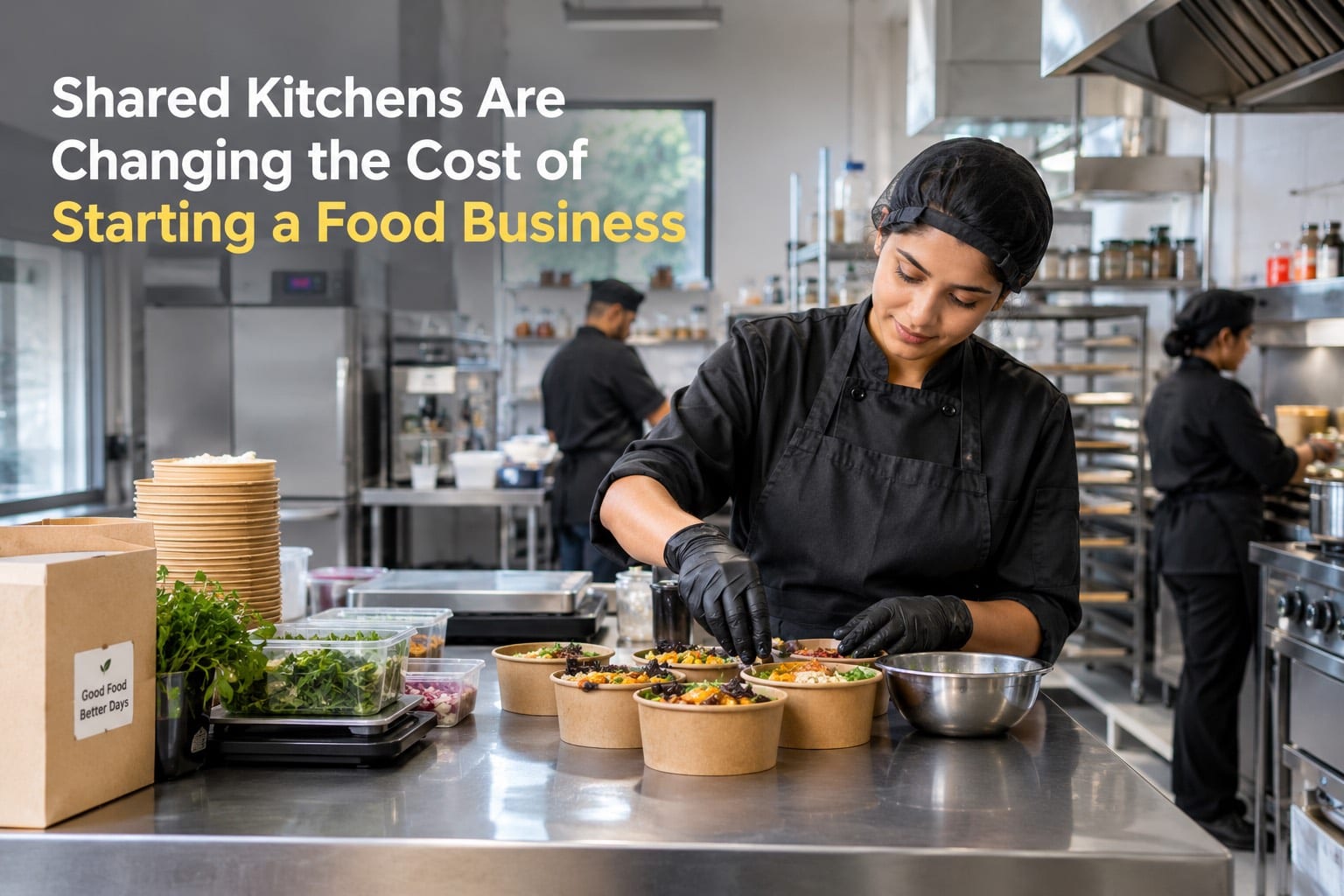

A food entrepreneur can have a marketable recipe, paying customers and the skills to produce—and still lack an approved kitchen.
Building a commercial facility creates financial commitments before the first order: equipment, refrigeration, installation, premises and operating overhead. Shared kitchens offer another entry point. Entrepreneurs rent production space and equipment while developing the business around them.
That changes the startup calculation. Capital that would otherwise be committed to a facility can remain available for ingredients, packaging, customer acquisition and working cash.
But affordable entry and sustainable earnings are separate achievements. The business must generate enough revenue to cover rented infrastructure, compensate labor and retain a surplus.
The opportunity is to use shared capacity to build a repeatable commercial operation.
“A shared kitchen lowers the cost of getting started. The sales model determines whether the business can stay.”
What the Research Establishes
In 2021, Colorado State University and The Food Corridor surveyed food businesses through a cooperative agreement with USDA’s Agricultural Marketing Service. They collected 179 complete responses. Thirty-two businesses had started as home-based operations before moving into shared kitchens.
The resulting research reported kitchen rental fees averaging 36% of sales among respondents providing rental-fee information. For respondents operating more than ten years, that share was below 10%.
Those fees substituted for building, equipment and overhead expenses entrepreneurs would otherwise incur. Researchers also warned that apparent profits could reflect owners paying themselves less than the full value of their labor and management.
The survey primarily captured businesses still operating. Its findings describe historical participants, rather than providing a comprehensive measure of business survival.
USDA’s shared-kitchen research also identifies differences in sales channels. Businesses with smaller sales commonly used farmers markets; higher-sales businesses more commonly reached grocery and retail outlets.
That association does not establish that retail access causes growth. It demonstrates why production capacity and customer access must be examined together.
Replace Speculative Production With Confirmed Orders
One practical application is a prepared-food business organized around recurring purchases.
Customers order a weekly package before a published cutoff. The entrepreneur purchases ingredients against confirmed quantities, produces a limited menu during scheduled kitchen sessions and distributes through pickup windows or concentrated delivery routes.
The model connects four operating decisions:
- Product: specified portions, packaging and menu boundaries.
- Ordering: confirmed quantities before purchasing.
- Production: repeatable batches and scheduled equipment access.
- Distribution: predictable collection points or delivery routes.
These decisions determine how efficiently rented kitchen time becomes saleable food.
An extensive menu increases purchasing and preparation complexity. Scattered delivery addresses consume labor. Late changes disrupt batch quantities.
Recurring purchases can also spread customer-acquisition expenses across several orders. That advantage depends on retention and margin. A returning customer who requires costly exceptions can generate activity without producing adequate earnings.
“A recurring customer is valuable when the order produces recurring profit.”
Separate Owner Pay From Business Profit
Consider an illustrative operation serving 60 households, each purchasing a $100 weekly package containing five individual meal portions.
Over a four-week operating period, the business sells 1,200 portions and generates $24,000.
The figures below are hypothetical planning assumptions, not observed results or an earnings forecast.
| Four-week item | Assumption | Amount |
|---|---|---|
| Revenue | 60 households × $100 × four weeks | $24,000 |
| Ingredients | $7 per portion | $8,400 |
| Packaging | $1.25 per portion | $1,500 |
| Payment processing | Assumed 3% of revenue | $720 |
| Distribution | $1.40 per portion | $1,680 |
| Owner labor allowance | 80 hours × $35 | $2,800 |
| Assistant labor | 60 hours × $25, including assumed employment costs | $1,500 |
| Kitchen rental | Assumed production allocation | $1,600 |
| Storage | Assumed charge | $200 |
| Other operating overhead | Insurance, software, marketing and administration | $600 |
| Total modeled costs | $19,000 | |
| Operating surplus after owner labor allowance | Before income taxes and excluded expenses | $5,000 |
The $2,800 owner labor allowance recognizes work performed. The remaining $5,000 represents modeled operating surplus.
Startup expenses, debt service and equipment purchases are excluded. Actual working hours and expense assumptions require validation.
This distinction prevents unpaid work from being mistaken for profitability. A business that covers ingredients and rent while leaving its owner inadequately compensated has not demonstrated sustainable earnings.
Published rates show why facility costs require local investigation. Hive Kitchen in Illinois lists 40 hours monthly at $680 per month under a three-month subscription or $640 per month under six months. Storage costs extra. Those packages are examples, not the basis of this illustration.
Find the Point Where the Model Breaks
The illustration assigns variable costs of $10.25 to each $20 portion. That leaves $9.75 per portion toward $6,700 in fixed commitments over the modeled period.
Using the Small Business Administration’s break-even method, the operation needs 688 portions to cover those commitments—approximately 35 households purchasing throughout the four weeks.
At 40 households, revenue falls to $16,000 and operating surplus falls to $1,100.
At 30 households, the operation loses $850.
These scenarios hold fixed commitments constant. They show how reduced demand changes the result before the operator signs longer rental agreements or adds staff.
An additional $1 in ingredient cost per portion removes $1,200 from surplus at the original volume.
Production capacity must also match the forecast. Cooking, cooling, refrigeration, packaging and sanitation must fit within available facilities and working hours. A sales target exceeding safe capacity creates an operational problem regardless of its projected margin.
Use Business Accounts to Concentrate Demand
Recurring business buyers offer another way to organize production.
Potential customers include employers purchasing scheduled lunches, retreat operators ordering breakfast packages and accommodation managers arranging arrival meals.
An illustrative pilot could combine three business accounts purchasing 25 portions each with 25 households purchasing five portions. That produces 200 portions weekly.
Bulk orders can reduce selling effort and delivery stops. They also create concentration risk: losing one account removes a meaningful share of demand.
Discounts should correspond to measurable savings through larger batches, simpler packaging or consolidated distribution. Otherwise, the business exchanges margin for volume without improving its economics.
Ordering deadlines, payment terms, cancellation responsibilities and delivery requirements should be established before production commitments expand.
Turn Earnings Into Durable Value
Personal wealth requires resources retained after obligations are met.
Operating surplus can support cash reserves, production improvements and documented systems. Its value depends on whether the business consistently generates it after recognizing the owner’s work.
Useful measures include repeat purchasing, contribution per product, total labor hours, customer concentration and cash remaining after expenses and taxes.
Documented recipes, purchasing specifications and production procedures allow another trained person to perform more of the work. Customer relationships and operating systems can contribute to business value when they support dependable, transferable earnings.
IMFounder’s reporting on Sysco’s distribution strategy examines how distribution shapes commercial options. Its coverage of Travis Kalanick’s Atoms venture follows another approach to food-production infrastructure.

For an independent operator, the immediate task is matching rented capacity to profitable demand.
“The wealth-building opportunity begins when the business pays for the owner’s labor—and still has money left.”
Validate Before Expanding
Kitchen access alone does not authorize every food activity. Required permissions depend on the jurisdiction, products and business operations.
Begin with a defined product and ordering cycle. Measure ingredient yield, packaging, purchasing time, production, sanitation, customer administration and distribution.
Expand when repeat purchases and demonstrated capacity justify additional commitments.
Shared kitchens change the cost of entering commercial food production. Their lasting value depends on what entrepreneurs build around that access: paid demand, disciplined production and earnings that remain after the work is compensated.
Renée Tomato™ — Culinary Journalist | Hospitality Systems Analyst / Covering AI, labor, and infrastructure across the global food economy
Watch: Diversifying Income Beyond Hourly Rentals
Kitchen EDU’s August 2026 webinar examines events, catering partnerships and additional sales channels with representatives of The KAWS and Findlay Market.<iframe width=”100%” height=”420″ src=”https://www.youtube.com/embed/T05zNDzpeQI” title=”Kitchen EDU: Diversifying Income Beyond Hourly Rentals” loading=”lazy” allow=”accelerometer; autoplay; clipboard-write; encrypted-media; gyroscope; picture-in-picture; web-share” allowfullscreen></iframe>
Sources and Sites
- USDA — Shared Kitchens and Food Startups
- USDA-supported research — Business Viability and Growth, August 2022
- SBA — Break-Even Analysis
- Hive Kitchen — Published Rates
- New York — Shared-Use-Kitchen Guidance
- Illinois — Shared-Kitchen Guidance
- Kitchen EDU — Webinar Listing
- YouTube — Diversifying Income Beyond Hourly Rentals