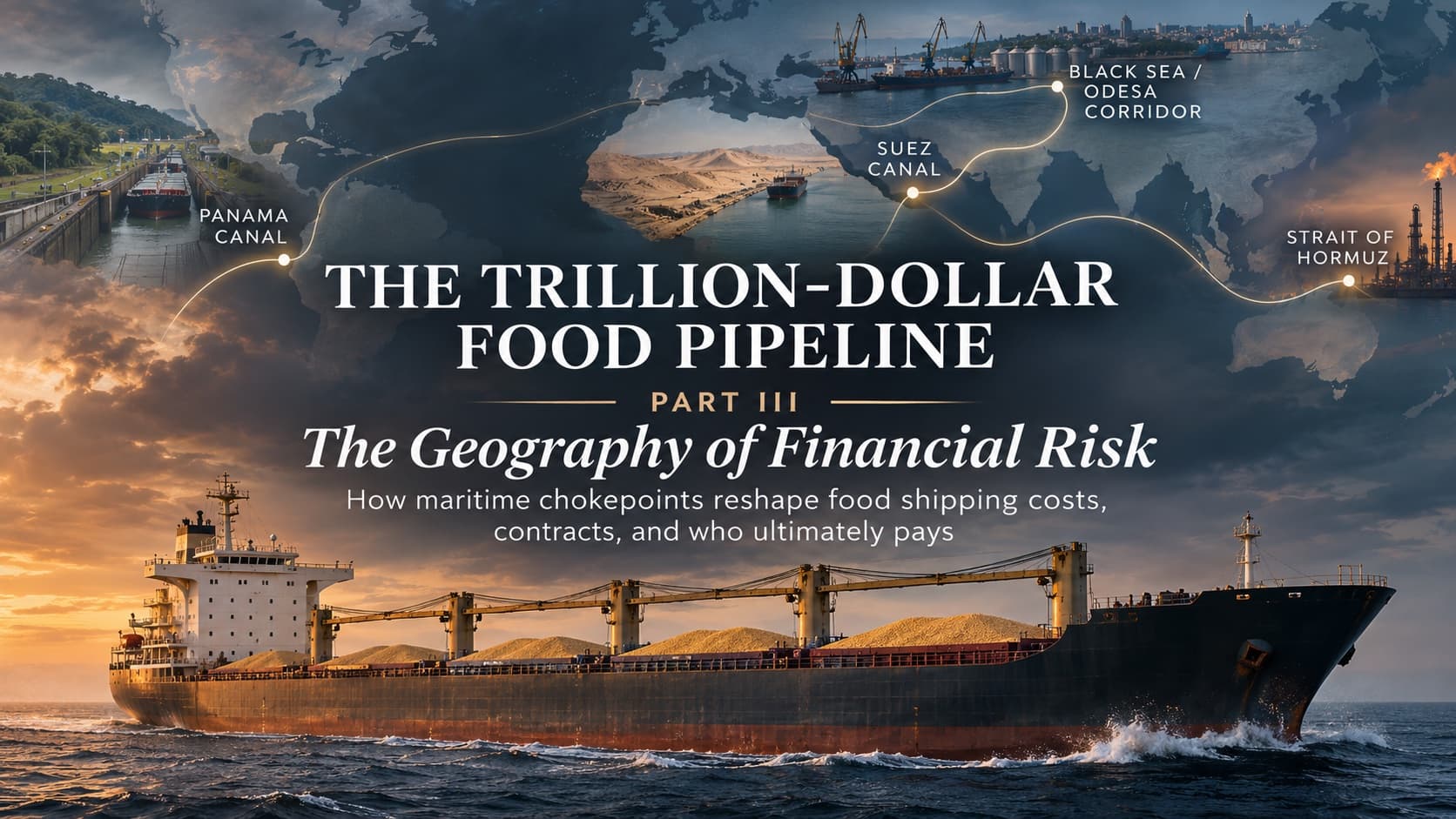

The Trillion-Dollar Food Pipeline — Part III
In2026, disruptions across four maritime corridors exposed how the cost of moving food depends not only on distance, but on water, vessel design, insurance, contract terms and the ability to shift losses onto someone else.
The Geography of Financial Risk
A grain ship approaching the Panama Canal carries more than agricultural commodities. It carries a charter agreement, insurance coverage, a delivery commitment, fuel expenses and an expected cost for the voyage. Change the route, and those obligations change with it.
An illustrative 82,000-deadweight-ton Kamsarmax carrier could face approximately $295,850 in identified Panama Canal charges if its draft permits passage through the older locks. If its loading requires the Neopanamax locks, the identified charges rise to $506,850.
The difference is $211,000. The lower figure has a condition attached: it requires a draft shallow enough for the older locks, which may mean carrying less grain.
The commodity is the same, and the buyer still needs it. Yet a technical distinction involving draft and lock assignment can materially alter the economics of the transaction. Add a drought, a contested strait or an insurer reluctant to cover the voyage, and the original calculation begins to unravel.
In 2026, global agricultural trade faced several versions of that problem at once:
- Panama imposed water-related transit restrictions.
- Ukraine’s Black Sea corridor came under renewed attack.
- The Strait of Hormuz was severely restricted amid attacks on shipping.
- Suez recovered, but unevenly across vessel types.
Part I of this series showed that moving Brazilian soybeans to the coast can cost more than shipping them across an ocean. Part III follows the cargo onto the water. There, the 2026 disruptions did not add one worldwide surcharge. They redistributed costs, risks and bargaining power according to route, cargo, contract and the options each participant held.
The critical question is not only how much a disrupted voyage costs. It is who has the contractual obligation—and the financial capacity—to absorb the difference.
Panama: When Water Becomes a Transportation Cost
The Panama Canal sells time and distance: passage between two oceans that spares ships the voyage around South America. But its capacity depends on freshwater. During drought, the authority must manage reservoir levels while allocating passage among competing vessels. That is a form of scarcity in which access itself becomes valuable.
In 2026, rainfall in the canal watershed was reported to be 34 percent below average from May through August, and September restrictions reduced daily transit capacity. As conditions improved, the authority’s September 28 advisory announced 33 daily slots from October 15 and raised the maximum Neopanamax draft to 49 feet. The same advisory warned that vessels without reservations could face indefinite delays.
For a merchant shipping against a contractual delivery window, booking access, permitted draft and waiting time can matter as much as the toll.
What a grain carrier might pay
The comparison below applies the Panama Canal Authority’s published tariffs to an illustrative 82,000-DWT Kamsarmax.
Table 1: Panama Canal transit charges, illustrative 82,000-DWT Kamsarmax
| Identified charge | Panamax locks (qualifying draft) | Neopanamax billing |
|---|---|---|
| Transit toll | $223,000 | $365,600 |
| Booking | $50,000 | $100,000 |
| Tugs | $11,600 | $30,000 |
| Fixed freshwater surcharge | $10,000 | $10,000 |
| Security | $1,250 | $1,250 |
| Identified total | $295,850 | $506,850 |
Illustrative calculation from the Panama Canal Authority tariff effective January 1, 2025. Excludes the variable freshwater surcharge, locomotive charges, linehandlers and auction premiums. The Panamax case requires a qualifying loaded draft; actual cargo intake at that draft has not been established.
A Kamsarmax’s beam places it in the authority’s super-vessel category. A vessel arriving with a draft above 39.5 feet must use the Neopanamax locks and is billed accordingly. On a hypothetical 66,000-tonne cargo under the Neopanamax case, identified charges equal approximately $7.68 per tonne.
The canal’s own finances tell a separate story. A Republic of Panama securities filing reported approximately $5.7 billion in canal revenue for fiscal 2025 and a $2.965 billion contribution to the national treasury. The canal can generate substantial national revenue while particular grain routes become less competitive. Infrastructure profitability and customer competitiveness are different measurements.
The Longer Voyage That Can Cost Less Than It Looks
A shorter route is not necessarily the cheaper commercial decision. Sailing from the US Gulf around the Cape of Good Hope eliminates Panama’s charges while adding fuel and vessel time.
A Breakwave Advisors comparison of the US Gulf–Qingdao route found that the Cape voyage could require approximately 20–21 additional days and about 600 additional tonnes of very-low-sulfur fuel oil. The model below uses two price inputs:
- Fuel: Platts’ Singapore 0.5% sulfur fuel oil assessment of $628 per tonne for March 3, 2026.
- Vessel time: $20,400 a day, a Kamsarmax earnings figure from Star Bulk’s second-quarter 2026 results.
Table 2: Modeled Cape detour economics, US Gulf–Qingdao
| Modeled Cape detour | Amount |
|---|---|
| Additional fuel | $376,800 |
| Additional vessel time | $408,000–428,400 |
| Gross additional cost | Approximately $785,000–805,000 |
| Net cost after avoiding identified Panamax-lock charges | Approximately $489,000–509,000 |
| Net cost after avoiding identified Neopanamax charges | Approximately $278,000–298,000 |
Modeled comparison, not an actual fixture. The daily earnings figure is a proxy, not a charter quotation. Both net figures assume the same 66,000-tonne cargo, which may not be achievable at a Panamax-qualifying draft. Certain fuel, operational and canal charges remain excluded.
Under the Neopanamax case, the modeled net additional cost of sailing around Africa is approximately $4.20–4.50 per tonne. That does not prove the Cape is the better route. It shows that the penalty may be far smaller than the map suggests.
A shorter route is not necessarily the cheaper commercial decision.
Actual fixtures show how strongly origin matters. The USDA Grain Transportation Report of August 27, 2026 listed reported China-bound heavy-grain fixtures, agreed on different dates in July and August:
- US Gulf: $69.25 per metric ton
- Pacific Northwest: $35
- Brazil: approximately $49.75–52
The difference between those two fixtures was $34.25 per tonne. Because they were agreed on different dates, it is not a contemporaneous freight spread.
Nor can the gap be attributed to Panama alone: vessel supply, port conditions, distance and timing all affect freight. But for an importer choosing between origins, the relevant figure is not the farm price. It is the cost of the commodity at the destination.
Hormuz: The Disruption That Reaches Farms Before Harvest
The Strait of Hormuz is usually treated as an oil-market problem. For agriculture, its most direct consequence is fertilizer.
According to IFPRI economist Rob Vos, the Middle East supplies about one-third of global urea exports. An estimated 3.9 million tonnes of those exports were suspended after the conflict escalated at the end of February 2026. The World Trade Organization recorded urea prices rising from about $400 per metric ton to more than $850 in April, before falling to around $453 in June.
The reversal matters: the April peak did not persist. But farmers who bought fertilizer during the disruption paid substantially more for it.
Brazil connects this shock to the soybeans examined in Part I. IFPRI reported three findings:
- Brazilian farmers rely almost entirely on imported fertilizer.
- About 40 percent of those imports come via Hormuz.
- Local prices rose more than 35 percent in the conflict’s first two weeks.
IFPRI gives no traceable source for the 40 percent figure, so it should be read as the institute’s estimate rather than a customs statistic.
The mechanism is clear regardless. A Brazilian soybean producer can face a higher cost of production while international soybean prices remain comparatively stable. The farmer’s margin narrows before the crop exists.
Severely restricted, not closed
Hormuz remained severely restricted in October 2026, but traffic had not stopped. Lloyd’s List Intelligence counted 124 transits in the week covered by its October 8 brief, against 122 the week before. Other trackers report different counts because their vessel thresholds and methods differ. With attacks continuing, a strait can remain navigable on a map while ordinary trading becomes commercially difficult.
Suez: One Crisis, Another Route’s Opportunity
Suez shows that disruption redistributes revenue rather than simply destroying it. After Red Sea attacks began in late 2023, many operators diverted around Africa, and Egypt’s canal revenue collapsed.
The Suez Canal Authority’s chairman has put calendar-year revenue at about $10.2 billion in 2023 and $3.9 billion in 2024, as reported by Hellenic Shipping News. For fiscal 2025/26, covering July 2025 through June 2026, he reported $4.67 billion, up 23 percent. These are press-reported remarks rather than a written authority statement. The calendar-year and fiscal-year figures should not be compared directly.
Then Hormuz changed the traffic mix:
- Shipping-industry reporting citing Egyptian statistics showed 529 tankers transiting Suez in April 2026, up 28 percent, as Saudi crude was redirected to the Red Sea port of Yanbu.
- August revenue was reported at $567.1 million, up 56.7 percent.
- Container transits, by contrast, remained substantially below pre-attack levels, according to BIMCO data.
- Comparable figures for dry-bulk grain were not established.
One waterway’s disruption can become another waterway’s demand shock.
Ukraine: When Insurance Decides Whether Grain Moves
Ukraine’s problem is neither water nor tolls. It is whether ships will enter its ports at all.
After the Black Sea Grain Initiative ended in July 2023, Ukraine opened its own maritime corridor and restored substantial agricultural shipping. The danger did not end. Kyiv Post reported that on July 22, 2026, no vessel entered the Greater Odesa ports, the first such day since the corridor opened, amid attacks on port infrastructure and ships.
Ukrainian farm groups have said the disruption cut agricultural exports by 60 percent. That figure has not been independently corroborated as a sector-wide statistic.
When shipowners refuse a port call, grain accumulates, financing periods lengthen and buyers seek new delivery terms. Some cargo may shift toward the Danube or overland networks, but those routes carry their own constraints. The adjustment can reach the farm gate even when international demand holds.
Insurance is part of the response. The Unity facility was created with Marsh, Lloyd’s underwriters and the Ukrainian government. It launched in November 2023 for grain and critical food shipments and subsequently expanded to all non-military cargo, providing up to $50 million in hull and protection-and-indemnity war-risk cover. Insurance cannot remove the danger. It can make the danger financially manageable enough for some voyages to proceed.
The Contract Determines Who Pays
The most consequential shipping infrastructure in this investigation may be contractual.
In April 2025, BIMCO approved revisions to its standard war-risk clauses for voyage and time charters, citing the war in Ukraine and attacks on Red Sea shipping. VOYWAR 2025 sets out what happens when an owner chooses an alternative route because of war risk:
- Freight: freight is adjusted for the estimated time and expenses incurred, or saved, as documented by the owner.
- Payment: due within seven calendar days of the specified invoice-and-documentation trigger.
- Security: the owner holds a lien on the cargo for the adjusted amount.
- Method: this replaced a 100-mile threshold that BIMCO considered disproportionate.
The revisions also tightened the treatment of insurance. Charterers reimburse qualifying additional war-risk insurance costs, but owners must, on request, demonstrate reasonable efforts to obtain appropriate cover and terms. Reimbursement is net of voyage-specific discounts and benefits such as no-claims bonuses.
These are recommended standard clauses, not universal obligations. Their effect depends on incorporation into individual charters, and their adoption in grain shipping has not been documented. But they show how the industry responds when disruption stops being exceptional. Instead of relying on a fixed freight price, standard wording sets out how certain costs are recalculated and who carries them.
Geography determines the possible routes. Contracts determine which businesses carry the financial consequences when those routes change.
The ADM connection
BIMCO’s drafting team for the 2025 revisions included Henning Babiel of ADM, one of the agricultural merchants examined in Part II.
That participation is documented. What positions ADM took, and whether any provision reflects its preferences, is not. The significance lies in interest, not influence: the merchants that move the world’s grain have a direct commercial stake in the rules that decide who pays when a ship changes course.
Revenue Is Not Profit, and Premiums Are Not Gains
Longer voyages tie up more vessel capacity, which can support charter rates. Star Bulk Carriers reported second-quarter 2026 net income of $144.9 million, against about $39,000 a year earlier. Average time-charter-equivalent earnings rose from $13,624 to $24,486 per vessel per day. Those results show how sensitive dry-bulk earnings are. They do not show that chokepoint disruption caused the increase, since dry-bulk owners also carry iron ore, coal and other cargoes.
Higher war-risk premiums reflect greater expected losses, not necessarily underwriting profit. Canal authorities can gain revenue without every customer benefiting. The distinctions that matter are between revenue, profit and the transfer of risk.
The Farmer May Pay Before the Consumer
Under FOB sales, the buyer generally arranges and pays for ocean freight; under CIF and CFR terms, the seller does. Charter clauses then allocate rerouting and insurance costs between owners and charterers.
The party that pays the first invoice is not necessarily the one that bears the cost:
- A merchant may absorb it in a thinner margin.
- An importer may accept a lower return.
- A processor may adjust purchasing prices.
- An exporter may lower its bid at origin.
Consumers may eventually pay more, but no available evidence quantifies how much of a given maritime cost reaches them. IFPRI found international cereal prices relatively stable in 2026 while input costs climbed. It also noted that energy and shipping costs take three to six months to reach store prices in wealthier economies.
An agricultural supply chain can experience financial stress without an immediate increase in supermarket prices. The cost often settles first with those who have the least pricing power.
An agricultural supply chain can experience financial stress without an immediate increase in supermarket prices.
2027–2031: The Value of an Alternative
Three analytical scenarios follow from the 2026 disruptions. They are directions to watch, not predictions of specific outcomes.
Route optionality gains value. Exporters with access to several corridors can switch when one fails; those tied to a single route carry more exposure. In February 2026, the Panama Canal Authority and the U.S. Grains & BioProducts Council signed a memorandum of understanding that includes a feasibility study for a grain storage facility on the canal. A study is not a commitment to build.
Contract management becomes a competitive skill. Merchants that understand their freight exposure and negotiate clear risk clauses may outperform those relying on rigid terms.
Input security rises up the agenda. Hormuz showed that maritime risk reaches fertilizer as well as grain. Import-dependent countries may diversify suppliers, add storage or expand domestic production.
Redundancy costs money. But relying solely on the cheapest normal route becomes expensive when that route fails.
Who Can Afford to Keep Food Moving
The waterways of 2026 did not fail in the same way. Panama ran short of water, Hormuz became dangerous and Odesa’s ports went quiet. Yet each shock moved along the same lines: toward whoever lacked an alternative route, a protective contract or the balance sheet to wait.
The most consequential advantage in global food transportation is not necessarily control of a waterway. It is the ability to manage alternatives, negotiate risk and determine where unexpected costs ultimately settle.
Part IV, Where the World’s Food Money Goes, follows the cargo past the ports. It moves into the processors, manufacturers and distributors that turn commodities into the products the world buys, and asks where the value of food finally lands. To read Part 2, [click here]
Sources
Primary
- Panama Canal Authority — Maritime Services Tariffs, effective January 1, 2025
- Panama Canal Authority — Advisory, September 28, 2026
- Republic of Panama — Form 424B5 (SEC)
- USDA — Grain Transportation Report, August 27, 2026
- USDA — Grain Transportation Report, February 19, 2026
- IFPRI — Iran war: From fertilizer to food crisis? (July 2, 2026)
- WTO — Fertilizer trade impacted by Strait of Hormuz conflict (July 10, 2026)
- BIMCO — VOYWAR 2025 clause and explanatory notes
- BIMCO — War risk clauses approval, April 9, 2025
- Star Bulk Carriers — Second Quarter 2026 Results
- Marsh — Unity insurance facility expansion
Secondary
- Lloyd’s List Intelligence — Strait of Hormuz Brief, October 8, 2026
- Ahram Online — Suez revenue, FY2025/26
- Hellenic Shipping News — Suez revenue
- GOSSHIPS — Suez tanker transits
- Daily Beirut — Suez August 2026 revenue
- Kyiv Post — Greater Odesa ports
- Insurance Journal (Reuters) — Ukraine export disruption, September 16, 2026
- Breakwave Advisors — US soybean and Panama Canal dynamics
- Supply Chain Dive — Panama Canal slot reductions