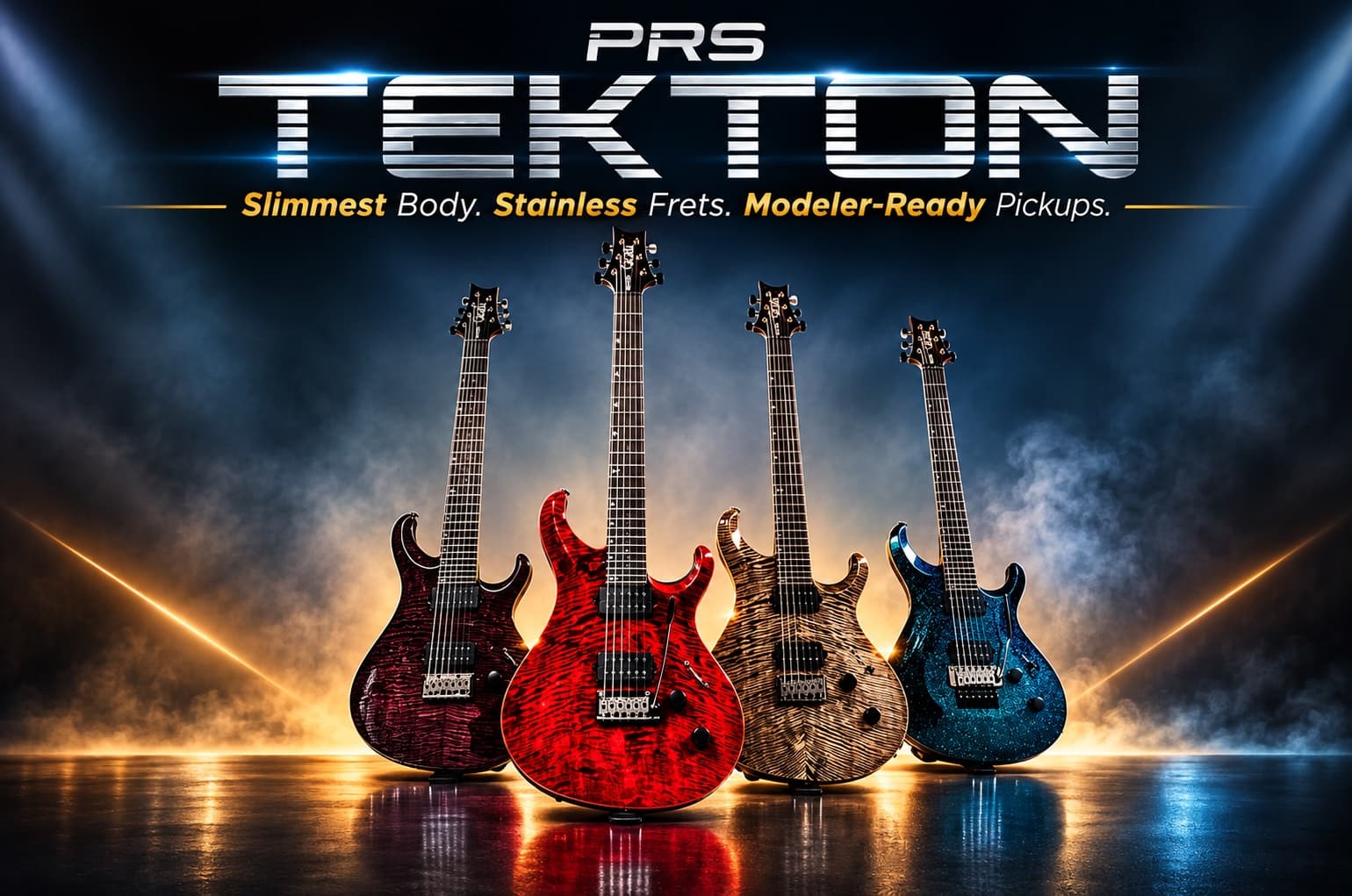

Stainless steel frets, modeler-ready Stylus pickups and the slimmest body PRS has ever built. Here’s what experts say, what it weighs and what it costs in Canada and the U.S.
PRS Tekton is the new guitar family everyone in the guitar world is talking about, and for good reason. Launched on October 20, 2026, this all-new, USA-built range pairs the thinnest body and neck PRS has put into standard production with stainless steel frets, a flatter 16-inch radius and brand-new Stylus humbuckers voiced to sound great through amp modelers and tube amps alike. (Some players search for it as “PRS Tektron,” but the official name is Tekton.)
Is it truly revolutionary? Reviewers at Guitar World and MusicRadar describe it as a serious, carefully engineered challenge to modern-spec rivals such as Ibanez and Jackson. This guide covers everything you need before you buy: who Paul Reed Smith is, the full specs, weight, performance, what has changed, what the experts are saying, and the PRS Tekton price in Canada and the U.S.
What Is the PRS Tekton? The Whole Family at a Glance
PRS calls this a new family rather than a single model. Director of Sales Jim Cullen said the company is “planting a flag for a whole new family of guitars,” according to Guitar World’s launch report. Retail listings explain that the name comes from the ancient Greek word for an artisan or builder.
Four models are available:
- Tekton: six-string with a PRS hardtail bridge
- Tekton T: six-string with PRS’s two-point tremolo
- Tekton Floyd: six-string with a Floyd Rose tremolo and an alder body
- Tekton SVN: seven-string with a string-through hardtail bridge
Every model shares a new body silhouette that sits between the Custom 24 and the offset Vela. As MusicRadar points out, the range has no artist affiliation. It is PRS’s new USA-built bolt-on family, created because players kept asking for more modern-spec guitars.
Who Is Paul Reed Smith? The Maker Behind the PRS Tekton
Paul Reed Smith, born on February 18, 1956, built his first stringed instrument, an electric bass, in 1972 as a Maryland high-school student and finished his first electric guitar at 19, according to Wikipedia’s PRS Guitars entry. He went on to be mentored by former Gibson president Ted McCarty, debuted the PRS Custom at the 1985 NAMM Show, and collected enough dealer pre-orders to open a factory in Annapolis that same year. In 1996 the company moved to its present home in Stevensville, Maryland, and launched its Private Stock custom shop.

Today PRS spans affordable SE and S2 guitars through to custom-built Private Stock instruments. Its artist roster includes heavy-music names such as Mark Tremonti, Mark Holcomb and Herman Li, as noted in Guitar World’s launch coverage.
Smith has been in the spotlight lately. John Mayer inducted him into Guitar Center’s RockWalk in September 2026, and he has addressed the old joke that PRS guitars are only for dentists. “I didn’t know Carlos Santana and John Mayer were dentists,” he told fans, adding that PRS has worked hard to keep its SE guitars affordable, as Guitar World reported. The Tekton continues that story by courting the progressive and metal players who have always been drawn to the brand.
PRS Tekton Specs at a Glance
These are the shared specifications reported by Guitar World’s reviews and retailer listings:
- Made in: the USA
- Body: mahogany back with a highly flamed mango top (alder on the Floyd), “Shallow Violin” carve, high-gloss nitro finish
- Neck: bolt-on maple, Modern D profile, satin nitrocellulose finish, hormigo strength rods
- Fingerboard: Indian ebony, 16-inch radius, offset dot inlays, Luminlay side dots
- Frets: 24 jumbo stainless steel
- Scale length: 25.5 inches (648 mm) on six-strings, 26.5 inches (673 mm) on the SVN
- Nut: PRS composite, 42.8 mm wide on six-strings, 48.4 mm on the SVN
- Pickups: two PRS Stylus alnico 5 humbuckers, volume, push/pull tone control for coil-splitting, 3-way blade switch
- Hardware: PRS Phase III locking tuners, smoked black finish
- Strings: PRS Signature 10–46
- Case: PRS Premium gig bag included
- Left-handed: no left-handed option listed at launch
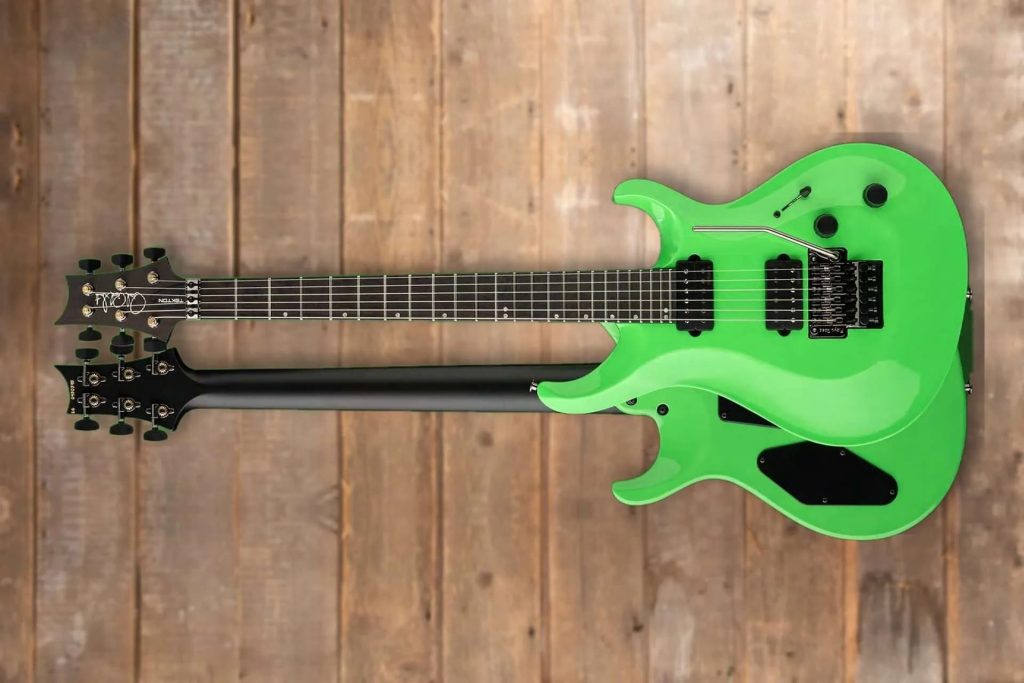
Finishes include Bloodstone Red, Slate Blue, Imperial Topaz, Black Tourmaline, Violet Tourmaline and Fuchsia Aura, while the Floyd arrives in solid colors such as White Holoflake, Purple Royale, Neon Green and Hot Pink.
PRS Tekton Weight: Light Enough for Long Sessions
Weight matters when you are three songs deep into a set. Guitar World lists the Tekton SVN at 6.6 lb (3 kg), and a retailer listing from Andertons shows 6.9 lb for a Tekton T in Imperial Topaz. Reviewers described the Tekton T as wonderfully lightweight and said the longer-scale SVN stays similarly light.
Individual guitars always vary. For context, one Custom 24 with a Floyd Rose listed at zZounds weighed 8 lb 1 oz, so the slimmer Tekton body makes a noticeable difference in practice.
7 Revolutionary Upgrades: What Has Changed on the PRS Tekton
1. The Thinnest Body and Neck PRS Has Ever Put Into Production
Both Guitar World and Guitar.com report that the Tekton has the thinnest body and neck in PRS’s standard lineup. The shape blends the flagship Custom 24 with the offset Vela, and a generous belly carve keeps it comfortable.
2. PRS Stylus Pickups Built for Modelers
The new PRS Stylus pickups are medium-output alnico 5 humbuckers with a flatter response than most. PRS voiced them for clarity, articulation and character through tube amps and digital rigs. Guitar World’s review found they keep clean tones clean, keep high gain tight and deliver excellent string separation, with convincing coil-split sounds on top.
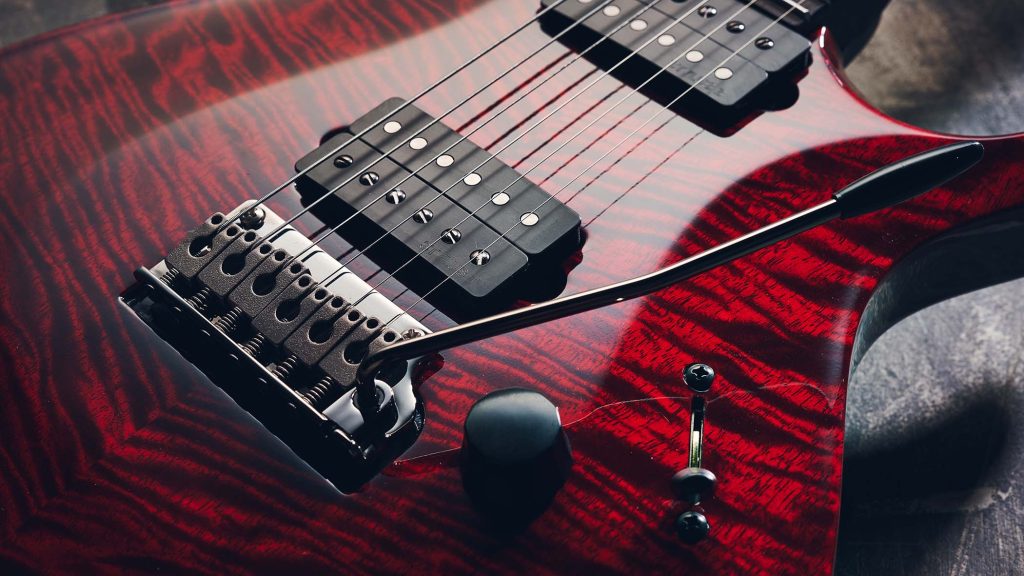
3. Sculpted Ergonomics for Effortless Upper-Fret Access
An exaggerated cutaway scoop and a heavily sculpted neck heel make the highest frets easy to reach. The review compares the heel to Ibanez’s All-Access joint, a long way from the bulky heel of a traditional Custom 24.
4. A 16-Inch Radius, Ebony and Stainless Steel Frets
The flatter 16-inch radius is new for PRS, and Guitar World reports it is the first time the company has used stainless steel frets. Each Indian ebony fingerboard carries natural “birthmarks” in the grain, so no two are identical. The Bird inlays are replaced by offset dots.
5. A Longer Scale and Wider String Spacing
Six-string models move from PRS’s signature 25-inch scale to a Fender-familiar 25.5 inches. The SVN uses 26.5 inches for tighter low notes. String spacing matches John Mayer’s Silver Sky and Mark Lettieri’s Fiore, which is said to help with sweeps, arpeggios and precise picking.
6. Hormigo Strength Rods for a Stable Neck
Each maple neck is reinforced with hormigo strength rods, a dense hardwood reinforcement that PRS says adds stability and resonance. It takes its cue from the carbon fiber rods used in Herman Li’s Chleo signature.
7. A USA-Built Seven-String: The PRS Tekton SVN
The SVN is PRS’s first USA production seven-string and its first seven-string at any price with a bolt-on neck, according to Guitar World’s SVN review. It features a 26.5-inch scale, a 48.4 mm nut and a substantial string-through hardtail bridge.
PRS Tekton Performance: How It Plays and Sounds
Playability is where reviewers say the Tekton earns its reputation. The contoured back and subtly offset shape let the guitar balance well and sit comfortably against the body, and the Modern D neck is thin but substantial, so fans of Jackson and Charvel should feel at home. The reinforced maple stays stable whether your hand is stretching for wide bends or racing through scale runs, and the fretwork and finishing are flawless, as you would expect at this price.
Sound is just as impressive. Guitar World tested the Tekton T through a Line 6 HX Stomp digital rig and found the pickups crisp and clear, letting carefully dialed tones shine through without overpowering a clean signal. On the seven-string, the reviewer ran compressed cleans, crunchy overdrive and extreme-metal tones modeled on Mesa/Boogie, Soldano and Peavey amps, and the full humbucker stayed tight and full under heavy distortion. The split-coil position adds a wiry snarl to low notes, while on the T it ranges from punchy single-coil rock to glassy cleans. The PRS two-point tremolo remains superb for expressive vibrato, and it can still shriek when you want it to.
Which PRS Tekton Model Should You Choose?
- Tekton (hardtail): a firm, dependable response and the simplest tuning stability, ideal for rhythm-focused players.
- Tekton T: PRS’s two-point tremolo with steel plate and brass saddles gives you vibrato and shimmer without Floyd Rose complexity.
- Tekton Floyd: the choice for dive bombs, flutter effects and harmonics, with an alder body and bold solid colors.
- Tekton SVN: the extended-range option for drop tunings and low-B clarity, thanks to its 26.5-inch scale.
PRS Tekton Review Roundup: What Experts Are Saying
In its PRS Tekton review, Guitar World tested the Tekton T and awarded 4.5 stars overall, with five stars for sound. The verdict: far from a phoned-in modern rework, it is all-new and shaped around what today’s players need. The headline sums up the mood: “The ergonomics are the best of any PRS model yet, by far.” The only ergonomic complaint is the hard edge of the carved top against the picking arm.
The same publication gave the PRS Tekton SVN a full five stars and called it, if anything, even better than the T. Its reviewer wrote: “This is a truly fantastic-feeling and sounding seven-string.”
Guitar World’s editors were more divided in their reaction piece. News Editor Matt Owen was fascinated by a humbucker designed with modelers in mind, comparing the idea to FRFR speakers. Deputy Editor Matt Parker admitted he was initially underwhelmed, saying the guitars look less like a “tectonic shift” than a refined evolution, though colleagues who played them called them stellar. Deputy Reviews Editor Stuart Williams tried the Tekton T briefly and came away with a sense of evolution: unmistakably PRS, yet unlike any other PRS he had held. Editor-in-Chief Michael Astley-Brown noted the ergonomics sit closer to Ibanez and Ernie Ball Music Man than to Gibson, and suggested a cheaper S2 version could push the range into the mainstream.
Guitar.com framed the series as a middle ground between the flagship Custom 24 and the offset Vela, highlighting the thin body and the modeler-friendly pickups. MusicRadar said the range shows the build quality and attention to detail PRS is known for, and that the Bloodstone Red finish looks astonishing in person.
Why Players Love the PRS Tekton (and the Fair Criticisms)
What people love:
- Ergonomics: a lightweight, balanced body and a slim D-shaped neck that suits fast playing
- Clear, defined tone: Stylus pickups that stay tight under heavy gain and work with modelers
- Versatility: coil-splitting opens up glassy cleans and single-coil rock tones
- A seven-string done right: a proper 26.5-inch scale and a comfortable neck
- Distinctive looks: familiar PRS DNA without the Bird inlays
What critics mention:
- The hard top edge where the picking arm rests
- Color combinations that will not suit every taste
- A premium price, with no cheaper S2 or SE version announced yet
- No left-handed option at launch
Treat the “revolutionary” label as revolutionary for PRS rather than for the guitar world. It is a bold, well-executed modernization, and reviewers disagree only on how radical it is.
PRS Tekton vs. Ibanez, Jackson and the CE24
Guitar World suggests several alternatives. For six-strings, consider the PRS CE24 ($2,699) for a classic double-cut shape, the Jackson American Series Soloist SL2 DX ($2,629) for a neck-through metal machine, or the Japanese-built Ibanez AZ2402 ($2,049), which is closely matched on specs. For seven-strings, the Ibanez RGDR4327R ($2,999) and Strandberg Boden Original N2.7 ($2,599) compete, while the PRS SE Mark Holcomb SVN offers a far cheaper entry at around $1,199.
PRS Tekton Price in Canada and the U.S.
U.S. pricing: the Tekton and Tekton T list at $2,899, while the Tekton Floyd and Tekton SVN list at $2,999. Every guitar includes a PRS Premium gig bag, according to MusicRadar. Dealers such as zZounds list the Floyd at $2,999.
Canadian pricing: Canadian dealer The Arts Music Store lists the Tekton and Tekton T at $4,060 CAD, and the Tekton Floyd and Tekton SVN at $4,200 CAD. Canadian prices typically exclude sales tax and vary by dealer, so compare local stores before you buy.
Availability: stock is still settling. As of November 1, 2026, some listings show reserve-now or pre-order status, and one U.S. dealer estimates new orders will ship by November 11.
Who Should Buy the PRS Tekton?
This range suits progressive, metal and modern-rock players who want a fast neck, stainless frets and tight, clear tone. It is ideal for guitarists who run amp modelers and anyone who has found traditional PRS ergonomics bulky. Seven-string players should audition the SVN.
Skip it if you want a vintage Les Paul feel, need a left-handed model or are working with a tighter budget. In that case, PRS’s SE and S2 lines may be a smarter starting point.
PRS Tekton FAQs
Is it PRS Tekton or PRS Tektron?
The correct spelling is Tekton. “Tektron” is a common misspelling.
Is the PRS Tekton made in the USA?
Yes. Guitar World lists the reviewed models as USA-made, and MusicRadar describes the range as PRS’s new USA bolt-on family.
Is the PRS Tekton good for metal?
Yes. It was designed for the most technical modern players, with stainless frets, a 16-inch radius, coil-splitting and a seven-string option, though reviewers say it is versatile enough for many styles.
How much does the Tekton weigh?
Reported weights are roughly 6.6 to 6.9 lb (about 3 kg), depending on the model and the individual guitar.
Final Verdict: Is the PRS Tekton Worth It?
The PRS Tekton is not a gimmick. It is a thoughtful, USA-built modernization that delivers real ergonomic and tonal advantages, and reviewers at Guitar World, MusicRadar and Guitar.com have largely welcomed it. Whether you call it revolutionary or simply evolved, it gives modern players a premium PRS built around their needs.
If you want a lightweight, fast guitar that works equally well with a modeler or a tube amp, it deserves a spot on your shortlist. Try one in person, A/B it against the CE24 if you can, and let your hands decide.
Prices and availability were checked on November 1, 2026 and may change. This guide is based on PRS’s launch information and published hands-on reviews.
Related Articles on IMFounder
- MacBook Pro Touch Screen: 7 Shocking Truths Behind Apple’s Biggest U-Turn
- Old Music Gear Is Back: The Untold Story Behind Music’s Vintage Revival
- Marantz Restoration — A Story of Music, Memory, and a 50-Year-Old Soul.
- Vinyl and Cassette Revival in 2025: Why Analog Music Is Spinning Back Into Our Lives
- 55 Years of Technics SL 1200 — And It Still Has Something Modern Tech Can’t Replace
- The 10 Greatest Turntables of All Time