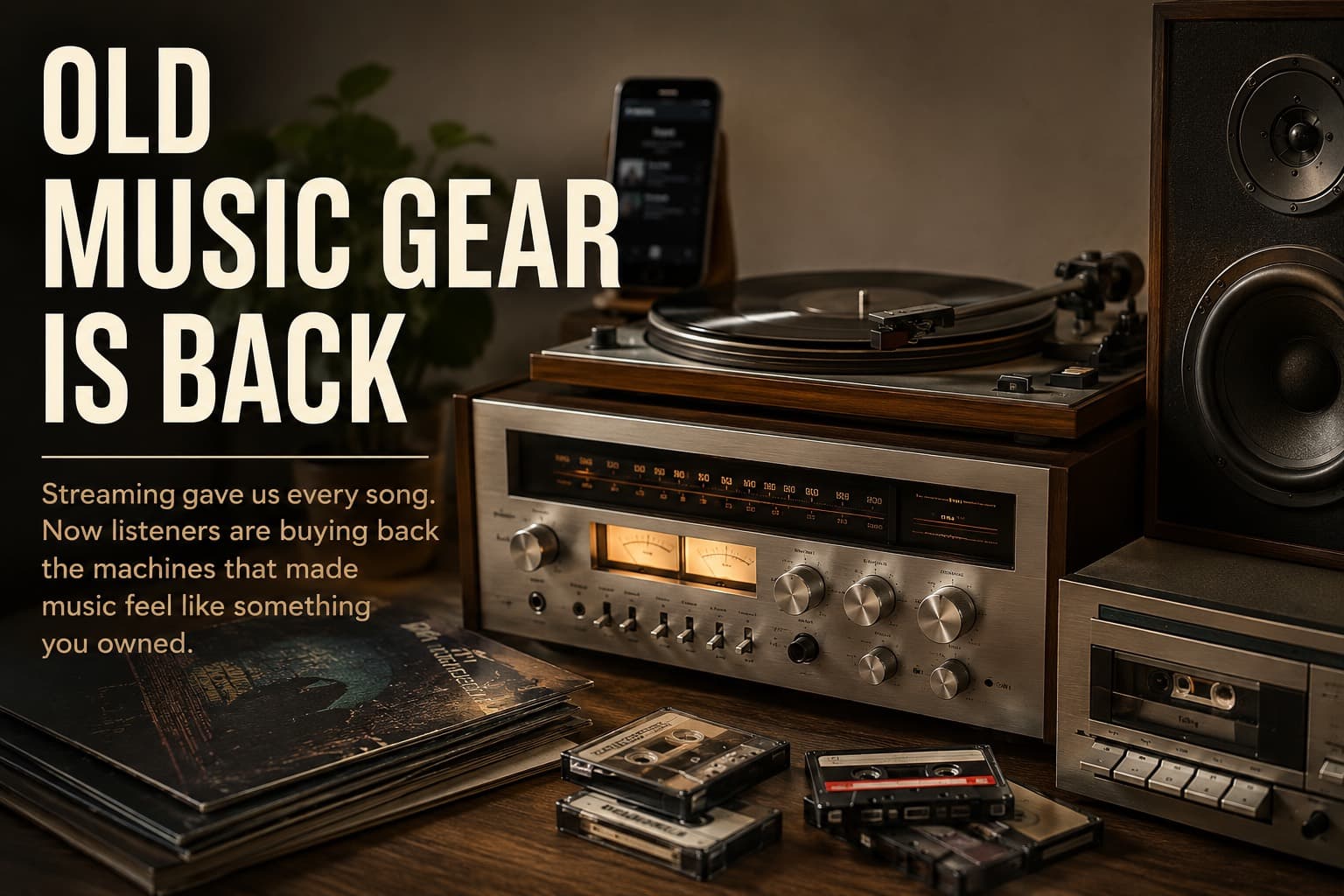

There is a curious contradiction happening in music right now. We have never had easier access to music, yet more people are deliberately buying machines that were designed decades ago to play it. While streaming services can put tens of millions of songs in your pocket within seconds, collectors are searching Facebook Marketplace for 1970s receivers, hunting for discontinued Technics turntables, buying cassette decks that haven’t been switched on in years and paying good money to restore amplifiers that were manufactured before many of today’s listeners were born. Old music gear is back, and this time the revival is about far more than nostalgia.
The resurgence is particularly interesting because the technology itself is no longer necessary. Nobody needs a 40-year-old receiver to listen to an album. Nobody needs a cassette deck when a phone can stream almost any recording ever made. Nobody needs a turntable when a digital file can deliver music instantly and, in many cases, with greater technical accuracy. Yet vintage audio equipment continues to attract listeners because it offers something that digital music cannot: a physical relationship with the act of listening. You switch on the amplifier, select an input, lower the tonearm, watch the record begin to spin and hear the first few seconds before the music settles into the room. The equipment becomes part of the experience rather than disappearing behind it.
The Return of Old Music Gear Is Bigger Than a Retro Trend
It would be easy to dismiss the renewed fascination with old music gear as another cycle of retro culture. Vinyl came back, cassette tapes came back, film cameras came back and mechanical watches became fashionable again. Surely vintage stereo equipment is simply following the same pattern.
There is some truth to that, but it doesn’t explain the entire phenomenon. Unlike many retro products that are primarily decorative or collectible, good vintage audio equipment remains functional engineering. A properly serviced amplifier from the 1970s can still power a modern listening system. A well-maintained direct-drive turntable can still provide years of reliable service. A restored cassette deck can still play a collection that has survived several generations of technology. The equipment may be old, but the fundamental task it performs has not changed.
That is why the best vintage audio isn’t valuable simply because it is old. It is valuable because it was well designed, well built and capable of surviving long enough to become relevant again.
And that distinction is important.
There is a huge difference between buying an old electronic component because it has a famous name on the front and buying a piece of equipment because its engineering, construction, repairability and performance have earned a reputation over decades. The vintage market contains plenty of mediocre products, overpriced listings and equipment that needs far more work than its seller admits. But it also contains extraordinary machines that continue to demonstrate why they became legendary in the first place.
Vinyl Started the Journey, but the Equipment Became the Obsession
The modern analog revival didn’t begin with receivers or amplifiers. For many listeners, it began with a record.
Vinyl gave physical music a cultural comeback long before most people started thinking seriously about the equipment used to play it. As IMFOUNDER explored in its earlier feature, “Vinyl and Cassette Revival in 2025: Why Analog Music Is Spinning Back Into Our Lives,” the renewed interest in physical formats has been driven by a combination of collectability, ritual, nostalgia, ownership and a desire for something more tangible than a digital playlist.
That movement naturally created a second question for listeners: what should I play my records on?
The answer quickly becomes an equipment journey.
A person buys a first turntable. Then they discover that cartridges matter. Then they start comparing phono stages. Then the amplifier becomes important. Then the speakers. Eventually, they begin looking at vintage receivers, direct-drive turntables and classic Japanese audio equipment. What started as buying records quietly becomes a hobby built around the entire listening system.
That progression is visible in my own experience as a collector. What began with a Technics SL-1600 eventually developed into a collection of six turntables, hundreds of records and multiple pieces of vintage audio equipment. I recently documented that journey in “The 10 Greatest Turntables of All Time: A Founder’s Personal Collection and the Machines That Made Me Fall in Love With Vinyl.” The article isn’t simply a ranking of turntables; it explains how one machine can fundamentally change the way someone interacts with music.
And that is one of the secrets behind the vintage-audio revival: the hardware can become part of the story.
Why Do People Want Vintage Audio Equipment?
The simplest answer is that vintage equipment provides an experience modern electronics often deliberately hide.
Modern consumer electronics are designed to become invisible. Your phone disappears into the background. A streaming application disappears into an interface. Wireless speakers eliminate cables. Digital amplifiers can be tiny. A modern system can be extraordinarily good while occupying almost no physical or emotional space.
Vintage equipment does the opposite.
A classic receiver announces itself. It has weight. It has switches, knobs, meters, lamps and mechanical controls. Wooden cabinets give it a presence that makes it look more like furniture than disposable electronics. A turntable requires physical interaction. A cassette deck makes you handle the medium. Even the imperfections become part of the experience.
That doesn’t necessarily mean vintage equipment sounds objectively better.
This is where serious music enthusiasts need to separate engineering from mythology. A modern amplifier can measure better than a 50-year-old amplifier. A modern digital source can offer lower noise and greater technical precision. A well-designed contemporary turntable can outperform an inexpensive vintage model. Age is not a specification.
But audio isn’t consumed only through specifications.
People also respond to texture, design, ritual, familiarity and emotional association. The experience of owning a beautiful machine and using it every evening can be more meaningful than owning technically superior equipment that feels completely anonymous.
For many collectors, the emotional value of the system is part of the system’s value.
The Marantz Effect: When Restoration Becomes Part of the Music
Few things explain the emotional side of vintage audio better than restoration.
A broken piece of old audio equipment can easily be treated as electronic waste. But collectors often see something completely different: an opportunity to bring an important machine back to life.
That was the central experience behind my own Marantz restoration story on IMFOUNDER. What began with a 50-year-old Marantz 2230 purchased through Facebook Marketplace eventually became a much larger restoration involving a specialist technician, a craftsman building a custom wooden case and a long process of bringing the receiver back to the condition it deserved.
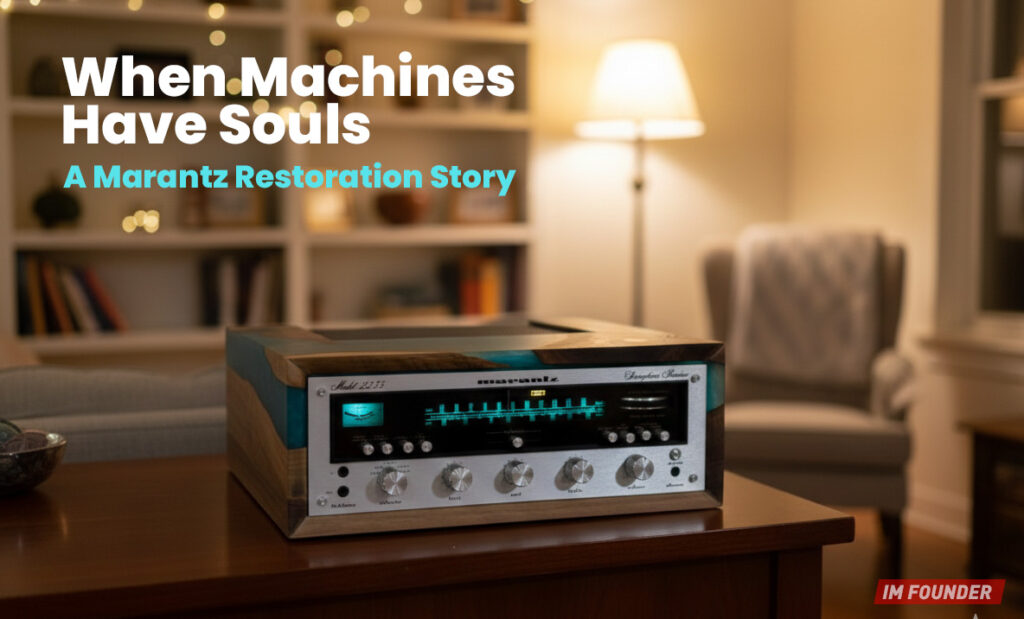
The receiver arrived with rust, scratches and a damaged button, and there was no certainty that it would become the machine I imagined. Yet when it was connected to speakers, it already had enough character to make restoration feel worthwhile. That is the moment that explains why collectors become obsessed with old music gear: the machine stops being an object and starts becoming a project.
Restoration also changes the relationship between owner and equipment. You learn what is inside it. You understand why components fail. You start recognizing the difference between cosmetic restoration and electronic restoration. You discover the people who still know how to work on equipment from another era. Eventually, you begin to appreciate the craftsmanship in ways you never would have if you had simply purchased a new amplifier from a retail shelf.
A restored receiver is therefore more than an old receiver.
It is an old receiver with a story that continues.
The Golden Age of Japanese Hi-Fi Is Being Rediscovered
A substantial portion of today’s vintage-audio obsession revolves around Japanese equipment from the 1970s and 1980s. Technics, Pioneer, Sony, Sansui, Yamaha, JVC, Denon, Kenwood and other manufacturers produced enormous numbers of receivers, amplifiers, turntables and cassette decks during the golden age of consumer hi-fi.
Some were inexpensive mass-market products. Others were ambitious engineering statements.
What makes the era particularly attractive today is the combination of engineering and industrial design. Large aluminium faceplates, wooden side panels, analog meters, illuminated controls and substantial physical construction created equipment that looked serious. Even relatively ordinary consumer products could have an impressive physical presence.
The Technics SL-1200 is perhaps the clearest example of how an old product can transcend its original purpose. Originally developed as a high-quality direct-drive turntable, it became a defining piece of DJ culture and eventually a collector’s object. The SL-1600 and SL-1700 occupy a different part of the story, offering the convenience of automation while retaining the engineering philosophy that made Technics so respected.
That is why our recent IMFOUNDER feature on legendary turntables includes both historically important vintage machines and modern designs. The lesson isn’t simply that older is better. It is that certain products survive because their design continues to make sense decades after their introduction.
The Cassette Comeback Was Never Really About Sound
Cassette tapes are perhaps the clearest example of why this movement cannot be explained entirely through audiophile logic.
Nobody seriously needs a cassette to obtain the highest possible technical fidelity from a recording. Yet cassette culture continues to attract collectors, independent musicians and younger listeners.
Why?
Because a cassette is intimate.
It is small enough to hold in your hand. It can have handwritten artwork, custom packaging and limited-edition significance. It feels personal in a way a streaming link does not. You don’t simply have access to the recording; you have an object associated with the recording.
That was one of the central themes of IMFOUNDER’s earlier coverage of the vinyl and cassette revival. The return of analog formats is partly about music, but it is also about ritual and ownership.
And once people begin collecting cassettes, they need cassette decks.
That creates another pathway into old music gear.
A collector might start with tapes from childhood, discover an old Technics or Sony deck, learn that the deck needs servicing, begin looking for a better model and eventually end up with several machines. The format creates the reason to buy the equipment, and the equipment creates the reason to explore the format more deeply.
Streaming Didn’t Kill the Vintage-Audio Market. It Helped Create It.
This may be the biggest irony of the entire story.
Streaming was supposed to make physical music unnecessary. Instead, its success may have made physical listening more desirable to a particular group of listeners.
Streaming is extraordinarily good at discovery. It gives listeners access to enormous catalogues, personalized recommendations and instant playback. There is no argument that a vintage turntable can compete with that convenience.
But convenience has a side effect: it removes friction.
You don’t have to choose an album. You don’t have to get up. You don’t have to handle anything. You don’t have to maintain anything. The music arrives almost immediately.
For many people, that is exactly what they want.
For others, it eventually becomes part of the problem.
When music is available everywhere, all the time, it can become background noise. A playlist can continue for hours while you work, drive, exercise or scroll through social media. The music remains present, but the act of listening becomes less deliberate.
A turntable changes that behaviour.
You choose the record. You remove it from its sleeve. You clean it if necessary. You place it on the platter. You lower the tonearm. You sit down.
The equipment forces you to participate.
And in an era of increasingly algorithmic entertainment, that small amount of friction can feel surprisingly valuable.
From Algorithms Back to Albums
There is another reason the physical-audio revival matters: it represents a reaction against algorithmic consumption.
Modern music discovery increasingly happens through recommendation engines, playlists, short-form video and social media. IMFOUNDER recently examined this transformation in “TikTok and the Death of the 3-Minute Song,”, which looked at how short-form platforms and streaming incentives are changing songwriting and the way audiences encounter music.
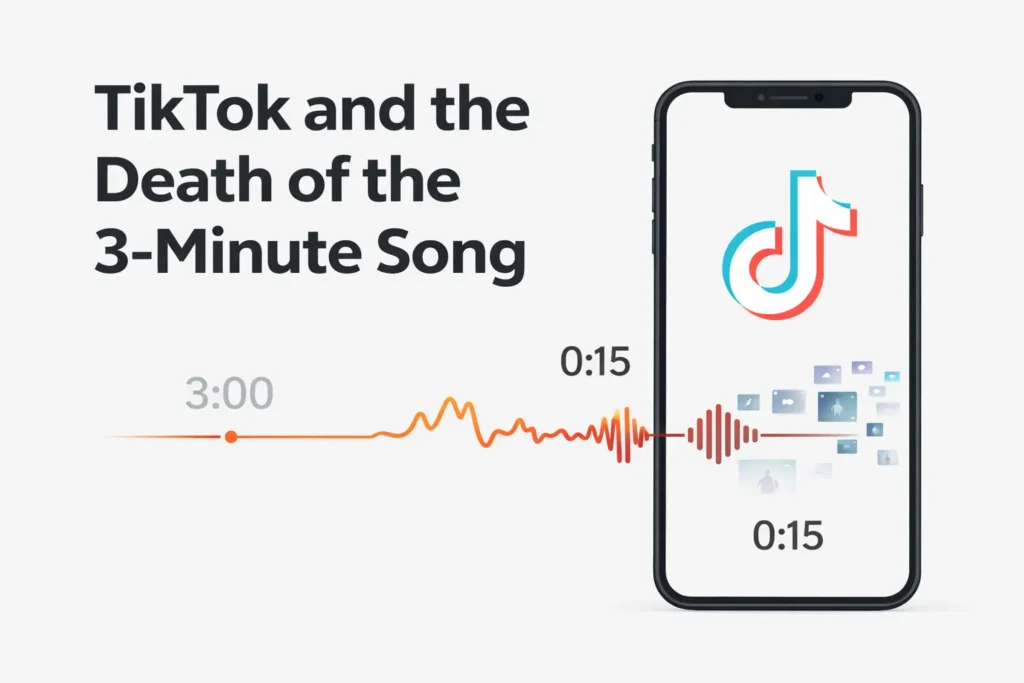
That doesn’t mean algorithms are destroying music. They have made discovery dramatically easier and have created opportunities for independent artists that would have been difficult to imagine decades ago.
But the consumption model is different.
A short video may introduce you to a 15-second hook. A streaming recommendation may immediately play another song. An algorithm can continuously predict what you might want next.
Physical media asks a different question:
What do you want to listen to?
That distinction matters.
The resurgence of old music gear is therefore connected to something much larger than nostalgia. It is part of a growing desire to make some forms of entertainment intentional again.
Why Younger People Are Buying Equipment They Never Grew Up With
Perhaps the most surprising part of this movement is that you don’t have to be old enough to remember the golden age of hi-fi to appreciate it.
For someone who grew up with Spotify, a cassette deck isn’t obsolete technology. It is an unfamiliar object.
A 1970s receiver isn’t an outdated version of something they already own. It is a beautifully engineered machine from another era.
That makes vintage equipment particularly interesting to younger collectors. They are not necessarily trying to recreate their childhood. They are discovering a technological culture they never experienced firsthand.
Social media accelerates the process. A beautifully restored receiver, a stack of records and a turntable can become an aesthetic statement as easily as a listening system. The equipment fits into interiors, photography, collecting culture and personal identity.
But the people who stay with the hobby usually move beyond aesthetics.
They start listening.
They learn.
They compare cartridges and amplifiers. They discover different pressings. They visit record stores. They search for service manuals. They learn which vintage models are worth restoring and which ones are better left alone.
That’s when the trend becomes a genuine hobby.
Old Music Gear Also Offers Something Modern Products Often Don’t: Repairability
Perhaps the strongest practical argument for vintage equipment is repairability.
A good piece of vintage audio equipment can often be opened, diagnosed, serviced and repaired. Components can be replaced. Switches can be cleaned. Belts can be changed. Connections can be repaired. Wooden cases can be refinished.
That doesn’t mean every vintage product is easy to repair. Some are extremely complex, and replacement parts can be difficult to find. Some equipment may have suffered decades of abuse, poor modifications or improper servicing.
But the philosophy is different.
The expectation was often that the machine would be serviced.
Modern electronics increasingly move in the opposite direction. Miniaturization, integrated components, proprietary parts and sealed construction can make repair difficult or uneconomical.
Vintage equipment reminds us of a different industrial philosophy: build the machine so someone can keep it alive.
That is an increasingly attractive idea.
But Buying Old Music Gear Requires More Knowledge Than Buying New
The growing popularity of vintage equipment also creates a serious problem for newcomers: the market can be full of misinformation.
A seller may describe a receiver as “fully working” when only the basic functions have been tested. A turntable may look immaculate but have worn bearings or a problematic motor. A cassette deck may play a tape while having poor transport performance. An amplifier may power on while still requiring significant electronic servicing.
Collectors therefore need to distinguish between vintage, serviced, restored and simply old.
Those words do not mean the same thing.
A clean faceplate does not prove an amplifier has been serviced. A new belt does not constitute a complete restoration. A replacement cartridge doesn’t make a 50-year-old turntable mechanically perfect.
The smartest vintage buyers research the exact model, understand common failure points, check service history and, where possible, test the equipment properly before buying it.
The objective isn’t to buy the oldest machine.
It is to buy the right machine.
The Best Vintage Equipment Isn’t Necessarily the Most Expensive
Another misconception is that vintage audio is automatically an expensive audiophile hobby.
It can certainly become expensive. Rare turntables, historically significant amplifiers and exceptionally preserved examples can command serious prices.
But the appeal of old music gear is much broader.
Some of the most enjoyable equipment was never considered luxury equipment when it was new. Its current appeal comes from durability, design, performance and the fact that enough examples survived to create a community around them.
That is why the vintage market can be so fascinating.
A collector can spend months searching for a particular receiver, find one with cosmetic damage, negotiate a reasonable price, have it professionally serviced and end up with a remarkable listening system that feels completely different from buying a new product from a showroom.
There is discovery involved.
There is risk.
There is research.
And there is the satisfaction of finding something that other people overlooked.
This Isn’t a War Between Analog and Digital
The mistake would be to turn this into another “vinyl versus streaming” argument.
There is no need to.
Streaming is brilliant at what it does. It is the ultimate discovery tool and the easiest way to access music. Vinyl offers physical ownership and ritual. Cassette offers intimacy and collectability. Vintage amplifiers and receivers provide mechanical interaction and character. Modern digital equipment provides convenience, accuracy and flexibility.
The future doesn’t have to choose one.
In fact, the most interesting music systems increasingly combine them.
A listener can discover an artist on Spotify, buy the album on vinyl, play it through a 1970s receiver and use a modern digital source for everything else. There is no contradiction in that system.
The technologies can coexist because they solve different problems.
And that may explain why the old music gear revival feels different from previous nostalgia cycles.
People aren’t necessarily rejecting the future.
They are choosing what they want to carry forward from the past.
So, Why Is Everyone Buying Old Music Gear Again?
Because something changed in the way we experience technology.
For decades, the goal was to make technology smaller, faster, cheaper and more convenient. Music followed exactly the same trajectory. Vinyl became CDs. CDs became MP3s. MP3s became streaming. Physical collections became digital libraries.
Every step solved a genuine problem.
But somewhere along the way, something else disappeared: the feeling of owning the experience.
Vintage audio brings some of that back.
A receiver has a face. A turntable has a ritual. A cassette has a physical presence. A record collection takes up space. A restored amplifier can carry evidence of the people who owned it before you.
And perhaps most importantly, old music gear encourages you to slow down.
That is why the resurgence shouldn’t be dismissed as a fad.
The vinyl revival created the audience. The cassette revival proved that physical formats could become culturally relevant again. Streaming created unprecedented convenience. Restoration created a way for enthusiasts to preserve the machines. Collectors turned the equipment into objects of passion.
Now those worlds are converging.
The result is a new generation of listeners who don’t necessarily want to choose between old and new. They want both.
They will stream an album on the way to work, come home, pull a record from the shelf, switch on a 50-year-old receiver and spend the evening listening to music through equipment that was built long before they were born.
And maybe that’s the real reason old music gear is back.
It isn’t because people suddenly believe everything made in the past was better.
It is because, after years of making technology disappear into screens and subscriptions, people are rediscovering the pleasure of owning something they can see, touch, understand, repair and keep.
The machine is old.
The experience is timeless.
Related Articles on IMFounder
- The 10 Greatest Turntables of All Time
- Marantz Restoration — A Story of Music, Memory, and a 50-Year-Old Soul.
- Vinyl and Cassette Revival: Why Analog Music Is Spinning Back Into Our Lives
- How Artificial Intelligence Is Redefining Music Creation and Culture
- TikTok and the Death of the 3-Minute Song