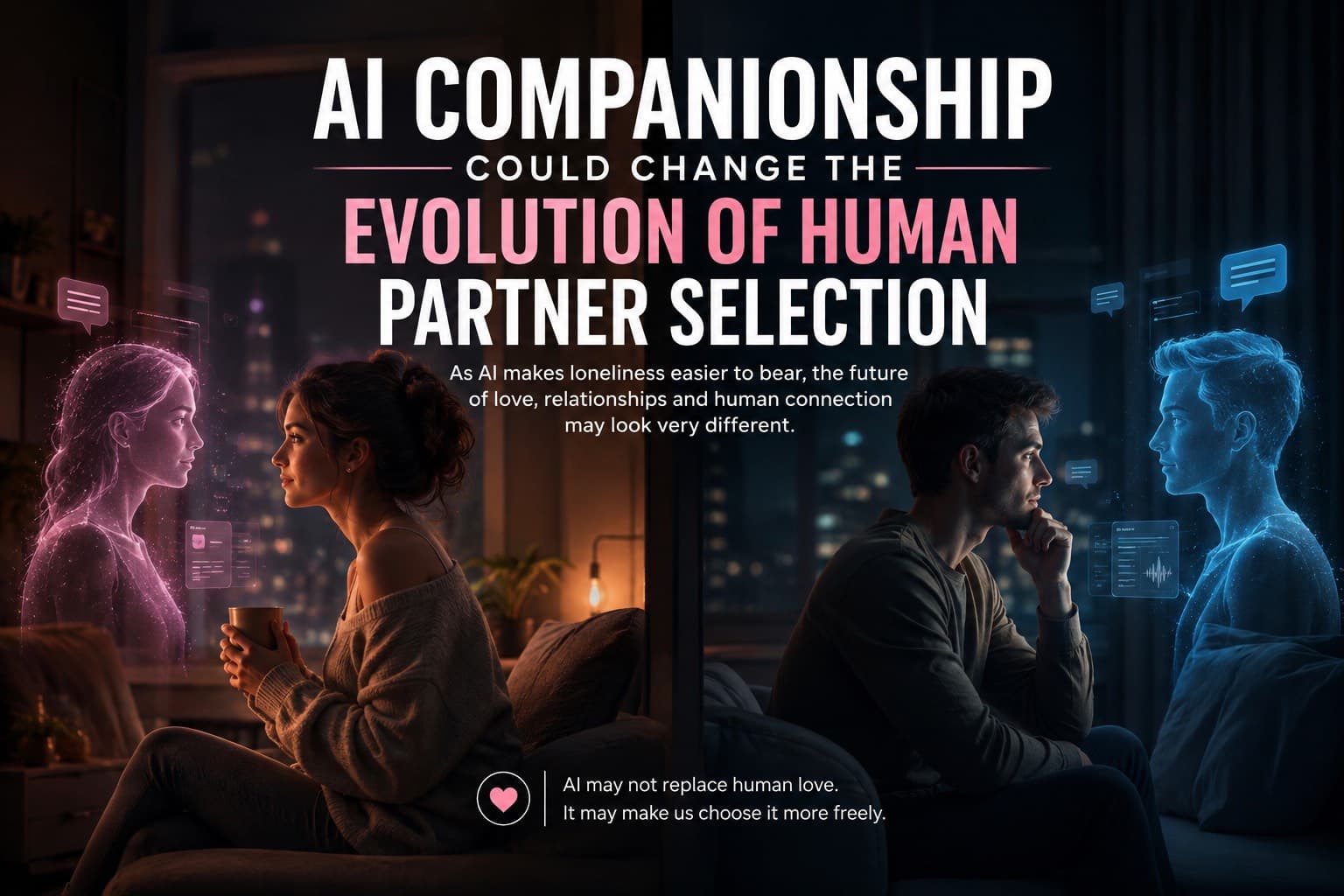

The Real Threat From AI Isn’t Artificial Love. It’s Making Bad Human Love Obsolete.
AI may not destroy human relationships. It could make loneliness less powerful, desperation less necessary and mediocre relationships considerably harder to justify.
For most of human history, romantic partnership was never simply about love. People partnered for protection, property, children, labor, financial security, social standing and access to resources. Marriage connected families and consolidated survival long before anyone expected one person to simultaneously become a lover, best friend, financial partner, co-parent, therapist and lifelong source of emotional fulfillment.
Modern society dismantled much of that economic dependency. Women gained greater financial autonomy, contraception separated sex from reproduction, divorce became more accessible, and technology dramatically expanded the pool of potential partners. Artificial intelligence may now be approaching one of the few dependencies that remains remarkably powerful: the emotional fear of being alone.
That possibility is considerably more interesting than another story about people dating chatbots.
AI companionship is developing into a parallel system of emotional support capable of providing conversation, reassurance, attention, memory and perceived intimacy without requiring another human being to provide it. If that sounds threatening, it is because we have spent years assuming loneliness is one of the forces that keeps humans moving toward one another. But loneliness is also one of the forces that keeps people choosing partners they do not actually want.
What happens to dating when being alone stops feeling like an emergency?
“The most important thing AI may remove from dating isn’t the human partner. It’s the fear of being alone.”
Loneliness Has Always Been Part of the Dating Market
Human beings are social animals, and social isolation has measurable consequences for psychological and physical health. That need for connection inevitably affects romantic decision-making. People remain in relationships they know are finished, return to partners they know are wrong for them, tolerate behavior they would otherwise reject and rush intimacy because beginning again feels worse than remaining where they are.
Artificial companionship introduces something unprecedented into that calculation because the machine can answer back.
A series of studies published in the Journal of Consumer Research found that interactions with AI companions could produce immediate reductions in loneliness, with some experiments finding effects comparable to interacting with another person. Feeling heard appeared to be an important mechanism behind the effect. The research does not establish AI as a substitute for human friendship or therapy, but it demonstrates something important: people can experience genuine social relief from interactions they know are artificial. Oxford Academic
Longer-term research is more complicated. Some studies have associated heavier social-chatbot use with greater emotional loneliness, while experiments comparing supportive chatbots with human interaction have found that artificial companionship does not consistently reproduce the psychological benefits of human connection. The scientific picture is therefore not that AI “cures loneliness.” It is that AI can apparently satisfy portions of the social experience while researchers are still determining where useful support ends and unhealthy substitution begins.
That distinction could become central to the future of dating. If AI can make periods of solitude less psychologically painful without convincing people to abandon human relationships entirely, individuals may begin choosing partners from a fundamentally different emotional position.
“If AI can make solitude less painful without making humans unnecessary, it could change who we choose when we’re no longer choosing someone simply to escape being alone.”
AI Could Become Emotional Rehabilitation
The most medically and socially interesting application of AI companionship may have very little to do with artificial boyfriends or girlfriends. It may function more like emotional rehabilitation.
Consider the millions of people re-entering the dating market after divorce, betrayal, abusive relationships, bereavement or years of isolation. Others have difficulty communicating boundaries, processing rejection or distinguishing healthy attraction from familiar dysfunction. Traditional advice tells these people to heal before dating again, but many interpersonal skills are difficult to develop without interaction.
AI creates the possibility of a low-stakes rehearsal environment.
Research presented at CHI 2026 found that users described AI companions as sources of emotional validation and social rehearsal, even as researchers cautioned about over-reliance and withdrawal from human relationships. That concept deserves considerably more attention than the spectacle of people falling in love with software.
An appropriately designed companion could help a person examine why a rejection produced disproportionate anger, rehearse a difficult conversation, recognize recurring relationship patterns or distinguish between setting a boundary and punishing another person. Someone could practice expressing a need without immediately placing another human being inside the emotional blast radius. CHI 2026 research on AI companionship
This is not psychotherapy, and consumer AI should not be confused with clinical mental-health treatment. But the underlying behavioral opportunity is significant. Technology already helps people practice languages, interviews, public speaking and professional negotiations. There is no obvious reason interpersonal communication should remain exempt.
“The healthiest AI companion may not be the one that makes you fall in love with it. It may be the one that teaches you how to stop confusing chaos with love.”
Could AI Cool the Gender War?
Modern dating has become remarkably adversarial. Women describe experiences with emotionally unavailable, unsafe or unserious men. Men describe feeling disposable, economically judged or unable to satisfy escalating expectations. Dating applications compress human beings into photographs, height, income, occupation, age and a handful of sentences, while social media monetizes whatever resentment follows when those interactions fail.
The result is an increasingly profitable gender conflict. Painful dates become content. Content becomes generalization. Generalization becomes ideology, and algorithms reward whichever interpretation generates the strongest emotional reaction. Millions of people then re-enter the dating market having consumed hours of content explaining why the opposite sex cannot be trusted.
AI could easily make this worse. A companion engineered primarily for engagement might endlessly validate a user’s grievances because agreement keeps the conversation pleasant. A man who believes all women are manipulative does not need an artificial companion confirming that worldview. Neither does a woman convinced every man is dangerous.
But properly designed systems could provide the opposite intervention. An AI companion could challenge distorted interpretations, interrupt escalation and create distance between emotional injury and impulsive action. It could help someone process rejection before retaliation, recognize that another person’s boundary is not an attack or understand that disagreement does not necessarily constitute disrespect.
There is currently no credible evidence demonstrating that AI companions broadly reduce aggression between men and women, and claiming otherwise would outrun the science. There is, however, evidence that these systems can provide emotional support and fulfill certain social needs. A 2026 systematic review covering 39 empirical studies found reported benefits including emotional support, personal development, adaptive functioning and social-needs fulfillment, alongside significant risks involving dependency, displacement of human relationships, compulsive use and commercial exploitation. Science Direct
The design question therefore matters enormously. AI companionship could become another machine optimized to keep angry people angry, or it could become a pressure valve that helps people regulate emotion before returning to human interaction.
“AI could become either gasoline for the gender war or a pressure valve for it. The difference will be what these systems are designed to reward.”
Partner Selection Changes When Nobody Has to Participate
This is where artificial companionship could begin influencing human partner selection itself.
Someone who feels socially starved enters dating differently from someone whose emotional baseline is reasonably secure. The first person may primarily ask whether someone will choose them. The second has the psychological room to ask whether they actually choose that person.
If artificial companionship can satisfy even a modest portion of someone’s need for conversation, reassurance and acknowledgment, walking away from an unsuitable relationship becomes less frightening. Women may become less willing to tolerate men they do not respect. Men may become less willing to pursue women who demonstrate no reciprocal interest. Rejection may become less catastrophic because romantic attention is no longer carrying the entire burden of emotional connection.
Paradoxically, that could make the distinctly human parts of relationships more valuable.
AI can generate conversation, compliments and reassurance. What it cannot genuinely reproduce is a shared physical life between two autonomous people: touch, sacrifice, sex, family, mutual responsibility, spontaneous adventure, conflict followed by genuine repair, caring for someone when it is inconvenient and watching another human being change across decades.
If artificial companionship makes simulated affection abundant, commitment may become more valuable precisely because it cannot be generated on demand.
“When affection becomes abundant, commitment may become more valuable—not less.”
Marriage, Motherhood and the Freedom to Say No
The demographic implications are more complicated.
There is currently no credible evidence establishing that AI companionship is causing women to remain childless, and declining fertility across developed economies began long before generative AI. Housing costs, childcare, delayed marriage, economic insecurity, education, contraception, changing gender roles and individual preference all play significant roles.
AI is nevertheless arriving inside an existing transformation in how women approach partnership and motherhood.
If companionship becomes available without partnership, one traditional incentive for entering or remaining in a relationship becomes weaker. Some people may partner later. Others may become more selective. Some may decide they never wanted marriage. Some women who previously might have compromised heavily to secure both partnership and motherhood may decide that motherhood without the right partner—or no motherhood at all—is preferable.
That does not mean AI is convincing women not to reproduce. It means technology could make an independent life emotionally easier to sustain.
The demographic consequence, if one develops, may therefore be indirect. Artificial companionship could alter the cost-benefit calculation surrounding unsuitable relationships. A woman who does not experience being single as emotional deprivation has less reason to accept a partnership simply because the alternative is loneliness. The same logic applies to men.
This may reduce the number of relationships formed from scarcity while increasing the standards required for relationships formed voluntarily.
“AI doesn’t have to convince women not to have children. It only has to make a life without an unsatisfying relationship feel less like a failure.”
Technology May Raise the Price of Admission to Human Love
Most discussions of AI companionship begin with an assumption that if machines become emotionally satisfying, human intimacy loses.
That conclusion may be backwards.
Perhaps mediocre intimacy loses.
Perhaps relationships maintained primarily through fear of loneliness lose. Perhaps manipulation, emotional withholding and artificial scarcity become less effective dating strategies when attention itself is no longer scarce.
That would force human relationships toward the things machines cannot genuinely provide.
An AI can simulate unconditional positive regard with remarkable consistency. Human unconditional love is fundamentally different because it comes from someone with independent desires, needs and agency. Another human being can disagree, disappoint, leave and choose a completely different life. When that person remains, forgives, compromises and repeatedly chooses the relationship anyway, the choice has meaning precisely because it was never guaranteed.
AI cannot manufacture that meaning.
It may help expose it.
“The machine can give you unconditional attention. Only another free human being can give you unconditional love.”
The most constructive future for AI companionship may therefore have little to do with replacing husbands, wives, girlfriends or boyfriends. It could become an emotional bridge between human relationships: a place to recover after heartbreak, practice communication, process rejection, recognize unhealthy patterns and experience companionship during periods of isolation without immediately seeking another person to fill the silence.
That could change the evolutionary dynamics of partner selection in ways we are only beginning to understand. Humans have historically chosen mates while carrying powerful biological, economic and social incentives against remaining alone. Technology has already weakened many of the economic incentives. AI may begin weakening the emotional ones.
The result could be fewer relationships entered from desperation, later marriages, more selective partnering and, at the margins, more people choosing childlessness. But it could also produce something considerably more optimistic: healthier relationships among the people who continue choosing them.
Partnership would become less about escaping solitude and more about finding another person whose presence genuinely improves a life that was already emotionally sustainable.
That is not the death of romance.
It may be a higher standard for it.
For thousands of years, humans have pursued companionship partly because being alone carried enormous economic, social and emotional costs. Artificial intelligence may be the first technology capable of reducing that final cost without necessarily removing the human desire for connection.
We built AI companions because technology companies recognized that loneliness was a market.
What we may have accidentally built is something more consequential: a tool capable of giving people enough security to stop choosing relationships out of fear.
And if that happens, AI will not have replaced human love.
It may have finally forced us to choose it freely.
Related Articles on IMFounder
- The Truth About AI Girlfriends & Digital Companionship
- A.I. Social Media Accounts Are Growing Faster Than Humans And It’s Changing Everything
- Humanized Robots Companies Leading The Humanoid AI Race
- Sophie Rain, OnlyFans, and the $40 Million Question
- Gen Z’s Attention Span Crisis Is Reshaping How Startups Build Products
- Why Attention Is More Valuable Than Money
- 16 Countries Banning Kids From Social Media in 2026
- Gen Z’s Attention Span Crisis Is Reshaping How Startups Build Products