
Canada’s immigration system is undergoing a structural reset as of December 2025. For founders, startup teams, and global entrepreneurs, immigration is no longer just a legal formality — it is a strategic risk factor that directly affects timelines, capital planning, and go-to-market execution.
Several of these shifts were already anticipated earlier this year. In particular, ImFounder’s in-depth breakdown of Canada’s 2025–2026 immigration trends highlighted how political pressure, housing shortages, and public backlash are reshaping IRCC priorities. Those warnings are now materializing in real-world delays and tightened pathways.
1. Startup Visa (SUV): A Program in Structural Backlog
Canada’s Startup Visa (SUV) was designed to attract innovative founders, but by late 2025 it has become one of the most backlogged economic immigration programs in the country.
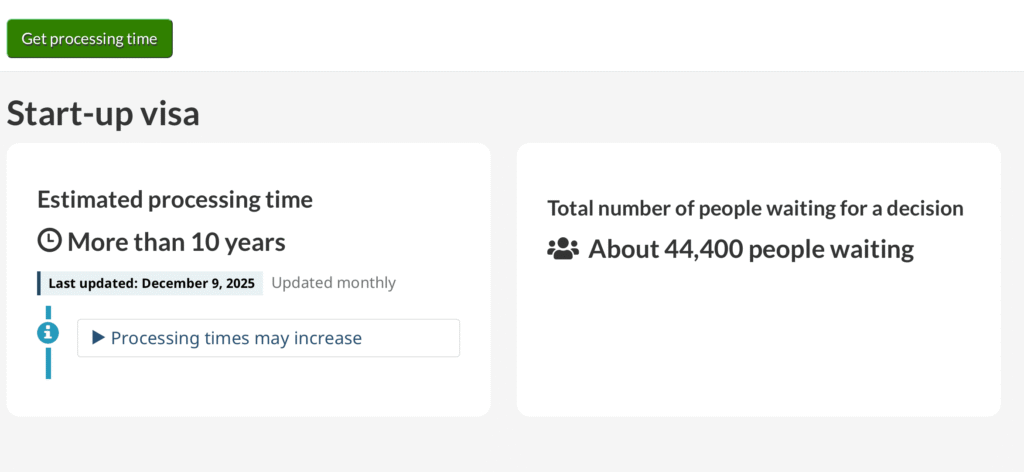
As documented in ImFounder’s analysis of Canada’s startup visa delays and the growing entrepreneur crisis, the SUV inventory has grown far beyond IRCC’s annual processing capacity. Founders applying today are realistically facing waiting timelines exceeding 8–10 years, with some estimates placing full resolution well beyond a decade unless intake caps or processing capacity change.
This means the SUV is no longer a viable “entry strategy” for founders who need to build, hire, and operate in Canada within a predictable timeframe. For most early-stage and growth-stage startups, SUV should be treated as a long-term PR lottery, not an operational pathway.
2. Work Permits From Outside Canada: Timelines Have Increased
With SUV timelines effectively unusable, many founders rely on work permits from outside Canada. However, these timelines have also lengthened in 2025.
As of December 2025, average IRCC processing times are approximately:
- India: 9–11 weeks
- China: 10–12 weeks
- Nigeria: 7–9 weeks
- United States: 6–8 weeks
These timelines apply only after documentation is complete. Any LMIA involvement, additional security screening, or compliance review can push total wait time well beyond three months.
This reality aligns with the broader labour-market recalibration described in our coverage of the future of work in Canada, AI adoption, remote roles, and IRCC policy alignment, where Canada is increasingly selective about whoenters and why.
3. Inside-Canada Applications Are Even Slower
Many founders assume arriving in Canada first (on a visitor or study permit) and then switching status will be faster. In 2025, the opposite is often true.
- Work permit applications filed inside Canada are now taking 6–8 months (180–220+ days) on average.
- This delay is driven by internal prioritization rules, compliance reviews, and backlog redistribution inside IRCC.
For startups operating on runway and milestones, this delay can be financially fatal if not planned correctly.
4. Immigration Policy Is Now Politically Charged
Immigration in Canada is no longer a purely economic discussion. It is now deeply political.
As outlined in our reporting on anti-immigration protests and rising public pressure in Canada, IRCC policy is increasingly influenced by voter sentiment around housing shortages, healthcare strain, and wage suppression.
For founders, this means:
- Fewer “leniency windows”
- More document scrutiny
- Slower discretionary approvals
- Less tolerance for speculative or low-impact business cases
Canada still wants founders — but only those who clearly demonstrate economic value.
5. What Founders Should Do Now (Practical Strategy)
Given December 2025 realities, founders should recalibrate expectations:
Do NOT:
- Rely solely on the Startup Visa for timely entry
- Assume historical processing times still apply
- Build hiring plans around optimistic IRCC estimates
DO:
- Treat SUV as a long-term PR option, not an entry mechanism
- Use outside-Canada work permits where possible
- Build buffer time (3–6 months) into immigration planning
- Align business cases tightly with Canada’s labour priorities
- Work with immigration professionals who understand post-2024 IRCC behavior, not legacy rules
Final Perspective
Canada remains one of the world’s most attractive destinations for founders — but the system is no longer forgiving, fast, or founder-friendly by default.
As consistently highlighted across our’s immigration and policy coverage, the winners in this environment are not just innovative entrepreneurs, but those who plan immigration as a core business risk, not an afterthought.