



Massive Outage Shocks Berlin: What Happened?
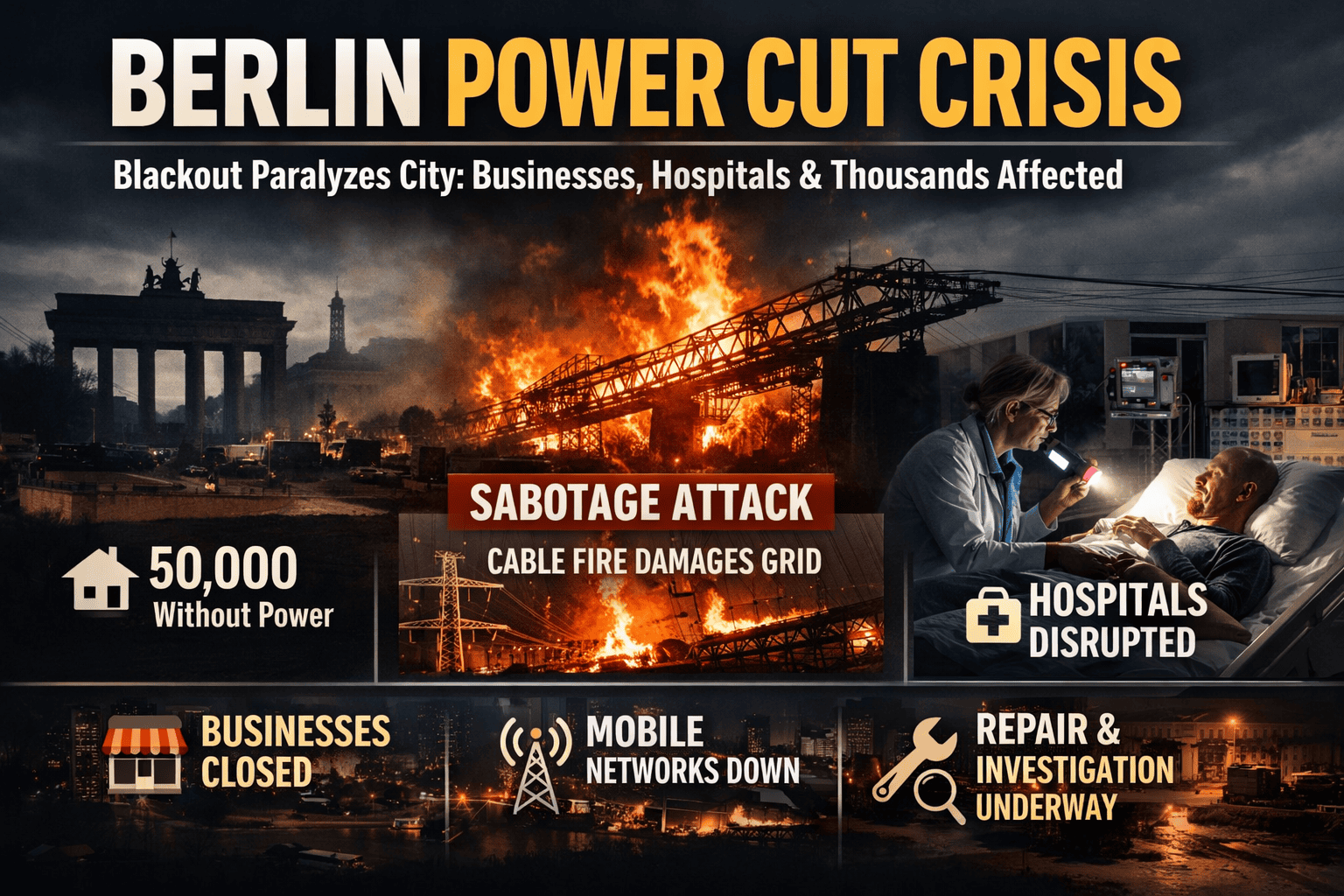
A major power outage has struck Berlin’s southwest districts, leaving tens of thousands without electricity and disrupting everyday life across the German capital. The incident originated in the early hours of January 3, 2026, when a fire severely damaged high-voltage cables on a key cable bridge near the Lichterfelde power plant. The blaze caused critical components of the city’s electrical grid to fail, resulting in widespread blackout conditions affecting households, businesses, hospitals, communication networks and essential services across Nikolassee, Zehlendorf, Wannsee and Lichterfelde. ANSA.it+1
Local police and state security services are investigating the fire as a suspected act of arson. Authorities have identified the involvement of a far-left extremist group known as the Vulkangruppe, which has reportedly claimed responsibility for the incident. Investigators deem the claim credible, noting the group’s history of politically motivated sabotage in Berlin’s energy infrastructure. heise online+1
The Technical Cause of the Outage
The disruption stemmed from significant damage to multiple high-voltage and medium-voltage cables, which are fundamental to transmitting electricity through Berlin’s grid. These cables were installed on a bridge over the Teltow Canal and are part of the network feeding power and district heating systems throughout the affected districts.
- Five high-voltage cables and ten medium-voltage lines were damaged when incendiary devices were detonated beneath them, according to official briefings.
- The fire and resulting heat severely compromised the structural integrity of the conductors, making normal operation impossible.
- Repair and reconnection are complex, requiring highly skilled technicians and specialized methods, particularly amid sub-zero weather that can hamper excavation and trenching work. heise online
Immediate Impact: Households, Businesses, and Public Services
The outage has had cascading effects across multiple sectors of daily life:
Households and Individuals
- Up to 50,000 households initially lost power, with estimates indicating that some could remain without electricity until January 8 or beyond as repair efforts continue. Energy Connects
- Loss of electricity also meant loss of heating and hot water, crucial in sub-zero winter conditions.
- Mobile signal and internet connectivity faltered in several neighborhoods, causing communication challenges for residents.
- Schools and community services have suspended operations, prolonging the disruption. en.haberler.com
Business and Commercial Impact
- More than 2,000 businesses were left without power, forcing closures of retail stores, cafés, restaurants, and service outlets during what is normally a busy post-holiday period. ANSA.it
- Retailers and SMEs are facing significant revenue losses as consumer footfall drops and systems fail.
- Prolonged outages have strained supply chains and inventory systems, particularly for businesses dependent on real-time digital operations.
- Local business associations have projected millions of euros in damages due to closed operations and lost productivity. Energy Connects
Hospitals, Healthcare Facilities, and Emergency Services
- Several care facilities and hospitals in the affected regions had to rely on backup generators, which were strained in their capacity to maintain full operations.
- Some patients were relocated or had non-critical procedures postponed for safety reasons.
- Emergency response units reported temporary communication interruptions, compelling the use of alternative contact points and field communications. Sky News
Telecommunications and Transport Disruptions
- Mobile networks experienced reduced coverage in parts of the blackout zone, affecting phone calls, data usage, and emergency alerts.
- Public transport systems, including S-Bahn and tram services, saw delays and operational interruptions due to signal failures and loss of power at stations and intersections.
How Officials Are Responding: Restoration, Safety and Prevention
Berlin authorities, supported by the federal government, have taken a multi-pronged approach to restoring services and protecting residents:
Power Restoration Strategy
- Stromnetz Berlin technicians are working around the clock to repair and bypass damaged cables.
- Temporary solutions aim to restore basic power to the majority of households before full infrastructure repairs are complete.
- Grid operators and emergency planners have estimated that full restoration could take several days to a week, depending on weather and logistical constraints. Energy Connects
Emergency Support and Public Safety
- Berlin has mobilized support from the Bundeswehr (German armed forces) to assist in logistics, heating, and food distribution as needed. DIE WELT
- Emergency shelters have been set up to provide warmth, charging stations, and critical information for affected residents.
- Public advisories have encouraged prudent use of mobile devices and cooperation with emergency responders.
Criminal and Security Response
- The Berlin Senate has classified the act as a severe infrastructure attack. Law enforcement agencies, including state and federal security services, are investigating the Vulkangruppe’s alleged role in the incident.
- Increased patrols and surveillance measures have been implemented to deter further sabotage attempts and protect critical infrastructure. heise online
Looking Ahead: Infrastructure Hardening
Longer-term plans are already under discussion to improve Berlin’s resilience:
- Investment in underground power infrastructure to reduce vulnerability to above-ground attacks and weather impacts.
- Grid modernization, including automation and distributed energy resources to isolate faults and maintain supply during localized disruptions.
- Collaboration between government, utilities, and private sector partners on rapid response protocols and redundancy measures to minimize future impact.
Conclusion: A Challenging Test for Berlin’s Infrastructure
The Berlin power cut triggered by suspected arson has underscored the vulnerability of modern urban infrastructures to deliberate attacks. Tens of thousands of residents have endured loss of power, heating and connectivity at a critical time of year, while businesses and essential services face economic and operational strain. Efforts to restore electricity and enhance future resilience are well underway, combining technical, security and emergency response strategies.
Berlin’s experience serves as a case study in how cities must balance infrastructure innovation with robust contingency planning to withstand both natural and human-induced crises.




[…] Elektrische Rolltore bleiben zu, Alarmanlagen fallen aus. […]