


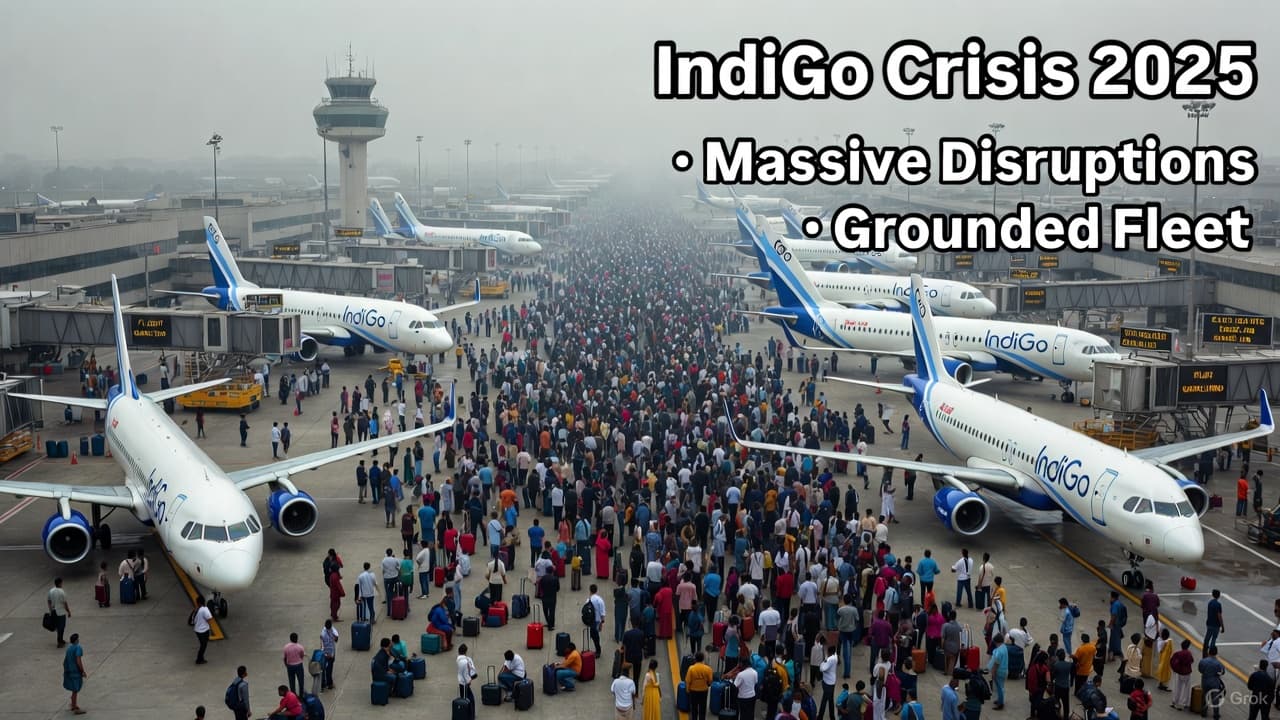

In early December 2025, India’s largest airline, IndiGo, plunged into one of the most severe operational crises in its history, leading to widespread chaos at airports nationwide. What began as a failure to adequately prepare for new regulatory changes escalated into thousands of flight cancellations, stranding passengers and disrupting travel during a peak season. This event, often referred to as the “IndiGo chaos,” highlighted vulnerabilities in India’s aviation sector, dominated by IndiGo with a 65% market share. Critics have questioned the government’s handling, accusing it of leniency toward powerful corporates, while the fallout raises concerns about potential indirect effects on international aviation, including in Canada and the United States.
What Happened: The Nationwide Disruption
The crisis unfolded starting December 2, 2025, when IndiGo began cancelling hundreds of flights daily due to a combination of internal planning failures and external factors. Airports across India, including major hubs like Delhi’s Indira Gandhi International, Mumbai, Bengaluru’s Kempegowda International, Hyderabad, Chennai, Ahmedabad, and Thiruvananthapuram, descended into mayhem. Passengers faced long queues, delayed baggage, and sudden cancellations, with social media flooded with complaints under hashtags like #IndiGoCrisis and #FlightCancellations.
Scenes included clashes between frustrated travelers and ground staff, with some passengers missing weddings, business meetings, and family events. In one notable case, a newlywed couple from Bengaluru was stranded in Bhubaneswar and had to attend their reception virtually via Zoom. The airline urged passengers to check flight statuses online, but many reported last-minute changes and inadequate support.
By December 9, operations began stabilizing, with IndiGo reporting 91% on-time performance and operating over 1,800 flights. However, the airline warned of ongoing disruptions, with full recovery expected by February 10, 2026.
Causes of the Crisis
The primary trigger was IndiGo’s inadequate preparation for the Directorate General of Civil Aviation’s (DGCA) revised Flight Duty Time Limitations (FDTL) rules, aimed at reducing pilot fatigue. These rules, announced in January 2024 and implemented in phases (July and November 2025), included:
- Increasing mandatory weekly rest for pilots from 12 to 48 hours.
- Limiting night-time landings to two per week (down from six).
- Extending the “night duty” definition from midnight-5 a.m. to midnight-6 a.m.
- Requiring quarterly fatigue reports and capping consecutive flying hours at 14 (up from 12 in a prior revision).
IndiGo, operating over 2,200 daily flights—twice that of competitor Air India—failed to adjust rosters despite 18 months’ notice. Compounding factors included a hiring freeze, pilot pay freeze, non-poaching agreements with rivals, adverse weather, airport congestion, and minor technology glitches. Experts, including the Federation of Indian Pilots and aviation safety specialist Captain Amit Singh, labeled it “wilful negligence” and a “strategic mistake.” The airline’s on-time performance plummeted to around 10% at one point.
Statistics and Data: Quantifying the Impact
The scale of the disruption was unprecedented:
- Total cancellations: Nearly 5,000 flights since the crisis began, with over 2,000 in the first week alone.
- Daily breakdowns: Over 1,000 cancellations on peak days; 400+ on December 9 (including 152 in Delhi, 121 in Bengaluru, 58 in Hyderabad); 500+ on December 8.
- Passenger impact: Over 40,000 affected at Mumbai airport alone (December 1-8), with 2.66 lakh facing delays; thousands stranded nationwide.
- Operational stats: IndiGo flew only 59,438 of 64,346 approved flights in November; on-time performance improved from 75% (December 8) to 90% (December 9).
- Economic toll: Refunds exceeded ₹750 crore; over 8,500 stranded bags processed, with 800 pending; IndiGo’s shares dropped nearly 17% in eight days, impacting parent company InterGlobe Aviation (valued at $23 billion).
- Market context: India’s domestic aviation carried 165 million passengers in 2025, projected to double by 2030; IndiGo holds 65% share, making it “too big to fail.”
These figures underscore the crisis’s breadth, affecting 138 destinations and prompting special trains for stranded passengers.
Government Response: Actions Taken
The Indian government, through the Ministry of Civil Aviation and DGCA, responded swiftly but faced scrutiny for its approach. Key actions included:
- Ordering a 10% cut in IndiGo’s winter schedule (from 2,200 to about 1,900 daily flights), doubling an initial 5% directive, to ensure resource management.
- Imposing fare caps to prevent price gouging amid surging demand.
- Issuing show-cause notices to CEO Pieter Elbers and senior officials, demanding explanations by December 8; threatening penalties, suspensions, and even sacking leadership.
- Granting temporary exemptions: Withdrawing certain FDTL provisions (e.g., no substitution of rest for leave) and exempting night flights until February 10, 2026.
- Mandating full refunds by December 7 (over ₹827 crore processed) and deploying oversight teams at 11 airports for inspections.
- Launching a high-level inquiry and enforcement investigation; Minister Ram Mohan Naidu blamed IndiGo’s “internal mess” and vowed “very, very strict action” to set an example.
The government also probed why IndiGo’s international operations remained stable amid domestic collapse, suggesting resource prioritization. Opposition parties demanded parliamentary statements, leading to walkouts.
Why the Perception of Government Inaction and Deference to Corporates?
Despite these measures, critics argue the government has “bowed down” to corporates like IndiGo. Opposition leaders, including Congress MPs KC Venugopal and Gaurav Gogoi, accused the regime of shifting blame to the airline while ignoring DGCA’s role in enabling a duopoly (IndiGo and Air India control over 90% of the market post-Jet Airways and GoAir bankruptcies). The exemptions and rule rollbacks are seen as a “U-turn” favoring IndiGo’s pleas for leniency, potentially compromising pilot safety.
Experts note the government’s delayed FDTL implementation (postponed from June) allowed the crisis to brew, and its finger-pointing ignores systemic issues like monopolistic risks. Comedian Abijit Ganguly and social media users called it “collateral damage” in a sector where IndiGo’s dominance was unchecked. The Delhi High Court questioned the economic losses and unfair fare hikes by rivals, urging systemic fixes. However, Minister Naidu defended the rules, stating IndiGo flagged no issues beforehand and calling for more airlines to break the duopoly.
Potential Impact on Canada and the United States
While IndiGo’s operations are primarily domestic and short-haul international (to over 30 destinations in Asia, the Middle East, and Europe, like Istanbul), the crisis has limited direct effects on North America. IndiGo does not operate transatlantic flights to Canada or the USA. However, indirect ripples could emerge through global aviation networks.
Passengers connecting via IndiGo’s international routes (e.g., codeshares with Turkish Airlines or Qantas) might face delays in reaching hubs for onward flights to North America. The crisis exposes fragility in low-cost models, potentially influencing regulators in Canada and the USA—where similar fatigue rules exist under bodies like Transport Canada and the FAA—to review enforcement, especially amid pilot shortages. Financially, IndiGo’s share plunge could dent investor confidence in global aviation stocks, including those tied to Airbus (IndiGo’s major customer).
In the USA, where IndiGo has no direct presence, the event might prompt scrutiny of airline monopolies, drawing parallels to domestic issues. For Canada, minimal impact was noted in past global outages (e.g., July 2024 Microsoft incident at Calgary airport), but this could spur calls for diversified partnerships. Overall, the crisis serves as a case study for international aviation resilience, with no reported widespread disruptions in North America as of December 11, 2025.
Conclusion
The IndiGo crisis of December 2025 revealed deep-seated issues in India’s aviation sector, from regulatory compliance to market concentration. While the government has imposed penalties and reforms, perceptions of corporate favoritism persist amid calls for greater competition. Globally, it underscores the need for robust planning in an interconnected industry, with potential lessons for Canada and the USA to mitigate similar risks. As IndiGo hires external experts for a root-cause analysis and offers ₹10,000 vouchers to severely affected passengers, the focus shifts to preventing future meltdowns.


