
What Official Government Data Confirms — and What Comes From Independent Analysis
Claims circulating online suggest that more than 23,000 Canadians died while on medical wait-lists in a single year. The figure has sparked intense debate about Canada’s healthcare system — but it also raises a critical question:
What does official Canadian government data actually confirm, and what comes from non-government sources?
This article separates verified government reporting from independent estimates, so readers can understand the facts without confusion or exaggeration.
What Official Canadian Government Data Confirms
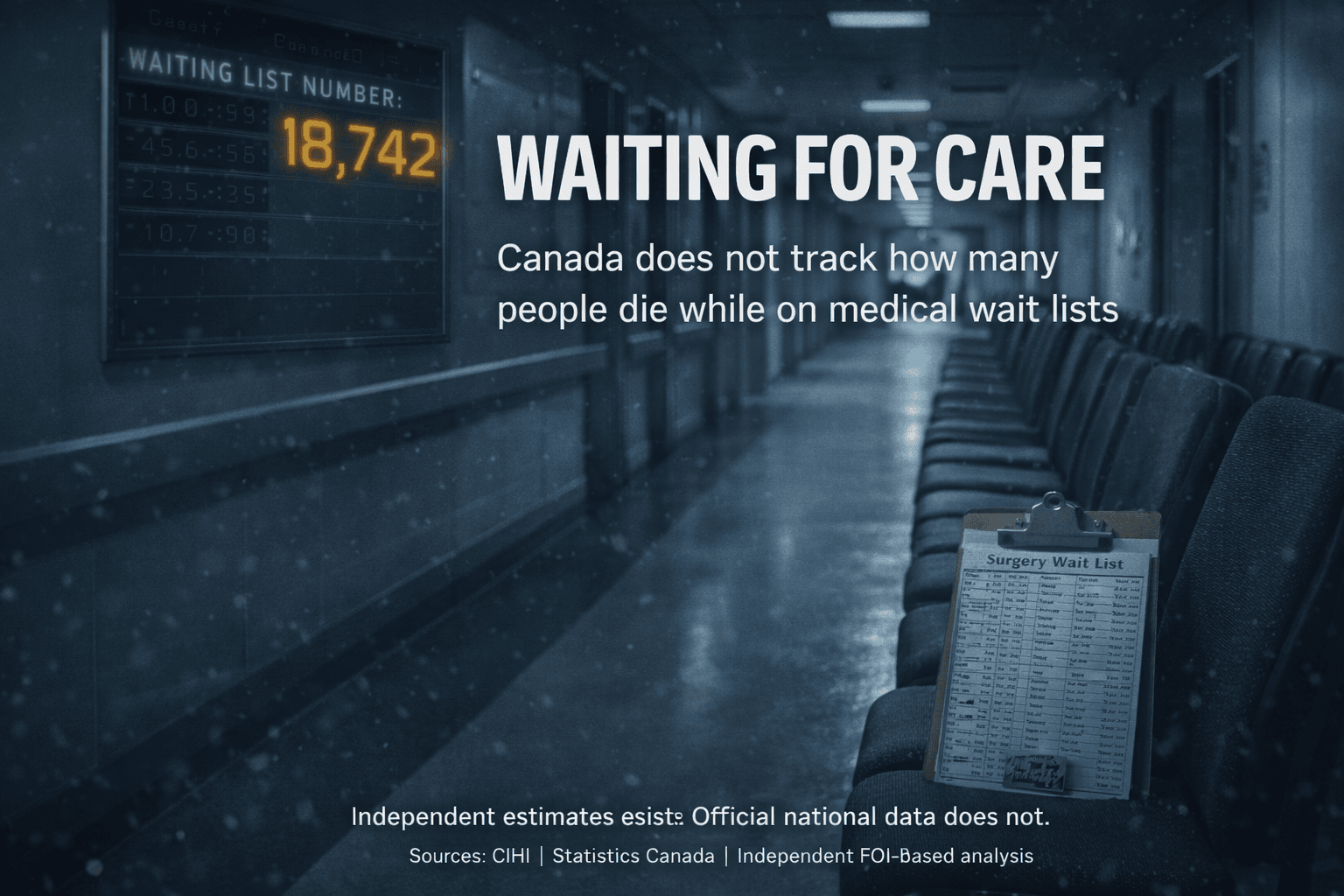
1. Canada does not publish a national statistic for “wait-list deaths”
There is no official federal dataset from:
- Statistics Canada
- Health Canada
- Canadian Institute for Health Information (CIHI)
that reports how many people died while waiting for surgery or diagnostic procedures.
This is a crucial point.
Statistics Canada tracks:
- Total deaths per year
- Causes of death
- Age-adjusted mortality rates
But death records do not include a field for “was the patient on a wait list”.
As a result, no official Canadian government body publishes a national number of deaths occurring while patients were awaiting care.
2. What CIHI does officially report
CIHI, a federally funded health data agency, publishes:
- Median wait times for priority procedures (hip replacement, cataract surgery, cancer care)
- Hospital performance indicators
- Post-surgical mortality (e.g., death within 30 days after surgery)
However:
- CIHI does not track deaths before treatment
- CIHI does not publish wait-list mortality totals
- CIHI explicitly distinguishes access metrics from mortality metrics
In short, official government reporting confirms long wait times — but not wait-list deaths.
3. An exception: organ transplant wait-lists
There is one limited area where official data exists.
CIHI publishes confirmed deaths of patients waiting for organ transplants (kidney, liver, heart, lung).
These numbers are:
- Official
- Verified
- Narrow in scope
However, they do not apply to general surgeries or diagnostic procedures, and therefore cannot be used to generalize the healthcare system as a whole.
Where the “23,000+ deaths” Figure Comes From
Independent analysis — not an official government statistic
The widely cited figure of 23,000+ deaths originates from SecondStreet.org, a Canadian public policy think tank.
SecondStreet:
- Filed Freedom of Information (FOI) requests to provincial health ministries
- Collected administrative data from provincial wait-list systems
- Aggregated responses from provinces that provided data
According to SecondStreet’s analysis:
- At least ~23,700 patients died while listed for surgery or diagnostics in the most recent fiscal year analyzed
- Ontario, Quebec, and British Columbia reported the highest raw numbers
- Several provinces did not provide data or provided incomplete records
Important methodological clarification
SecondStreet explicitly states that:
- The data represents people who died while registered on a wait list
- It does not prove causation
- Deaths may have occurred for unrelated reasons
For example:
- A patient waiting for a knee replacement who dies from an unrelated illness is still counted
- The data does not confirm that delayed care caused the death
This distinction is critical and often lost in social media summaries.
Why Official Government Data Is Missing
Canada’s healthcare system is:
- Provincially administered
- Fragmented in data standards
- Not required to centrally track wait-list mortality
There is:
- No federal mandate
- No standardized national reporting framework
- No requirement to publicly disclose deaths occurring during wait-listed status
As a result:
- Government agencies can confirm wait times
- They can confirm overall deaths
- But they cannot officially confirm how many deaths occurred while waiting
What Can Be Stated Responsibly
Based on verified sources:
✅ Confirmed by government data
- Canada has long surgical and diagnostic wait times
- Mortality data exists at a national level
- Organ transplant wait-list deaths are officially tracked
⚠️ Based on independent analysis
- The “23,000+ deaths” figure comes from FOI-based provincial data
- It is not an official federal statistic
- It counts deaths during wait-listed status, not deaths caused by waiting
Conclusion
There is no official Canadian government number confirming that 23,000 Canadians died because they were waiting for medical care.
However, independent analysis using government-sourced provincial data suggests that tens of thousands of patients may have died while registered on wait lists — a finding that highlights significant gaps in transparency and health system reporting.
The lack of official national data does not disprove the problem — but it does underscore how limited public accountability and fragmented data collection make it difficult to measure the true human cost of delayed care.
Editorial note from IMFOUNDER
This article distinguishes between official government reporting and independent third-party analysis. Figures attributed to non-government sources are presented with appropriate context and methodological clarification. IMFOUNDER does not claim causal attribution unless confirmed by official authorities.