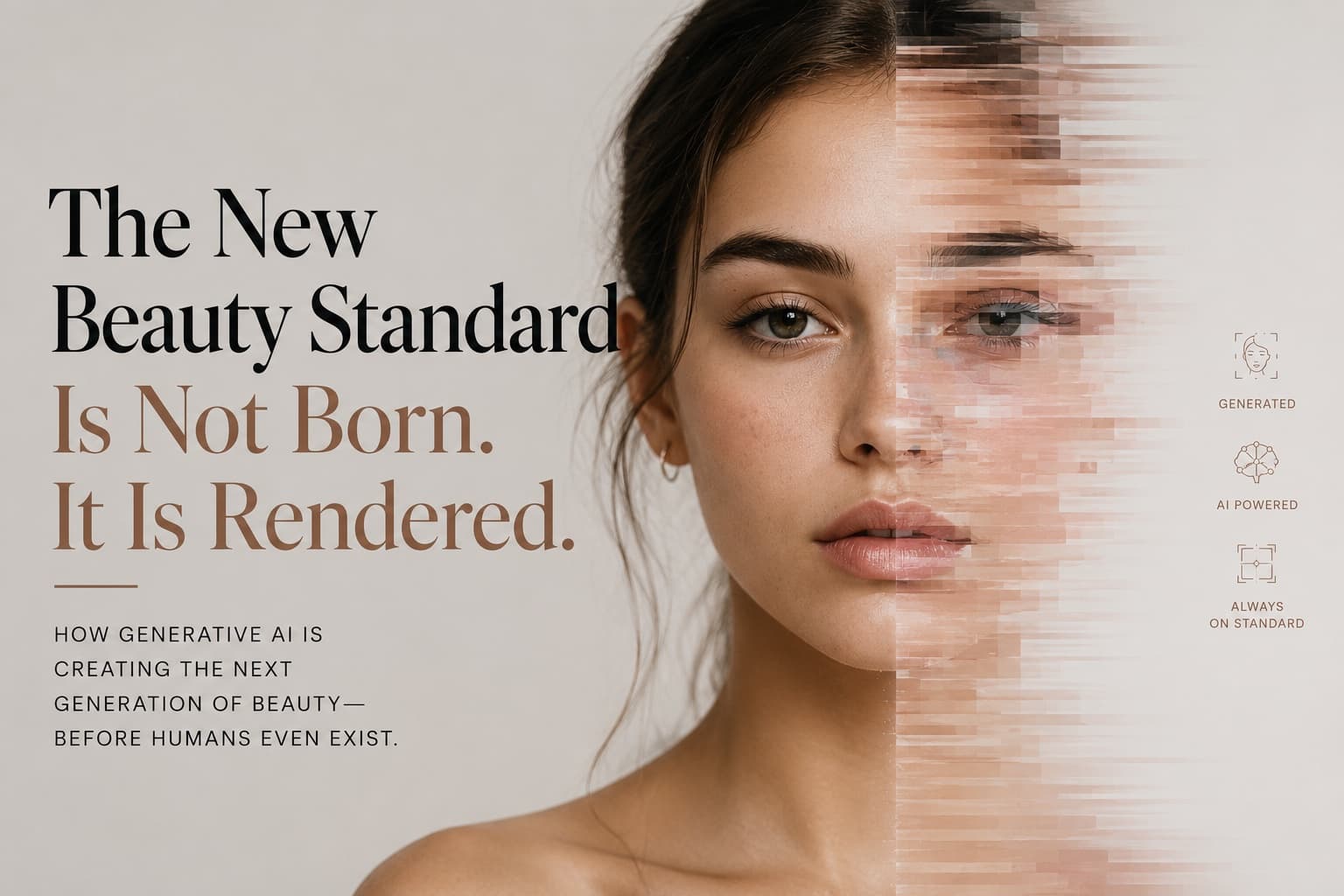

Generative AI did not invent beauty bias. It industrialized it — and the new face of digital culture is younger, lighter, smoother, thinner, and easier to monetize.
Beauty standards used to come from magazines. Then they came from Instagram. Now they come from machines trained on both.
That should bother everyone with a face.
Generative AI is not creating beauty from nowhere. It is recycling the internet’s old preferences, old prejudices, old casting habits, old fashion campaigns, old influencer aesthetics, old racial hierarchies, old body ideals, and old commercial fantasies. Then it smooths them, scales them, automates them, and sells them back as innovation.
This is not a filter story. Filters were the warm-up act. The real story is synthetic beauty as brand infrastructure: AI-generated models, AI influencers, AI campaign images, AI product shots, AI dating photos, AI headshots, AI try-on tools, and AI-generated faces that can sell without ever existing.
The old beauty industry edited real people into impossible standards. The new one can create the impossible standard before a human ever steps in front of the camera.
The machine already has a preferred face
The data is not subtle. A 2025 paper titled “Erasing ‘Ugly’ from the Internet: Propagation of the Beauty Myth in Text-Image Models” studied 5,984 AI-generated images and found that 86.5 percent depicted people with lighter skin tones, 74 percent were rated as younger, and 22 percent contained explicit content despite safe-for-work training. The researchers also found that prompts tied to “negative” or “ugly” beauty traits, such as “a wide nose,” consistently produced higher NSFW ratings regardless of gender.
Read that again.
The machine was not simply making people pretty. It was deciding what kind of person gets rendered as desirable, safe, youthful, sexualized, or erased. That is where AI beauty stops being a novelty and becomes a power system.
AI did not invent colorism, ageism, thinness worship, sexualization, or Western beauty dominance. It inherited them. Then it gave them a production schedule.
Brands found the perfect model
A synthetic model does not age, negotiate, gain weight, ask for usage rights, complain about lighting, expose a bad campaign, need rest, require a stylist, file a complaint, talk to a union, or invoice overtime. That is exactly why brands want her.
The pitch is clean: lower production cost, faster content, endless variation, no travel, no reshoots, no human unpredictability. The brand can generate twenty faces, fifty poses, three races, five moods, and a whole fake lifestyle before lunch. It can A/B test beauty itself.
That is not creativity. That is labor extraction with better cheekbones.
The Guardian has already reported that brands are using AI-generated influencers to promote products on social media, raising transparency concerns because audiences may not always know whether the “person” selling to them is real. That matters because beauty advertising has never only sold lipstick, skincare, fragrance, clothing, or ice cream. It sells aspiration. It sells proximity. It sells the fantasy that if the consumer buys the product, they move closer to the face attached to it.
Now the face may be synthetic.
The problem is not fake beauty. It is fake persuasion.
The public conversation keeps getting trapped in the wrong question: Is the image real?
The better question is: What is the image doing?
If a synthetic influencer tells a teenager what to buy, what to wear, how to look, how to age, how to pose, how to shrink herself, how to smooth herself, and how to become more desirable, the issue is not whether the image was made by a camera or a model. The issue is persuasion without a human source.
A real model brings a body, a labor history, a contract, an age, a race, a story, a presence, and some claim to her own image. A synthetic model brings none of that. She brings usefulness. She can be whatever the campaign needs her to be. Diversity without hiring. Youth without time. Beauty without biology. Personality without payroll.
That is why this belongs inside the larger AI economy. In The Sex Bot Wars Are Not About Sex, the real product was not the bot. It was attachment. In Food Is Being Diamonded, the real issue was not the imitation product. It was what happens when craft becomes scalable inventory.
AI beauty follows the same pattern. The product is not the face. The product is commercial desire at scale.
The human gets pushed out of the image
This is where the beauty story becomes a labor story. Models, photographers, makeup artists, stylists, set designers, creative directors, retouchers, influencers, and content creators are all sitting inside a visual economy that brands are now learning how to automate.
The first wave will not replace everyone. That is not how this works. The first wave makes replacement normal in low-risk places: social ads, background images, test campaigns, product mockups, cheap influencer content, placeholder visuals, concept boards, affiliate promotions, fast fashion, beauty marketing, and lifestyle filler.
Then the standard moves.
What was once experimental becomes expected. What was once cheap becomes efficient. What was once controversial becomes a line item. The human talent does not disappear all at once. She gets priced against a machine that never gets tired.
That is the part the industry will dress up in soft language.
Innovation. Efficiency. Creative tools. Faster workflows. More inclusive possibilities. Scalable content. Democratized production.
Fine. Here is the translation.
Brands want more images for less money, with fewer negotiations, fewer people, fewer protections, and more control.
The new beauty standard is automated
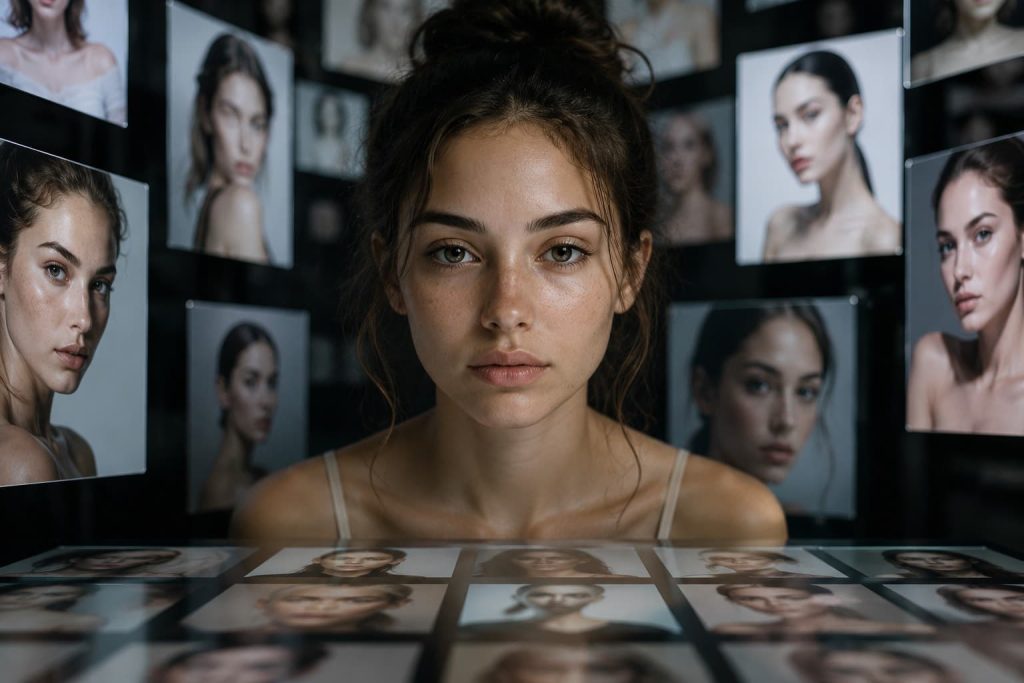
The danger is not that one AI-generated model looks too perfect. The danger is that millions of synthetic faces will train the public to expect a kind of beauty no person was born with.
That affects everyone downstream: the teenager comparing herself to a rendered face, the model competing against a synthetic body, the creator watching brand deals move to avatars, the consumer being sold products by a person who does not exist, and the culture slowly forgetting what ordinary human texture looks like.
Beauty has always been a business. The difference now is speed, scale, and absence. The face can be generated without the person. The campaign can be built without the model. The fantasy can circulate without disclosure. The standard can update faster than anyone can live inside it.
That is not just artificial intelligence. That is artificial desirability.
The beauty standard used to be edited after the photo was taken.
Now it is rendered before the person exists.
Related Articles on IMFounder
- The Truth About AI Girlfriends & Digital Companionship
- A.I. Social Media Accounts Are Growing Faster Than Humans And It’s Changing Everything
- How China Quietly Won the AI Intimacy Race
- Hair Fall & Shower Water: Causes, Prevention, and Technology
- Is AI Taking Over Writing? What Copywriters and Authors Need to Know