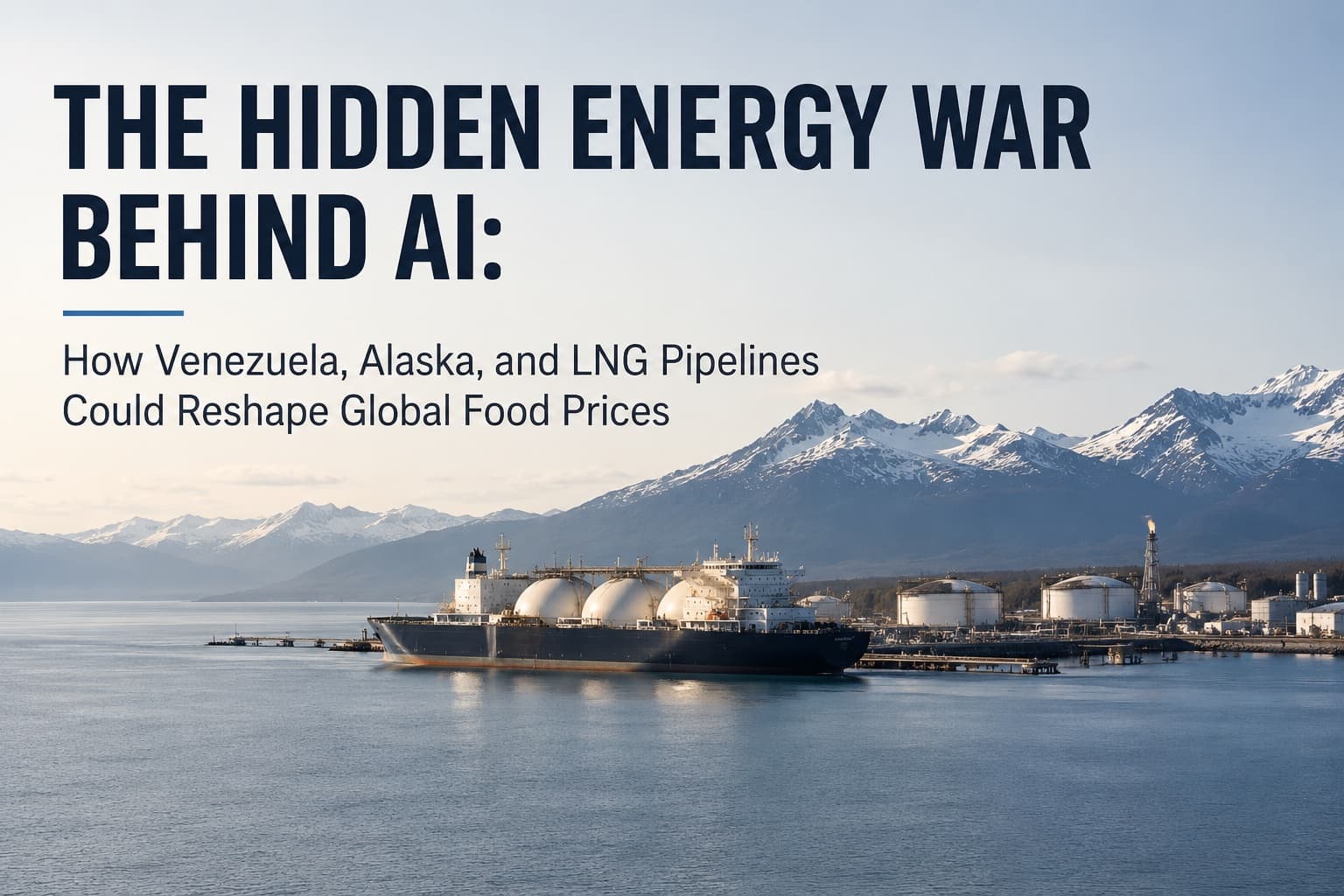

Venezuela. Alaska. Your Dinner Table. Connect the Dots.
Most people think artificial intelligence lives in the cloud.
In practice, it runs on pipelines. LNG terminals. Gas turbines. Refrigerant compressors. Industrial cooling systems. And one of the largest energy infrastructure expansions in modern history.
While public discussion around AI remains focused on automation, software, and labor disruption, a far larger industrial story is unfolding underneath it: the race to secure enough physical energy infrastructure to power the next generation of computation.
The modern food economy is not farm-to-table. It is pipeline-to-port-to-distribution-center-to-table. And the infrastructure being built right now will determine what moves through that chain — and at what cost — for the next several decades.
Despite years of discussion surrounding renewable energy transition strategies, much of the AI-era electricity buildout remains heavily dependent on natural gas infrastructure. While renewable generation continues expanding globally, current data center growth patterns are also increasing near-term dependence on dispatchable natural gas generation. The demand surge is no longer theoretical. It is already active and accelerating.
THE DEALS BEING SIGNED RIGHT NOW
In March 2026, Shell signed multiple agreements with the Venezuelan government covering offshore natural gas development, onshore oil and gas opportunities, exploration, and workforce development. Reuters reported the agreements included technical and commercial partnerships with Venezuelan engineering firm VEPICA alongside Baker Hughes and KBR.
That combination deserves attention.
Shell brings the capital and the project framework. Baker Hughes brings compression systems, turbines, and power generation equipment. KBR brings large-scale engineering capability. VEPICA — a Venezuelan firm — brings the local industrial integration that converts a resource opportunity into long-duration infrastructure positioning.
At the center is Venezuela’s Dragon gas field, estimated to contain approximately 4.5 trillion cubic feet of natural gas. The project is designed to route Venezuelan gas into Trinidad and Tobago’s Atlantic LNG infrastructure. Trinidad and Tobago already possesses LNG export infrastructure operating below full capacity, making Venezuelan gas one of the fastest potential pathways back into Atlantic export markets. First gas exports are targeted for Q3 2027.
Venezuela has long represented one of the world’s largest constrained energy reserves. Years of sanctions, infrastructure degradation, and underinvestment left much of the country’s industrial energy network operating below potential. The re-entry of engineering and compression firms signals that global capital increasingly views Venezuela not simply as an oil-producing state, but as a reconstruction economy — and reconstruction economies generate multi-decade industrial positioning.
Source: Reuters March 5, 2026; EconoTimes March 6, 2026; Caribbean News March 11, 2026; Ocean Energy Resources March 8, 2026
807 MILES. $44 BILLION. THE ALASKA CORRIDOR.
The same infrastructure logic is operating simultaneously in Alaska.
The Alaska LNG project — officially estimated at approximately $44 billion, though independent analysts project costs could exceed $60 billion once construction inflation is fully priced — includes a planned 807-mile, 42-inch pipeline transporting natural gas from Alaska’s North Slope to a major LNG export terminal in Nikiski on the Kenai Peninsula.
Glenfarne Alaska LNG now controls 75 percent of the project after acquiring its stake from the state-owned Alaska Gasline Development Corporation in January 2025. The state of Alaska retains a 25 percent ownership stake.
Baker Hughes signed definitive agreements with Glenfarne to supply main refrigerant compressors for the liquefaction terminal and power generation systems for the North Slope gas treatment facility, while also committing strategic investment capital into the project. Refrigerant compressors are effectively the mechanical core of LNG infrastructure, enabling natural gas to be supercooled into transportable liquid form. Without them, there is no LNG export economy.
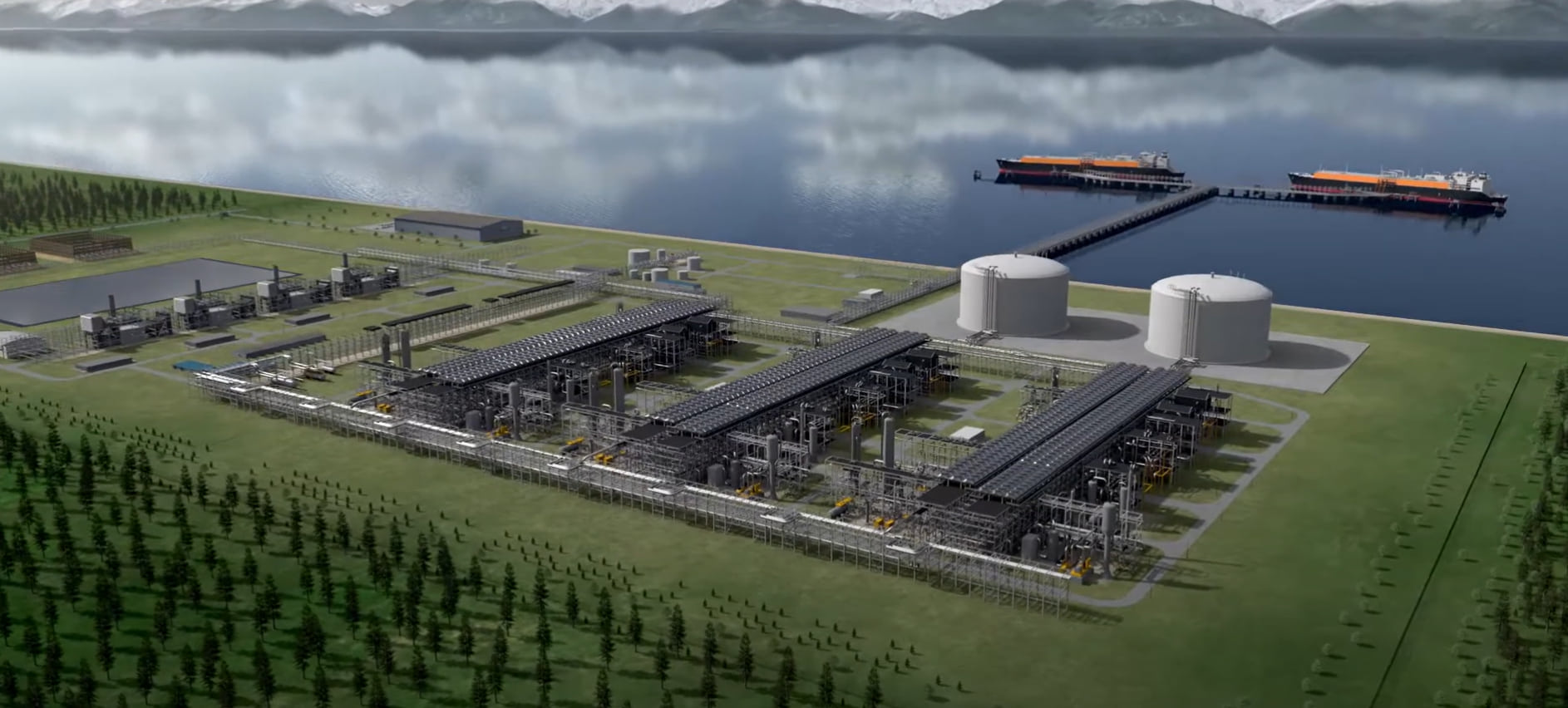
The agreements were announced at a Washington, D.C. ceremony attended by U.S. Secretary of Energy Chris Wright and Secretary of the Interior Doug Burgum.
The Nikiski terminal’s geographic positioning creates a logistics advantage that compounds with rising Asian energy demand. Transit time from Nikiski to Japan, South Korea, and Taiwan runs under ten days by direct Pacific routing — roughly half the transit time required from U.S. Gulf Coast facilities via the Panama Canal. According to project materials and industry reporting, preliminary commercial commitments already cover more than 60 percent of planned capacity, including non-binding agreements with Japan’s JERA Co. and Tokyo Gas, South Korea’s POSCO International, and Taiwan Semiconductor.
The project’s final investment decision remains pending, and several agreements currently remain non-binding. As of April 2026, no single binding contract exists with buyers. The decision — originally targeted for late 2025 — is behind schedule. The project may proceed. It may not. The capital flows and infrastructure positioning moving around it, however, are already in motion regardless of the final outcome.
Source: Baker Hughes press release November 10, 2025; Pipeline Technology Journal November 2025; Alaska Beacon April 2026; OilPrice.com November 2025; Blackridge Research 2026
THE AI DEMAND DRIVING ALL OF IT
According to the International Energy Agency, electricity demand from data centers surged 17 percent in 2025, with AI-focused facilities growing even faster — well outpacing global electricity demand growth of 3 percent. Capital expenditure among five major technology companies exceeded $400 billion in 2025 and is projected to rise by a further 75 percent in 2026.
Modern AI data centers require enormous cooling capacity in addition to computation, dramatically increasing electricity intensity per facility. Some large-scale AI data center campuses are beginning to approach the electricity demand profile of mid-size municipalities.
The Hamm Institute for American Energy estimates that meeting AI power demand will require the United States to increase natural gas production by 10 to 15 percent by the early 2030s, coinciding directly with expanding LNG exports. Industry analysts have confirmed that natural gas turbine orders already exceed manufacturing capacity years into the future — meaning the infrastructure buildout is constrained not only by capital and permitting, but by the physical limits of industrial production itself.
The result is a feedback loop with no near-term off-ramp.
AI expansion drives electricity demand. Electricity demand drives pressure on natural gas infrastructure. Natural gas demand accelerates LNG investment, export terminals, and pipeline construction. Infrastructure expansion reshapes transportation costs, fertilizer pricing, refrigeration economics, and food system margins across the entire supply chain.
Source: IEA Key Questions on Energy and AI 2026; Hamm Institute for American Energy 2025; American Action Forum 2026
WHERE THE FOOD ECONOMY ENTERS THE FRAME
Fuel moves food. Natural gas produces fertilizer. Electricity powers refrigeration. Diesel drives every truck between every farm and every distribution center in the country.
Nitrogen fertilizer production remains heavily dependent on natural gas feedstocks, directly linking energy volatility to agricultural pricing. When natural gas prices move, fertilizer costs follow. When fertilizer costs move, commodity prices follow. When commodity prices move, the entire food supply chain reprices — from the farm gate through processing, distribution, and onto the restaurant menu.
The cold chain — the refrigerated network that moves perishable food from production facilities to consumers — runs on diesel and electricity. Both are structurally tied to the infrastructure decisions currently being made in Venezuela and Alaska. A sustained shift in either input cost propagates through every layer of the food system without announcement.
Restaurants absorb all of these pressures simultaneously. Labor. Fuel surcharges. Ingredient costs. Refrigeration. Logistics. They operate at the final compression point of every upstream cost pressure in the food economy.
As throughput demand rises across aging pipeline networks, maintenance sectors tied to corrosion management, line intervention, integrity engineering, and uninterrupted transmission operations are also becoming increasingly valuable — a quieter economy expanding beneath the headline infrastructure projects.
Consumers experience these dynamics as higher grocery bills, shrinking portions, service fees, and rising menu prices. The infrastructure producing those outcomes remains largely invisible to the people absorbing the costs.
Source: IEA; U.S. Energy Information Administration; Brookings Institution Global Energy and AI Report 2026
THE BOTTOM LINE
The global economy is reindustrializing around computation, energy security, and physical infrastructure resilience. That process does not require public awareness to proceed. It is being built in the ground right now by companies that understood the demand curve before most consumers had considered the connection between a data center in Virginia and a gas field off the coast of Venezuela.
The food economy sits downstream of every decision being made in those corridors. Every pipeline tariff. Every compressor contract. Every export terminal built or delayed. Every fertilizer price that moves because natural gas moved first.
Venezuela. Alaska. Your dinner table.
The dots are already connected. Most consumers will only notice once the costs reach their daily lives.
The AI economy may appear digital on the surface, but underneath it is rapidly becoming one of the most energy-intensive industrial expansions in modern history.
Related Articles on IMFounder
- 7 Explosive AI Updates in April 2026 That Will Shock Every Founder
- ChatGPT Agent vs Claude — The Explosive New AI Leader
- ChatGPT Image Generation Update — New ChatGPT Image Generation update brings improved realism, editing, and workflow advantages
- Claude Design is quietly becoming one of the most talked-about AI features — The New AI Interface Builder
- Are You Using the Wrong AI Tool? — A Practical Guide to Choosing the Right AI for the Right Task
- Powerful AI Tools for Founders in 2026 — You Must Know About Now