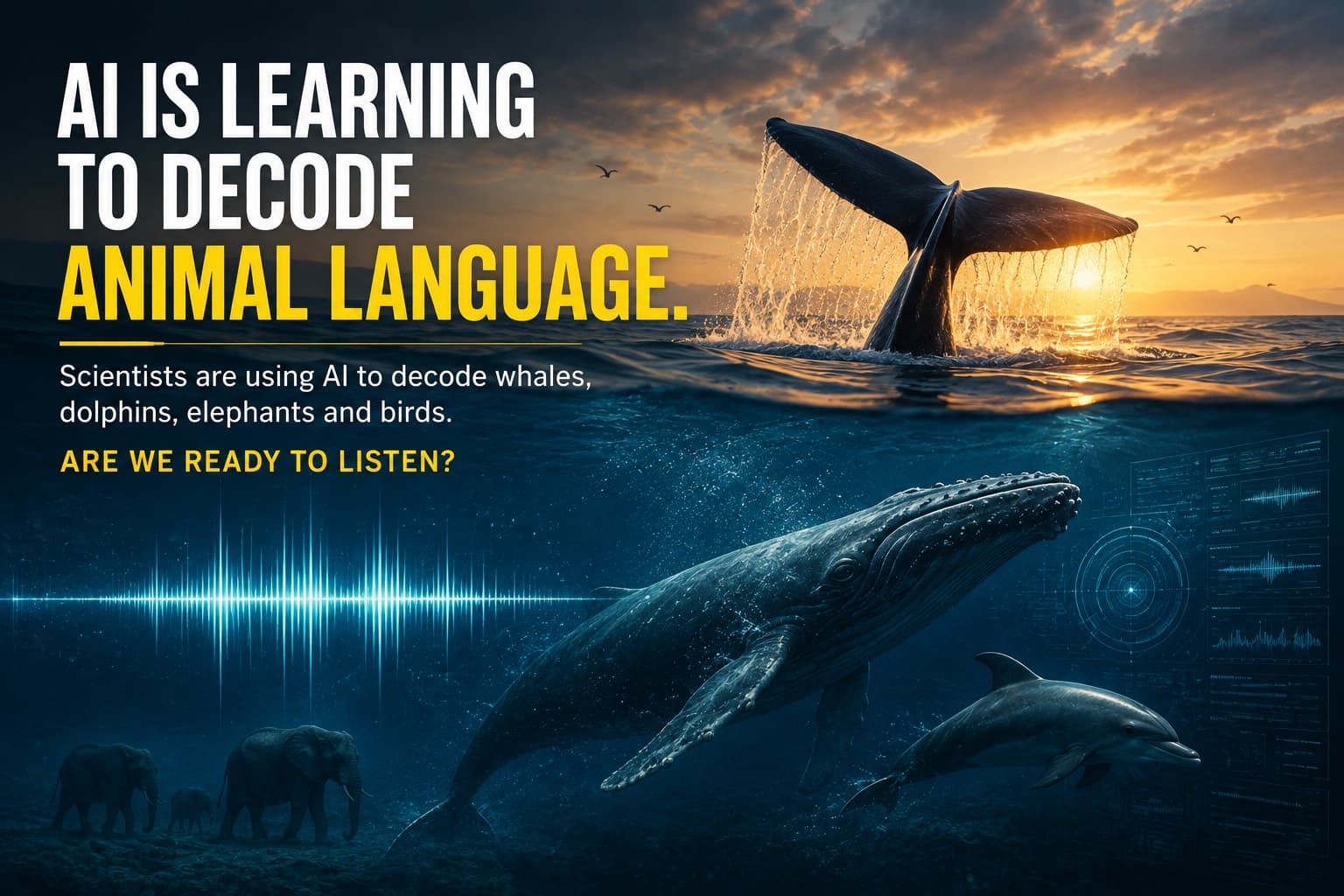

Scientists are using artificial intelligence to decode whales, dolphins, elephants and birds—and humanity may be approaching its first genuine conversation with another species.
For most of human history, animals have been forced to live inside a world narrated entirely by us.
We decide which sounds are warnings, which behaviors indicate distress and which forms of intelligence qualify as intelligence at all. We call one animal a companion, another a product and another a pest. Conveniently, none of them can challenge the classification.
Artificial intelligence may be about to disrupt that arrangement.
Around the world, researchers are building machine-learning systems designed to identify patterns inside animal communication. These models are analyzing dolphin whistles, whale clicks, elephant rumbles, bird songs and primate calls at a scale no human research team could process manually.
The ambition is no longer simply to determine whether an animal is frightened, hungry or searching for a mate. Scientists want to understand the architecture of nonhuman communication—and eventually build systems capable of translating between species.
We taught AI to generate human language by feeding it enormous amounts of human communication. Now researchers are attempting the same fundamental process with the rest of the animal kingdom.
The result could be the most consequential translation project in history.
Humanity has spent thousands of years speaking for animals. AI may finally give them the ability to interrupt.
The large language model is leaving the human world
Human language models learn by searching for relationships among words, sentences and contexts. Animal-communication models apply similar pattern-recognition methods to enormous collections of clicks, whistles, movements and environmental information.
The challenge is considerably harder.
A human sentence arrives surrounded by familiar context. Researchers already understand the language, culture and physical world in which it operates. Animal communication arrives without a dictionary, a Rosetta Stone or confirmation that the species organizes meaning in anything resembling human grammar.
A whale click could identify an individual, coordinate movement, express emotion or perform several functions simultaneously. A sound may change meaning depending on who produced it, who received it, what happened immediately before it and whether a ship was passing overhead.
Scientists therefore need more than recordings. They need synchronized behavioral data: location, movement, social relationships, environmental conditions and the identity of every animal involved.
That is where AI becomes transformative.
Machine-learning systems can search through millions of observations, detect recurring structures and connect specific vocal patterns with visible behavior. They can recognize distinctions too subtle, too fast or too data-intensive for unaided human analysis.
The nonprofit Earth Species Project is developing foundation models for animal communication with research involving crows, beluga whales, elephants and other species. Its models are designed to find shared structures across large collections of biological sounds rather than requiring researchers to build a separate system from scratch for every animal.
The organization has already developed models capable of sorting animal vocalizations and assisting researchers with individual recognition. The long-term objective is an AI system that can identify communicative structures across species—even when scientists do not yet understand what those structures mean.
It is the beginning of a nonhuman language model.
Whales are becoming the ultimate test case
Sperm whales communicate through patterned sequences of clicks called codas. For decades, researchers compared these signals to Morse code: discrete rhythmic units exchanged through the darkness of the ocean.
New research suggests that description was radically simplistic.
Researchers from UC Berkeley and the Cetacean Translation Initiative, better known as Project CETI, have identified vowel-like acoustic qualities within sperm-whale codas. The whales appear to manipulate sound in more complex ways than previously recognized, introducing subtle variations that could dramatically expand the amount of information their communication contains.
Some whale populations also use distinct dialects. Their communication varies among social groups and geographic regions, suggesting language-like systems influenced not only by biology but also by culture.
Project CETI is now using autonomous underwater gliders equipped with hydrophones to follow sperm-whale conversations in real time. The robots listen for codas and adjust their movement toward the whales, allowing researchers to gather sound and behavioral data during dives that can exceed a mile in depth.
This is not yet translation. No scientist can type a whale coda into a computer and receive a reliable English sentence.
But the infrastructure required for translation is being assembled: persistent listening, individual identification, behavioral context, pattern recognition and increasingly sophisticated models of vocal structure.
The distinction matters. AI has not unlocked “whale language,” regardless of how aggressively a viral headline may claim otherwise. Scientists are identifying the components from which meaning might eventually be reconstructed.
They are building the dictionary before they know the alphabet.
Google is listening to dolphins
Google has entered the field with DolphinGemma, a model developed alongside the Wild Dolphin Project and researchers at Georgia Tech.
DolphinGemma was trained to analyze the vocalizations of Atlantic spotted dolphins and generate dolphin-like sound sequences. Researchers can run the technology using Google Pixel phones in the field, allowing them to process sounds while observing wild dolphins rather than waiting to return to a laboratory.
The system is also being paired with an experimental interface called CHAT, or Cetacean Hearing Augmentation Telemetry. Researchers associate synthetic whistles with specific objects dolphins appear interested in, such as seagrass or scarves used during play.
The immediate goal is not to convert dolphin conversation into subtitles. It is to establish a small, mutually understood vocabulary.
If a dolphin learns that one synthetic whistle corresponds with a particular object, produces that whistle and then receives the requested object, scientists may have created the foundation for deliberate two-way interaction.
That would be primitive compared with human conversation. It would also be historic.For the first time, another species could be given a technological interface through which it intentionally communicates with humans using shared signals.
The first animal translator may look less like Google Translate and more like an interspecies walkie-talkie.
Translation could change the legal status of animals
The technological problem may prove easier than the moral one.
If an AI system reliably determines that elephants use individual names, whales transmit cultural knowledge or farm animals communicate specific forms of distress, that information will not remain safely contained inside a scientific paper.
It could enter courts, legislatures and corporate supply chains.
In February 2026, NYU Law’s More Than Human Life program announced a collaboration with Project CETI examining how whale communication could influence legal advocacy for animals and nature. The partnership recognizes that translation is not simply a scientific achievement. It could become evidence.
Legal systems have historically treated animals as property because their interests must be interpreted by humans. Credible translation technology could complicate that structure. If animals communicate preferences, relationships, fear, grief or resistance in repeatable patterns, their inner lives become harder to dismiss as projection.
The implications extend far beyond whales.
Could an animal’s translated distress become evidence in a cruelty case? Could communication data alter standards for captivity? Could highly intelligent species gain new legal protections? Would corporations be required to disclose what their livestock-monitoring systems detect?
The dangerous question is not whether animals can speak.
It is whether humans will recognize their communication once understanding it becomes economically inconvenient.
The first successful animal translator could become a scientific instrument, a corporate surveillance system or a witness stand. Possibly all three.
Animals cannot consent to becoming datasets
Translation also creates risks for the species being translated.
Researchers could use synthesized calls to attract animals, manipulate their movements, influence mating behavior or drive them away from commercially valuable territory. Poachers could exploit location data or imitate social signals. Tourism companies could turn “conversations” with wildlife into another invasive experience sold to customers.
Even conservationists could unintentionally cause harm by broadcasting signals whose full meaning they do not understand.
A synthetic whale call might sound convincing to an algorithm while communicating aggression, danger or social information to the animal receiving it. Generating plausible animal sounds is not the same as using them responsibly.
Scientists are therefore proposing ethical standards for interspecies AI. Suggested principles include minimizing harm, protecting behavioral privacy, preventing coercion and allowing animals to disengage from experiments.
Yes, behavioral privacy.
That phrase may sound absurd until we consider what these systems are collecting: family relationships, movements, reproductive behavior, emotional states, conflict, cooperation and location. Humans would consider comparable information intensely personal.
AI ethics has focused almost exclusively on human stakeholders. A 2026 paper published in Science and Engineering Ethics argues that sentient animals should be explicitly included in AI-governance frameworks. The authors contend that animals are already affected by AI systems but remain largely invisible within debates over responsible technology.
Once animal communication becomes machine-readable, ignoring those interests becomes considerably more difficult.
We may not like the translation
Humanity imagines speaking with animals as a sentimental fantasy. We picture dolphins delivering ancient wisdom or household pets confirming that they adore us.
Reality may be less flattering.
Animals may communicate constantly about danger created by humans. Whales may exchange information about ship noise. Elephants may warn one another about roads, farms and armed people. Captive animals may repeat signals associated with boredom or distress.
Translation may not reveal a hidden Disney movie.
It may reveal an uninterrupted emergency broadcast.
There is also no guarantee that animal intelligence will fit neatly into human words. Other species experience magnetic fields, ultrasound, seismic vibrations, chemical signals and sensory worlds we cannot naturally perceive. Their communication may contain concepts with no direct equivalent in human language.
A true animal translator may therefore do more than convert sounds into English. It may force AI to model entirely different ways of experiencing reality.
That could become the technology’s greatest intellectual contribution.
The current generation of artificial intelligence was built from the accumulated language of one unusually dominant primate. Expanding it to the communication systems of whales, birds, elephants and other species could challenge the assumption that intelligence must resemble us to be meaningful.
We are not on the verge of downloading a pet app that turns barking into flawless sentences. The science is early, translation claims require restraint, and enormous gaps remain between finding patterns and proving meaning.
But the direction is unmistakable.
For the first time, humanity possesses machines capable of listening to another species at its own scale—across millions of sounds, years of behavior and patterns invisible to the human mind.
AI may not give animals language. They already have communication systems of their own.
It may finally give humans the ability to hear them.
FAQ:
I’d add this near the end, before the final conclusion:
Can AI translate animal language?
Not yet. Current AI systems can identify patterns in animal vocalizations and connect them with behavioral and environmental data, but scientists cannot reliably translate most animal communication into human sentences.
What is Project CETI?
Project CETI is a research initiative studying sperm-whale communication using AI, machine learning, underwater recording systems and behavioral data.
What is DolphinGemma?
DolphinGemma is an AI model developed by Google with researchers studying Atlantic spotted dolphins. It is designed to analyze dolphin vocalizations and generate dolphin-like sound sequences.
Can AI understand whale language?
AI can help researchers identify patterns and structures in whale communication, but reliable translation into human language has not yet been achieved.
Why is AI useful for animal communication?
AI can process enormous quantities of sounds, movements and environmental data, allowing researchers to identify patterns that would be difficult or impossible to detect manually.
Could AI change animal rights?
Potentially. If researchers eventually establish reliable evidence that animals communicate preferences, distress, relationships or other meaningful information, that evidence could influence how animals are treated legally and ethically.