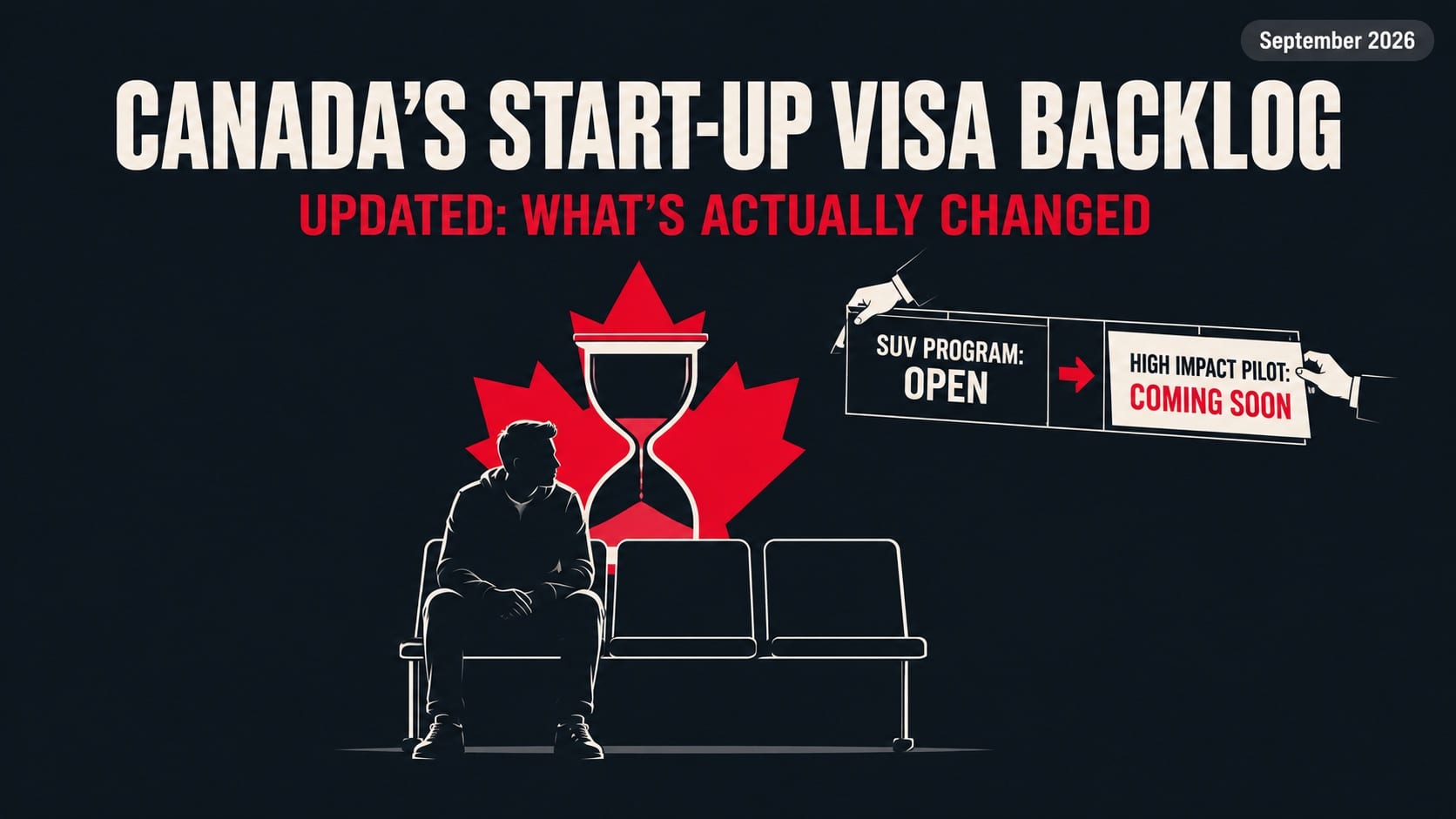

We’ve been covering this story since December 2025. Here’s exactly what’s moved, what hasn’t, and what it means if you’re still waiting.
Updated: September 2026
The Canada Start-Up Visa backlog is not a story we’re covering for the first time. IMFounder has tracked this program’s collapse since the fall of 2025, through the December 2025 pause, the March 2026 passage of Bill C-12, and our own deep-dive case file on the 43,000-plus founders left waiting. This piece is different from those. It’s not a fresh take — it’s a status check. What has genuinely moved since we last reported? What hasn’t? And if you’re one of the founders still sitting in the queue, what does today’s picture actually mean for your file?
Short version, before the detail: the program is now more closed than it was when we last wrote about it, the replacement finally has a name but still no rules, the backlog got bigger instead of smaller, and a new Federal Court ruling just made the legal escape hatch a lot narrower for most applicants. None of that is good news. All of it is worth knowing precisely, rather than guessing.
What We Reported Before — A Quick Recap of IMFounder’s Start-Up Visa Coverage
For readers new to this story, here’s the trail we’ve left so far:
- In September 2025, our coverage of the broader anti-immigration backlash flagged the Start-Up Visa’s processing time at 53 months — already a 70% jump in two years at that point, and the first clear sign the program was in trouble.
- In December 2025, as IRCC moved to pause intake, our breakdown of that month’s immigration policy changeswarned founders to stop treating the SUV as an operational pathway and start treating it as “a long-term PR lottery.”
- In March 2026, our analysis of Canada’s AI investment plan connected the SUV’s collapse to a bigger pattern — Canadian-founded, venture-backed startups increasingly incorporating outside the country entirely.
- In April 2026 (updated June 2026), our most detailed piece, “Canada Startup Visa 2026: Shocking Truth for 43,000 Trapped Founders,” laid out five real, documented founder cases, explained what Bill C-12 could mean for pending files, and flagged the Tousi v. Canada mandamus ruling as a potential lifeline for delayed applicants.
If you’ve read that piece, you know the shape of the crisis already. What follows is the update.
What Has Changed Since Our Last Report
The pause is now total — the June 30, 2026 deadline has passed
When we last covered this, the SUV had two closure dates: December 31, 2025, when new applications from the general public stopped being accepted, and a narrower exception for anyone holding a valid 2025 commitment certificate, who had until June 30, 2026 to file. That second window has now closed. IRCC’s own Start-Up Visa page currently states plainly that the program “was paused on June 30, 2026” and that it will “continue to process applications we accepted before this date.” In practical terms: there is now no filing route into the Start-Up Visa left open to anyone, for any reason. If you didn’t have an accepted file before that date, the door is fully shut.
The replacement program finally has a name — but still no rules
Back in April, all we could tell you was that a “new, targeted pilot” was expected sometime in 2026, with no further detail. That has changed, slightly. IRCC’s 2026–27 Departmental Plan now confirms the replacement will be called the High Impact Start-up Pilot, aimed at “elite entrepreneurs.” That’s genuinely new information. What hasn’t changed is everything that matters for planning purposes: no published eligibility criteria, no minimum investment or revenue thresholds, no job-creation targets, no confirmed role for designated organizations, and no launch date. Treat the name as confirmation that IRCC is still building this program, not as a signal you can act on yet.
The backlog got bigger, not smaller
This is the update that should concern current applicants most. When we last reported, the widely cited figure was roughly 43,200 pending Start-Up Visa files, as of late 2025. The most recent tracking available, from early-to-mid September 2026, put the combined Start-Up Visa and Federal Self-Employed Persons Program inventory at approximately 53,800 files, still climbing by over a thousand files in the most recent month tracked, with both programs’ processing times still sitting above ten years. Even accounting for the fact that this newer figure combines two programs rather than the SUV alone, the direction is unmistakable: closing the door to new applicants has not, on its own, made the queue behind that door any shorter.
The mandamus strategy just got a lot narrower
This is the most consequential legal update since our last report, and it’s one every applicant considering court action needs to understand before spending money on a legal opinion. Our earlier coverage highlighted Tousi v. Canada (Citizenship and Immigration), 2025 FC 671 — a real April 2025 Federal Court decision in which the applicant had waited over 62 months with no communication from IRCC and no structured reason for the delay. The Court found the delay unreasonable and ordered IRCC to decide within 90 days. We described this, accurately at the time, as a genuine and usable precedent.
Since then, IRCC formalized a three-tier priority system through Ministerial Instructions issued in December 2025:
| Tier | Who Qualifies | What It Means |
|---|---|---|
| Tier 1 | At least one team member holds a valid SUV work permit, backed by a qualifying investment: roughly CAD $200,000 from a venture capital fund, or CAD $75,000 from an angel group or qualifying incubator | Highest priority, processed first |
| Tier 2 | Meets the investment/support criteria but no team member holds the SUV work permit | Processed after all Tier 1 files |
| Tier 3 | Doesn’t meet the investment/support criteria | Lowest priority, processed last |
A more recent Federal Court decision has now tested mandamus against this tiered system directly — and IRCC won. An applicant who had been waiting since March 2021, whose file fell into the lowest priority tier, sought a writ of mandamus. The Court denied it, finding that IRCC is entitled to prioritize applications to manage a genuine backlog, and that a delay is not unreasonable where a structured, consistently applied prioritization system explains it. In plain terms: having a formal queue with a documented logic is now, itself, a defence against a claim that the delay is unreasonable.
What this means for you: if you’re Tier 1 and still facing a delay that looks disproportionate even within that top tier, mandamus remains a live option worth discussing with a lawyer. If you’re Tier 2 or, especially, Tier 3, a mandamus application is now a considerably harder case to win than it was when we first wrote about Tousi — the tier itself may be the “satisfactory justification” a court is now willing to accept.
The formal tier system is now documented with real dollar thresholds
Related to the above: when we last wrote about priority processing, it was described in general terms — funding from Canadian VC or angel investment, or acceptance into a top incubator. We can now report the specific thresholds IRCC is applying: roughly CAD $200,000 for venture capital backing, or CAD $75,000 for an angel group or qualifying incubator, combined with holding a valid SUV work permit, to reach Tier 1. If your file doesn’t currently meet that bar and you have any ability to bring in additional qualifying investment before your file comes up for review, this is worth an urgent conversation with your designated organization and your lawyer.
What Hasn’t Changed
It’s just as important to be honest about what’s stayed the same. Processing times for Tier 2 and Tier 3 applicants are still running past ten years. IRCC’s official public explanation — that volume simply outstripped admission spaces under the Immigration Levels Plan — hasn’t changed. No group cancellation order under Bill C-12 targeting Start-Up Visa files has been published in the Canada Gazette as of this writing, so that risk remains theoretical rather than realized, but it also hasn’t been ruled out or walked back. And the individual founders whose stories anchor this coverage — described below — have not, as far as the public record shows, seen their files move.
Real Founders, Real Consequences
Numbers make the scale of the backlog easy to grasp. They don’t capture what it costs a family. These cases are drawn from our own prior reporting and from major Canadian news coverage — not hypotheticals.
Maulik Pandya, founder of the AI-powered food-tech platform Eatance, applied in 2021 and has personally invested $1.7 million in a business generating roughly $1 million in annual revenue. Three years after applying, his status still read “application in progress.” His daughter had to delay her admission to McMaster University because, on temporary status himself, Pandya couldn’t cover international fees. As of the most recent public reporting, he was openly weighing a return to India.
Edeme Kelikume, founder of the newcomer housing platform Tempho in Brampton, applied in December 2023, when the quoted wait was around 18 months. Without PR status, he can’t access the business credit and government grants his own platform helps other newcomers secure. His wife gave up a more certain settlement path in the UK to come to Canada instead; their son has now missed two years of college. “It was me who got her from certainty to uncertainty,” he said.
Steeson Mathew of Loop Parking, and Ryo Wu and Allison Le, co-founders of COOCO — both profiled in CBC’s October 2025 reporting and in our own April 2026 case file — describe the same structural problem from different angles: temporary status blocks access to Canadian business credit and makes investors hesitant to commit capital without founders holding permanent residence. Mathew applied in August 2021 with signed city government contracts already in hand; when IRCC introduced incubator-based priority processing in 2024, it effectively moved newer, differently backed applicants ahead of founders like him who had already been waiting years.
Every one of these is a working business. None of them is a hypothetical.
Why Isn’t IRCC Working for Entrepreneurs?
IRCC’s position, restated consistently since 2025, is that Start-Up Visa files are processed alongside other federal business-class applications, and that overall wait times reflect admission-space allocation across the whole system rather than a problem unique to entrepreneurs. There’s some truth in that framing. But it doesn’t explain how a program built to deliver a decision in six months was allowed to grow an inventory that, at 2025 processing rates, represented close to a century’s worth of work — nor why, by IRCC’s own findings, nearly 80% of designated incubators failed to meet the compliance standard the department introduced in April 2024, while applications kept flowing through them regardless.
For entrepreneurs specifically, the damage compounds in a way it doesn’t for other immigration streams. A founder stuck in the backlog isn’t just waiting — they’re trying to raise capital, sign contracts, and hire senior staff while every serious investor asks the same question: will you actually still be here in five years? Temporary status doesn’t just inconvenience a founder. It depresses the value of the exact company Canada invited them here to build.
Bill C-12: Still a Risk, Still Unresolved
Bill C-12 received royal assent on March 26, 2026, giving Cabinet the power to cancel, suspend, or modify large groups of immigration documents and applications on public-interest grounds, with any such order required to be published in the Canada Gazette. As of this update, no group order targeting Start-Up Visa applicants has been issued. That’s the good news. The bad news is that the underlying condition that makes this a live risk — roughly 80% of designated incubators reportedly out of compliance with 2024 standards — hasn’t been resolved either. Applicants backed by a designated organization whose compliance status they haven’t personally verified should treat that as unfinished business, not old news.
The Cupertino Ambition vs. the Canada Start-Up Visa Backlog Reality
Officials have spent a decade pitching the Start-Up Visa as the foundation of a homegrown answer to Silicon Valley. That pitch gets harder to make with every update to this story, not easier. A backlog that grew even after intake closed. A replacement program with a name but no rules, ten months after it was first promised. A court decision that just made “your case is stuck behind thousands of others” a legally sufficient answer to “why has nothing happened.” None of that reads as a program preparing to compete for global talent. It reads as a program still managing the consequences of its own design.
Every month a founder spends deciding whether to relocate a working, revenue-generating company is a month a competing hub doesn’t have to spend convincing them to leave.
Wait Another 5–7 Years, or Walk Away? An Updated Framework
The calculus here is sharper than it was when we last wrote about it, because your tier now matters as much as your application year.
Staying may still make sense if: you’re confirmed Tier 1 (SUV work permit plus qualifying investment) and simply waiting for your position in that queue to come up; your business has real Canadian revenue or government contracts that don’t relocate easily; or you’re an early applicant (2020–2021) genuinely close to a decision regardless of tier.
Leaving may be the rational choice if: you’re Tier 2 or Tier 3 with no realistic path to qualifying investment before your file is reviewed, since mandamus is now a much harder case for you to win and the queue behind you could take a decade or more; your business needs immigration certainty to close its next funding round and investors are already asking; or your family is absorbing costs — missed school years, a spouse’s abandoned path elsewhere — that compound with every additional year.
There’s no dishonor in either decision. There is real cost in deciding passively, by simply letting another year pass without evaluating where you actually stand.
Your Real Options Right Now
- Confirm your tier, in writing, today. If you don’t already know whether your file is Tier 1, 2, or 3, and what specific investment threshold applies, get that confirmed by your designated organization or your lawyer before making any other decision.
- If you’re Tier 1 and still facing a disproportionate delay: a mandamus application remains a live option — this is the group Tousi still applies to most directly.
- If you’re Tier 2 or 3: a C-11 significant benefit work permit, a provincial entrepreneur program (British Columbia, Alberta, Manitoba, Saskatchewan, New Brunswick, Nova Scotia, or PEI), or an entrepreneur pathway in another country such as the UK’s Innovator Founder visa, Portugal’s D2 visa, or the UAE’s Golden Visa are all worth serious, parallel evaluation — none of them cancel your pending SUV file.
- If your designated organization’s MI72 compliance status is unclear: get it confirmed in writing now, given the unresolved Bill C-12 risk described above.
- Don’t wait for the High Impact Start-up Pilot to plan your next move. It has a name and a stated focus on “elite entrepreneurs,” and nothing else publishable yet. Treat any claim of early access, a confirmed date, or published criteria with real skepticism until IRCC itself publishes them.
Frequently Asked Questions About the Canada Start-Up Visa Backlog
Is the Canada Start-Up Visa program still accepting any applications in 2026? No. The narrow exception for applicants with a valid 2025 commitment certificate closed on June 30, 2026. IRCC’s own program page now describes the entire program as paused as of that date. Applications accepted before then continue to be processed.
What is the High Impact Start-up Pilot, and can I apply? It’s the confirmed name of IRCC’s planned SUV replacement, per the department’s 2026–27 Departmental Plan, aimed at “elite entrepreneurs.” No eligibility criteria, investment thresholds, or launch date have been published, so there is nothing to apply to yet.
How big is the Start-Up Visa backlog now, compared to when this story started? It has grown, not shrunk. Late-2025 figures put the Start-Up Visa-specific inventory at roughly 43,200 files. The most recent combined Start-Up Visa and Self-Employed Persons Program tracking, from September 2026, put the total closer to 53,800, with both programs still showing processing times above ten years.
Can I still use the Tousi v. Canada ruling to force a decision on my file? It depends heavily on your priority tier. Tousi v. Canada, 2025 FC 671 remains good law and a real precedent, particularly for Tier 1 applicants facing delays that look disproportionate even within the top tier. A more recent Federal Court decision denied mandamus to a Tier 3 applicant, finding that IRCC’s structured, tiered prioritization system was itself a satisfactory justification for delay. Get a lawyer’s assessment of your specific tier and timeline before filing.
Does Bill C-12 mean my application could be cancelled? Not automatically. Bill C-12 gives Cabinet the power to cancel groups of applications through an order published in the Canada Gazette, but no such order targeting Start-Up Visa files has been issued as of this update. Applicants backed by a designated organization that may not meet 2024 compliance standards face the highest theoretical risk and should get that status confirmed.
The Bottom Line
Nothing about this update makes the Canada Start-Up Visa backlog easier to sit inside. The pause is now complete, the backlog grew instead of shrinking, and the legal remedy that looked promising in our last report now depends heavily on a priority tier most applicants don’t control. What has genuinely improved is clarity: you can now find out exactly which tier your file sits in, what dollar threshold applies to it, and whether a court would actually hear your case. Use that clarity. Confirm your tier this week, get your designated organization’s compliance status in writing, and make your next decision — wait, pursue a parallel pathway, or leave — based on where you actually stand, not on how things looked when this story started.
This article is provided for general information purposes and reflects publicly reported data and IRCC policy as of September 2026. It is not a substitute for individualized legal advice. Immigration outcomes depend on the specific facts of each case — consult a licensed Canadian immigration lawyer or Regulated Canadian Immigration Consultant (RCIC) before making decisions about your application.