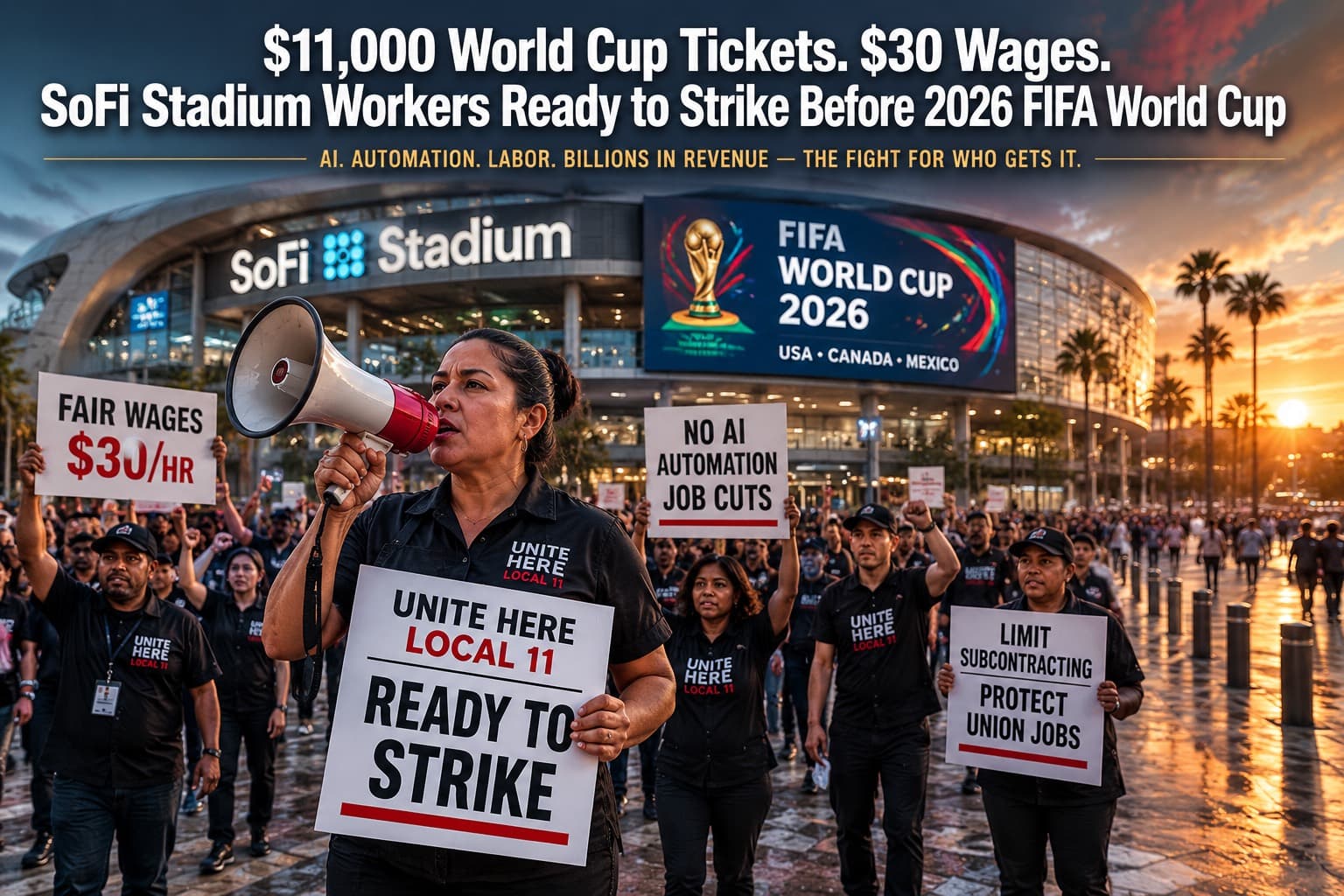

The SoFi Strike Heard Around the World as Workers Push Back Against the 2026 “AI World Cup.”
The 2026 FIFA World Cup will generate at least $10.9 billion. Some economists believe the full cycle could exceed $15 billion. A face-value ticket to the final reached $10,990. A single luxury suite at SoFi Stadium costs up to $209,000. The cooks, bartenders and dishwashers feeding the building are preparing to strike.
That gap is the story.
The money exists. It is being routed around the people who make the event run.
Roughly 2,000 concession workers at SoFi Stadium in Inglewood, California — represented by UNITE HERE Local 11 — are moving toward a strike authorization vote just before SoFi hosts the June 12 opener between the United States and Paraguay, the first of eight matches the venue will stage.
Their employer is Legends Global, which runs the stadium’s food and beverage operation under owner Kroenke Sports & Entertainment.
The contract has expired. Bargaining has failed. The workers walked away from negotiations with demands that go beyond wages. They have publicly asked FIFA and Kroenke Sports to restrict subcontracting, prevent automation that eliminates union jobs, keep ICE and Border Patrol away from tournament operations, and support housing protections for hospitality workers.
Seats to the match they will be working start around $1,422.
The leverage is the calendar itself.
Once global sponsors, broadcast schedules, tourism infrastructure and hospitality packages are locked to a date, disruption becomes expensive.
And that is exactly why this fight matters beyond one stadium.
Start with the floor: what the workers actually make
When Dodger Stadium concession workers — also represented by Local 11 — threatened to strike before the 2022 MLB All-Star Game, one worker earning $18.14 an hour eventually rose to $30.94 after the contract was settled. The raise only came after a 99 percent strike authorization vote.
Not goodwill. Pressure.
Los Angeles has since passed an “Olympic Wage” intended to move tourism workers toward $30 an hour by 2028, now the highest tourism minimum wage structure in the country.
Hold that number in your head while looking at the economics surrounding this tournament.
The money coming in
FIFA’s haul breaks records across the board: broadcasting rights above $4.2 billion, sponsorship above $2.8 billion, and matchday revenue projected to roughly triple compared to Qatar.
Demand is not the problem.
FIFA reported roughly 500 million ticket requests for the tournament, around ten times the combined demand for the 2018 and 2022 World Cups.
Pricing is where the extraction becomes impossible to ignore.
FIFA introduced dynamic pricing for the first time. Group-stage seats opened around $60. Final tickets opened around $6,730 before climbing to nearly $11,000 during later sales windows. Premium seats reached as high as $32,970.
The original North American bid promised hundreds of thousands of $21 group-stage tickets. The cheapest openly available seats later appeared closer to $120.
The face value of a single final ticket now exceeds what some concession workers previously earned in several months of labor.
The backlash became large enough that the attorneys general of New York and New Jersey opened investigations into FIFA ticketing practices.
But tickets are only one layer of the money machine.
Who runs the food — and keeps the margin
FIFA also restructured its hospitality business so the federation could capture more premium revenue directly instead of outsourcing large portions of it through older licensing structures.
Its hospitality partner, On Location — the same operator behind the Olympics, the Super Bowl and Coachella — now controls the Pitchside Lounge, Champions Club, VIP suites and FIFA Pavilion experiences.
That is the subcontracting flashpoint in plain language:
The most profitable hospitality work inside the building is increasingly being routed away from the existing workforce.
Below FIFA sits a concentrated concession ecosystem collecting revenue at nearly every major venue.
Legends Global operates SoFi Stadium.
Delaware North controls concessions and retail at MetLife Stadium, home of the tournament final.
Aramark staffs major venues nationwide.
Levy Restaurants — the concessionaire at Dodger Stadium — operates under Compass Group, one of the largest food-service corporations in the world.
These companies collect percentages from nearly every dollar moving through the concourse.
The pressure shaping all of them is identical:
protect the margin, reduce labor exposure, increase throughput.
The automation already inside the stadium
Local 11 wants restrictions on AI and automation because the technology is already installed.
Mashgin’s computer-vision checkout systems now operate in more than 145 sports venues and processed over 440 million transactions in 2024 alone. The company advertises transaction times of roughly 13 seconds while promoting increased concession revenue and reduced staffing friction.
Amazon’s “Just Walk Out” cashierless stores have spread through NFL venues, with some of the heaviest deployments appearing at Lumen Field in Seattle — itself a 2026 World Cup venue.
AiFi now operates dozens of cashierless stadium stores, including installations at Intuit Dome and BMO Stadium in Los Angeles.
SoFi already functions as a fully cashless venue.
The industry counted roughly 245 cashierless stadium stores as of 2024, and the number continues climbing.
Every one of these systems is sold to operators using the same language: speed, efficiency, throughput, labor reduction — a continuation of the automation trends already reshaping modern sports venues, explored previously in The Two 2026 FIFA World Cups
The workers understand exactly where that points.
That is why they are attempting to establish limits before the largest event in the stadium’s history normalizes another layer of labor compression.
It is the same pressure pushing workers across the economy to assemble a living from multiple sources rather than rely on a single stable job.
The housing grab around the stadiums
The money does not stop at the turnstiles.
A Deloitte analysis commissioned by Airbnb projected roughly $212 million in Airbnb host earnings during the tournament alongside a 90 percent increase in nightly rates across host cities.
In the tri-state area surrounding the final, some listings reached roughly $6,000 per night. Hotel rates around opening matches are projected to surge by nearly 300 percent.
The people servicing the event increasingly cannot afford to live near it.
In Inglewood — a neighborhood economically transformed by the stadium sitting inside it — the contradiction is no longer abstract.
Why the timing matters
A World Cup is not simply a sporting event with concessions attached.
It is a temporary economic zone:
a transportation network,
a food distribution system,
a hospitality operation,
a security infrastructure,
a global advertising platform,
and a luxury economy standing up simultaneously inside a single region.
The workforce feeding and operating that system is now stating, publicly and at maximum leverage, that the foundation underneath the spectacle is unstable.
The same consolidation logic reshaping stadium labor is also restructuring the middle layer of food distribution while automation and consumer shifts continue pressuring the broader food industry.
The 2026 FIFA World Cup may ultimately showcase more than soccer.
It may expose what happens when global entertainment infrastructure collides with labor instability, automation pressure, housing crises, and an American hospitality workforce increasingly treated as expendable infrastructure.
The money is there.
The dispute is over who it reaches.
Frequently Asked Questions
Why are SoFi Stadium workers threatening to strike?
Workers represented by UNITE HERE Local 11 are demanding protections against automation, limits on subcontracting, better wages, and stronger worker protections ahead of the 2026 FIFA World Cup.
What company operates concessions at SoFi Stadium?
Food and beverage operations at SoFi Stadium are managed by Legends Global under Kroenke Sports & Entertainment.
How much are 2026 FIFA World Cup tickets?
Prices vary by match and category, but premium and final-match tickets have reached thousands of dollars during sales periods.
What is a cashierless stadium?
A cashierless stadium uses technologies such as computer vision and automated checkout systems that allow fans to purchase items without interacting with a cashier.
Could a strike affect the 2026 FIFA World Cup?
Labor disruptions could affect food service, hospitality operations, and the overall fan experience at tournament venues.
Related Articles on IMFounder
- The Shocking Cost of ChatGPT and Claude Inside Modern Companies
- LinkedIn Has a Fake Job Problem and People Are Finally Starting to Notice
- How Gen Z Is Building Multiple Income Streams
- The Dark Truth Behind Canada’s International Student Explosion
- Google’s $15 Billion AI Data Centre Raises Water Concerns in a Country Where over 600 Millions Already Face Water Stress