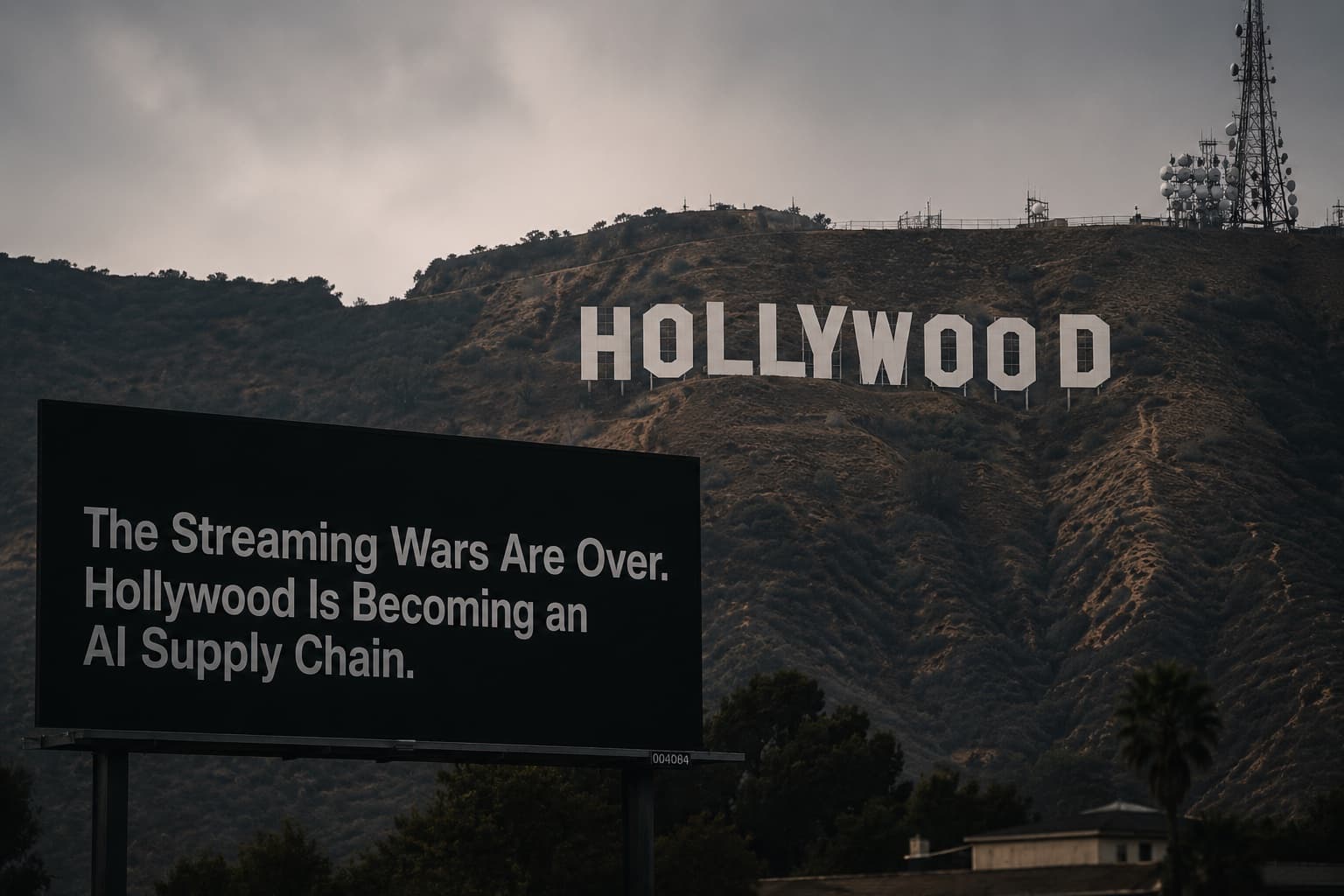

Hollywood is no longer fighting the streaming wars. That era is over.
The new fight is bigger, colder, and far more structural. The industry is being rebuilt around consolidation, artificial intelligence, sports rights, platform control, and labor compression. The proposed Paramount Skydance acquisition of Warner Bros. Discovery is not just another media merger. It is a signal that the next version of Hollywood will be controlled by fewer companies, larger libraries, deeper debt structures, and increasingly automated production systems.
This is not a story about entertainment gossip. It is a story about infrastructure.
Hollywood is not becoming more creative. It is becoming more consolidated.
For years, streaming companies chased subscribers at any cost. Netflix set the pace. Disney, Warner Bros. Discovery, Paramount, Peacock, Apple, and Amazon followed. The promise was simple: more choice, more content, more direct access for consumers.
The result has become something else entirely.
The streaming wars did not end because someone won. They ended because the survivors started buying the battlefield.
Streaming is turning back into cable with algorithms. Prices are rising. Paid subscriptions now carry advertising. Bundles are returning. Sports rights have become premium weapons. Platforms are fighting churn, not just competition. The race is no longer about who can launch the flashiest app. It is about who can survive long enough to own the audience, the library, the advertising stack, and the next distribution lane.
That is why the Warner Bros. Discovery deal matters.
Paramount Skydance’s proposed acquisition would combine major studio infrastructure, streaming platforms, television assets, sports rights, news operations, and some of the most valuable intellectual property in entertainment. Warner Bros., HBO, DC, CNN, TNT Sports, Paramount, CBS, Paramount+, and HBO Max do not represent a normal acquisition target. They represent a media supply chain.
The streaming wars did not end because someone won. They ended because the survivors started buying the battlefield.
The merger is being reviewed by regulators in the United Kingdom and faces state-level scrutiny in the United States. That alone shows how large this transaction is. Regulators are not simply looking at whether two companies can combine their logos. They are looking at whether one merged entity could control too much of the entertainment market, reduce competition, and narrow the number of buyers available to creators, workers, distributors, and consumers.
The public-facing language is scale. The business language is synergy.
That word matters.
AI does not need to replace the movie star to change Hollywood. It only needs to replace the entry-level ladder.
Synergy sounds clean in investor decks. In practice, it usually means merged departments, fewer duplicate roles, shared systems, consolidated offices, reduced vendor relationships, and fewer people doing the work that used to require separate teams. Hollywood workers already understand this. Every merger arrives with promises about growth. Then the cost-cutting starts.
In Hollywood, “synergy” is the word executives use before workers find out which floor got emptied.
At the same time, AI is moving from novelty to production infrastructure.
The clearest warning shot is Dreams of Violets, a feature-length AI-generated film premiering at Tribeca. The film was reportedly created for roughly $2,000 using AI tools instead of a traditional production model. No normal feature budget. No traditional cast. No full camera crew. No physical sets operating at standard scale.
That does not mean every blockbuster becomes an AI film tomorrow. That is not the point.
The point is proof of concept.
If one creator can produce a festival-screened feature using AI tools and a tiny budget, studios will not ignore the math. They may not replace prestige filmmaking first. They will start where the risk is lower and the volume is higher: pitch reels, storyboards, previsualization, localization, dubbing, synthetic backgrounds, marketing assets, short-form dramas, low-budget genre content, animated tests, background performers, and filler programming for global platforms.
AI does not need to replace the movie star to change Hollywood. It only needs to replace the entry-level ladder.
That is where the labor threat becomes most serious.
The first people exposed are not the A-list actors with franchise contracts. The first people exposed are background performers, junior editors, storyboard artists, concept artists, low-budget camera crews, voiceover talent, casting assistants, production assistants, freelance post-production workers, indie writers, and emerging filmmakers.
These are the workers who make the industry function. They are also the workers who use lower-budget projects to build careers, credits, relationships, and leverage.
If AI absorbs that layer, Hollywood does not just lose jobs. It loses its apprenticeship system.
The entertainment industry has always depended on a middle class of creative labor. Not everyone begins at the top. Workers climb through shorts, indie projects, background work, assistant jobs, post-production rooms, writers’ rooms, and production departments. Remove the lower rungs, and the industry becomes even more closed, more inherited, and more dependent on capital access.
The most vulnerable person in Hollywood is not the celebrity. It is the person trying to become one.
This is the real connection between streaming, AI, and the Warner Bros. Discovery transaction.
Consolidation reduces the number of buyers.
Streaming economics reduce the tolerance for expensive risk.
AI reduces the need for traditional labor in certain production categories.
Together, they create a new studio system built around fewer gatekeepers, cheaper content pipelines, and more control over distribution.
That is not creative democratization. That is industrial redesign.
Supporters will argue that AI gives independent creators access to tools they could never afford. That is partly true. A filmmaker without financing can now build visual worlds that once required studio backing. But the same tools that empower one independent artist can also be used by major studios to pressure wages, reduce crew size, and justify lower budgets.
Technology does not arrive in a vacuum. It arrives inside a business model.
And Hollywood’s business model is currently defined by debt, consolidation, advertising pressure, subscription fatigue, sports rights, franchise dependence, and fewer greenlights.
AI is not entering a healthy Hollywood. It is entering a Hollywood already trained to cut.
The forecast is clear.
In Hollywood, “synergy” is the word executives use before workers find out which floor got emptied.
In 2026, AI becomes normalized in pre-production, pitch development, marketing, localization, and short-form content. In 2027, studios build internal AI workflow teams and call them efficiency departments. By 2028, hybrid production becomes standard: human-led prestige content at the top, AI-assisted volume content underneath.
The public will still see movie stars, red carpets, franchises, and awards campaigns. But underneath that surface, the production economy will continue shifting.
Fewer companies will control more content. Fewer buyers will decide what gets made. Fewer workers will have access to entry-level creative labor. More content will be produced by systems designed to lower dependency on people.
Hollywood is not dying.
It is becoming a supply chain.
And like every supply chain touched by automation, the first question is not what the technology can create.
The first question is who the technology makes unnecessary.
Related Articles on IMFounder
- Netflix Is Quietly Rewriting the Rules of Streaming, And Most People Haven’t Noticed Yet
- A Battle Between Titans: How Netflix, Paramount, and Comcast Are Competing to Buy Warner Bros
- The Streaming Wars Backfired: Why Piracy Is Surging in the United States, Canada, and Globally