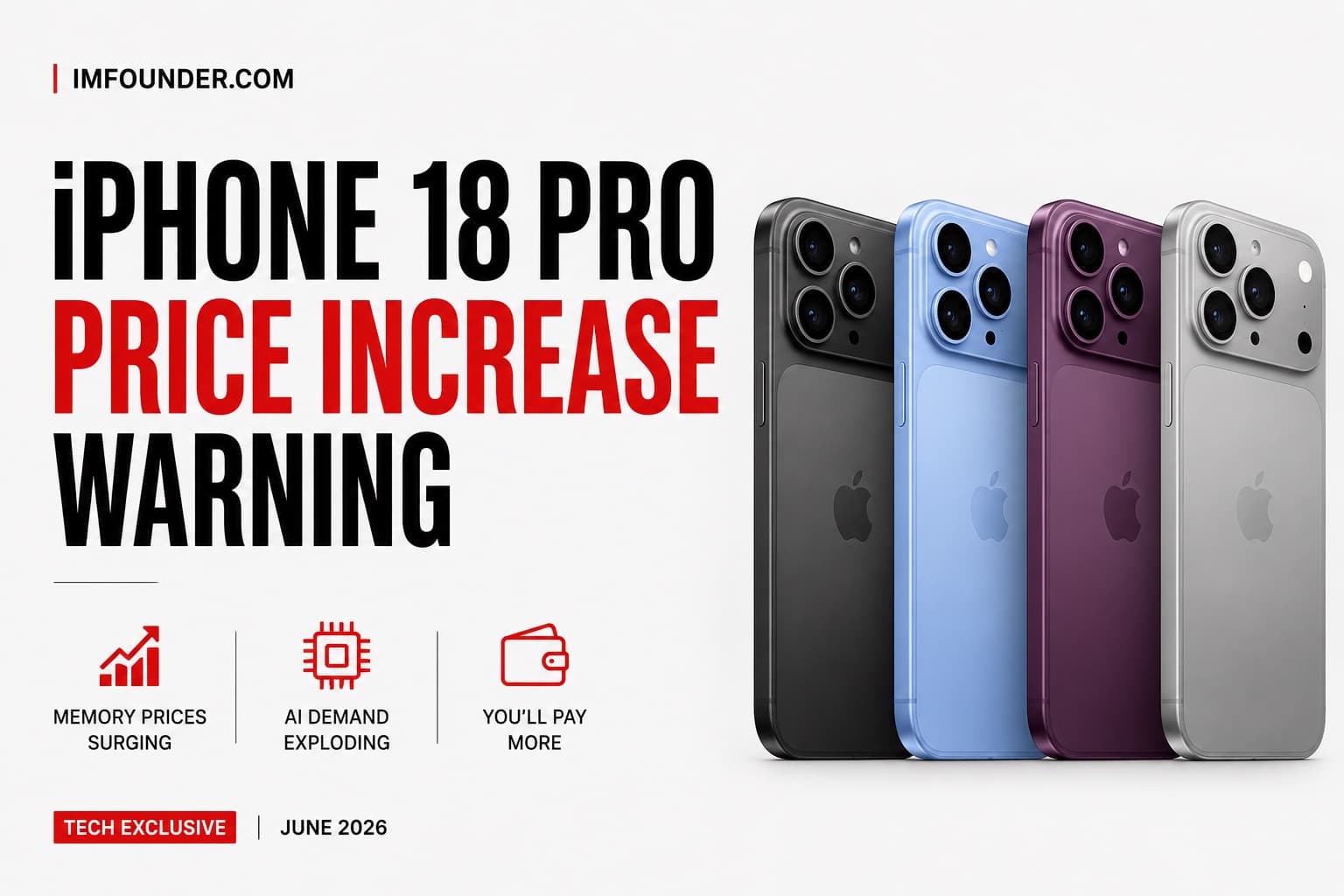

The iPhone price increase memory crisis is no longer speculation whispered in analyst calls — it’s been confirmed at the highest level. Apple CEO Tim Cook told The Wall Street Journal on June 17, 2026, that price hikes across Apple’s entire product lineup are now “unavoidable,” pointing directly to spiraling memory component costs driven by the global AI boom. For hundreds of millions of iPhone users, the message is blunt: your next device will cost significantly more — and the culprit is not Apple.
1. Tim Cook’s Bombshell: The iPhone Price Increase Is “Unavoidable”
Cook is not a CEO who typically reaches for alarm language. Which is exactly why his June 17 statement to the Wall Street Journal hit the tech world like a thunderclap.
“Unfortunately, price increases are unavoidable. We’re doing our best to mitigate the huge increases that are being passed to us, and we’ve been trying to shield our customers from the increases, but the situation has become unsustainable.”
Apple has long wielded its enormous purchasing muscle to absorb component price swings and protect consumers. That shield has now officially cracked. According to analysts cited by TechSpot, the upcoming iPhone 18 Pro lineup could see prices jump by $200 or more, and the anticipated foldable iPhone Ultra is expected to debut at no less than $2,000.
2. The AI Memory Crisis Is the Engine Behind Every iPhone Price Hike
To understand why Cook is sounding the alarm, you need to follow the memory supply chain — and we already did. In our investigative deep-dive The Great RAM Squeeze: How AI Is Manipulating the Memory Market, we exposed how Big Tech AI companies are systematically starving consumers of affordable RAM.

The condensed version: Samsung, SK Hynix, and Micron — three companies controlling over 93% of global DRAM production — have pivoted their factories away from consumer memory toward High-Bandwidth Memory (HBM) for AI accelerators. The margins are irresistible. AI companies pay 2–3× what a consumer device maker will. And the contracts are enormous.
Micron took it a step further by shutting down its entire Crucial consumer RAM brand by February 2026, effectively removing 25% of open-market DRAM supply in a single business decision. The result has been catastrophic for consumer electronics pricing across the board.
3. AI Data Centers Are the Hidden Memory Thieves Behind Your iPhone Price Hike
How One AI Deal Broke the Entire Memory Market
Here is the uncomfortable truth buried beneath the corporate euphemisms: every time OpenAI trains a new model, every time Meta builds a new data center cluster, billions of memory chips are absorbed that would otherwise land in your iPhone, laptop, or gaming console.
Reports indicate that OpenAI’s Stargate infrastructure project alone locked up an estimated 40% of global DRAM supply in a single procurement deal, according to Implicator.ai. RAM prices tripled in the weeks that followed. Every consumer device category absorbed the shock — smartphones, laptops, gaming hardware, even cars with smart electronics.
Apple’s vast supply chain leverage kept it insulated longer than most manufacturers. But as Cook made clear, even Cupertino has hit its breaking point.
4. How Much More Will the iPhone Price Increase Memory Crisis Actually Cost You?
Real Numbers for Real Consumers
The current iPhone lineup sits at: iPhone Air at $999, iPhone 17 at $799, and iPhone 17 Pro at $1,099. If the $200+ increase projections prove accurate — and analysts have little reason to believe they won’t — brace for the following:
- iPhone 18 Pro: ~$1,299–$1,399 starting price
- iPhone 18 Pro Max: potentially $1,499+
- iPhone Ultra (foldable): $2,000+, possibly higher at launch
Critically, experts warn that elevated memory costs are unlikely to normalize before 2027 at the earliest, according to Attack of the Fanboy. That means two full Apple product generations will be priced in this new, inflated reality.
5. Apple Is Not Alone — This Is a Full-Scale Consumer Electronics Crisis
The iPhone Price Increase Memory Crisis Is a Symptom of a Larger War
Apple is only the most visible casualty. Across the industry, the story is the same:
- Laptop prices are projected to rise by approximately 40% due to memory cost inflation
- SSD prices have surged to 16× the cost of traditional hard drives amid the AI supply chain crisis
- Xiaomi has warned of significant smartphone price hikes as memory component budgets swell by an estimated 25%
- Valve confirmed Steam Deck stock issues tied directly to the same memory and storage shortage
- Entry-level PCs may effectively disappear as a product category by 2028 if pricing trajectories hold
The AI revolution is real, it is powerful, and it is expensive. The question no one in the tech industry wants to answer honestly is: who pays for it?
The answer, as Tim Cook has now confirmed, is you.
What Should You Do Right Now?
If you are sitting on an iPhone 13, 14, or 15 and have been waiting for the right moment to upgrade, that moment is now. The iPhone 17 lineup may represent the last generation of Apple’s “pre-crisis” pricing era. Once iPhone 18 pricing rolls out — expected in fall 2026 — consumers will face a very different sticker reality.
We will continue tracking the AI-driven memory crisis and its impact on everyday consumer technology. For the full context on how the semiconductor industry got here, read our original investigation: The Great RAM Squeeze: How AI Is Manipulating the Memory Market.
Related Articles on IMFounder
- AMD CEO Lisa Su just killed Nvidia’s $4,000 AI box
- Fable 5 Shockwave: Why the AI Arms Race Just Turned Geopolitical
- Apple Forgot Steve Jobs’ Most Important Lesson: Design Is How It Works
- Inside the Trump Mobile Scandal: How a $499 “Made in USA” Promise Was Exposed as a Reskinned Chinese Phone
- The WWDC 2026 Announcement
- M5 Chip Was Cracked by an AI in Just 7 Days