
You probably didn’t notice it the last time you opened Netflix.
No major redesign. No headline announcement. No viral rollout.
But something fundamental has changed, and it might be one of the most important shifts in streaming since auto play.
On the surface, Netflix still looks like a content platform.
Underneath, it’s becoming something else entirely.
The Real Problem Was Never Content
For years, Netflix operated under a simple assumption:
More content equals more engagement.
And for a while, that worked. Originals exploded. Libraries expanded. The platform became a global leader in streaming.
But that strategy created a new, less obvious problem.
Too much choice.
Users weren’t leaving because there was nothing to watch.
They were leaving because they didn’t know what to pick.
This is the part most platforms underestimated.
Access is no longer the advantage.
Clarity is.
From Streaming Platform to Decision Engine
What Netflix is building now isn’t just a better recommendation system.
It’s a decision engine.
Instead of asking, “What should we show users?”
Netflix is asking, “How quickly can we help someone press play?”
That shift changes everything.
It shows up in:
- tighter, more confident recommendations
- less emphasis on endless browsing
- faster pathways from opening the app to watching something
Because every second of hesitation is a risk.
Not just that you won’t watch something, but that you’ll leave entirely.
The Fight for Your First 10 Seconds
The biggest competition Netflix faces today isn’t another streaming platform.
It’s speed.
You open an app, scroll for a few seconds, and if nothing grabs you, you move on. That behavior has been shaped by short-form platforms that deliver instant engagement without requiring a decision.
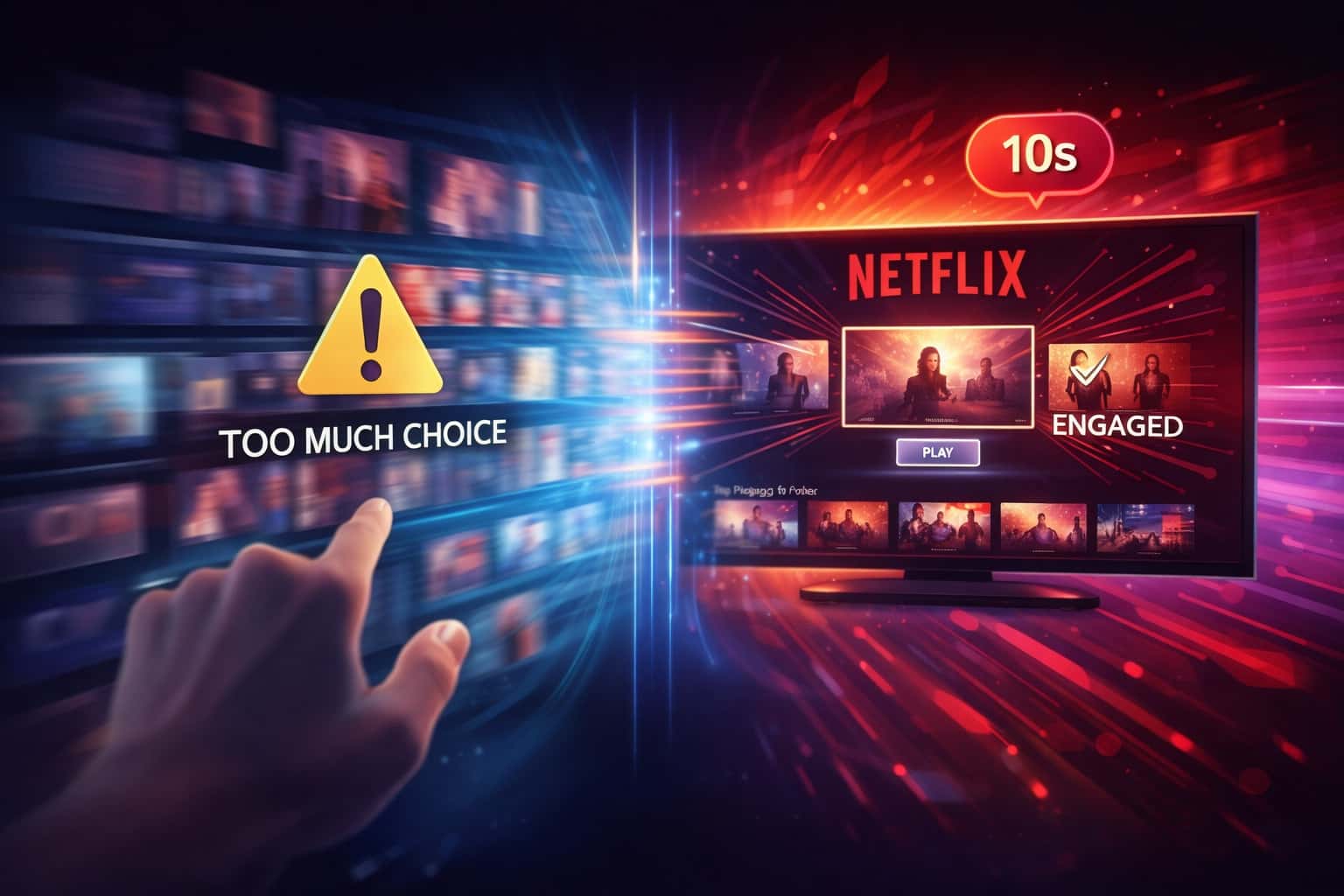
Netflix used to operate differently. It assumed users would take time to browse, explore, and decide.
That behavior is disappearing.
Now, if Netflix doesn’t capture your attention almost immediately, you’re not switching to another show.
You’re switching platforms.
Why More Content Isn’t the Answer Anymore
For years, the solution was simple: produce more.
More shows meant more opportunities to win attention.
But more content also created more friction.
When users are faced with too many options, they don’t make better choices.
They make no choice at all.
This friction is one reason why some viewers are even drifting back toward piracy as streaming becomes more fragmented and harder to navigate.
This is where Netflix is evolving.
Instead of expanding endlessly, it’s focusing on making its existing library feel easier, faster, and more intuitive to navigate.
It’s not about having the biggest catalog anymore.
It’s about making that catalog usable.
The Strategy Behind the Shift
This isn’t a design update. It’s a strategic shift.
Netflix is moving from:
- quantity to precision
- discovery to decision-making
- browsing to immediate engagement
And that shift is happening quietly.
There’s no big campaign around it. No clear feature you can point to.
But the impact is real.
The platform is becoming more opinionated.
More selective.
More focused on reducing friction at every step.
The Risk: When Personalization Becomes Limitation
There’s a trade-off here.
As platforms get better at predicting what you’ll watch, they also risk narrowing what you see.
Less browsing means less discovery.
More precision can lead to repetition.
Over time, this creates a content loop where users are shown more of what they already like, instead of something new.
It’s efficient.
But it can also be limiting.
The Bigger Shift Across Tech
What’s happening with Netflix isn’t isolated.
It’s part of a larger trend across technology.
We’re moving away from platforms that give users choices
and toward platforms that make decisions for them.
Because in a world defined by constant information and limited attention, the most valuable product isn’t content.
It’s clarity.
The Bottom Line
Netflix isn’t trying to win by having the most content anymore.
It’s trying to win by making watching feel effortless.
And if it succeeds, it won’t matter how big a competitor’s library is.
Because the platform that removes friction the fastest
is the one that keeps your attention.
Final Thought
The next time you open Netflix and immediately click on something…
pause for a second.
Did you choose it?
Or did Netflix get really good at choosing it for you?
References: Netflix Research:Here’s a short, clean list with just titles:
- Netflix Research: Recommendation Systems — https://research.netflix.com/research-area/recommendations
- How Netflix Uses Data Analytics to Recommend Content — https://www.jobaajlearnings.com/casestudies/how-netflix-uses-data-analytics
- Netflix Personalization Engine & Sales Conversions — https://www.articsledge.com/post/netflix-s-personalization-engine-and-sales-conversions
- Business Insider: Netflix Homepage and Decision Fatigue — https://www.businessinsider.com/netflix-updates-homepage-combat-decision-fatigue-ai-search
- Netflix Algorithm Case Study (New America) — https://www.newamerica.org/insights/why-am-i-seeing-this/case-study-netflix
- eMarketer: Netflix Algorithm Strategy — https://www.emarketer.com/content/netflix-s-algorithm-bet-faces-churn-test
- Tom’s Guide: Netflix Personalization Limits Discovery — https://www.tomsguide.com/entertainment/netflix/2026-could-be-the-year-to-cancel-your-streaming-subscriptions
Related Reading on IMFounder
- A Battle Between Titans — How Netflix, Paramount, and Comcast Are Competing to Buy Warner Bros
- The Streaming Wars Backfired — Why Piracy Is Surging in the United States, Canada, and Globally
- The TikTok Effect — The Death of the 3-Minute Song