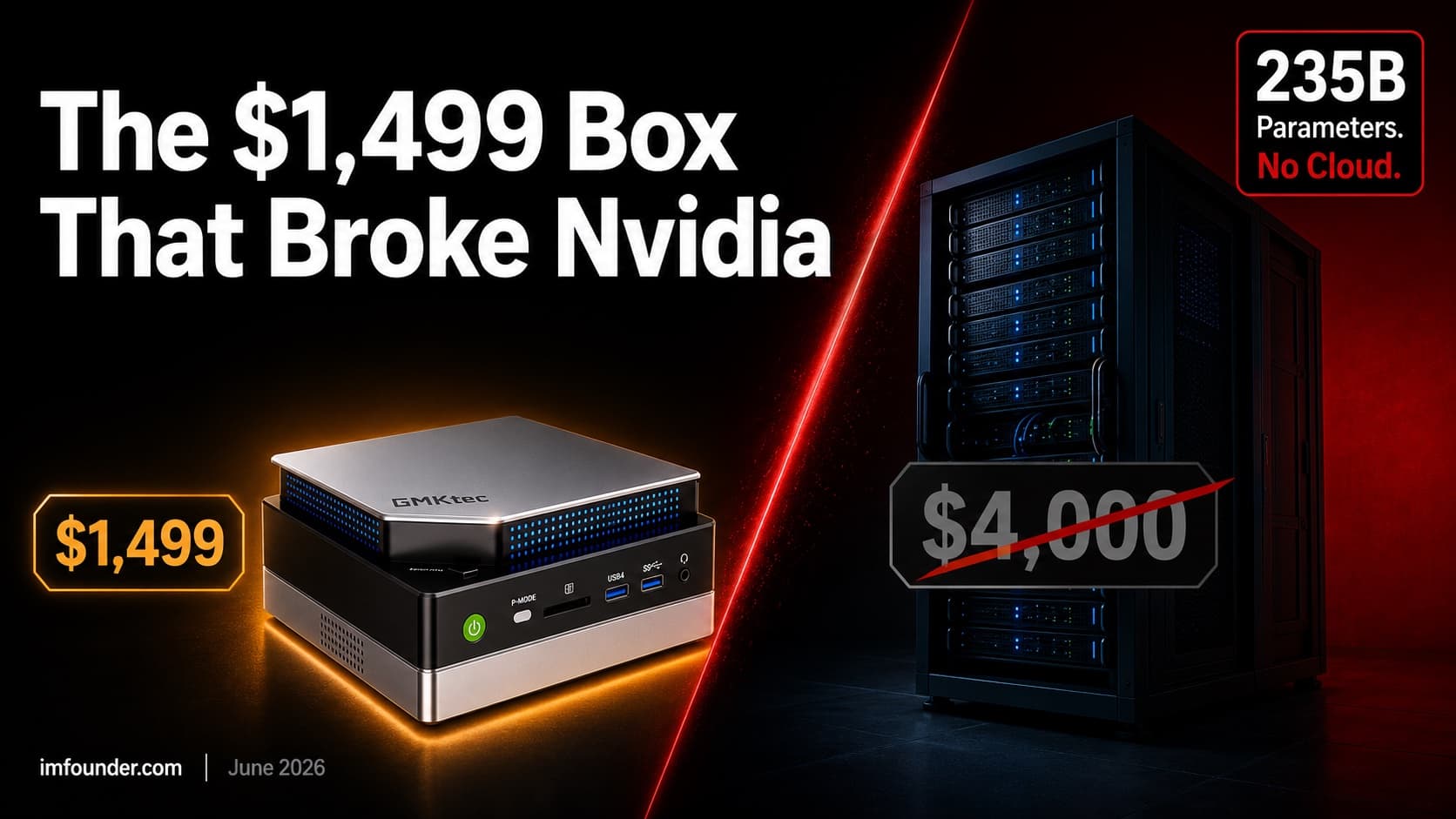

She walked on stage, held it in one hand, and ran a 235-billion-parameter model live. No data center. No cloud. No rented GPU.
The chip inside is something nobody saw coming. The AMD Ryzen AI Max+ 395 is the first x86 silicon where CPU and GPU share the same 128GB of memory. That single trick lets a desktop run models that used to need a server rack.
This isn’t a hardware nerd story. This is a founder story. Because what Lisa Su held in her hand that day isn’t just a product — it’s a repricing of the entire AI industry. And the math hits different when you’re the one cutting the monthly invoices.
Here are 7 reasons this changes everything.
1. The AMD Ryzen AI Max+ 395 Is the First x86 Chip That Actually Solves VRAM
Every AI workload you’ve wanted to run locally has slammed into the same wall: video memory.
An RTX 4090 — Nvidia’s former consumer flagship at roughly $1,600 — gives you 24GB of VRAM. A Llama 3 70B model at 4-bit quantization needs 42GB. That model doesn’t fit. You pay for cloud access instead.
The AMD Ryzen AI Max+ 395 (codename “Strix Halo”) deletes this problem at the architecture level. Built on TSMC’s 4nm process with 16 Zen 5 CPU cores and 40 RDNA 3.5 GPU compute units, its defining feature is 128GB of unified LPDDR5X-8000 memory that CPU and GPU share as one continuous pool.
On Linux, you can assign 110GB of that directly to the GPU. The RTX 5090 — Nvidia’s latest top-tier consumer card — caps out at 32GB. An entire server rack used to be your only alternative. Now it fits in your bag.
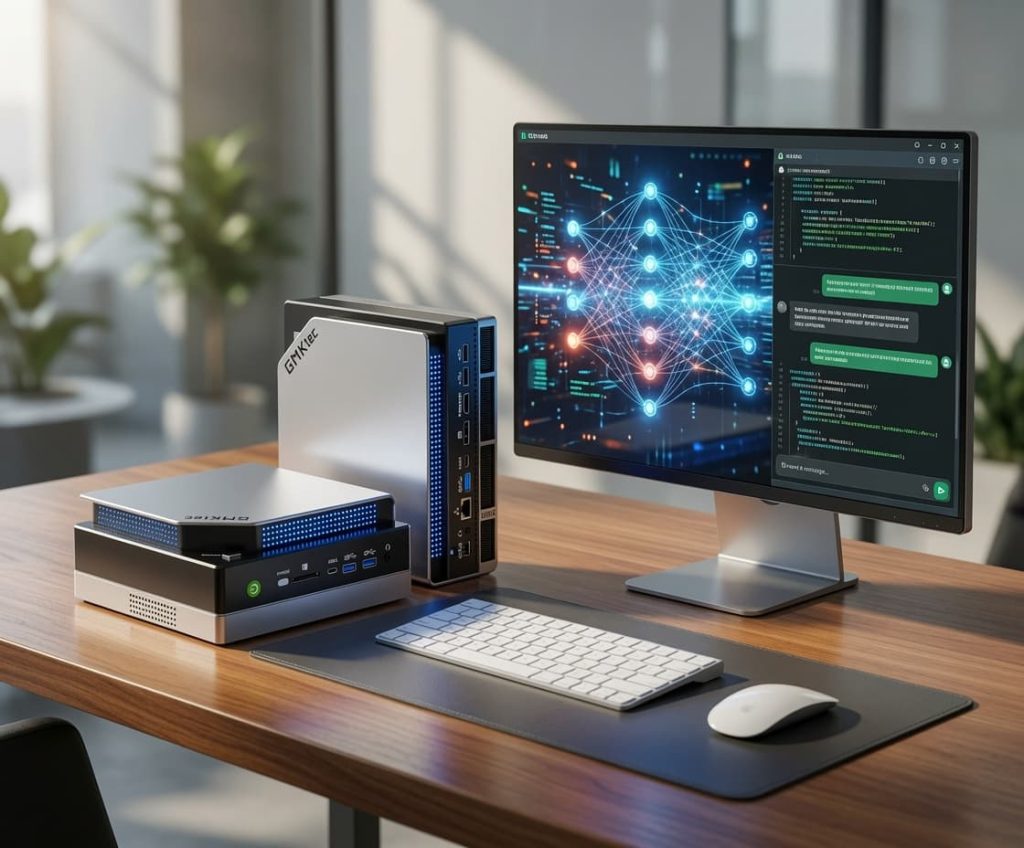
2. This Is the Same Move Apple Made. But for Everyone Else.
Apple’s M-series chips redefined what a laptop could do for AI workloads by sharing memory between CPU and GPU. Founders noticed. The M3 Max became a legitimate local inference machine. But it came with tradeoffs: macOS only, Apple’s walled garden, no x86 compatibility, and a price premium that started at $3,000+.
The AMD Ryzen AI Max+ 395 brings the same unified memory architecture to x86.
That means Windows. Linux. Full compatibility with every AI framework — llama.cpp, Ollama, LM Studio, vLLM, and every tool your stack already depends on. No porting. No rewrites. No ecosystem lock-in.
This is the missing piece. The architecture that was supposed to be Apple’s moat just became a commodity.
3. The Benchmark That Broke the Room
Let’s be concrete. Here are the real numbers from AMD’s demo and independent third-party testing:
AMD Ryzen AI Max+ 395 beat an Nvidia RTX 5080 by more than 3x on DeepSeek R1 inference. Not a theoretical benchmark. Real-world LLM inference. A $1,499 mini PC outran a $1,000 discrete GPU.
On the GMKtec EVO-X2 — the most widely available Ryzen AI Max+ 395 mini PC, available for $1,499–$1,800 depending on storage configuration:
- Qwen3 235B: ~11 tokens/second, first token in 0.03 seconds
- GPT-oss 120B: ~14.7 tokens/second
- Llama 3.3 70B: Fast, with significant headroom to spare
- DeepSeek V3: Runs fully locally, no cloud required
One clarification worth making: Qwen3 235B is a Mixture-of-Experts (MoE) model. It has 235 billion total parameters, but each inference pass activates only about 22 billion of them. That’s why the speed is practical. You’re moving active weights, not the full model.
These numbers aren’t marketing materials. Forum teardowns, independent reviewer benchmarks, and real production deployments from developers on Level1Techs and Reddit are confirming them.
AMD’s official Ryzen AI Max+ 395 benchmark →
4. The Real Cost Problem Founders Are Ignoring
Here’s the math nobody is putting in headlines.
A typical heavy AI user today pays:
| Tool | Monthly Cost |
|---|---|
| Claude Code Max | $200 |
| ChatGPT Pro | $200 |
| Cursor | $20 |
| Gemini Advanced | $20 |
| Total | $440/month |
That’s $5,280 per year leaving your account. For rented intelligence that throttles you at 3am, logs your prompts, goes down during outages, and raises prices whenever it wants.
The AMD Ryzen AI Max+ 395-powered EVO-X2 costs roughly $1,499–$1,800.
At $440/month in avoided subscriptions, the hardware pays for itself in 9 to 10 months.
After that? You’re running frontier-class AI on electricity. Approximately $9–$12 per month at full load, depending on your local rates.
Year one: break even. Year two: free intelligence. Private. Unlimited. Yours.
5. How to Set Up the AMD Ryzen AI Max+ 395 Mini PC in Under an Hour
This is not a hardware project. There is no exotic tooling. No driver nightmare. The setup is genuinely simple.
Step 1: Get the hardware. The GMKtec EVO-X2 (128GB config) is the most accessible option. Available on Amazon →
Step 2: Install Ollama. Open your browser, go to ollama.com, download, run.
Step 3: Pull the model.
bash
ollama pull qwen3:235bStep 4: Point your tools at localhost. Claude Code supports local models via API configuration. Cursor does too. Same interface you already use — except nothing leaves your machine, nothing costs per request, and no company throttles your usage.
On Linux, set the GPU memory to 110GB for maximum performance. On Windows, AMD Variable Graphics Memory gives you up to 96GB. Both configurations handle every major open-weight model available today.
6. What the AMD Ryzen AI Max+ 395 Can Actually Run Right Now
Let’s be specific about what’s in scope for daily founder use:
Comfortably fits and runs fast:
- Qwen3 235B (MoE, full model)
- DeepSeek V3 (full model)
- Llama 3.3 70B (with headroom)
- Gemma 3 27B
- Mistral Large
- Microsoft Phi-4
- GPT-oss 120B
What this chip is NOT for:
- Model training (still need datacenter-scale GPU clusters for that)
- Multi-user API serving at scale (this is a personal inference machine, not a production server)
- Tasks requiring 200GB+ simultaneously (rare at current model sizes)
For reference: AMD’s own benchmarks show the AMD Ryzen AI Max+ 395 hitting up to 9.1x faster inference than competing Intel Arc laptop chips on 7B–8B models. On 14B models, the lead is consistent and decisive.
This is a daily-driver machine for a solo founder, small team, or AI-heavy developer workflow. It is not a proof of concept.
7. What This Means for the AI Industry — And For You
Nvidia spent a decade building a moat around VRAM scarcity.
They convinced every layer of the industry — from hyperscalers to solo founders — that serious AI required their hardware. H100s for training. 4090s for inference. A constant upgrade cycle. Permanent GPU vendor dependency. Software locked to CUDA.
The AMD Ryzen AI Max+ 395 doesn’t just offer an alternative. It reframes the question.
When a $1,499 box with the Ryzen AI Max+ 395 runs the same models as a $4,000 Nvidia DGX Spark — in a chassis the size of a thick paperback — the conversation stops being about which GPU vendor and starts being about whether you need cloud at all.
This matters at the startup level. Your AI costs are operational costs. Every $440/month going to inference subscriptions is money not going into product, hiring, or distribution. A one-time hardware purchase that eliminates recurring inference costs in under a year is a real financial decision. Not a hobbyist experiment.
AMD CEO Lisa Su said at CES 2026: “AI is for everyone.” The AMD Ryzen AI Max+ 395 is what that looks like in silicon.
Who Should Buy This?
Buy it if you:
- Pay $200+/month in LLM subscriptions and use AI daily
- Build with code agents (Claude Code, Cursor, Continue) and want zero latency
- Handle sensitive data, IP, or client code that cannot reach third-party servers
- Are sick of API rate limits killing your momentum at 2am
- Want to stop renting intelligence you already know how to use
Skip it for now if you:
- Only occasionally use ChatGPT for light tasks (API is still cheaper)
- Need to fine-tune or train models (you need different hardware)
- Already have a production GPU server running above 70% utilization
The Bottom Line
The AMD Ryzen AI Max+ 395 is the most disruptive piece of consumer AI hardware to hit the market since Apple’s M1.
Not because the specs are impressive — though they are. Because of what the specs make possible: private, unlimited, frontier-class AI inference, owned outright, paying for itself in under a year.
Lisa Su didn’t walk on stage with a whitepaper. She walked on stage with a lunchbox, held it in one hand, and ran a 235B model. That’s a product demo. That’s a market statement.
Nvidia built a kingdom on VRAM scarcity. AMD just released the flood.
Your move.
Related Articles on IMFounder
- Anthropic Mythos Preview: Revolutionary New AI Model from Anthropic
- Claude Fable 5 Unleashed: The AI Anthropic Called Too Dangerous Is Now Open to Every Founder
- 7 Explosive AI Updates in May 2026 That Will Shock Every Founder
- Why Canada’s Biggest AI Bet Could Be a Game-Changer for Founders and New Immigrants
- The Shocking Cost of ChatGPT and Claude
- ByteDance’s DeerFlow and the Rise of AI Employees
- Are You Using the Wrong AI Tool? A Practical Guide to Choosing the Right AI