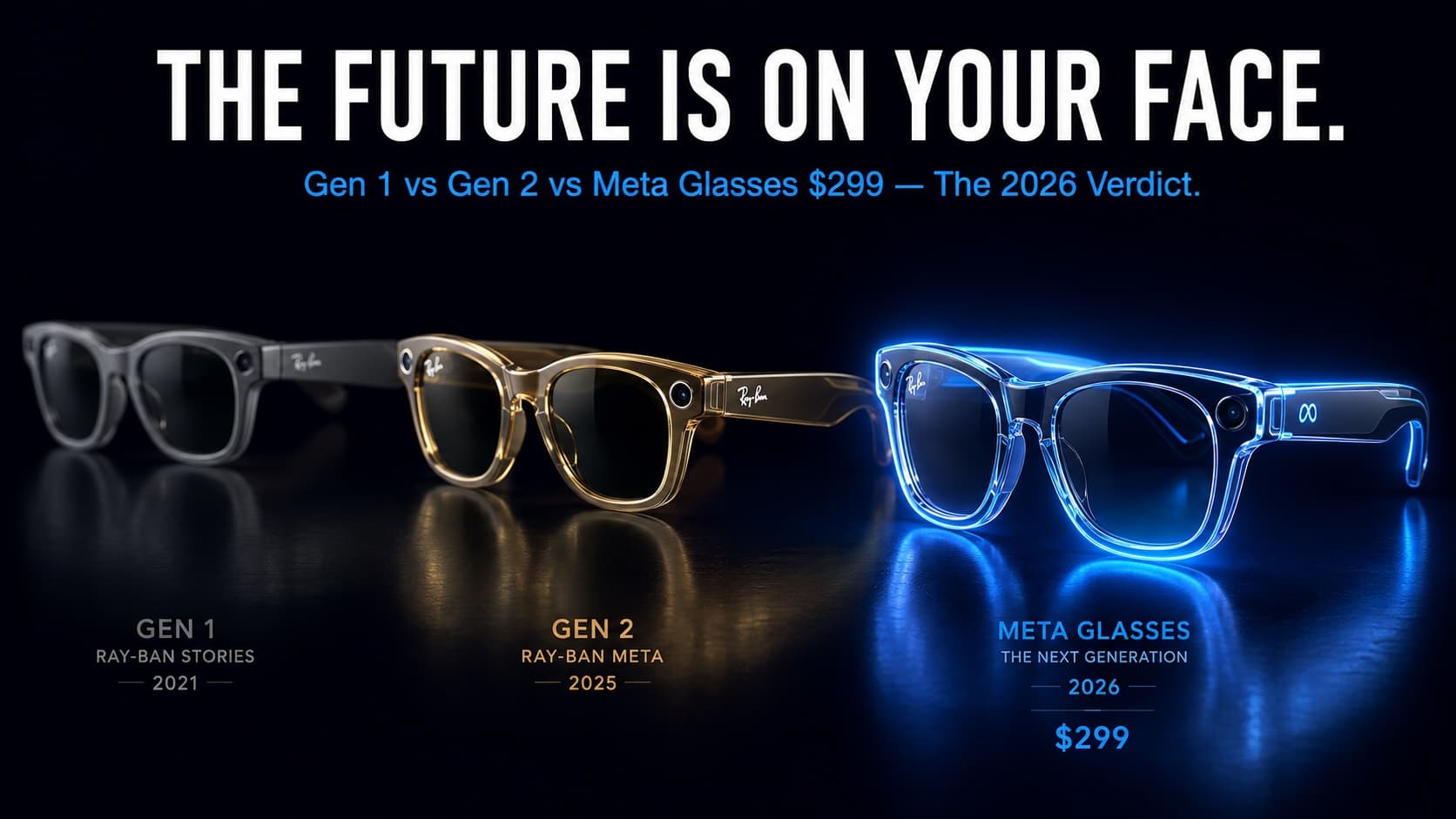

Meta Ray-Ban Smart Glasses have officially gone mainstream — but as of June 23, 2026, the market just got a whole lot more complicated. Meta dropped a bombshell: its very own branded AI glasses, called Meta Glasses, going on sale immediately at $299 — no Ray-Ban logo, no Oakley shield, just Meta. With over two million units sold since launch and a commanding 69–80% share of the global AI glasses market, Meta is now undercutting its own premium lineup to own every price tier. This changes everything about how you should think about buying smart glasses in 2026.
I’ve tested multiple generations of Meta Ray-Ban Smart Glasses — and now got hands-on time with the brand-new Meta Glasses lineup at the launch event. Here is the honest, unfiltered breakdown: Gen 1 vs Gen 2 vs the new $299 Meta Glasses, and exactly what you should buy today.
A Brief History of Meta Ray-Ban Smart Glasses: Four Generations in Five Years
Before the comparison begins, here is the full timeline of how we got here:
2021 — Ray-Ban Stories (The OG): The original Meta–Ray-Ban partnership product. A 5MP camera, 4GB storage, Qualcomm Snapdragon SDA429W, and battery life so short it was borderline offensive. No AI. No live translation. Discontinued, but still resold secondhand.
2023 — Ray-Ban Meta Smart Glasses (Gen 1): The real breakthrough. A 12MP camera, 32GB storage, Qualcomm Snapdragon AR1 Gen 1, and the introduction of Meta AI voice commands. Priced from $299, this is what millions of people own today.
2025 — Ray-Ban Meta Gen 2: Announced at Meta Connect in September 2025. The camera jumped to 3K Ultra HD, battery life doubled to eight hours, and Meta AI expanded significantly. Starts at $379.
June 23, 2026 — Meta Glasses (Breaking): Meta’s first self-branded AI glasses, stripped of Ray-Ban licensing costs, launching at $299. Three models, same Gen 2 hardware, powered by the new Muse Spark AI. Available now at Meta.com, Best Buy, Amazon, LensCrafters, and Sunglass Hut.
1. Design: Identical Frames, Zero Excuses (Still True in 2026)
The Meta Ray-Ban Smart Glasses Gen 2 look exactly like Gen 1. Same three core styles — Wayfarer, Skyler, Headliner. Same camera bump, same privacy LED. Gen 2 is a few grams heavier at 52g versus Gen 1’s 48g, but imperceptible in real life. Gen 2 offers 27 frame and lens combinations, including colorways like Shiny Cosmic Blue and Mystic Violet.
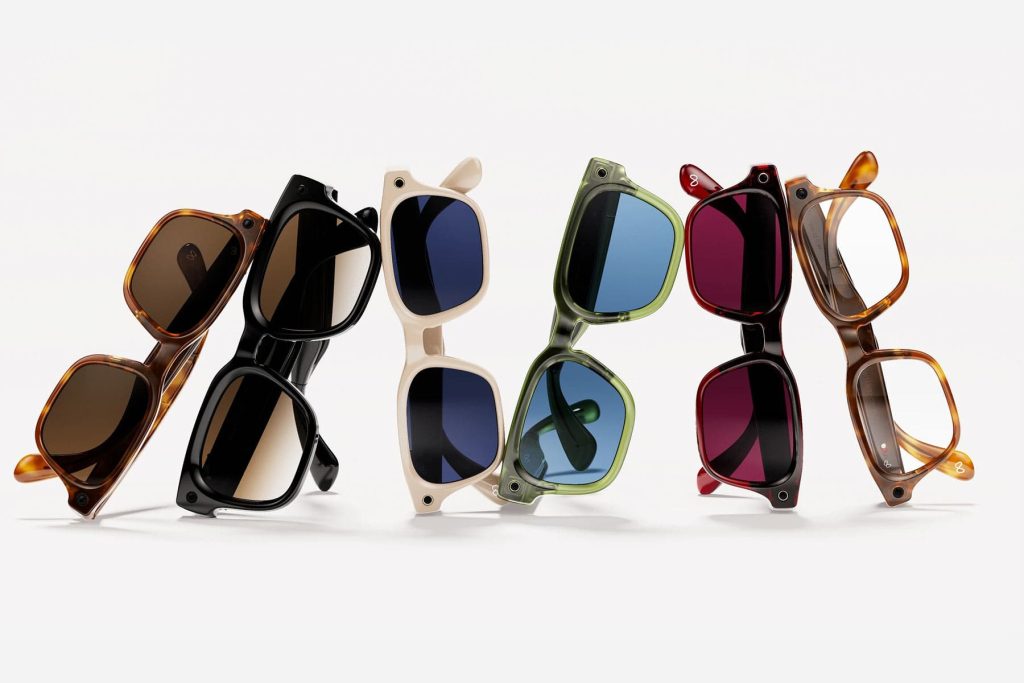
The new Meta Glasses (2026) take a different visual direction entirely. The Meta Adventurer is a clean, slim rectangle — think everyday-wearable Wayfarer-adjacent. The Meta Fury is bolder, thicker, more statement-making, with a striking translucent racing green colorway that actually reveals the circuitry underneath. The Meta Starfire (co-designed with Kylie Jenner, $399) is a slim oval frame closer to Prada or Gentle Monster than anything Meta has shipped before. The entire new lineup also features three-way adjustable nose pads, over-extension flexible hinges, and adjustable temple tips — ergonomic upgrades that the Ray-Ban line still lacks.
2. Camera: The Meta Ray-Ban Smart Glasses Gen 2 Win — Now Matched at $80 Less
The 2023 Meta Ray-Ban Smart Glasses captured video at 1080p at 30fps. Gen 2 jumped to 3K Ultra HD — maximum photo resolution of 3024×4032 pixels, with 3K at 30fps, 1200p at 60fps, and incoming slow-motion and hyperlapse modes. Image stabilization improved dramatically, producing near-cinematic smoothness during movement.
Here is the critical update: the new Meta Glasses (Adventurer and Fury) carry the exact same camera hardware as the Ray-Ban Meta Gen 2. Identical 12-megapixel ultrawide camera. Identical 3K video recording. Identical five-microphone array. The new lineup also adds a Dynamic Photo feature — a quick burst that automatically selects the sharpest frame from the sequence — a practical fix for the notoriously difficult blind-shooting experience. All this for $80 less than the Gen 2 Ray-Ban.
3. Battery Life: Gen 1’s Dirtiest Secret Is Solved — By Both Gen 2 and the New Meta Glasses
The original Meta Ray-Ban Smart Glasses Gen 1 offered roughly two to four hours of real-world battery life, which often depleted well below that after aging through twelve months of use.
“By early 2025, when I ran a half-marathon wearing them, they barely lasted two hours.” — Android Central reviewer, after six months with Gen 1.
Both the Ray-Ban Meta Gen 2 and the brand-new Meta Glasses fix this completely. Both deliver up to eight hours of typical use on a single charge, with the charging case adding approximately 40–48 hours of reserve. Both fast-charge to 50% in 20 minutes. The battery problem that plagued Gen 1 is simply gone — from both new options.
4. Muse Spark AI: The Feature That Makes the New Meta Glasses a Different Beast
This is where the June 2026 Meta Glasses pull ahead of everything that came before — including the Ray-Ban Gen 2. Both the Gen 1 and Gen 2 Meta Ray-Ban Smart Glasses run on the Qualcomm Snapdragon AR1 Gen 1 processor and share Meta AI via software updates. The new Meta Glasses ship with Muse Spark — Meta’s first proprietary, closed-weight AI model from its Meta Superintelligence Labs division, built specifically for wearable inference.
What does Muse Spark actually change? First, it operates in three modes — Instant (fast, low-latency replies), Thinking (deeper reasoning), and Contemplating (complex multi-step queries) — trading speed for depth depending on what you ask. Second, live translation now covers 20 languages, up from six on the Ray-Ban Gen 2 — adding Mandarin, Korean, Japanese, Arabic, and Hindi, among others. Third, a new pedestrian navigation feature is rolling out to provide turn-by-turn audio directions through the speakers without needing to check your phone. When CNN tested the glasses at the launch event, they correctly estimated the calorie content of a bowl of strawberries, translated Arabic signs to English in real time, and surfaced nearby museum recommendations from a casual spoken query.
Critically: Meta has confirmed Muse Spark is rolling out to existing Meta Ray-Ban Smart Glasses Gen 2 as a software update — so Gen 2 owners will gain these AI improvements too. Gen 1 owners may receive a partial rollout depending on hardware constraints.
5. Audio Quality: Consistently Excellent Across All Meta Glasses Lines
All current generations of Meta Ray-Ban Smart Glasses — and now the Meta Glasses — use the same open-ear directional speaker system and five-microphone array. Audio quality is genuinely impressive for glasses: rich mids, enough bass for casual listening, and clean call quality. The Conversation Focus mode, which amplifies the voice of whoever you are talking to in crowded environments, is available across Gen 2 and the new Meta Glasses. The new Meta Starfire adds one exclusive audio feature: you can set an AI-generated version of Kylie Jenner’s voice as your assistant, including for onboarding, battery alerts, and navigation cues.
6. BREAKING: Meta’s Very Own Smart Glasses Go on Sale for $299 — Full Breakdown
On June 23, 2026, Meta and EssilorLuxottica launched Meta Glasses — the first AI glasses to carry Meta’s own brand name instead of Ray-Ban or Oakley. This is not a minor product update. It is a strategic declaration: Meta is building its own hardware identity, separate from any licensed brand, at a price point designed for mass-market penetration.
Why $299? Meta CTO Andrew Bosworth put it plainly at the New York launch event: “Reaching people isn’t just about design and style. It’s also about the price point that you can reach, and so if you’re going to be wearing the Ray-Ban Wayfarer, you pay a premium for that.” The $299 price strips the Ray-Ban licensing cost out of the equation while keeping identical core hardware. EssilorLuxottica still manufactures every unit — their logo appears on the temple arms — but the Ray-Ban wordmark is gone.
The three models:
- Meta Adventurer ($299) — Classic rectangle shape, available in Standard and Large sizing. Clean, wearable, versatile. Multiple color options including tortoise, black, and green.
- Meta Fury ($299) — Bolder, thicker rectangular silhouette. Includes a striking translucent racing green finish that reveals the electronics inside. More statement, less understated.
- Meta Starfire / Meta Glasses by Kylie ($399) — Co-designed with Kylie Jenner. Slim oval frame, a subtle gemstone on the right lens near the camera, a metal nose pad (easier to clean makeup), a mirror inside the charging case, and the exclusive option to use an AI-generated version of Jenner’s voice for all assistant functions.
Together, the Adventurer and Fury offer 26 color and lens combinations, prescription support from -12 to +2.25 (a wider range than the Ray-Ban line’s -6 to +4), plus Transitions, polarized, and clear options. Read the full hands-on from Engadget’s launch coverage for an in-depth look at all three models.
Market context: IDC reports that smart glasses shipments surged 167% in Q1 2026 versus Q1 2025. Meta holds approximately 69–80% of the global AI glasses market. Average selling prices are expected to fall from $376 in 2026 to $229 by 2030, meaning the democratization of smart glasses is only accelerating. Competition is coming — Google and Samsung are collaborating on AI glasses launching later in 2026, and Snap launched its fully AR Specs on June 16 at $2,195 — but for now, Meta has the entire mainstream tier to itself.
7. Privacy: The Uncomfortable Reality Across Every Meta Glasses Line
The recording LED on all generations of Meta Ray-Ban Smart Glasses — and on the new Meta Glasses — has attracted consistent criticism. A 2024 Harvard study demonstrated that hacked glasses could perform real-time facial recognition. In 2026, a Wired investigation (published June 4, 2026) revealed that dormant facial recognition code called NameTag is already installed in the Meta AI companion app on over 50 million phones. The feature is not currently active, but an independent security researcher described the full biometric pipeline as “one switch away” from activation.
There is also the Kenya footage controversy from February 2026: human contractors at a Meta-engaged firm were found to be reviewing video clips captured through users’ glasses as part of an AI training pipeline — including footage of bathroom visits and nudity, captured by users who had opted into AI data sharing without understanding the full scope. Meta acknowledged the reports and said it was reviewing its data practices.
These concerns are not a reason to avoid smart glasses entirely, but they are a reason to be deliberate about where and how you use them. For a thorough breakdown, read Tom’s Guide’s privacy analysis of the Gen 2, and follow the Wired NameTag investigation for the latest on the Meta Glasses.
The Full Price and Specs Comparison: All Meta Glasses Lines in 2026
| Spec | RB Stories (2021) | RB Meta Gen 1 (2023) | RB Meta Gen 2 (2025) | Meta Glasses (2026) |
|---|---|---|---|---|
| Price (starting) | Discontinued | ~$224–$299 | $379 | $299 |
| Camera | 5MP / 1080p | 12MP / 1080p | 12MP / 3K video | 12MP / 3K video |
| Video fps | 30fps | 30fps | 30 / 60fps | 30 / 60fps |
| Battery (glasses) | ~3 hrs | ~4 hrs | ~8 hrs | ~8 hrs |
| Battery (with case) | ~8 hrs | ~32 hrs | ~48 hrs | ~40–48 hrs |
| AI model | None | Meta AI (basic) | Meta AI (expanded) | Muse Spark (new) |
| Live translation | None | 6 languages | 6 languages | 20 languages |
| Dynamic Photo | No | No | No | Yes |
| Pedestrian nav | No | No | No | Coming soon |
| Branding | Ray-Ban | Ray-Ban | Ray-Ban | Meta (own brand) |
| Frame styles | Wayfarer only | Wayfarer, Skyler | Wayfarer, Skyler, Headliner | Adventurer, Fury, Starfire |
| Rx support range | Limited | -6 to +4 | -6 to +4 | -12 to +2.25 |
| Adjustable nose pad | No | No | No | Yes (3-way) |
For full regional pricing, visit Meta’s official Gen 2 announcement and the new Meta Glasses product page.
So — Which Meta Ray-Ban Smart Glasses Should You Actually Buy in 2026?
Buy the new Meta Glasses ($299) if you…
- Are buying AI smart glasses for the first time and want the best value available today
- Want the same Gen 2 camera and battery but prefer Meta’s in-house frame designs over Ray-Ban’s aesthetic
- Need Muse Spark AI, 20-language translation, Dynamic Photo, or wider prescription coverage (-12 to +2.25)
- Like the idea of Meta directly controlling updates and pricing on your device
Buy the Ray-Ban Meta Gen 2 ($379) if you…
- Specifically want the Ray-Ban Wayfarer, Skyler, or Headliner aesthetic — the brand premium is real
- Prefer the established Ray-Ban frames over Meta’s newer, less proven designs
- Are buying as a fashion accessory where the Ray-Ban logo matters to you
- Note: Muse Spark AI is coming to Gen 2 via software update, closing the AI gap
Stick with Ray-Ban Meta Gen 1 ($224–$299) if you…
- Already own a pair and your battery life is still adequate for daily use
- Rarely shoot video, or 1080p has always served your needs
- Want to save money and are comfortable with the older AI capabilities
Skip all of the above if you…
- Want a full AR display right now — look at the Meta Ray-Ban Display ($799) with its 600×600 in-lens display and Neural Band wristband. For an exhaustive alternative comparison, Android Central’s Gen 1 vs Gen 2 breakdown covers every option in the market.
Final Verdict: The Best Meta Ray-Ban Smart Glasses Buy in 2026 Just Changed
Meta Ray-Ban Smart Glasses have been the best AI glasses on the market since 2023. As of June 24, 2026, the answer to “which one should I buy” is more nuanced than ever — and that is a good thing for consumers.
If you are starting fresh, the new Meta Glasses at $299 are almost certainly the right move. You get identical Gen 2 hardware — 3K camera, 8-hour battery, open-ear audio — plus Muse Spark’s smarter AI, 20-language translation, Dynamic Photo, and a wider prescription range, all for $80 less than the Ray-Ban Gen 2. The only thing you lose is the Ray-Ban wordmark on the frame. For most people, that is not a dealbreaker.
If you are an existing Gen 1 owner with working battery life and no pressing video quality needs, upgrading to either Gen 2 or the new Meta Glasses is compelling but not urgent — especially since Muse Spark AI is rolling out as a software update to existing Gen 2 glasses, and may partially reach Gen 1 as well.
The competition is coming. Google and Samsung AI glasses are on the horizon for late 2026. Snap’s $2,195 full-AR Specs arrived last week. Apple is quietly building something. But right now, in June 2026, Meta owns this category — and with a sub-$300 option that matches its premium hardware, the barrier to entry has never been lower.
The future is on your face. And now it costs $299.
Related Articles on IMFounder
- Apple AirPods Max 2 Review: New Features, Same Price
- Apple MacBook Neo: Gimmick or Game Changer?
- While Apple Repeats, Samsung Reinvents
- Pet Owners’ Guide to the Best Vacuums & Robot Cleaners
- Why Breville launched the Oracle® Dual Boiler