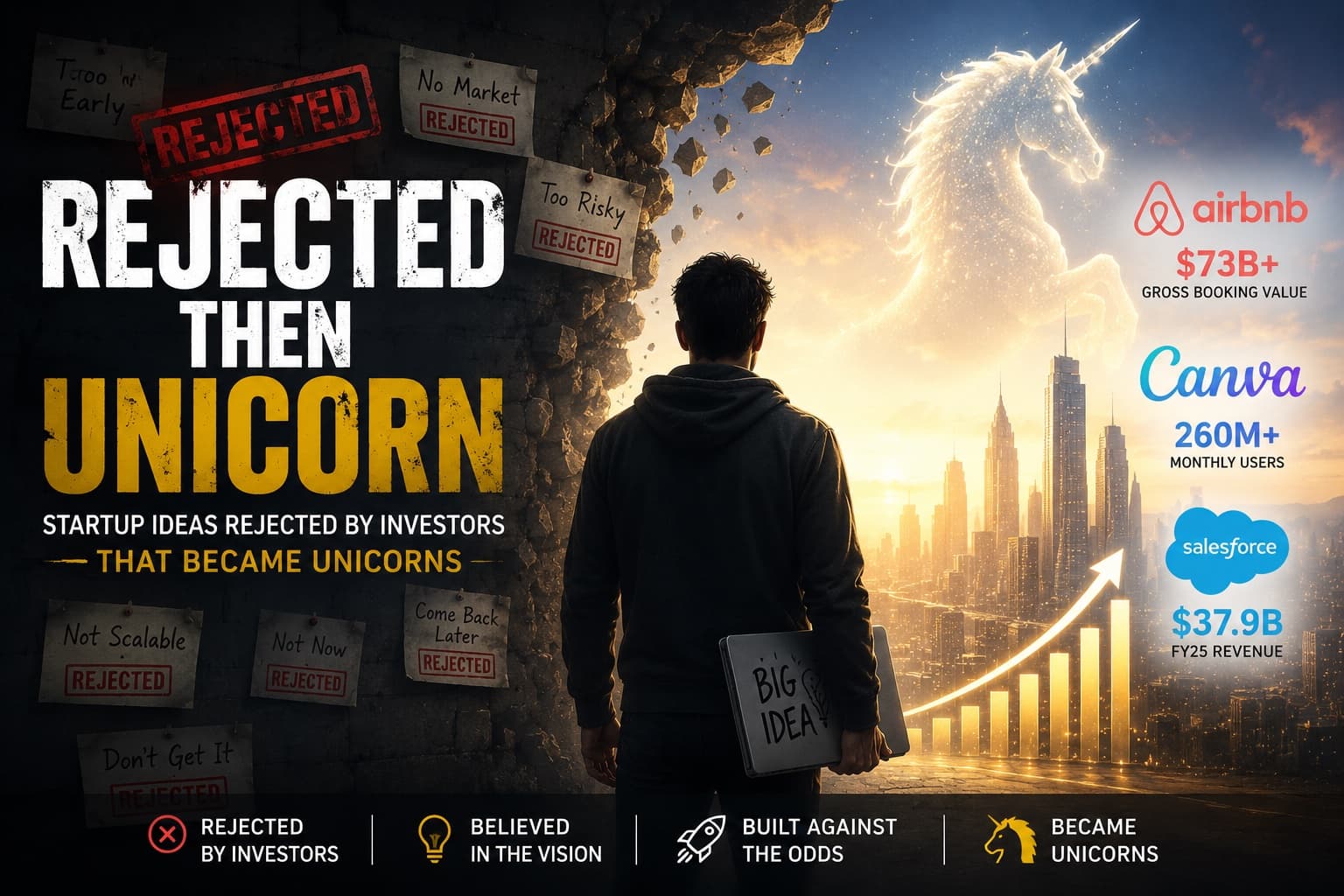

Startup ideas rejected by investors often look too early, too strange, or too small to fund. That is exactly why the best stories in tech are so valuable: they show how many “obvious no’s” were actually missed category creators. Airbnb was turned down by seven investors before becoming a giant; Canva was rejected more than 100 times; Salesforce was also repeatedly dismissed by Silicon Valley capital; and the pattern keeps repeating across modern startup history.
Startup Ideas Rejected by Investors: Airbnb’s Seven No’s
In 2008, Brian Chesky and his co-founders were trying to raise a modest $150,000 for 10% of Airbnb. Seven investors passed. Chesky later wrote publicly about the rejection letters, a reminder that the founders of what became one of the world’s defining travel platforms did not look “venture-backable” to everyone at the time.
The eye-opener is what happened next. Airbnb’s 2023 annual report shows 448.2 million Nights and Experiences Booked and $73.3 billion in gross booking value, with $9.917 billion in revenue and $4.8 billion in net income. That is not a lucky win. That is a scale story that turned a rejected pitch into a global infrastructure layer for travel.
The lesson is simple: investors are not rejecting “future outcomes.” They are rejecting the evidence available at that exact moment. For Airbnb, the evidence was thin. The demand turned out to be massive.
Startup Ideas Rejected by Investors: Canva and the Hundred-No Rule
Canva is one of the strongest modern examples of startup ideas rejected by investors. Melanie Perkins was turned down by more than 100 investors during her early fundraising push, a fact she has discussed in multiple interviews and profiles. Today, Canva’s own newsroom says the company reached 260 million monthly users in 2025 and $3.5 billion in revenue.
That gap between rejection count and scale is what makes Canva so important. The idea looked deceptively simple: make design accessible to everyone, not just professionals. Many investors heard “simple” and translated it into “not big enough.” The market later said the opposite.
This is one of the sharpest reminders in startup history that distribution can be stronger than consensus. Canva did not win by being the loudest pitch in the room. It won by becoming the easiest tool in the room to adopt, share, and keep using.
Startup Ideas Rejected by Investors: Salesforce and the Silicon Valley Wall
Marc Benioff has said that when Salesforce was starting out, he went to venture capital firms across Silicon Valley and was turned down every time. TechCrunch later summarized his account by saying “every VC in Silicon Valley turned us down.”
That rejection looks almost comical now. Salesforce reported $37.9 billion in fiscal 2025 revenue in its official results, and it remains one of the most important enterprise software companies in the world. The company’s growth shows how badly the market can misread a category when the product is ahead of the buyer’s mental model.
Salesforce matters because it proves that even “boring” enterprise software can become extraordinary when the timing, pricing model, and category education finally line up. In the early days, the pitch may have felt premature. Later, it became inevitable.
What These Rejections Really Reveal
The common pattern in startup ideas rejected by investors is not failure. It is mismatch. The investor wants evidence. The founder is trying to create evidence from scratch. The investor sees risk. The founder sees a market that does not yet know how to describe itself. That gap is where unicorns are often born.
There is also a quieter truth: many investors are optimizing for what already resembles success, not what could define the next decade. That is why the best founders often hear the same objections over and over: too early, too niche, too hard to scale, too crowded, too unproven. The companies above proved that those objections are often just descriptions of what category creation looks like before it works.
If you are writing about startups, the real headline is not “investors were wrong.” The real headline is that venture investing is a prediction business, and prediction is weakest exactly where the next giant is being built.
The founder’s takeaway
The best founders do not treat rejection as a verdict. They treat it as feedback about timing, framing, and proof. Airbnb kept going until travel behavior caught up. Canva kept going until design became democratized. Salesforce kept going until cloud software became the default operating layer for business.
For founders, that means one brutal but useful rule: a rejected pitch is not the same thing as a bad company. Sometimes it is just a company that arrived before the room was ready.
Related Articles on IMFounder
- Why Every Startup Suddenly Wants to Become an “AI Company”
- 5 Powerful Startups You Can Launch With Only $1,000
- Why 90% of Startups Fail (Data + Real Case Studies)
- The Founder’s Complete Guide to Visas, Grants & Funding in Canada and the USA
- Top 10 Startup Ideas for 2026: Opportunities Smart Entrepreneurs Should Not Ignore
Sources & References
- Brian Chesky’s original “7 Rejections” story (Airbnb)
- Business Insider: Brian Chesky reflects on early Airbnb investor rejection
- TechCrunch: Marc Benioff says every VC in Silicon Valley turned Salesforce down
- Canva Case Study – 100+ investor rejections before global success
- Founded.com: Melanie Perkins’ Canva origin story and fundraising struggles
- Financial Express: Canva founder rejected by 100 investors before competing with tech giants
- Rejected.vc – Historical database of famous startup rejections