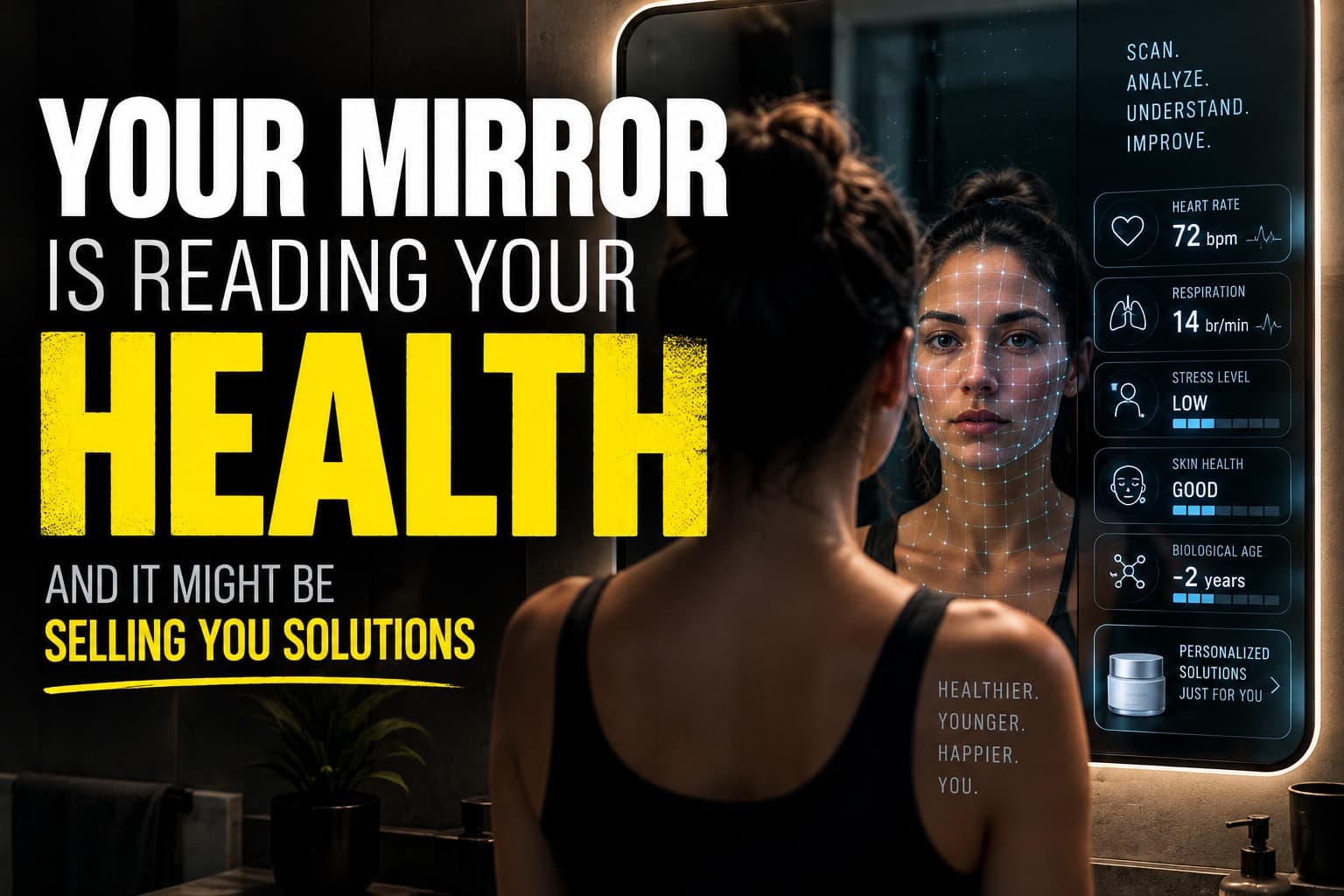

AI-powered mirrors are evolving from beauty devices into biometric health systems that can analyze skin, stress, heart rate and signs of disease—then sell consumers solutions to problems they did not know they had.
The mirror has always been one of the most psychologically loaded objects in the home.
It reflects the face we present to the world, but it also invites inspection. We stand before it searching for evidence: a new line, a bad night’s sleep, a change in weight, an unfamiliar mark or the first suggestion that time has been moving faster than expected.
Until now, the mirror has remained silent.
That is about to change.
A new generation of AI-powered mirrors can analyze the person standing before them, estimate vital signs and produce personalized health information within seconds. Using cameras, specialized lighting and machine-learning models, these systems claim to detect subtle changes in facial blood flow that human eyes cannot see.
Some can estimate pulse and respiration. Others promise insights involving blood pressure, metabolic health, cardiovascular risk, stress and physiological age. Beauty companies are developing related systems that assess skin texture, pigmentation, hydration and visible aging before generating personalized product recommendations.
The mirror is being transformed from a passive surface into a biometric scanner.
That could make preventive health monitoring effortless. It could also create the most intimate sales platform ever installed inside a home.
The smart mirror will not wait for you to identify an insecurity. It will scan your face, manufacture a score and place the solution beside it.
The Camera Can See Your Pulse
The technology behind many health mirrors is known as remote photoplethysmography, or rPPG.
Despite the science-fiction presentation, the basic principle is understandable. Every heartbeat changes the volume of blood moving through vessels beneath the skin. That circulation produces extremely small variations in skin color.
The changes are usually invisible to a person looking in the mirror, but a sufficiently sensitive camera can capture them. Software analyzes the video signal, isolates patterns associated with blood flow and estimates measurements such as heart rate and respiration without touching the body.
Traditional photoplethysmography already powers familiar technologies. A pulse oximeter shines light through a fingertip. Smartwatches use optical sensors against the wrist. Remote PPG attempts to extract related information from a video of the face.
The camera becomes the sensor.
AI is valuable because the signal is messy. Lighting changes. People move. Cameras differ. Skin tones absorb and reflect light differently. Makeup, facial hair and environmental conditions can affect the image.
Machine-learning systems are trained to separate physiological patterns from that visual noise.
What once required a wearable could theoretically happen during an ordinary glance at the bathroom mirror.
That is the seduction of the technology: no cuff, patch, ring, watch or conscious act of measurement. The health check disappears into an existing habit.
You look at yourself. The system looks inside you.
The 30-Second Health Scan Has Arrived
Canadian health-technology company NuraLogix has developed the Anura MagicMirror, a tabletop system that analyzes facial blood-flow information using the company’s DeepAffex AI platform.
The company says its technology can produce numerous measurements and “condition likelihood” assessments from a roughly 30-second facial scan. Its broader platform advertises more than 100 health and wellness parameters, including pulse, respiration, blood-pressure-related information, stress indicators and several categories of health risk.
That language requires precision.
In June 2026, NuraLogix announced that its Anura Mobile Core software received FDA clearance for contactless measurement of adult pulse and respiration rates.
That clearance does not mean every wellness score or disease-risk estimate generated by the company’s broader platform has been approved as a medical diagnosis.
NuraLogix explicitly states that measurements and condition-likelihood assessments beyond its FDA-cleared pulse and breathing features are intended for informational and wellness purposes. They are not intended to diagnose, treat, cure or prevent disease.
That gap—between a cleared measurement and a futuristic screen filled with health predictions—is where the smart-mirror market becomes both fascinating and dangerous.
Consumers rarely interpret a percentage, red warning or “elevated risk” label as casual entertainment. Once a device presents information in medical language, the distinction between wellness and diagnosis can disappear emotionally, even when it remains legally explicit.
A mirror does not need to diagnose a disease to frighten someone into behaving as though it has.
The Bathroom Is Becoming a Clinic
NuraLogix is not alone in imagining the mirror as a health interface.
Health-technology company Withings introduced Omnia, a concept mirror designed to combine data from scales, watches, sleep systems and other connected devices.
Instead of making every measurement through the mirror itself, Omnia acts as a central health display, synthesizing information involving weight, cardiovascular activity, metabolic health, sleep and fitness.
Its AI voice assistant is designed to interpret the information, provide guidance and potentially connect users with medical professionals. Withings has presented Omnia as a concept rather than a commercially available diagnostic device—an important distinction often lost when futuristic products circulate online.
Companies such as Shen.AI are also developing camera-based health technology that can be integrated into mirrors, phones, kiosks and telehealth platforms. Shen says its system can use a short facial scan to estimate measurements including heart rate, heart-rate variability, blood pressure and stress-related indicators.
The commercial vision extends far beyond wealthy consumers installing futuristic hardware in their bathrooms.
Health mirrors could appear in pharmacies, gyms, corporate offices, hospitals, hotels, airports and elder-care facilities. A person could receive a wellness scan while checking into a clinic—or while standing near the cosmetics counter.
This could expand access to basic screening, particularly in areas where clinical staff or conventional equipment are limited. A low-friction system might encourage people to monitor health indicators they would otherwise ignore.
But location changes the power relationship.
A mirror used privately at home is one thing. A mirror installed by an employer, retailer or insurance company is something else entirely.
Who receives the results? How long are they stored? Can the information affect employment benefits, insurance pricing or product eligibility? Is the scan genuinely voluntary if declining it appears suspicious?
The bathroom may become a clinic.
The clinic may become a checkout line.
Beauty Technology Wants the Same Face
Health companies are not the only businesses attempting to extract data from reflections.
At CES 2026, South Korean beauty conglomerate Amorepacific presented AI skin-analysis technology integrated into Samsung Electronics’ AI Beauty Mirror.
The system uses camera-based optical diagnostics to evaluate pores, redness, pigmentation and wrinkles before recommending personalized skincare. According to Amorepacific, the technology draws from a dataset containing more than 450,000 cases.
It is one of the clearest examples of a global electronics manufacturer and a major beauty company combining cosmetic analysis with smart-mirror hardware.
L’Oréal is approaching the same market through software. The company acquired augmented-reality and AI specialist ModiFace in 2018 and has since deployed the technology across makeup, hair-color and skincare experiences.
Its AI-powered skin diagnostic analyzes visible signs including under-eye wrinkles, firmness, fine lines, radiance, dark spots, deeper wrinkles and pores before recommending a personalized product routine.
The consumer-facing L’Oréal Paris Skin Genius compares a user’s selfie with a database of clinically graded faces representing different ages, ethnicities and skin types.
Perfect Corp., the publicly traded beauty-technology company behind YouCam, provides another commercial layer. Its AI Skin Analysis platform evaluates visible skin concerns—including wrinkles, spots, texture, moisture, oiliness and acne—then helps beauty brands and retailers generate individualized product recommendations.
In January 2026, Perfect Corp. partnered with PHOENIX Pharma Italia to bring AI skin analysis and product recommendations into pharmacies.
That places the technology inside a particularly powerful environment: one where beauty, wellness and medical authority already overlap.
These companies are not all manufacturing mirrors. Some build the hardware. Others build the computer-vision engines, consumer databases and recommendation systems that can operate through mirrors, smartphones and retail displays.
Together, they are creating the infrastructure for automated beauty consultation.
The Mirror Can Create a Problem by Measuring It
At its best, AI skin analysis could replace vague marketing with useful personalization.
Consumers would no longer need to select from a wall of nearly identical products based on packaging, influencer content or the most persuasive advertisement. Software could monitor visible changes, compare results over time and identify products appropriate for a person’s skin.
At its worst, the technology becomes an automated insecurity engine.
Beauty advertising has always profited from the distance between how people look and how they believe they should look. AI makes that distance measurable.
The mirror can enlarge a pore, assign it a severity score, compare it with an idealized dataset and recommend a subscription serum before the person has finished brushing their teeth.
The customer does not need to feel dissatisfied when entering the experience. The system can discover dissatisfaction on their behalf.
Personalization sounds benevolent because it promises relevance. But personalization also increases persuasive power.
A generic advertisement says millions of people need a product. A biometric recommendation says your face needs it, this feature is deteriorating and this purchase is the rational response.
That is not conventional marketing.
It is algorithmic intimacy.
The future beauty counter will not ask what you want to change. It will calculate what can be monetized.
Wellness Is Becoming a Full-Time Performance
Turning the face into a dashboard may alter how people experience their bodies.
Wearable technology has already introduced millions of consumers to daily scores for sleep, stress, readiness, recovery and movement. These tools can help users recognize patterns and adopt healthier habits.
They can also create compulsive monitoring.
Researchers and clinicians have discussed “orthosomnia,” in which people become so focused on achieving ideal sleep-tracker scores that the anxiety itself interferes with sleep.
A similar dynamic could emerge when facial scans become part of the morning routine.
A person feels fine until the mirror labels their stress elevated.
They slept well until the device calls their recovery poor.
Their skin looked normal until an algorithm grades its biological age.
The number can become more authoritative than the lived experience.
Smart mirrors may also encourage constant micro-comparisons with previous scans. A small fluctuation caused by lighting, hydration, temperature or model uncertainty could be interpreted as meaningful deterioration.
The person is no longer looking at a face.
They are reviewing performance data.
The Bias Is Already Visible
Camera-based health measurements face a serious technical problem: they depend on light interacting with skin.
A 2025 review published in npj Digital Medicine found that publicly available datasets used in remote-photoplethysmography research were heavily biased toward participants with lighter skin and contained limited representation across demographic groups.
That matters because systems trained on unrepresentative data may perform differently across populations.
Medical technology has already demonstrated the consequences. Pulse oximeters have been found to overestimate blood-oxygen levels in some patients with darker skin, potentially delaying recognition of dangerous hypoxemia. Facial-analysis software has also historically produced higher error rates for darker-skinned people, particularly women.
A smart mirror might therefore deliver its most sophisticated performance to the people best represented in its training data—and less reliable results to everyone else.
The consequences go beyond inconvenience.
A beauty mirror could misclassify pigmentation or inflammation. A wellness mirror could generate inconsistent vital estimates. If users believe the device possesses medical authority, an inaccurate reassuring result could be as harmful as an unnecessary warning.
Performance must be validated across skin tones, ages, lighting conditions, health states and camera environments.
“Works on a face” is not a meaningful standard when human faces vary enormously.
Your Face Is Now Health Data
A smart mirror may collect one of the most sensitive combinations of information imaginable.
It can capture a recognizable image, biometric characteristics, inferred stress, cardiovascular indicators, behavioral patterns and long-term changes in appearance. If the system connects with wearables or health accounts, it could also access information about sleep, weight, activity, fertility or medical history.
A password can be changed after a breach.
A face cannot.
Companies may offer anonymous scanning or claim to process certain information locally. Those protections matter, but consumers need more than a privacy-policy link displayed during setup.
They need to know whether images leave the device, whether raw video is retained, whether results train future models, whether third parties receive inferences and whether deletion removes both the original data and derived biometric profiles.
In the United States, some health information held by doctors and insurers is protected by HIPAA. Consumer wellness technology does not automatically receive identical protection simply because it displays medical-looking information.
The Federal Trade Commission has expanded scrutiny of health apps and connected devices, while states are developing additional rules involving biometric and consumer-health data.
But the technology is advancing faster than the public’s understanding of what is being collected.
A person may consent to a heart-rate scan without realizing that the same facial video could support additional inferences later.
The mirror sees one face.
The company sees a dataset with future commercial possibilities.
Prevention or Permanent Self-Surveillance?
There is a serious positive case for this technology.
Contactless monitoring could support older adults, people with mobility limitations, telehealth patients and communities with limited clinical resources. A mirror that notices a persistent physiological change might encourage someone to seek professional care earlier.
Long-term trends could prove more useful than isolated measurements taken during an annual appointment.
Smart mirrors could help move healthcare from episodic treatment toward continuous prevention.
But useful screening requires clinical restraint.
A device should clearly separate validated measurements from experimental wellness estimates. It should explain uncertainty instead of hiding it behind polished graphics. It should direct serious concerns toward qualified professionals rather than an online store.
Most importantly, the company interpreting the health signal should not be financially rewarded for convincing the user that something is wrong.
That is the conflict at the center of AI lifestyle technology.
The same system capable of identifying a meaningful change can also identify the precise moment a person becomes vulnerable to a sale.
Mirror, Mirror, on the Wall—Who Owns the Healthiest Data of All?
The smart mirror will probably not arrive as one dramatic product that suddenly replaces the glass above every bathroom sink.
Its functions will spread gradually.
A skincare scanner appears in a beauty app. A camera estimates heart rate during telehealth. A fitness display adds stress analysis. A hotel mirror offers a wellness check. An insurer rewards voluntary biometric monitoring.
Eventually, being analyzed while looking at yourself may stop feeling unusual.
That normalization is the real story.
A traditional mirror provides a reflection without retaining it. It does not remember yesterday’s face, compare it with today’s or transmit the difference to a cloud platform.
The AI mirror remembers.
That memory could reveal early warning signs, support healthier decisions and make preventive screening more accessible. It could also intensify body anxiety, reproduce medical bias and convert private biological change into a recurring revenue stream.
The technology is not inherently dystopian. But placing a diagnostic-looking system inside one of the most psychologically sensitive rituals of daily life demands more than technical accuracy.
It demands rules about who may measure us, what they may infer and whether they are allowed to sell us something immediately afterward.
For centuries, people have asked mirrors whether they looked old, tired, healthy or beautiful.
Soon, the mirror may answer.
The question is whether it will be speaking as a health tool—or as a salesperson.
Related Articles on IMFounder
- How Sysco Corporation Consolidated the Middle Layer of Food Distribution
- Why Starbucks’ TikTok Creator Program Changes the Future of Work
- Fashion Is Designing Clothes That Make You Invisible to AI
- The New Beauty Standard Is Not Born. It Is Rendered. How AI Is Redefining Beauty
- 7 Brutal Truths About Meta Ray-Ban Smart Glasses Gen 2 vs Gen 1
- The Rise of Streetwear in North America: From Subculture to Mainstream