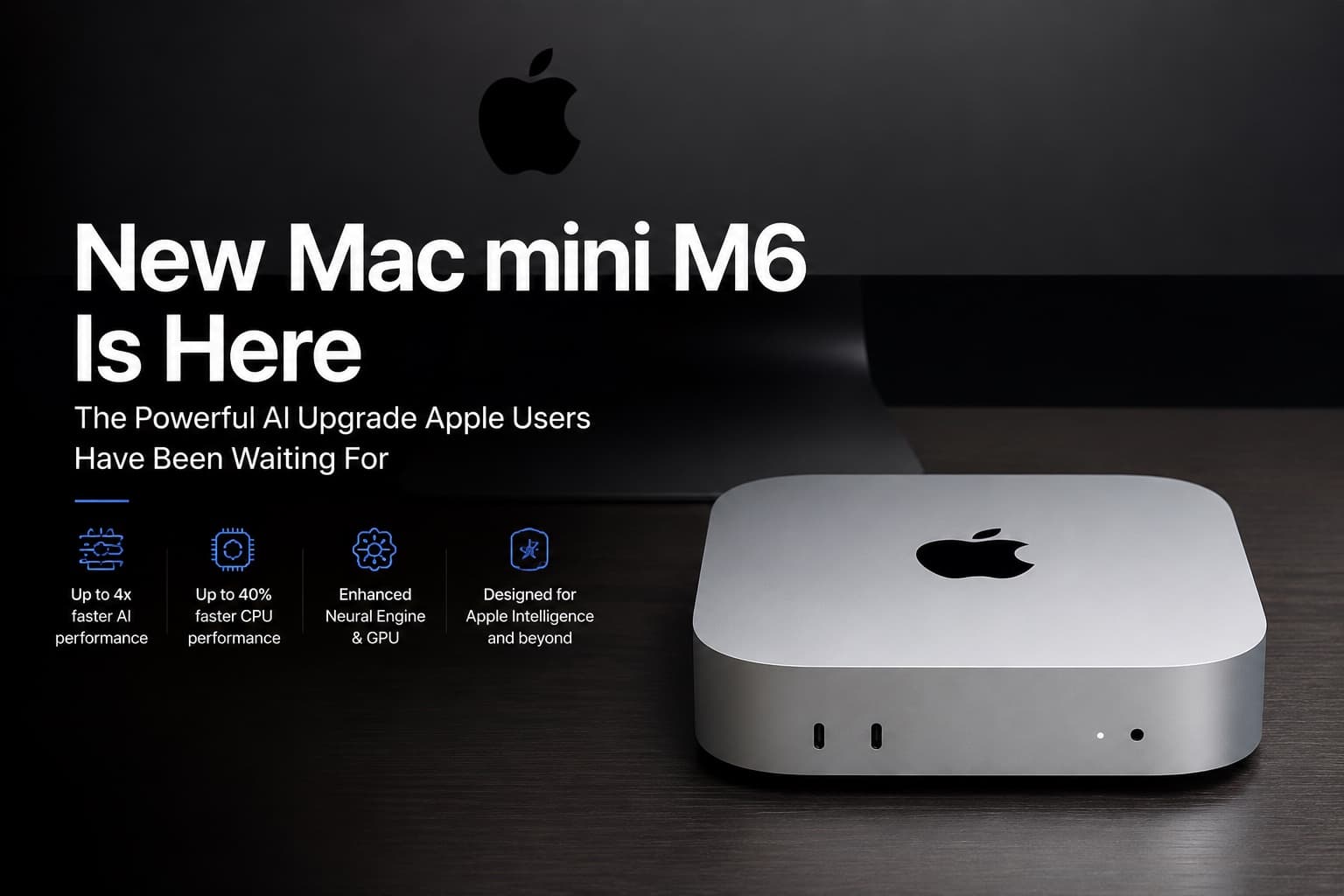

Apple has officially unveiled the new Mac mini M6, alongside a more powerful Mac mini M5 Pro, and this tiny desktop may represent one of the company’s most interesting hardware releases in years.
The reason isn’t simply that the processors are faster.
The new Mac mini is being pushed into a very different era of computing: local AI, agentic workflows and powerful on-device intelligence.
Apple says the Mac mini M6 delivers up to four times faster AI performance, up to twice the graphics and storage performance, and up to 40% faster CPU performance compared with the previous generation in selected workloads. Meanwhile, the M5 Pro version is aimed squarely at developers, video professionals and users running significantly more demanding workflows.
But specifications are only half the story.
The much bigger question is whether the new Mac mini can genuinely become an affordable AI workstation — and whether existing Mac owners should spend their money upgrading.
New Mac mini M6: What Has Actually Changed?
At first glance, almost nothing.
The new Mac mini keeps the same incredibly compact design introduced with the M4 generation. Apple hasn’t attempted to reinvent the exterior because, frankly, it didn’t need to. The real transformation is happening inside.
The entry-level model now uses Apple’s new M6 chip, while the higher-end configuration uses the M5 Pro.
The M6 includes:
- 12-core CPU
- 12-core GPU
- Neural Accelerators integrated into GPU cores
- Dual 16-core Neural Engine
- Up to 32GB unified memory
- Up to 170GB/s memory bandwidth
Apple says these architectural changes allow the M6 Mac mini to deliver up to four times faster AI performance than the M4 Mac mini in selected comparisons.
The M5 Pro takes things further, with configurations reaching an 18-core CPU, 20-core GPU and up to 64GB of unified memory. That additional memory matters enormously for professional workloads and, increasingly, for local AI.
This is one of the most important things buyers should understand: in the AI era, memory is becoming just as important as processor speed.
Can the New Mac mini M6 Run AI Natively?
Yes — and this is arguably the biggest reason the new Mac mini exists.
The new Mac mini can run AI workloads locally, meaning certain tasks can be processed directly on your computer rather than being sent entirely to a cloud server.
That has several advantages:
- Better privacy
- Faster response times
- No per-query cloud API cost for some workflows
- Ability to work with sensitive local data
- More control for developers
- Potential for always-on AI automation
Apple’s hardware architecture combines the CPU, GPU and Neural Engine for AI workloads. The M6 also introduces Neural Accelerators within the GPU cores on Mac mini, while Apple has significantly increased AI-focused compute capability.
But there is an important distinction here.
Running Apple Intelligence is not the same as running every AI model locally.
Apple Intelligence and the new AI capabilities in macOS are designed to take advantage of Apple silicon. However, users asking whether they can download every massive frontier model and run it locally should manage their expectations.
The practical capability depends on:
- Model size
- Available unified memory
- Model quantization
- Software optimization
- Context window
- Whether the workload uses CPU, GPU or Neural Engine acceleration
A Mac mini M6 with 16GB memory can handle lighter local AI experimentation and Apple’s own AI features, but it is not the ideal machine for large local language models.
For serious local AI work, the M5 Pro with 48GB or 64GB unified memory is significantly more interesting.
Apple itself specifically highlights the higher-end M5 Pro for demanding workflows, including large language models and advanced video production.
The New Mac mini Could Become a Surprisingly Good Personal AI Server
This may be the most exciting part of Apple’s announcement.
The Mac mini is small, quiet, relatively power-efficient and designed to remain running continuously. Those characteristics make it unusually attractive as a personal AI machine.
Imagine a Mac mini sitting permanently in your home or office running:
- A local AI assistant
- Automated research workflows
- AI agents
- Document processing
- Private knowledge databases
- Local transcription
- Coding assistants
- Home automation intelligence
- Always-on business workflows
Apple is now explicitly talking about the Mac mini as a platform for agentic and always-on computing workflows.
That is a major shift.
For years, the Mac mini was primarily viewed as Apple’s cheapest desktop. Now it has the potential to become something else: a compact edge computer that can sit quietly on a desk and continuously run intelligent software.
For entrepreneurs and small businesses, that could eventually become much more valuable than simply having a faster machine for Photoshop or spreadsheets.
macOS 27 Makes the AI Story More Interesting
The hardware is only part of the equation.
The new Mac mini arrives with macOS 27, and Apple is expanding the software infrastructure available to developers building AI-powered applications.
Apple’s Foundation Models framework gives developers access to Apple’s on-device foundation model through native APIs, while the newer framework architecture can also work alongside external and cloud-based language models.
That could lead to a more interesting generation of Mac applications.
Instead of every AI feature requiring a browser tab and an API subscription, some applications may increasingly combine:
- Local Apple models
- Local system intelligence
- On-device tools
- Private Cloud Compute
- External models when necessary
That hybrid approach may ultimately be more practical than the simplistic idea that “everything must run locally.”
Mac mini M6 vs Mac mini M5 Pro: Which One Should You Buy?
Buy the Mac mini M6 if:
- You are coming from an older Intel Mac
- You still use an M1 Mac
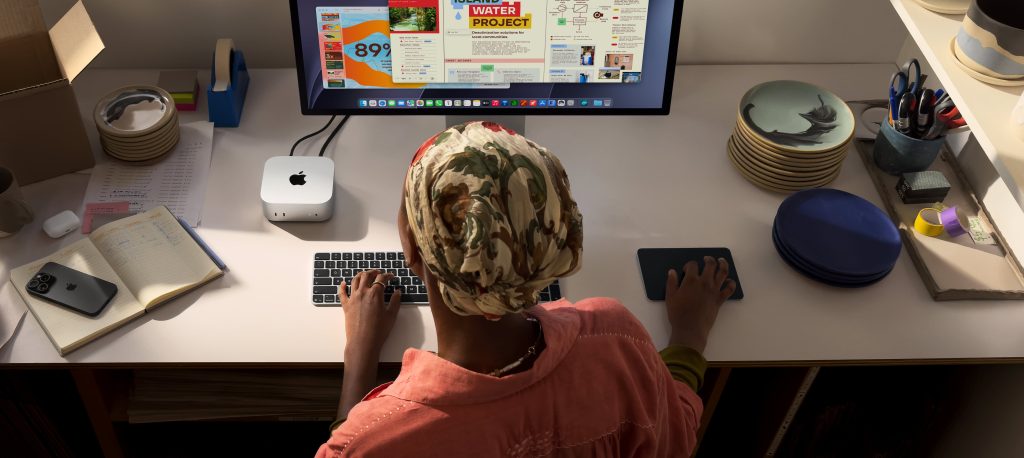
- You want a powerful everyday computer
- You edit photos and moderate video
- You code
- You use Apple Intelligence
- You want to experiment with local AI
- You want the best value entry into Apple’s latest desktop generation
The M6 appears to be the sweet spot for most people.
Apple has significantly increased CPU performance, graphics capability, memory bandwidth and AI acceleration. For someone upgrading from an Intel-based Mac or an early M1 machine, the difference could be dramatic.
Buy the Mac mini M5 Pro if:
- You run larger local AI models
- You work with large datasets
- You edit professional video
- You use 3D applications
- You compile large software projects
- You want significantly more unified memory
- You need Thunderbolt 5
- You expect to keep the machine for many years
The M5 Pro is the more serious long-term investment.
Its biggest advantage isn’t simply raw processing speed. It’s the ability to configure substantially more memory, which could become increasingly important as AI software becomes more demanding.
Should You Upgrade From the M4 Mac mini?
For most M4 owners: No, not immediately.
The M4 Mac mini was already an exceptionally capable machine.
It introduced Apple Intelligence support, a 16-core Neural Engine, hardware-accelerated ray tracing and substantial performance improvements.
If your current M4 Mac mini handles everything comfortably, the M6 upgrade is more of a luxury than a necessity.
However, there are exceptions.
You should seriously consider upgrading if:
- Local AI is becoming part of your daily workflow
- You need faster graphics
- You frequently hit memory limits
- You want Wi-Fi 7 or improved networking
- Your business depends on AI automation
- You want to build or host AI agents locally
For ordinary office work, web browsing and even moderate creative tasks, the M4 remains excellent.
Should M1 Mac Owners Upgrade?
Yes — this is where the new Mac mini becomes much more compelling.
The M1 was revolutionary, but it is now several generations behind Apple’s latest silicon.
The new M6 offers major improvements in:
- CPU performance
- GPU performance
- Memory bandwidth
- AI acceleration
- Neural Engine capability
- Connectivity
- Storage performance
More importantly, software is beginning to change.
AI is becoming a fundamental computing workload, much like graphics, video and networking. The M1 remains capable, but the M6 is designed for a world where AI workloads are becoming normal rather than experimental.
If you still have an M1 Mac mini and your budget allows it, this is one of the strongest upgrade opportunities Apple has offered.
What About Intel Mac Owners?
The answer is even easier.
Absolutely upgrade.
The difference between an Intel Mac mini and the new M6 generation will be enormous in responsiveness, efficiency, graphics, AI capability and long-term software support.
If you’re still using Intel, the new Mac mini isn’t merely an upgrade.
It is a completely different generation of computing.
New Mac mini M6 Price and Availability
Apple’s new Mac mini starts at $899 in United States for the M6 configuration, while the M5 Pro starts at $1699, according to Apple’s United States store. The new models are scheduled to become available on September 22, 2026.
The higher prices mean buyers need to configure carefully.
My strongest recommendation for anyone interested in AI is simple:
Don’t buy based only on storage. Pay attention to unified memory.
Storage can be expanded externally.
Unified memory cannot.
If you expect to use local AI, keep the machine for several years or work with demanding applications, spending more on memory is usually the smarter investment.
The Bigger Problem: Is 16GB Enough for AI?
For basic users, yes.
For serious AI experimentation, it is becoming the minimum rather than the ideal.
A 16GB Mac mini can comfortably support:
- Apple Intelligence
- Everyday AI applications
- Smaller local models
- Coding assistants
- Image and text workflows
- General AI experimentation
But larger local models can quickly consume available unified memory.
That’s why the M5 Pro configuration becomes particularly attractive. With 48GB or 64GB available, it provides significantly more room for larger models and multitasking.
For someone buying specifically to explore local AI over the next three to five years, I would prioritize:
- Unified memory
- Chip tier
- Storage
In that order.
External SSDs can solve storage limitations. You cannot add more unified memory later.
The Verdict: Is the New Mac mini M6 Worth the Upgrade?
Yes — but the answer depends heavily on what you’re upgrading from.
The new Mac mini M6 is one of Apple’s most important desktop updates because it isn’t simply faster.
It is built for a changing computing landscape.
The traditional desktop was designed around applications. The next generation will increasingly involve AI models, intelligent agents, automated workflows and software capable of operating continuously in the background.
The Mac mini’s tiny footprint, Apple silicon efficiency and increasingly powerful unified memory architecture make it unusually well suited to that future.
My recommendation:
Intel Mac owners: Upgrade immediately if you need a desktop.
M1 Mac owners: Strong upgrade recommendation, especially for AI, creative work and long-term ownership.
M2/M3 Mac owners: Upgrade if local AI or professional workloads justify the investment.
M4 Mac mini owners: Keep your machine unless you specifically need more AI performance, networking improvements or the M5 Pro’s additional power and memory.
AI developers and power users: The M5 Pro with higher unified memory is the more strategic purchase.
The standard M6 Mac mini is probably the best choice for most people.
But the M5 Pro version may be the sleeper hit.
As AI moves from cloud services into personal computers, businesses and always-on devices, the question may no longer be, “How fast is my desktop?”
It may become:
“How much intelligence can my computer run for me?”
And for the first time, Apple’s smallest desktop looks increasingly prepared to answer that question.
Related Articles on IMFounder
- Apple Vision Pro Layoffs: The Brutal 60-Job Warning That Apple’s Headset Dream Is Changing
- Apple Upcoming Products: The Secret Roadmap Revealed
- Apple Price Hike 2026: 7 Brutal Tech Increases Destroying Wallets Worldwide
- Apple OpenAI Lawsuit Exposes Shocking Trade Secret Betrayal
- Apple years of delays, Apple Finally Unleashes Siri AI
- 9 Explosive WWDC 2026 Leaks That Reveal Apple’s Biggest AI
- Apple’s “Unbreakable” M5 Chip Was Cracked by an AI in Just 7 Days
- Google’s $15 Billion AI Data Centre Raises Water Concerns in a Country Where over 600 Millions Already Face Water Stress