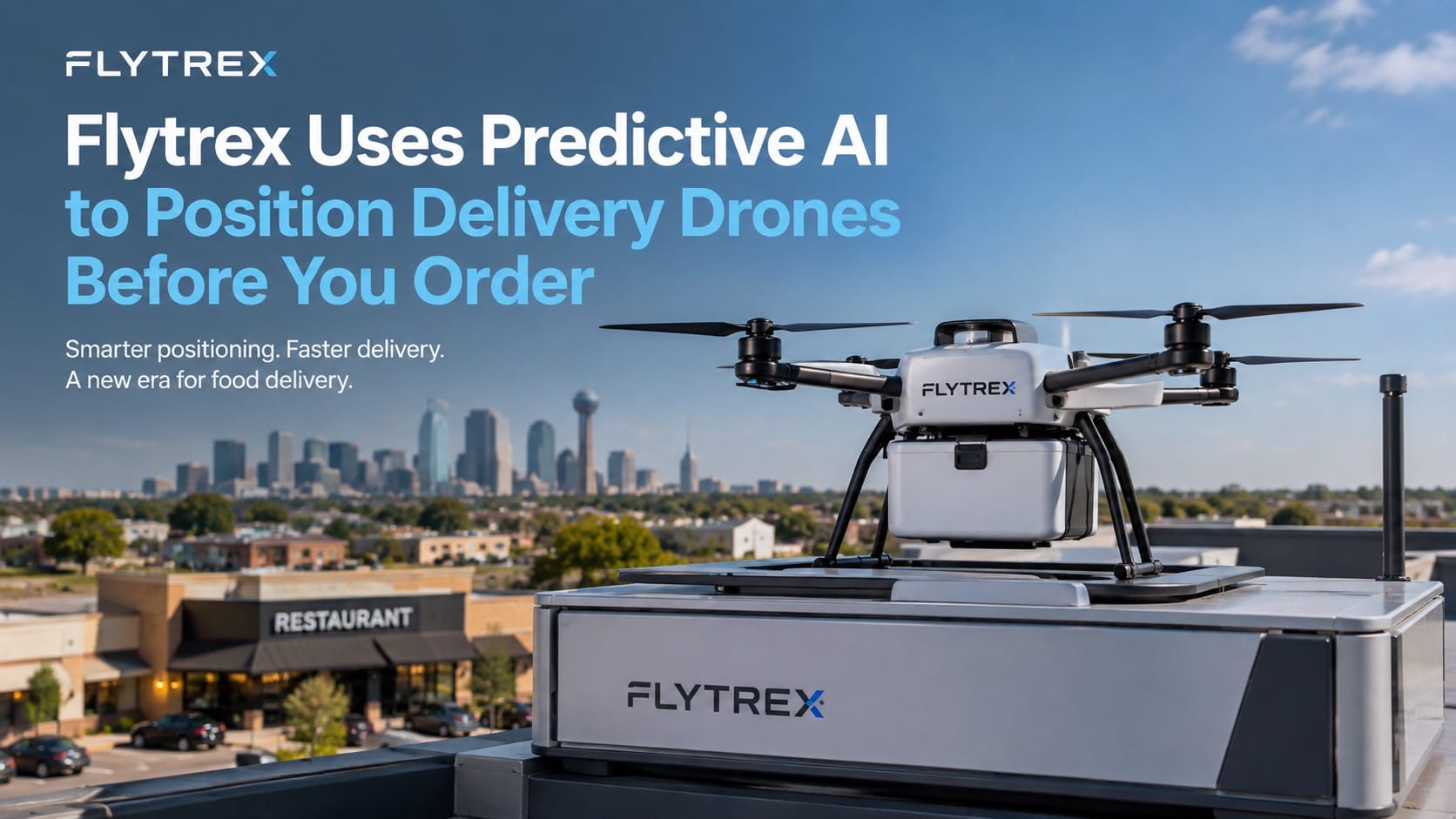

Flytrex is placing aircraft on restaurant rooftops before customers order. The system could reduce delivery costs and human handoffs while giving algorithms greater control over which restaurants receive transportation capacity.
A Flytrex drone may already be parked on a restaurant roof in suburban Dallas–Fort Worth before a customer opens a delivery app.
The aircraft is not there because software read anyone’s mind. It is there because a machine-learning model calculated that the restaurant, at that hour, is likely to receive an order.
That distinction defines the story.
Flytrex forecasts demand at participating restaurants. It does not publicly claim to predict which individual will order, what that person will buy or where a particular customer lives. The drone is positioned before the transaction. The food is prepared only after the restaurant receives the order.
What changes is who decides where delivery capacity waits.
What Flytrex Built
On September 16, 2026, Flytrex announced two connected systems: an unpowered rooftop dock and predictive AI fleet positioning.
The company says its machine-learning models analyze historical demand, time of day, weather, restaurant location and other network signals. An idle drone can then be dispatched in advance to a restaurant expected to receive orders.
The drone lands on a dock installed on the restaurant’s roof or an adjacent elevated structure and shuts down its motors.
After an order is cooked and packaged, the aircraft lowers a tether and hook to a loading position. A restaurant employee attaches the bag without touching the drone or climbing onto the roof. The aircraft retracts the package and flies directly to the customer.
The design eliminates an inefficient stage of conventional drone delivery.
Most operators dispatch an aircraft from a centralized hub after the food is ready. The drone must fly empty to the restaurant, or a worker must transport the meal from the kitchen to a separate launch site. That pickup movement adds time and labor to every order.
Flytrex is attempting to remove both.
Why the Prediction Matters
The aircraft is the visible technology. Utilization is the economic story.
A drone waiting above the correct restaurant converts a forecast into a faster delivery. A drone waiting above the wrong restaurant becomes stranded capital: an aircraft that is not producing revenue and is unavailable elsewhere in the network.
That makes forecasting accuracy central to the business model.
Flytrex co-founder and CEO Amit Regev said the docks are used for landing and staging, require no power and do not require major property modifications. A waiting aircraft cannot recharge on the dock. Its value depends on being positioned where an order materializes before its available battery reserve becomes a problem.
Flytrex has not disclosed how long an aircraft can remain docked, how frequently assignments are recalculated or what percentage of its predictions correctly anticipate restaurant demand.
Regev framed the system more dramatically: “Our system knows where the next order is coming from before it’s placed.”
The documented mechanics describe restaurant-level forecasting—not individual prediction.
Artificial intelligence does not need to predict exactly what one person will eat. It only needs to predict where enough people will probably order it.
The Restaurant Becomes Logistics Infrastructure
Flytrex says the system requires no additional real estate, structural modifications or dedicated drone staff at the restaurant.
Stated differently, the restaurant or landlord supplies the roof, while restaurant employees supply the final loading labor.
That converts commercial rooftops into logistics assets.
A Capriotti’s Sandwich Shop near the Frisco–Little Elm border is one publicly identified North Texas location. Flytrex says its early installations include independent restaurants and larger regional or national brands.
The commercial arrangements remain private.
Flytrex has not disclosed whether restaurants or property owners receive compensation for rooftop access, who pays for installation and maintenance, who insures the dock or who carries liability when equipment or packages are damaged.
It has also not disclosed whether rooftop agreements prevent restaurants from working with competing drone operators.
Those questions will become more consequential if drone delivery expands. Restaurant operators may eventually negotiate not only leases, parking access and drive-through rights, but control of the airspace and infrastructure attached to their buildings.
The restaurant supplies the roof and the hands. The network supplies the decision.
Who Controls the Order?
A single Flytrex delivery can pass through several companies, none of which cook the meal.
Flytrex predicts where an available aircraft should wait.
Delivery-orchestration company Nash determines whether an order should travel by drone or ground courier. Its system evaluates conditions such as weather, payload and route suitability before selecting a delivery method.
Uber Eats or DoorDash may control the customer transaction. Uber announced a strategic partnership and investment in Flytrex in 2025. Flytrex has also delivered DoorDash orders in Dallas–Fort Worth.
The restaurant prepares and packages the food.
A restaurant employee performs the physical loading step.
Customers see the finished delivery. They do not see the layered decisions determining where the aircraft waited, whether the order qualified to fly or which company controlled the underlying transaction data.
Who owns the combined forecasting information has not been publicly established. Neither has whether participating restaurants can inspect their demand forecasts, challenge their placement or transfer their performance history to another provider.
That data could become more valuable than the delivery itself.
It reveals when customers order, which restaurants produce dependable volume, which meals fit aircraft restrictions, which neighborhoods accept drone delivery and when ground couriers remain necessary.
The Labor Transfer
Regev described the model as requiring no courier, runner or Flytrex employee stationed at the restaurant.
The work most directly exposed includes people transporting orders from kitchens to launch hubs, drivers completing short suburban trips and personnel assigned to individual pickup sites.
The labor does not disappear completely. It moves.
Aircraft require assembly, maintenance, remote supervision and regulatory compliance. Restaurant employees still prepare and package orders. Someone at the restaurant must carry the meal to the loading area and attach it to the drone’s hook.
Flytrex has not disclosed whether restaurants receive compensation for adding that responsibility to existing kitchen labor.
Ground couriers also remain inside the system. Weather, excessive payload, unsupported addresses, equipment shortages and flight restrictions can redirect an order from the aircraft network to a driver.
Automation therefore takes the most predictable deliveries first.
Human workers inherit the exceptions.
The human courier is not disappearing immediately. The worker is becoming the backup system for the machine.
The Hidden Economics
Flytrex claims the rooftop system reduces its delivery costs by 60 percent and cuts delivery times in half.
These are company figures.
Flytrex has not published the original cost per delivery, the new dollar amount, the period used for comparison or an independent audit supporting the percentage.
A complete accounting would require figures that remain private:
- Aircraft acquisition
- Dock installation
- Insurance
- Maintenance
- Battery replacement
- Remote supervision
- Failed deliveries
- Ground-courier backup
- Restaurant fees
- Deliveries completed per aircraft per hour
Even if the 60 percent figure holds, it measures Flytrex’s cost. It does not establish that restaurants receive lower commissions, consumers pay lower delivery fees or workers share any portion of the savings.
None of those outcomes has been disclosed.
Scale claims also require clarification.
In May 2026, Flytrex announced a target of 60 delivery sites across Dallas–Fort Worth by mid-2027, potentially reaching approximately five million residents. In September, the company said installation was underway at more than 100 rooftop dock locations.
The numbers may measure different infrastructure. One delivery territory could contain multiple restaurant docks. Flytrex has not publicly reconciled them.
Platform Advantage
Restaurants with aircraft waiting overhead may gain a speed advantage over competitors without rooftop access.
The forecast determines which merchants receive staged transportation capacity. Models trained on historical volume can then produce a self-reinforcing pattern:
- Strong order volume attracts more aircraft.
- More available aircraft create faster delivery.
- Faster delivery attracts more customers.
- Higher demand causes the model to assign more capacity.
An algorithm can create the market conditions that later appear to validate its prediction.
Established chains generate the consistent transaction volume predictive systems reward. A new independent restaurant may have strong food and customer demand but insufficient historical data to justify dedicated aircraft.
Flytrex has not disclosed how new merchants qualify for prepositioned drones, how limited aircraft are divided among restaurants or whether its models correct for advantages created by previous allocations.
The pattern follows a larger food-system structure.
IMFounder’s investigation into Sysco’s distribution strategy documented how market power accumulates inside infrastructure consumers rarely see. A restaurant can remain independently owned while depending on outside companies for ingredients, logistics, technology and customer access.
Flytrex introduces another layer: control over where delivery capacity appears.
Regulation and Physical Limits
Flytrex’s operating partner, Causey Aviation Unmanned, received FAA Part 135 air-carrier certification in January 2023. Flytrex later received additional authorization for Beyond Visual Line of Sight operations, including shared-airspace operations with Wing in the Dallas–Fort Worth region.
The distinction matters.
Part 135 certification establishes an air-carrier operating framework, but drone operators still require applicable aircraft approvals, exemptions, waivers and authorized operating areas. Certification does not create unlimited national access.
Broader expansion depends partly on the FAA’s proposed Part 108 framework, which is designed to normalize certain Beyond Visual Line of Sight operations under a standing regulatory structure rather than relying entirely on case-by-case approvals. The framework remained pending as of September 2026.
Physical restrictions remain equally significant.
Suburban yards provide delivery areas that dense urban neighborhoods and apartment buildings often cannot. Aircraft payload limits restrict order size. Flytrex’s Sky2 is designed to carry up to 8.8 pounds, but large family orders, beverages and awkward packaging can still require ground delivery.
Noise, privacy, weather and access to commercial roofs will determine where the system can operate.
Regev said the docks are made from steel and engineered for Texas heat and heavy rain. The aircraft remain subject to separate flight restrictions. A dock can survive a storm without the aircraft being permitted to fly through it.
Dallas–Fort Worth provides a logical test market: extensive suburban development, large residential yards, congested roads, existing Flytrex operations and an established restaurant-delivery market.
Whether that model transfers efficiently into dense cities remains unresolved.
What Happens Next
Flytrex has not built a machine that knows exactly what one person will order. It has built something more commercially powerful: infrastructure that moves before demand becomes visible.
The next stage will connect these forecasts to restaurant staffing, inventory, pricing, advertising and kitchen production. Delivery platforms will not simply respond to consumer choices. They will position aircraft, promote selected restaurants and distribute transportation capacity according to what their systems expect people to buy.
That creates a market in which the prediction can influence the outcome. Restaurants receiving faster delivery capacity become more attractive to customers. More orders strengthen their ranking. Stronger rankings attract additional aircraft. The algorithm’s forecast becomes the advantage that helps make the forecast come true.
Customers will still believe they are choosing from an open marketplace. Restaurants will still appear to compete independently. But the decisive competition may happen earlier, inside systems determining which business receives the aircraft, visibility and speed required to reach the customer first.
The future of food delivery will not be controlled by the restaurant with the best meal. It will be controlled by the platform that decides which restaurant gets a drone before hunger becomes an order.
Sources
- Flytrex: Rooftop Docks and Predictive AI Positioning
- DroneXL: Flytrex Rooftop Dock Analysis
- The Drone Girl: Flytrex Operations and Regev Interview
- Dallas Innovates: Flytrex Rooftop Expansion
- Dallas Innovates: Flytrex and Nash Partnership
- FAA: Package Delivery by Drone
- FAA: BEYOND Program
- Reuters: The United States Drone-Delivery Race