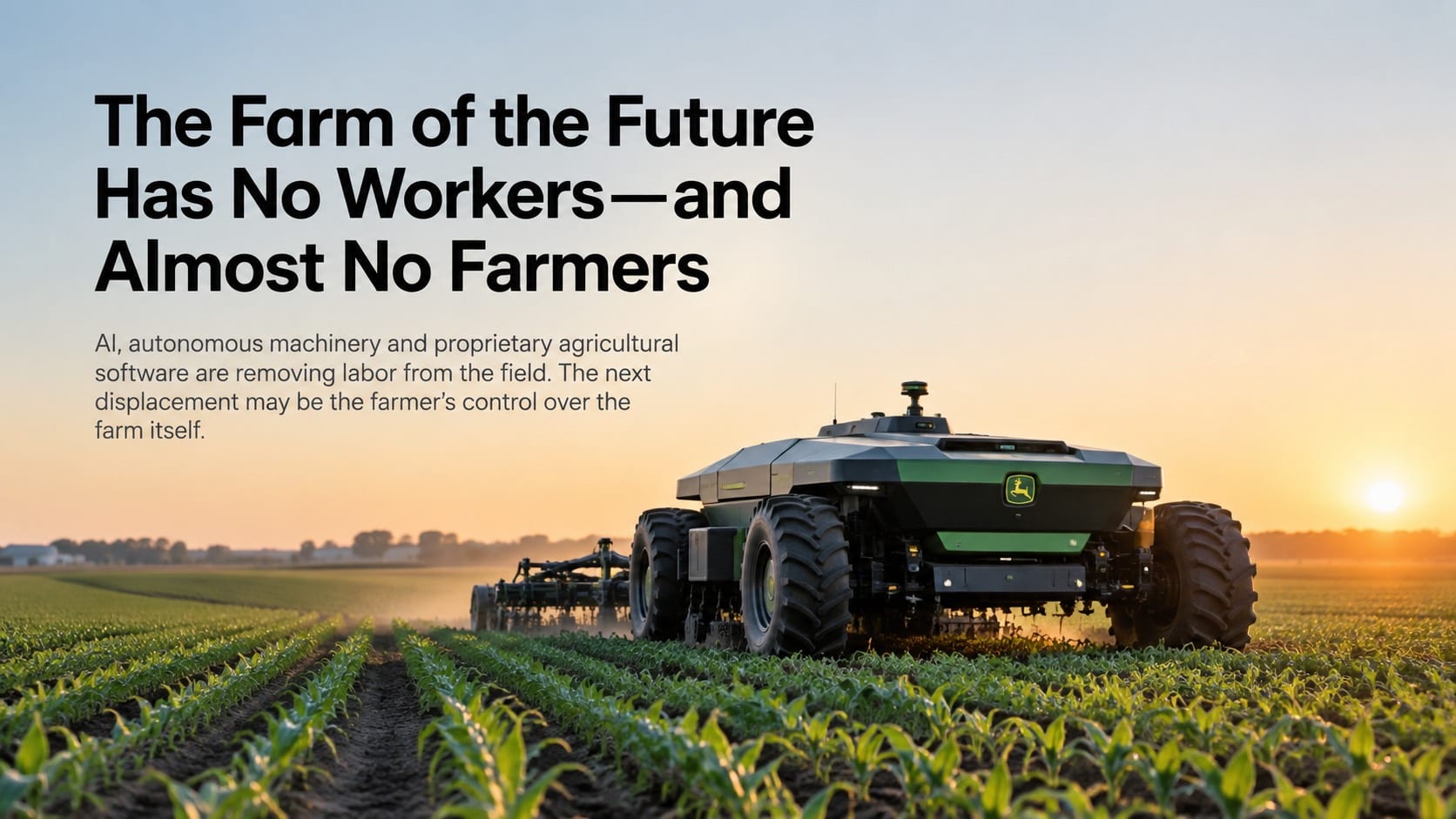

AI, autonomous machinery and proprietary agricultural software are removing labor from the field. The next displacement may be the farmer’s control over the farm itself.
The farm of the future will still have soil, water, crops and machinery.
What it may not have is many people.
Autonomous tractors can already till fields without drivers. Computer-vision systems can distinguish crops from weeds. Laser machines can kill unwanted plants without herbicides or hand-weeding crews. Drones can monitor acreage faster than human crop scouts. Artificial intelligence can calculate when to irrigate, where to apply fertilizer and which sections of a field are likely to underperform.
This is usually presented as progress: fewer chemicals, lower labor costs, more precise production and better yields.
All of that may be true.
But the agricultural AI revolution contains another transfer of power that receives far less attention. Farmers may continue owning the land while losing control over the machinery, software, data and automated decisions required to farm it.
The future farm may not eliminate the farmer completely.
It may transform the farmer from an independent producer into a licensed operator inside somebody else’s technological system.
The farmer may own the field while the technology company owns the intelligence required to operate it.
The Machine Has Learned to See the Field
Agricultural automation is not new. Mechanized harvesters, tractors and irrigation systems have been replacing physical labor for generations.
Artificial intelligence changes the machine’s role.
Traditional machinery performs a task. AI-powered machinery observes the environment, classifies what it sees and decides how to respond.
John Deere has introduced autonomous equipment using cameras, sensors and artificial intelligence to navigate fields, detect obstacles and continue agricultural work with limited human involvement. The company’s autonomous 9RX tractor, announced as part of its CES 2025 technology expansion, was designed for large-scale tillage operations.
The human operator does not necessarily sit inside the machine. The tractor can be monitored through a mobile device while it works.
That distinction matters.
Removing the driver does more than eliminate one position. It separates agricultural production from the physical presence of the person responsible for the land. One operator can potentially supervise multiple machines, multiple fields and eventually multiple farms.
The tractor is no longer just equipment.
It is a mobile data-collection platform that continuously records how the farm operates.
AI Is Killing Weeds With Lasers
One of the clearest commercial examples is Carbon Robotics.
Its LaserWeeder uses computer vision and artificial intelligence to identify weeds before targeting them with lasers. The company markets the technology as an alternative to hand labor, herbicides and mechanical cultivation.
Carbon Robotics says its current system recognizes more than 100 crop models and can reduce weed-control costs by as much as 80 percent. The company also claims participating farms have recorded yield improvements, although outcomes vary by crop, acreage and operating conditions.
The underlying system is trained on an enormous agricultural image library. Carbon says its plant model has incorporated approximately 150 million labeled plants from more than 100 crops across 15 countries.
Every field makes the system more knowledgeable.
Every machine produces additional training material.
Every participating farm contributes to an agricultural intelligence layer that becomes increasingly difficult for an individual producer to recreate independently.
This is the real competitive advantage. The machine is valuable, but the accumulated dataset makes the machine smarter. A farmer can purchase another piece of equipment. Reproducing millions of labeled crop and weed images is considerably harder.
The farm supplies the biological reality. The technology company converts that reality into proprietary intelligence.
The most valuable crop harvested from an automated farm may eventually be the data.
Labor Shortages Created the Opening
Agricultural technology companies are not inventing the labor crisis.
Farm work is physically demanding, seasonal and frequently dangerous. Producers across the United States have struggled to recruit enough workers while labor, housing, transportation and regulatory costs continue to rise.
Automation offers an obvious response.
A machine does not require worker housing. It does not call out sick during harvest. It does not need transportation to a remote field. It can operate at night, repeat the same movement thousands of times and document every pass.
For large producers, the economic argument can become overwhelming.
The first jobs placed under pressure will not necessarily be entire occupations. AI will remove individual tasks: crop scouting, weed identification, chemical application, irrigation monitoring, counting, sorting and equipment operation.
Once enough tasks disappear, the job disappears with them.
The result will not be a completely empty farm overnight. Agriculture still contains weather, biological variation, equipment failures and physical conditions that software cannot perfectly control. Human judgment remains necessary.
But fewer humans will be required per acre.
The surviving positions will also change. Farms will need technicians, software operators, remote supervisors, data analysts and mechanics capable of servicing increasingly computerized machinery.
The field worker does not automatically become the robotics technician.
That transition requires training, access and time—the three things workers facing displacement are rarely given.
The Small Farmer Faces a Different Problem
Large agricultural operations can distribute the cost of expensive technology across thousands of acres. A smaller producer cannot.
That creates another consolidation mechanism.
If autonomous equipment lowers the cost of operating large farms but remains financially inaccessible to small ones, automation will not simply improve agricultural productivity. It will strengthen the operators already capable of financing it.
The farmer unable to purchase the technology may lease it, hire an agricultural technology contractor or subscribe to a managed service. Each option keeps the farm operating, but another layer of revenue leaves the producer.
This is where automation connects directly to IMFounder’s previous examination of food-distribution consolidation.
Independent restaurants may appear to compete at the consumer level while relying on the same concentrated distribution infrastructure behind the scenes. Farms could follow the same pattern. Thousands of producers may remain legally independent while depending on a narrow group of companies for machinery, software, crop intelligence, repairs, financing and market access.
Ownership on paper does not guarantee operational independence.
The producer carries the land cost, weather exposure, crop risk and debt. The technology provider collects recurring revenue from the system the producer needs to compete.
That is not the disappearance of the farm.
It is the conversion of the farm into platform infrastructure.
The Agricultural Exchange Is the Next Layer
In The Emergence of a Digital Agricultural Exchange, IMFounder examined how agricultural trade could move toward digital systems connecting producers, buyers, processors, logistics providers and financial markets.
Autonomous farming expands that possibility.
A digitally operated farm can produce continuous information about planted acreage, crop development, expected yield, water consumption, disease pressure and harvest timing. That information is commercially valuable long before the crop reaches a warehouse.
A sufficiently integrated platform could know:
- What has been planted
- How quickly it is growing
- What inputs have been applied
- When it will be harvested
- How much the farm is likely to produce
- Which buyers need that commodity
- What transportation will be available
- Where regional shortages may emerge
The farm stops being an isolated production site. It becomes a live node inside a predictive commodity network.
That could reduce waste and improve coordination. It could also allow companies with superior data to anticipate market movement before individual farmers understand what is happening around them.
Artificial intelligence would not merely help grow the food.
It could influence when the food is sold, where it moves and who captures the margin.
Trump Wants Farmers to Bypass the Meatpacking System
The economic consequences become larger when agricultural automation intersects with President Donald Trump’s plan to expand direct meat processing and sales.
In September 2026, Trump signed an executive order directing federal agencies to support farmers’ and ranchers’ ability to butcher, process, package and sell their own meat across state lines. The administration presented the policy as an attack on concentrated meatpacking power and a way to give producers more control over the value of the animals they raise. The order begins a regulatory process; it does not immediately eliminate federal inspection, food-safety or interstate-commerce requirements. White House
The economic argument is significant.
A rancher selling cattle into the conventional commodity system is paid primarily for the live animal. Slaughtering, fabrication, packaging, branding, distribution and retailing occur farther down the supply chain, where additional margin is created. Allowing more producers to process and sell their own beef could let them retain more of that value.
It could also redirect money into rural economies. Independent slaughterhouses, mobile processing units, refrigerated storage facilities, local delivery companies, butchers and regional food marketplaces would be needed to support direct sales. Revenue currently concentrated inside national packing and distribution networks could circulate through smaller agricultural communities.
AI could make that decentralized market operational.
Automated systems could forecast consumer demand, schedule processing, track individual animals, manage food-safety records, optimize carcass utilization and match available cuts with buyers. A rancher could theoretically raise, process, brand and sell beef through a digital marketplace without surrendering the product to a dominant processor or national distributor.
Trump’s policy could shorten the beef supply chain. AI could turn that shorter chain into a functioning market.
But decentralization does not automatically produce independence.
Processing remains the bottleneck. Equipment is expensive. Federal and state inspection capacity is limited. Cold storage, product liability insurance, sanitation, packaging and refrigerated transportation create substantial costs. Smaller producers could gain legal market access and still lack the capital required to use it.
That gap creates an opening for technology and financial platforms.
A company offering processing access, AI pricing, online sales, payments, traceability and delivery could become the new intermediary between rancher and consumer. Farmers would escape the traditional meatpacker only to become dependent on the digital marketplace controlling demand and customer data.
The broader economy could therefore move in two directions.
A genuinely competitive system would distribute processing capacity, increase producer margins, create rural businesses and give consumers greater access to regionally produced meat. A platform-dominated system would merely replace four powerful meatpackers with a small number of agricultural technology companies.
The question is not whether farmers will be permitted to sell more of what they produce.
The question is whether they will control the infrastructure required to reach the buyer.
Opening the market means little if the farmer still has to rent access to the customer.
The Right to Repair Is Becoming the Right to Produce
When mechanical equipment failed, farmers traditionally relied on tools, replacement parts and practical knowledge.
Software-controlled machinery changes that relationship.
Repairs may require diagnostic access, authorized software, proprietary components or communication with the manufacturer. A malfunction can become more than a mechanical problem when the owner cannot independently access the system controlling the machine.
As farms become more autonomous, repair access becomes production access.
A disabled tractor, expired software service or inaccessible operating platform can interrupt planting and harvesting during narrow seasonal windows. The farmer may own a machine worth hundreds of thousands of dollars while lacking complete authority over its digital functions.
This is why agricultural right-to-repair disputes are not peripheral technology arguments. They concern who has the practical power to keep the food system operating.
The same applies to data portability.
Can a farmer take years of field information to a competing platform? Can software recommendations be independently audited? Who is responsible when an automated decision damages a crop? Can a manufacturer remotely disable functionality? Does the producer own the images and field records used to improve the company’s model?
These questions will determine whether agricultural AI remains a tool or becomes a dependency.
China Is Building the Entire System
China’s agricultural automation strategy demonstrates the scale of the transition.
The country is advancing autonomous tractors, agricultural drones, AI-monitored greenhouses, robotic harvesting and digitally managed fields as connected components rather than isolated inventions. The objective is not merely to sell farmers better equipment. It is to increase national production capacity while reducing reliance on manual labor and improving control over agricultural data.
That systems-level approach matters.
A nation that integrates crop genetics, machinery, satellite monitoring, artificial intelligence, logistics and commodity markets is not simply modernizing farming. It is constructing food infrastructure capable of seeing and managing the supply chain from seed to distribution.
American agricultural innovation remains powerful, but much of it is fragmented across manufacturers, startups, farm-management platforms and private datasets.
The global competition will not be won by the country possessing the best autonomous tractor.
It will be won by the system that connects the tractor, crop, market and distribution network.
What Happens Next
The autonomous farm will arrive unevenly.
Large commodity operations will adopt technologies that reduce labor and improve input efficiency. High-value specialty crops will use computer vision and robotics where hand labor is particularly expensive. Controlled-environment agriculture will become increasingly automated because greenhouses provide the structured conditions machines handle best.
The public will be told that AI is solving agricultural labor shortages.
The more consequential question is who owns the solution.
If farmers control their data, retain repair access, choose between interoperable systems and share in the value created by agricultural intelligence, AI could strengthen independent production.
If a handful of companies control the software, machinery, agronomic models and market platforms, farmers will become dependent on infrastructure they cannot inspect, reproduce or operate without permission.
The machines will continue working.
The fields will continue producing.
Food will continue moving through processors, distributors and retailers until it reaches the consumer, who may never know how few people—or how few independent decisions—remain behind it.
The farm of the future may have no workers.
Eventually, it may have no farmer in the traditional sense either.
It will have a landowner, a fleet of autonomous machines and a subscription agreement with the company that tells both of them what to do.
Agriculture is not simply automating labor. It is deciding whether the intelligence of food production will belong to farmers—or to the corporations building the machines.
Related Articles on IMFounder
- Mahindra vs John Deere: Why American Farmers Are Fighting Back Against Tractor Giants
- Ghost Trucks: Inside America’s Driverless Food Distribution Network
- Data Is the New Crop: How Big Tech Is Quietly Taking Control of the Food Supply
- The Fastest Way Into the Economy Is Closing
- Why Cross-Border Business Matters More Than Ever
Sources
- John Deere: Autonomous Machines and Technology
- Carbon Robotics: AI-Powered Agricultural Systems
- USDA National Institute of Food and Agriculture: AI Education and Agricultural Workforce Development
- IMFounder: Sysco Distribution Strategy
- The Emergence of a Digital Agricultural Exchange