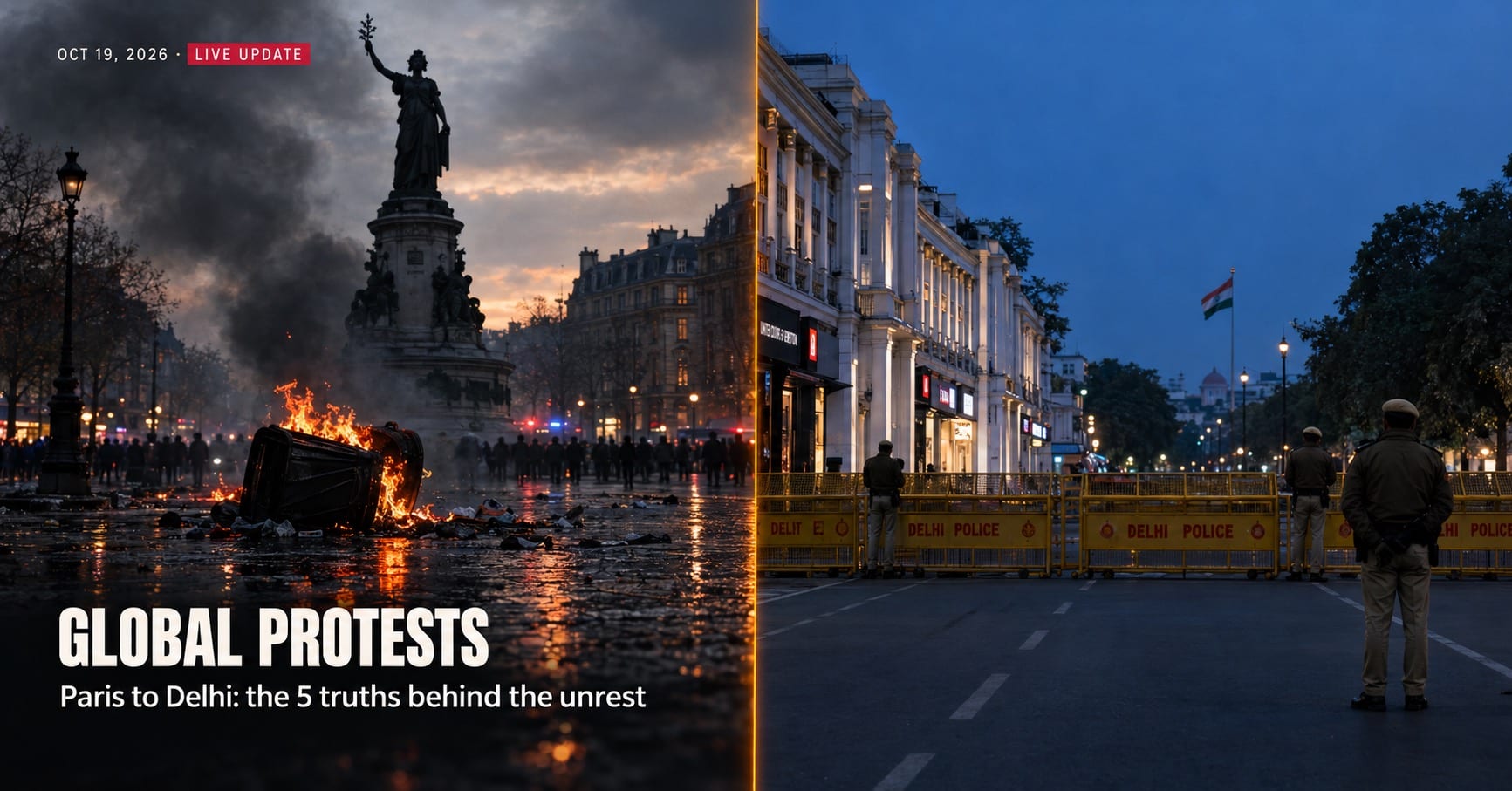

Half a million marched in France, shops were looted in European cities, and Delhi was sealed off to stop a youth movement. Here is what the verified record shows, and what it does not.
Global protests entered a dangerous new phase this weekend. In France, about 550,000 people marched on Saturday, October 17, according to the Interior Ministry, and a violent minority turned parts of those marches into arson, looting and street fighting. In India, authorities locked down the heart of the capital a week earlier to stop a youth-led movement from reaching it. The causes differ. The question is the same: how far will a government go to hold the street, and how far will a movement go to break through?
This report draws on published coverage from Al Jazeera, CNN, NPR, Newsweek and others, current as of Monday, October 19, 2026. Where official and movement figures differ, both are attributed. Where a claim is unproven, it is labelled as a claim.
Global Protests at a Glance: The 5 Truths
- France’s unrest began in school corridors and grew into a national revolt over living costs. The violence came from a minority of a largely peaceful crowd.
- The French state’s response, including injuries to children and thousands of arrests of minors, has become a scandal of its own.
- The unrest is spreading across Europe, but outside France it is smaller. Milan saw clashes, fires and looting. Lisbon saw tens of thousands march over wages and housing.
- In India, the fight is over who gets to vote, after a voter-list revision struck roughly 130 million names.
- Delhi’s crackdown is real and unusually sweeping, but the “Nazi” label is not supported by the evidence. The better-sourced comparison is the Emergency of 1975.
Global Protests Truth 1: France’s Riots Began in Classrooms
The France riots 2026 did not start with looters. According to Al Jazeera’s analysis, the movement began last month in high schools in Paris’s working-class northern suburbs, where students protested teacher shortages and poor facilities. Blockades spread to Bordeaux, Rennes, Nantes, Lyon, Lille and Marseille. On Saturday, trade unions and supporters of the “yellow vest” movement that emerged in 2018 joined the students.
The scale of the day and the scale of the damage are both on the record. Prime Minister Sébastien Lecornu said 1,200 people were arrested and 150 police officers were injured. A fire largely destroyed the historic town hall in Limoges. CNN reports that one police officer and one protester died, and that officials are exploring curfews. President Emmanuel Macron vowed that those who “sought to bring down the Republic” would be held accountable, and he promised meetings this week to discuss proposals and hear protesters’ demands.
Behind the anger is money. The proposed 2027 budget includes a €54 billion package of cuts and tax measures, and unions say it would freeze the civil-service pay scale for a fourth consecutive year, Al Jazeera reports. A presidential election is due in April 2027, so every party is weighing order against grievance. It is a reminder that global protests usually start with a local complaint before they find a bigger target.
Global Protests Math: 550,000 Marchers, 1,200 Arrests
Put the two official figures side by side and the arrests equal about 0.2% of the marchers. Arrests are not a perfect count of rioters, and the damage was real. Still, the arithmetic supports Al Jazeera’s finding that most people marched peacefully while a small minority attacked buildings and shops and clashed with police. Headlines that show only burning streets capture the second group and miss the first.
How France’s Response Became a Scandal of Its Own
The state’s reaction now draws as much scrutiny as the violence, and the policing question is central to how global protests end. Human Rights Watch, cited by Al Jazeera, said a 15-year-old lost a hand to a police stun grenade and a 14-year-old suffered a shattered jaw after being hit by a tear gas canister fired at close range. The organisation condemned excessive force against children and said the demonstrations had been overwhelmingly peaceful.
Earlier in the movement, the Justice Ministry reported 5,060 arrests as of October 6, with 87% of those arrested minors. At least ten cases had been referred to the police oversight body IGPN, according to a running timeline of the protests.
Jean-Luc Mélenchon, leader of France Unbowed, accuses the government of repressing school students and letting the confrontation escalate. Macron’s camp says violence will be prosecuted and punished. Nobody can say with confidence who benefits politically. One academic told Al Jazeera he sees only Marine Le Pen gaining, while another warned against assuming a far-right win. Le Pen has called the grievances legitimate and claimed the far left holds the protesters hostage.
Global Protests Spread Across Europe: Milan, Lisbon and Brussels
France was not alone this weekend. Newsweek counted protests in France, Albania, Italy, Portugal, Spain, Belgium and Greece. In Milan, a march against wars and rising living costs turned violent, with clashes, looted stores and fires. CGTN described masked demonstrators throwing stones and paving blocks at riot police and setting barricades alight. In Lisbon, tens of thousands marched against low wages and a housing crisis, and Newsweek cites a European Commission research report showing Portuguese house prices up 130% since 2013. In Belgium, an anti-fascist protest followed weeks of demonstrations over education and living costs.
Precision matters here. “Riots across Europe” overstates the picture, because CGTN notes the protests elsewhere did not reach French scale. Yet HEC Paris professor Alberto Alemanno said discontent may be spilling over, and CGTN reports his view that the “early stages” of a movement are emerging in Greece, Germany and Austria, with mobilisation expected in the coming week.
The cost of living protests across Southern and Western Europe differ in their local triggers. These global protests share targets, though: wages, housing, schools and austerity. Analysts say these global protests may widen before they settle.
Global Protests Reach Delhi: Inside the India Protest Crackdown
In India, the confrontation was about restriction rather than riots. The youth-led Cockroach Janta Party and the wider “Cockroach” campaign want the resignation of Chief Election Commissioner Gyanesh Kumar and a rollback of a contested voter-list revision. Al Jazeera reported that before the October 10 protest the government cancelled all trains to New Delhi, locked down more than 50 metro stations, imposed an internet shutdown and deployed nearly 30,000 personnel. Students were pulled off trains and buses, and others were placed under house arrest hundreds of kilometres from the capital.
On Saturday, police detained thousands of protesters and stopped vehicles at checkpoints on routes into the capital, according to the AP report carried by NPR. The movement says its founder, Abhijeet Dipke, and two other leaders, Saurav Das and Ashutosh Ranka, were detained at the airport on arrival. Dipke wrote on X that Modi had made an Emergency official. Sambit Patra, a spokesperson for Modi’s party, dismissed the demonstrators as “anarchic elements.”
The crackdown did not end the protests. The Diplomat reported that Monday’s march on October 12 drew unprecedented crowds despite the repression. On Friday, October 16, thousands thronged central Delhi waving the national flag and demanding the election chief’s resignation, NPR reported, and Modi had not publicly commented. In July, the same movement’s protests over exam paper leaks forced out Education Minister Dharmendra Pradhan.
This India protest crackdown is the sharpest test yet of how Modi’s third-term government handles youth dissent. It is also a test of how any democracy handles global protests led by the young.
What the India Protests Are About: 130 Million Names
The Special Intensive Revision is a voter-list exercise run by the Election Commission. According to Al Jazeera, it has struck 130 million names from the rolls. Critics say it reverses a founding principle by making citizens prove they may vote, and that it disproportionately hits Muslims, poorer Indians and other vulnerable groups. In September, The Indian Express reported that Kumar overruled concerns raised by the two other election commissioners, Sukhbir Singh Sandhu and Vivek Joshi, as summarised by Khaleej Times.
The government’s side deserves equal space. The Election Commission says disagreements are normal and that the report highlighted them selectively. BJP spokesperson Sambit Patra said differing views reflect a “healthy democracy,” and the commission says the decision to run the revision was unanimous, Deccan Chronicle reports. The BJP says the opposition is attacking a constitutional body, The Week reports, and both the BJP and the commission reject Rahul Gandhi’s accusations of vote theft.
Global Protests and the “Nazi” Label: What the Evidence Supports
Some posts online describe Modi’s government as Nazi. This report found no evidence that supports that label, and repeating it as fact would be inaccurate. None of the reporting reviewed for this article, including Al Jazeera, AP and NPR, uses it. Claims like this travel faster than facts in global protests, and they hand governments an easy way to dismiss legitimate criticism.
What critics inside India do argue is documented, serious and specific. Al Jazeera notes that the lockdown evoked the 1975 Emergency, when Indira Gandhi suspended civil liberties, censored the press and jailed political opponents. Pre-emptive detentions, house arrests, cancelled trains and an internet shutdown are measures that rights advocates and courts will scrutinise, and opposition leaders have accused the government of curbing dissent.
The differences matter as well. Opposition parties are active, major outlets are covering the story, and the Election Commission’s internal dispute surfaced through a newspaper investigation. Analysts told Al Jazeera that Modi appears weaker in public perception than at any point in years, even as he keeps tight control of key institutions. The evidence points to a democracy under strain and a government policing dissent heavily, not to anything resembling Nazi rule. Whether the policing was proportionate is a fair question, and the opposition says it was not.
Why Global Protests Keep Repeating: The Gen Z Pattern
Neither crisis is isolated. Last autumn, PBS reported that youth-led protests had spread across Nepal, the Philippines, Indonesia, Kenya, Peru, Morocco and Madagascar, where the president was forced out after a military mutiny. Protesters said they take cues from one another through digital platforms. Sociologist Donatella della Porta told Al Jazeera that French students are inspiring wider mobilisation over inequality, cuts to public investment and democratic rights.
The common thread in these global protests is young people who describe institutions as unresponsive. India’s July minister resignation shows that pressure can work. Nepal and Madagascar show how far it can go.
What to Watch Next
- France: Macron’s meetings this week, a possible curfew decision, and the end-of-October deadline Lecornu set for ministers to present first proposals on student demands. The 2027 budget fight and the April presidential election hang over everything.
- Europe: whether Greece, Germany and Austria see the mobilisation Alemanno expects, and whether Milan’s violence repeats.
- India: whether the Cockroach Janta Party returns to the streets, whether Kumar stays in office, and whether Modi addresses the protests, which he had not done as of October 16.
These three tests will show whether global protests cool or spread.
The Bottom Line on Global Protests
Two governments face the same generation but very different crowds. In France, a mostly peaceful movement produced deadly riots and a debate over police force against minors. In India, a mostly peaceful movement met a lockdown and a debate over democratic space. Both stories deserve sharper reporting and fewer slogans.
The riots in France and the Delhi lockdown are verifiable. The Nazi comparison is not. Readers who follow global protests should hold governments, protesters and headlines to the same standard: show the evidence.
Sources and method: this article is compiled from the published reports linked above and will need updating as events develop. Figures from officials, movements and rights groups are attributed to their source.
Related Articles on IMFounder
- The Vote highjack Controversy: The world’s biggest democracy becomes a joke under Modi.
- Trump Is Changing How American Beef Is Sold—and AI Is Moving Into the Slaughterhouse
- Canada Luring American Scientists: A Bold $541-Million Coup
- The Unyielding Fury of India’s Youth: CJP Protests Expose Education Crisis Under Modi Government
- Bill C-9 Canada: The Truth Behind the New Hate Crime Law
- India Paper Leak Scandal: 70+ Shattered Dreams, Student Suicides & Modi Govt 10-Year Shameful Failure