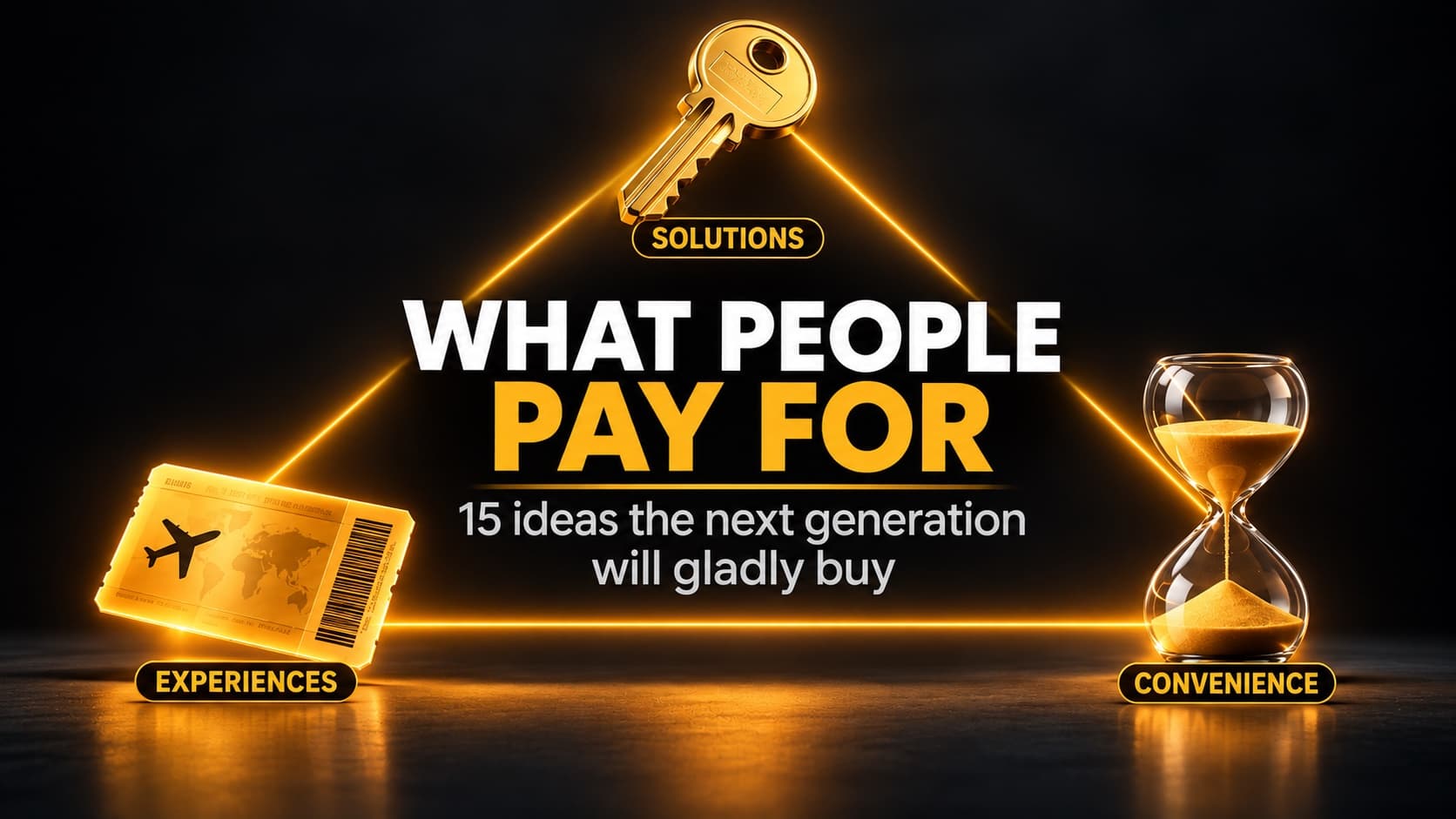

What people pay for has always come down to three things: a problem solved, a moment remembered or time handed back. Brands, logos and features are only packaging around those outcomes. The next generation of buyers, from Gen Z to Gen Alpha, can compare prices, read reviews and spot marketing spin in seconds, so vague value no longer survives. Understanding what people pay for today is the difference between a business that grows and one that quietly fades.
This guide ranks the top five ideas in each of the three categories: solutions, experiences and convenience. These are not random fads. Each idea rests on a durable human need, and each already shows strong signals in consumer spending trends. Whether you are a founder, marketer, creator or simply curious, treat this list as a map of where money is heading next.
A quick note on trust: this article relies on well-documented behavior and links to reputable sources instead of inventing statistics. Always check the linked sources for the latest figures before you make a financial or business decision.
What People Pay For: The Three Pillars of Value
Economists call it willingness to pay: the highest price a person will accept for something. In practice, it is less about price and more about perceived return. People spend when they believe the relief, joy or time they receive is worth more than the money they give up. That simple test explains what people pay for in every market, from a coffee to a holiday.
Three pillars hold up almost every purchase:
- Solutions remove a specific pain, risk or limitation.
- Experiences create memories, belonging and identity.
- Convenience gives back time and removes effort.
The strongest offers blend two or three pillars. A meal-prep service solves a nutrition problem, saves hours and feels like a small treat. In 1998, Joseph Pine and James Gilmore argued in Harvard Business Review that economies move from commodities to goods to services and finally to experiences, a idea they called the experience economy. The same logic now drives the convenience economy, where saving time is the product itself.
What People Pay For in Solutions: The Top 5 Ideas
A solution earns money by removing a clear, painful problem. The next generation values solutions that are personal, proven and easy to start. Here is what customers pay for when the problem is real.
1. Personalized Health and Longevity Solutions
Healthcare is shifting from reactive to preventive. Wearables, at-home testing, personalized nutrition and sleep coaching let people act before small issues become big ones. Buyers pay for clarity: what their data means and what to do next. The winners will pair technology with qualified professionals and be honest about limits. For credible background on prevention, the World Health Organization publishes global health guidance. In this category, trust is the product.
2. Accessible Mental Wellbeing Support
Younger generations talk about mental health openly, and they expect support that fits real life: affordable online therapy, guided coaching, journaling tools and peer support circles. People pay for privacy, fast access and human warmth. Digital tools work best as a bridge to qualified clinicians, not a replacement, and responsible brands say so clearly.
3. AI Copilots for Work, Learning and Creativity
AI tutors, writing partners, research assistants and workflow agents turn hours into minutes. Students pay for personalized explanations, and professionals pay for leverage. The key to what people pay for here is reliability: tools that cite sources, protect data and fit existing workflows beat flashy demos every time.
4. Financial Clarity and Automatic Wealth Tools
Rising living costs and confusing financial products leave many young adults anxious. Apps that simplify budgeting, automate saving, expose hidden fees and explain risk in plain language solve an emotional problem as much as a numerical one. People pay for calm. Clear pricing and honest education matter more than clever interfaces.
5. Home Energy and Sustainable Living Solutions
Rooftop solar, heat pumps, efficient appliances, home batteries and smart energy monitoring cut bills and emissions at the same time. The International Energy Agency tracks this global shift closely. Buyers commit when savings are measurable and installation is hassle-free, which is why financing options and one-stop installers win.
What People Pay For in Experiences: The Top 5 Ideas
An experience is a purchase that becomes a story. In a world of endless digital content, real moments feel scarce, and scarcity commands a premium. This is why the experience economy keeps growing even when budgets tighten.
1. Purposeful, Small-Group Travel
Travelers are moving from checklist tourism to trips with meaning: slow travel, cultural exchange, volunteering days, local guides and nature immersion. People pay for access they could not arrange alone and for impact they feel good about. Small groups, fair local partnerships and authentic storytelling set the best operators apart.
2. Live Events and Real-World Communities
Concerts, festivals, run clubs, supper clubs, maker markets and fan meetups meet a simple need: belonging. After years of screens, people crave shared energy that cannot be streamed. Event creators who build repeat communities, rather than selling one-off tickets, build loyal and predictable revenue.
3. Hands-On Skill-Building Workshops
Cooking classes, pottery, woodworking, photography walks, language immersion and cohort-based courses offer progress and pride. People pay not only for the lesson but for the identity of becoming someone who can do something new. Short, social and beginner-friendly formats sell best.
4. Immersive Technology Entertainment
Mixed reality, interactive theatre, location-based games and sensory exhibitions blend the digital and physical worlds. Quality decides success: the experience must feel seamless and emotionally engaging, not like a tech demo. Expect strong growth in family-friendly and educational formats.
5. Wellness Retreats and Recovery Rituals
Sauna clubs, breathwork sessions, sleep retreats and digital-detox weekends respond to a quiet driver: burnout. Buyers pay to feel restored, and they pay again when the ritual becomes a routine, which makes memberships and monthly passes especially powerful.
What People Pay For in Convenience: The Top 5 Ideas
Time is the one resource nobody can manufacture. The convenience economy wins when it gives time back without lowering quality. These are the convenience ideas with the clearest path to repeat customers.
1. Instant and Same-Day Delivery
Groceries, medicine, electronics and hot meals now arrive in minutes or hours. Consumers pay a premium for speed when the need is urgent or the day is already full. Reliable operations, fair pay for couriers and efficient routing will decide which services survive.
2. Self-Managing Subscriptions and Auto-Replenishment
Pet food, coffee, skincare and household basics that arrive before you run out remove one more decision from busy lives. People pay for never having to think about it. Easy pausing and cancelling is not a risk; it builds the trust that keeps customers for years.
3. One-Tap Payments and Unified Digital Identity
Checkout friction kills sales. Digital wallets, biometric login and saved preferences remove forms and passwords from the buying journey. Customers reward businesses that make paying effortless, provided their privacy is protected and data use is explained in plain words.
4. Done-for-You Home and Life Services
Cleaning, repairs, laundry, meal prep, personal shopping and admin help let busy households outsource chores. Vetted providers, upfront pricing and satisfaction guarantees turn a risky gig into a trusted service people book again and again.
5. Smart Automation and AI Agents for Everyday Errands
Booking appointments, comparing quotes, managing calendars and filing receipts are tasks people will happily delegate. Agents that act within rules you set promise to be the biggest time-saver of the next decade. Clear permission controls and visible activity logs are the trust layer that makes adoption possible.
How to Turn What People Pay For into a Profitable Offer
Knowing what customers pay for is only half the work. Apply these five rules to turn insight into income:
- Sell the outcome, not the feature. Nobody wants a drill; they want the hole, the shelf and the finished room.
- Make the value obvious in ten seconds. If a visitor cannot explain your offer after one look, simplify it.
- Earn trust before you ask for money. Real reviews, transparent pricing, guarantees and visible people behind the brand reduce doubt.
- Remove friction everywhere. Every extra click, form or surprise fee is a reason to leave.
- Build a reason to return. Community, memberships and continuous improvement turn one purchase into a relationship.
Before building anything large, test small. Interview ten potential customers, pre-sell a simple version and watch what they actually pay for rather than what they say they might buy. Behavior beats opinion.
Solutions vs Experiences vs Convenience: Which Should You Choose?
Solutions usually support higher prices because the pain is serious and the result is measurable, but they demand deep trust. Experiences create emotion and word-of-mouth, though they can be harder to scale. Convenience thrives on volume and repeat use, yet margins can be thin and competition is fierce.
Choose the pillar that fits your strengths, then borrow from the others. A healthcare solution with a beautiful experience and one-tap booking will beat a plain competitor almost every time. For wider consumer research, explore the free insights at McKinsey & Company and data from the OECD.
FAQ: What People Pay For in the Next Generation
What do people pay for the most?
People consistently pay for outcomes that protect health, save time, reduce stress or create meaningful memories. Whether the product is physical or digital, the purchase succeeds when it delivers one of those outcomes clearly.
Will the next generation spend on experiences instead of things?
Many younger consumers prioritize experiences, but they still buy goods that support their identity, comfort or productivity. The most successful brands combine both, wrapping a useful product in a memorable experience.
How can a small business use what people pay for to grow?
Start with one painful problem, solve it better than anyone else, remove friction from the buying process and ask customers for honest feedback. Small, focused offers often grow faster than broad ones because the value is easy to understand.
Conclusion: The Future Belongs to Value You Can Feel
Technology will keep changing, but what people pay for stays remarkably stable: a real problem solved, a moment worth remembering and time given back. The five solutions, five experiences and five convenience ideas above show where those needs are heading for the next generation. Pick one, serve it with honesty and make it effortless to buy. Do that, and you will not need to chase attention, because you will be offering exactly what people pay for.
Which of these 15 ideas would you pay for first? Share your answer in the comments and pass this guide to someone building the future.
Related Articles on IMFounder
- Business Ideas 2026: 105 Explosive Startup Opportunities Smart Investors Are Quietly Watching
- AI Agent Startup Ideas: 5 Brutally Simple Businesses You Can Launch With Free AI Tools in 2026
- The Complete Guide to Starting an AI Startup in Canada
- SAFE Note vs Convertible Note: The Brutal Truth That Could Cost You 20% of Your Company in 2026
- 10 AI Startup Ideas You Can Launch With Zero Dollars in 2026
- 20 AI Startup Ideas That Could Make You Rich in the Next Decade
- 5 Powerful Startups You Can Launch With Only $1,000
- Top 10 Startup Ideas for 2026: Opportunities Smart Entrepreneurs Should Not Ignore
- 10 Startup Ideas That Will Explode in Canada and the U.S. After 2026