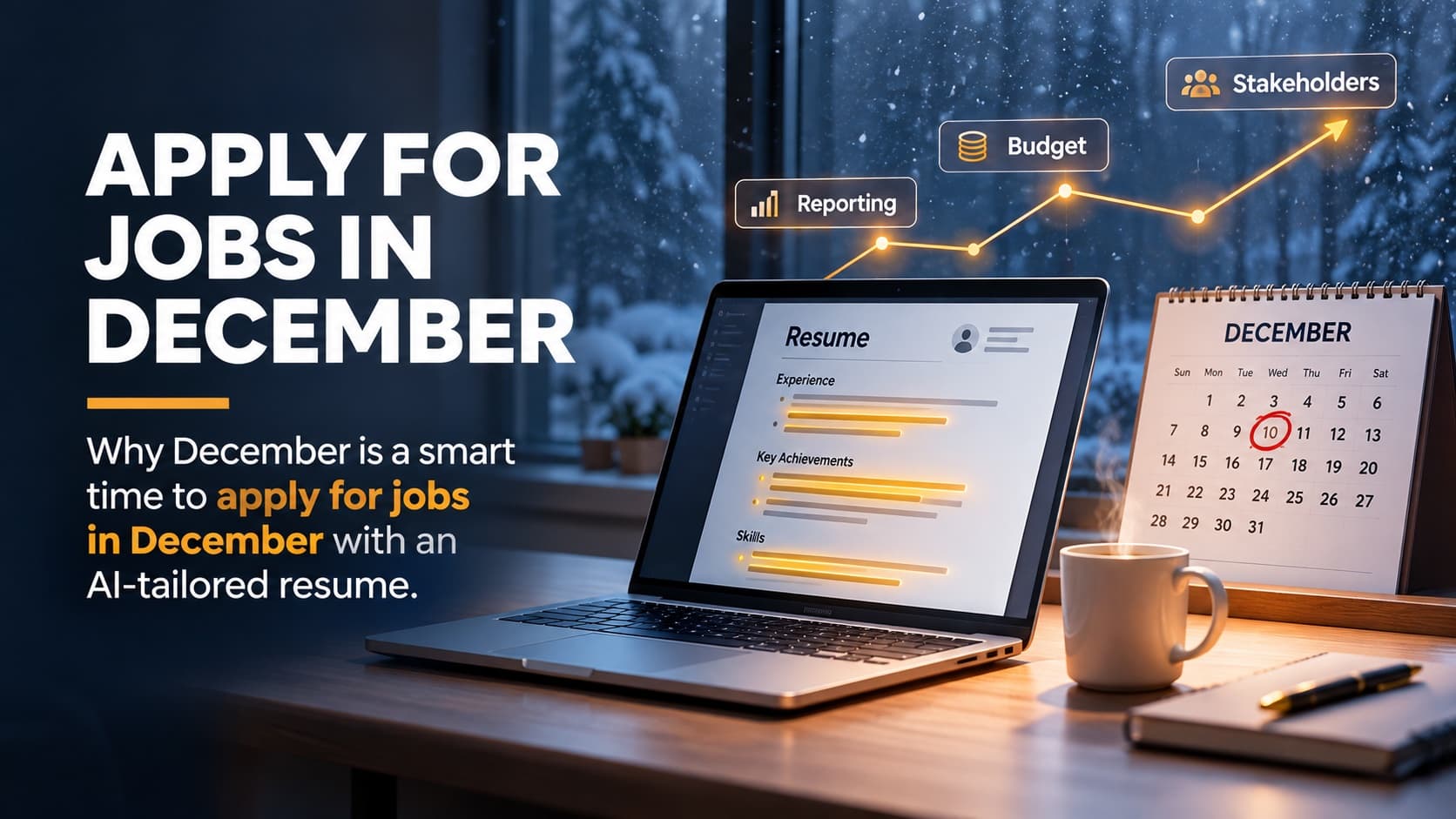

If you are wondering whether to apply for jobs in December, you have probably heard the usual advice: wait until January. It sounds sensible. Offices empty out, calendars fill with holiday plans, and it feels as if every hiring manager has switched off their email.
But that assumption is exactly what creates the opportunity. Many candidates pause their search over the holidays, so fewer applications compete for each open role. Recruiters who are still at their desks often have more time to read each resume properly. And today, AI tools let you tailor your resume to a specific job in minutes instead of hours, provided you use them honestly.
This guide explains why it can pay off to apply for jobs in December, where the limits are, and how to use AI to tailor your resume without sounding robotic or inventing a single line of experience. You will also get copy-and-paste prompts you can use today.
A quick note on realism: December is not magic. Some companies freeze hiring, and some decisions slip into January. The goal is not a guaranteed offer by New Year’s Eve. The goal is to put a strong, targeted application in front of people while the inbox is quiet.
Why You Should Apply for Jobs in December: 7 Proven Reasons
The reasons below come from recruiting firms, career publishers and hiring professionals. None of them is a promise, but together they make a strong case for staying active.
1. Less competition for every open role
Career publishers and recruiters repeat the same observation: a large share of job seekers hit pause in December. The Muse describes an applicant lull that gives recruiters more time to review resumes and can lead to longer interviews and quicker replies. Robert Half makes a similar point, noting that many people put their search on hold, which benefits those who stay active. Fewer rivals means your resume is easier to notice.
2. Hiring managers often have more time
With many colleagues on leave, inboxes calm down. TopResume points out that hiring managers who are in the office may have more time to answer emails and read the details of your resume. When you apply for jobs in December, a thoughtful application can get a closer look than it would during a hectic January.
3. Budgets and headcount plans are taking shape
By December, many companies know what next year’s budget looks like. Recruiting firm BGSF notes that managers who are finalising headcount and planning projects may use quieter days to review applications and schedule interviews. If a role is already approved, someone wants it filled soon.
4. Employers want to fill roles before the year ends
Built In reports that recruiters and hiring managers are often keen to close as many open orders as possible before the year is over, and that postings can even increase in December. Some employers also want new people in place before a busy January begins.
5. Year-end turnover creates openings
People change jobs at the end of the year, and each departure can leave a vacancy. PeopleReady notes that temporary and temp-to-hire roles are common at this time, and that companies sometimes offer full-time positions to temporary workers they already trust. A short-term role can be a real doorway.
6. A quiet calendar is ideal for networking
Fewer meetings and more goodwill make December a natural time to reconnect. A holiday greeting to a former manager or a short note to a recruiter feels friendly, not pushy. The Muse also lists networking among the reasons the month works well. Send three personal messages this week and see who replies.
7. You enter January already in the pipeline
Most candidates will start applying on the first Monday of the new year. A career expert quoted by Quartz described recruiters as flooded with applications in January but more responsive in December, when volume is lower. If you apply for jobs in December, you may already be in conversation while the rush begins.
The Honest Reality Check: What Happens After You Apply for Jobs in December
Hiring does not stop in December, but it can slow down. A piece from Ladders acknowledges that the pace may drop and that getting every decision-maker in the same room is harder over the holidays. Plan for that reality:
- Expect some delays. A silent week is normal, not a rejection.
- Prioritise fresh postings. Roles listed in the last few days are more likely to be actively managed.
- Follow up politely. A short, friendly note after about a week keeps you visible.
- Consider contract or temporary roles. They are often easier to approve and can lead to permanent offers.
- Keep your January diary open. Many interviews you earn in December will happen in the first weeks of the new year.
Why Tailoring Matters Even More When You Apply for Jobs in December
Most mid-size and large employers use an applicant tracking system, or ATS, to collect and organise applications. Recruiters can then search and filter candidates by job titles, skills and keywords. CareerFitter makes a useful clarification here: the software may not reject you on its own, but it influences how easily a recruiter can find and assess your resume.
AT&T’s careers team recommends tailoring your resume to each role and weaving keywords naturally into your summary, skills and experience. The logic is simple. When you apply for jobs in December, you face fewer rivals, so relevance becomes your biggest advantage. A resume that mirrors the language of the posting, truthfully, is easy to match and easy to shortlist.
The catch is time. Tailoring by hand can take around half an hour per application. This is where AI helps.
How to Tailor Your Resume with AI Before You Apply for Jobs in December
AI is excellent at three things: reading a long job description quickly, spotting the overlap with your background, and drafting clearer sentences. It is poor at knowing the truth about your career. So the rule is simple: you supply the facts, AI helps with the wording, and you approve every line.
Step 1: Build a master resume
Before you apply for jobs in December, spend one hour creating a master resume. List every role, project, tool, certification and measurable result, even those you would not normally include. Add context that AI often misses, such as team size, budget, number of customers or time saved. This document is your source of truth and is never sent to employers as it is.
Step 2: Decode the job description
Paste the job posting into your AI assistant and ask it to extract what matters. Try this prompt:
You are an experienced recruiter. Read the job description I paste below this line and list: (1) the eight most important skills, tools and qualifications, (2) the exact job title wording, (3) the three outcomes this hire must deliver, and (4) any phrases that signal company culture. Do not add anything that is not in the text.
Step 3: Match keywords to real proof
For each requirement, find evidence in your master resume. If you have it, note it. If you do not, leave it out. A good AI assistant will tell you where your resume has gaps, which is also useful for interview preparation.
Step 4: Rewrite your summary and top bullets
Now ask AI to draft the tailored version using only your facts:
Using only the facts in my master resume below, rewrite my professional summary and the five most relevant bullet points for the job description above. Match the job’s language where it is truthful. Keep every number, date and job title unchanged. If my resume does not support a requirement, tell me instead of inventing it. Use plain language and no buzzwords.
Here is what a good change looks like:
- Before: Responsible for managing social media accounts.
- After: Managed paid and organic social campaigns for a B2B software brand, reporting weekly on engagement and lead quality.
The second version works because it names the type of work, the context and the result, and it uses the language a recruiter would search for. It should only be used if it is accurate for you.
Step 5: Fact-check every line
This is the most important step. AI can confidently produce a tool you never used or a number you never reached. Read each sentence and ask, “Could I defend this in an interview?” If not, change it. LiveCareer warns that trying to trick the system tends to backfire, because a human hiring manager ultimately reads your application.
Step 6: Keep the format ATS-safe
A beautiful design is no use if software cannot read it. Use a single column, standard headings such as Experience, Education and Skills, and a common font. Avoid tables, text boxes, icons and headshots. Submit a PDF or DOCX according to the employer’s instructions.
Step 7: Add your own voice
Keyword stuffing and generic AI phrasing can hurt you. Dice cautions that overusing keywords can get a resume rejected by both software and people, and suggests adding your own ideas, voice and perspective so you stand out from AI-generated content. Add one sentence that only you could write, such as a project you are proud of or the reason this company interests you.
Step 8: Track every version
Save each tailored resume with a clear name, for example “Resume-Company-Role-December”. Keep a simple spreadsheet with the date applied, the contact person, the follow-up date and the status. When a recruiter calls, you will know exactly which version they have read.
A privacy tip: do not paste national ID numbers, your full home address, passwords or other sensitive details into any AI tool. Your resume rarely needs them, and you should check each tool’s data settings before uploading personal documents.
Your 7-Day Plan to Apply for Jobs in December
You do not need to apply to 50 roles. A focused week is enough to get moving.
- Day 1: Build your master resume and choose three target job titles.
- Day 2: Shortlist 10 roles posted recently and rank them by fit.
- Day 3: Decode the top three job descriptions with AI and map your proof.
- Day 4: Tailor, fact-check and submit your first three applications.
- Day 5: Update your LinkedIn headline and summary so they match your resume.
- Day 6: Message three contacts or recruiters with a short, friendly note.
- Day 7: Review responses, log everything and plan the next batch.
5 Mistakes to Avoid When You Apply for Jobs in December
- Mass-applying with one generic resume. When you apply for jobs in December, quality beats volume. Five targeted applications usually outperform thirty copies.
- Pasting AI output without editing. Recruiters read many AI-written resumes, and the sameness shows. Edit for voice and accuracy.
- Exaggerating or inventing experience. A claim that passes software rarely survives an interview or a background check.
- Following up too aggressively. One polite reminder after a week is enough. People are busy and often away.
- Waiting for the perfect resume. A good, honest, tailored resume sent today beats a perfect one sent in February.
Frequently Asked Questions
Is it worth it to apply for jobs in December?
For most people, yes. Competition is often lower and many employers still want to fill roles before the year ends. Just be realistic about slower replies and plan for interviews in January.
Do companies really hire during the holidays?
Many do. Employers finalise budgets, replace people who leave and prepare for a busy start to the year. Hiring speed varies by company and industry, so apply widely within your field.
Can AI write my resume for me?
AI can draft and polish it, but it should not decide what is true. Give it your verified facts, ask it to use only that material and review every line yourself.
Will recruiters know I used AI?
They may suspect it if your resume is full of generic buzzwords. Specific details, real numbers and your own voice make an AI-assisted resume read as human, because the content is yours.
How many jobs should I apply to in December?
There is no magic number. Start with three to five carefully tailored applications per week and increase only if you can keep the quality high.
Final Thoughts: Apply for Jobs in December and Start the New Year Ahead
The best time to look for work is not when everyone else does. It is when you can be seen. If you apply for jobs in December, you benefit from lighter competition, fresh budgets and recruiters who may finally have time to read your resume closely.
Combine that timing with an honest, AI-assisted tailoring process: build a master resume, decode the job, match your proof, edit with your own voice and check every fact. Do that, and you will not just apply faster. You will apply better.
Pick one role today, tailor your resume with AI, and send it. January will thank you.
Related Articles on IMFounder
- 7 Explosive AI Prompts Every Founder Needs Before Launching a Product
- 5 Powerful Claude AI for Sales Prompts That Will Close More Deals.
- 5 Proven Claude AI Prompts for Small Business Sales and Website
- The Explosive Startup Built With ChatGPT That Hit $401M: Medvi
- 7 Easy Steps to Create Stunning Animations From One Prompt and Launch Your YouTube Channel