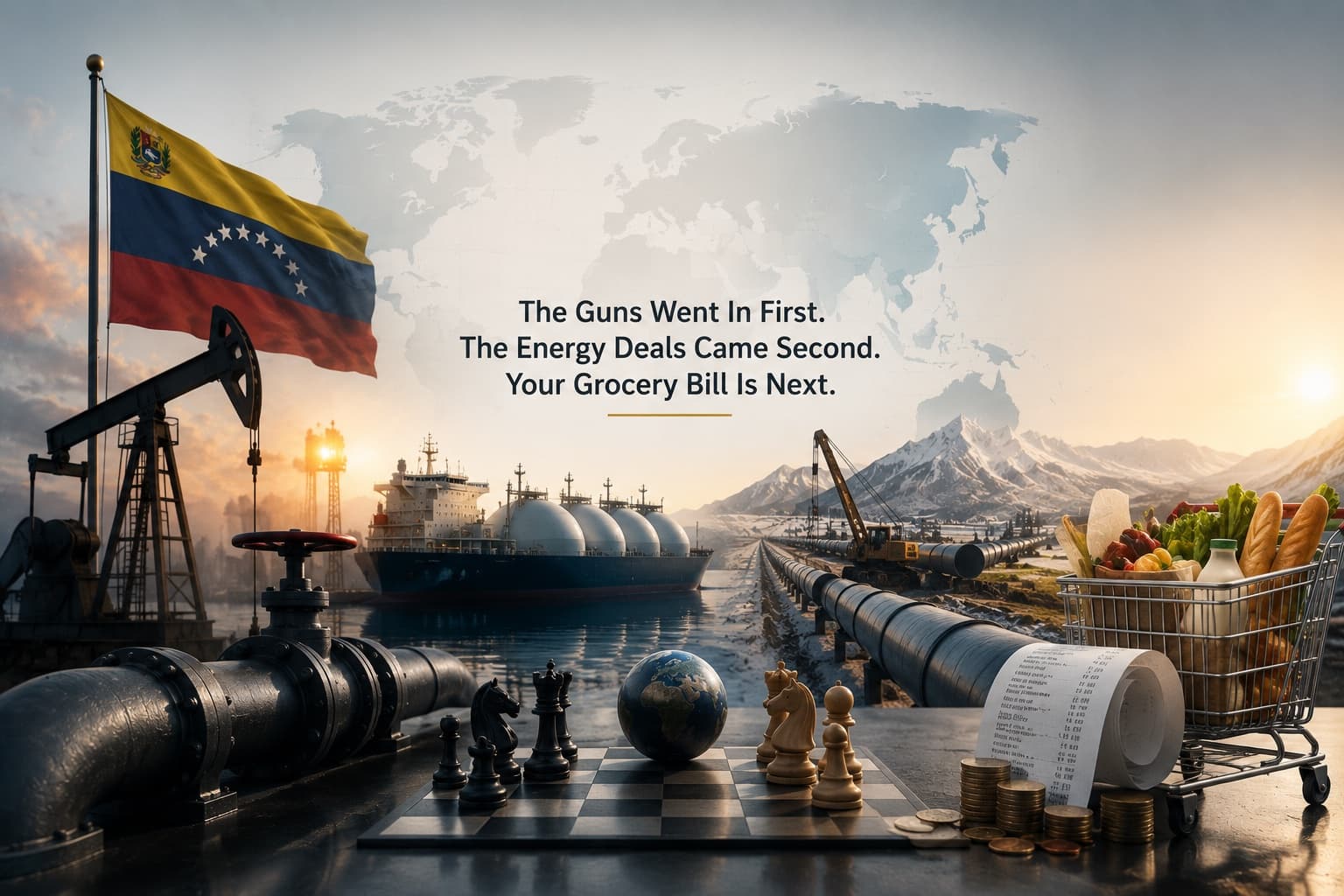

The United States removed a foreign government, handed 30-year energy licenses to Shell and BP, and left American gas stranded in Alaska. Nobody asked you. Nobody will.
Let’s talk about what actually happened in January 2026.
At 3am on January 3rd, US military forces entered Venezuela and captured President Nicolás Maduro. Six days later, Donald Trump was sitting in the East Room of the White House with nearly 20 of the largest oil and gas executives on the planet.
Six weeks after that, the US Secretary of Energy flew to Caracas.
Within 90 days of the military operation, Shell had a 30-year license. BP had signed. Chevron expanded. Repsol signed. Eni signed.
Let that timeline sit for a second.
The country had no permanent government. No free election had been held. No independent judiciary existed to enforce the contracts being signed. The security situation on the ground remained unresolved.
None of that stopped the contracts.
Because the contracts were never about Venezuela’s stability. They were about Venezuela’s reserves. And those reserves are the largest proven oil deposits on the planet.
Source: CNBC January 3, 2026; Fox Business January 3, 2026; Military.com January 21, 2026
The Numbers That Should Make You Angry
Venezuela holds 303 billion barrels of proven oil reserves. The world’s largest. It also holds the seventh largest natural gas reserves on Earth — 6,300 billion cubic meters — surpassing Saudi Arabia and the UAE combined.
Shell’s 30-year license covers the Dragon gas field alone — 4.2 trillion cubic feet — plus rights to three additional fields representing 12 trillion cubic feet of combined reserves. All of it processed into LNG through Trinidadian facilities that Shell does not own but will now control through contractual throughput agreements.
BP’s Cocuina-Manakin field straddles the Venezuelan-Trinidadian maritime border. The broader system it connects to holds an estimated 10 trillion cubic feet of gas.
Thirty-year licenses. Twelve trillion cubic feet. Signed within 90 days of a military operation that the sitting president of the United States publicly connected to energy access on the day it happened.
“We’re going to have our very large United States oil companies — the biggest anywhere in the world — go in, spend billions of dollars, fix the badly broken infrastructure, the oil infrastructure, and start making money,” Trump said at Mar-a-Lago hours after Maduro’s capture.
Plot twist: the US oil companies declined. According to Politico, citing four people familiar with the discussions, American companies passed when the administration asked if they wanted back in. The licenses went to Shell — Anglo-Dutch. BP — British. Repsol — Spanish. Eni — Italian.
The United States military conducted the operation. European energy corporations collected the licenses.
Source: J.P. Morgan January 2026; Energy Connects April 2026; Natural Gas Intelligence March 2026; Axios January 2026; NPR January 2026
Meanwhile Alaska Is Still Waiting
Here is the part that should make every person in America put down their phone and pay attention.
Alaska’s North Slope is sitting on enough natural gas to supply the entire US energy market for decades. The proposed Alaska LNG project — an 807-mile pipeline to a Nikiski export terminal — would connect American gas to Asian markets that are actively looking for supply alternatives to Middle East routes through the Strait of Hormuz.
Japan wants it. South Korea wants it. Taiwan wants it. Preliminary commitments already cover more than 60 percent of planned capacity.
The project cannot get financed.
Energy Secretary Chris Wright — the same man who flew to Caracas within six weeks of a military operation to sign off on foreign energy licenses — told a Senate hearing that Alaska LNG is his number one infrastructure priority.
“Not a week goes by that I don’t have multiple meetings or dialogues about it,” he said.
Then he acknowledged: “You have to build the pipeline first. The LNG export terminal is not hard to finance, but we can’t finance that without financing the pipeline.”
Translation: the administration moved at extraordinary speed to lock up 30-year extraction rights in a foreign country it just militarily occupied, but cannot find a financing mechanism for a domestic pipeline that would employ American workers, generate American tax revenue, and supply American allies.
American gas. American soil. American workers.
Still waiting.
Source: Alaska Public Media April 2026; Baker Hughes November 2025; Alaska Beacon April 2026
The Worst Case Scenarios Nobody Is Printing
This is where most outlets stop. They report the deal, note the complexity, and move on.
Here is what the worst case trajectory actually looks like — documented, projected, and entirely plausible.
Worst case scenario one — the contracts hold and the food costs rise anyway.
Shell and BP lock in 30 years of Venezuelan LNG extraction. The supply comes online. Global energy prices stabilize or decline slightly. But the margin from that price decline flows to Alphabet-sized energy corporations, not to the fertilizer manufacturers, not to the trucking companies, not to the cold chain operators, not to the restaurant on the corner. The structural benefit of cheaper energy gets captured at the corporate level before it reaches the food economy. Your grocery bill does not go down. Their earnings calls get better.
Worst case scenario two — the contracts collapse and the food costs spike.
Venezuela’s infrastructure is degraded beyond rapid repair. Rystad Energy puts the bill at $183 billion to restore production to 3 million barrels per day by 2040. The interim government is unstable. A new political situation emerges that voids the contracts. Shell and BP write down their positions and exit. The supply Venezuela was supposed to add to global markets never materializes. The LNG the Asian buyers were counting on does not arrive. Global energy prices spike. Fertilizer costs follow. Food production costs follow. The consumer absorbs the full impact of a geopolitical gamble that failed — with no refund and no explanation.
Worst case scenario three — Alaska never gets built.
The financing gap on the Alaska pipeline remains unresolved. The final investment decision gets delayed again — into 2027, 2028, beyond. The Asian buyers who signed preliminary commitments find other suppliers. The North Slope gas stays stranded. American workers who would have built and operated the infrastructure never get those jobs. The communities along the pipeline corridor never see the economic development. Meanwhile the energy revenue flows to European majors operating on 30-year licenses in Venezuela. The United States conducted the military operation. The United States absorbed the geopolitical risk. European corporations collected the return.
Worst case scenario four — all three happen simultaneously.
The Venezuelan contracts generate short-term supply that depresses prices enough to make the Alaska pipeline economics even harder to justify. The Venezuelan political situation destabilizes within five years, voiding the contracts. Alaska is still not built. The global LNG market tightens. Asia faces supply shortfalls. Energy prices spike globally. Fertilizer costs surge. Food production contracts. Supply chains compress. The restaurant industry — already operating on margins that cannot absorb sustained input cost increases — enters a wave of closures that makes the 2020 pandemic shutdowns look manageable.
None of these outcomes is inevitable. All of them are documented trajectories based on confirmed data.
Source: Rystad Energy 2026; Alaska Public Media April 2026; J.P. Morgan January 2026; IEA; USDA ERS Food Price Outlook 2026
Why Your Grocery Bill Is the Last Stop on This Train
Most people reading this are not energy traders. They are not geopolitical analysts. They do not track LNG futures or monitor Venezuelan production capacity.
But every single one of them eats.
And the connection between what happened in Caracas on January 3, 2026, and what happens at the grocery store checkout in 2027, 2028, and 2029 is direct, documented, and entirely ignored by most of the media covering either story.
Natural gas produces nitrogen fertilizer. Nitrogen fertilizer underwrites global crop yields. Diesel moves food through the cold chain from farm to distribution center to store. Electricity powers the refrigeration that keeps it safe at every stop. Every one of those inputs is directly tied to the energy infrastructure decisions being made right now by people whose names you do not know, in rooms you were not invited into, on behalf of shareholders you will never meet.
The food economy is not a separate system from the energy economy. It is downstream of it. Always has been. And right now the energy economy is being restructured by military operations, 30-year corporate licenses, and a domestic pipeline that cannot get financed — while the people who will pay the downstream costs are watching TikTok and wondering why eggs are still $7 a dozen.
Source: IEA; USDA ERS; Brookings Institution Global Energy and AI Report 2026
The Bottom Line
The guns went in on January 3.
The oil contracts followed within 90 days.
Shell gets 30 years.
BP gets the offshore fields.
The US oil companies declined.
Alaska still cannot finance the pipeline.
The Secretary of Energy called Alaska his number one priority from a Senate hearing room while his department was processing licenses for European multinationals to extract Venezuelan gas for the next three decades.
The food economy sits downstream of every one of these decisions. The fertilizer prices. The diesel costs. The cold chain margins. The restaurant closures. The grocery bill that keeps going up while the wages stay flat and the explanations stay vague.
This is not a conspiracy. It is a documented sequence of decisions with traceable consequences. The only question is whether the people absorbing those consequences are paying attention before the bill arrives.
Spoiler: it already has.
Related Articles on IMFounder
- How Sysco Corporation Consolidated the Middle Layer of Food Distribution
- Strait of Hormuz Crisis: Why Founders and Businesses Are in Serious Danger
- The Hidden Bill of War: How Geopolitics, Oil, and Power Are Reshaping the Global Economy
- The World on Fire: Why Global Instability Has Surged Since 2020
Sources: CNBC January 3, 2026; Fox Business January 3, 2026; NPR January 4, 2026; Axios January 5, 2026; Military.com January 21, 2026; Congress.gov CRS Report February 2026; Natural Gas Intelligence March 2026; Energy Connects April 2026; Alaska Public Media April 2026; J.P. Morgan Global Research January 2026; Baker Hughes November 2025; Shell Q3 2025 earnings; RBN Energy March 2026; Rystad Energy 2026; IEA; USDA ERS Food Price Outlook 2026