
Introduction: A Rivalry Between Brother Nations
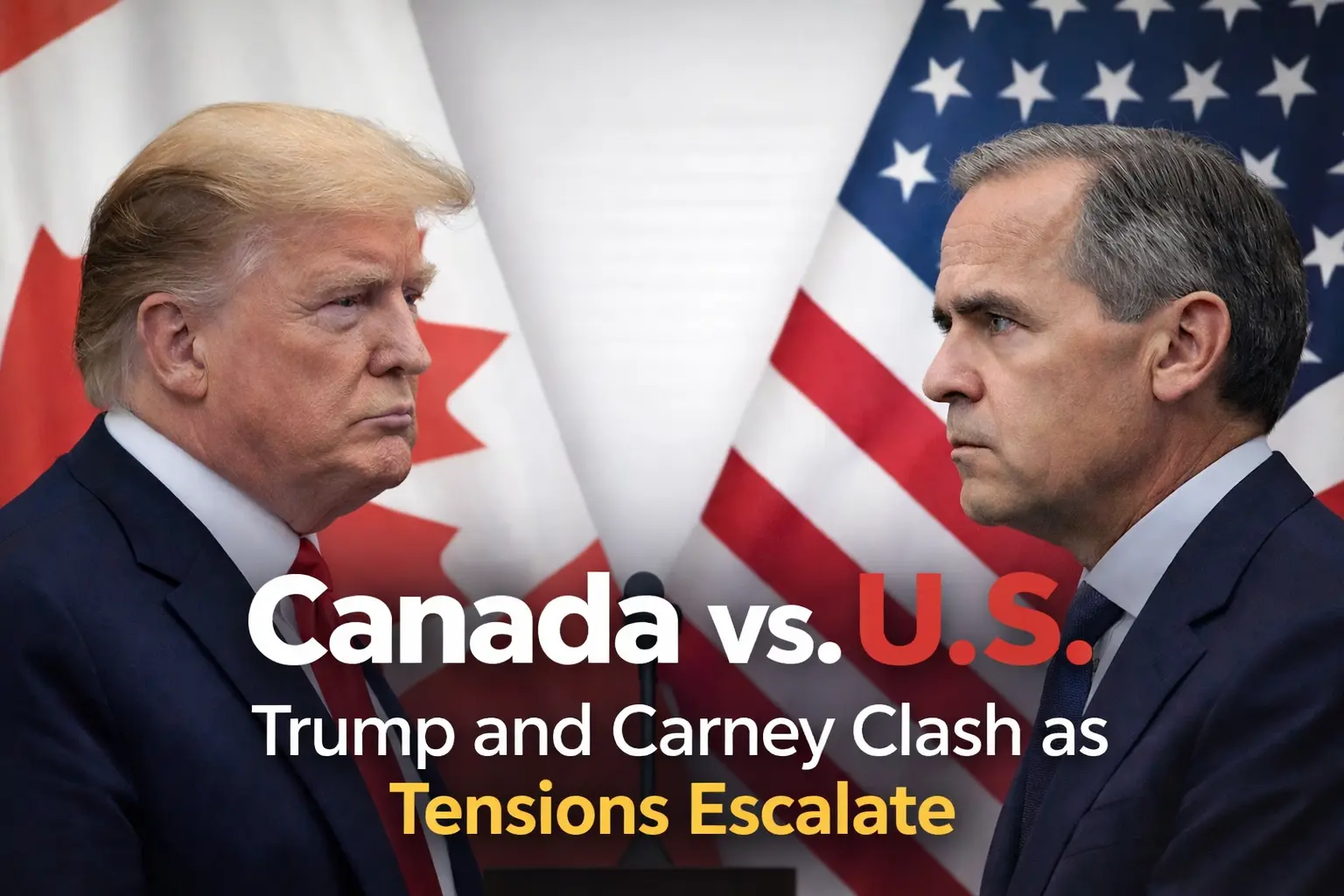
Canada and the United States are often described as “brother nations” — bound by the world’s longest undefended border, more than $2.5 billion in goods and services traded daily, and deeply intertwined political, cultural, and security relationships. Yet in recent weeks, that relationship has taken on a sharper edge as former U.S. President Donald Trump and Canadian Prime Minister Mark Carney exchanged pointed public remarks that reverberated far beyond the podium.
What might appear, at first glance, as political theater has quickly evolved into a meaningful signal for markets, multinational firms, and entrepreneurs on both sides of the border. This article breaks down what was said, why it matters, and what the next strategic moves by Washington and Ottawa could mean for North American business.
Setting the Stage: Why This Moment Matters
The Canada–U.S. relationship has historically weathered disagreements over trade, defense spending, energy, and technology policy. However, the current exchange comes at a sensitive economic moment:
- Global supply chains remain fragile following years of pandemic disruptions and geopolitical conflicts.
- North American governments are actively reshoring manufacturing in semiconductors, EVs, and clean energy.
- Inflation, interest rates, and currency volatility continue to shape investment decisions.
Against this backdrop, leadership rhetoric is not just symbolic. It can influence tariff policy, cross-border investment confidence, and regulatory alignment — all of which directly affect companies operating in both markets.
What Trump Said: Economic Nationalism, Revisited
Speaking at a recent campaign-style address in the United States, Donald Trump reiterated a familiar theme of “America First” economics, with a specific reference to trade imbalances and manufacturing competitiveness.
“We’re not going to let other countries, even our closest neighbors, take advantage of American workers and American companies anymore,” Trump said. “If we have to use tariffs or tough trade rules to protect our industries, we will.”
While Trump did not name Canada directly in every instance, his comments on steel, automotive manufacturing, and energy exports were widely interpreted by analysts as a signal that North American trade agreements could once again face pressure if he returns to office.
For Canadian exporters, particularly in Ontario’s automotive corridor and Western Canada’s energy sector such language raises concerns about the potential revival of cross-border trade friction reminiscent of the USMCA renegotiation era.
Carney’s Response: Stability, Markets, and the Rules-Based Order
Prime Minister Mark Carney, a former central banker with deep ties to global financial institutions, took a markedly different tone in his public remarks.
“Canada believes in open, fair, and rules-based trade,” Carney stated. “Our prosperity is built on partnership, not protectionism, and on strengthening supply chains that benefit workers and businesses on both sides of the border.”
Carney emphasized Canada’s role as a stable, predictable investment environment, positioning the country as a long-term partner for U.S. and global firms navigating economic uncertainty.
His comments were widely seen as an appeal to international markets and multinational corporations — reinforcing Canada’s reputation as a policy-consistent jurisdiction in contrast to what some investors view as the volatility of U.S. political cycles.
A Clash of Economic Philosophies
At the core of this exchange lies a fundamental difference in economic worldview:
Trump’s Approach
- Emphasis on bilateral trade leverage
- Willingness to use tariffs as a negotiating tool
- Focus on domestic manufacturing and supply chain sovereignty
Carney’s Approach
- Commitment to multilateral trade frameworks
- Market stability and regulatory predictability
- Positioning Canada as a global financial and innovation hub
For businesses, this divergence creates both risk and opportunity. Companies that rely on frictionless cross-border movement of goods may face uncertainty, while firms in sectors targeted for domestic investment, such as clean tech, AI, and advanced manufacturing — could benefit from increased government support.
What Comes Next: Strategic Moves to Watch
1. Trade Policy Signals
If U.S. political momentum continues to favor protectionist policies, companies should watch for early indicators such as:
- Reviews of USMCA provisions
- New tariff proposals on automotive parts, steel, or energy
- Incentive packages aimed at reshoring production
2. Canada’s Investment Diplomacy
Ottawa is likely to intensify outreach to:
- European and Asian investors
- U.S. technology firms seeking regulatory certainty
- Clean energy and infrastructure funds
Canada’s pitch will center on policy stability, access to North American markets, and a skilled, immigration-supported workforce.
3. Regulatory Alignment in Technology and AI
Both nations are developing frameworks for artificial intelligence, data privacy, and digital competition. Divergence in these rules could create compliance complexity for startups and multinational tech companies operating in both jurisdictions.
Impact on Business: Sector-by-Sector Analysis
Manufacturing and Automotive
The automotive sector remains one of the most integrated industries across the border. Any tariff threats or changes to content rules could:
- Increase production costs
- Delay EV and battery plant investments
- Reshape supplier networks across Ontario, Michigan, and Ohio
Energy and Clean Tech
Canada’s role as a major energy exporter — including oil, gas, and hydroelectric power — places it at the center of U.S. energy security discussions. At the same time, both countries are competing to attract clean tech manufacturing, from battery plants to hydrogen projects.
Startups and Venture Capital
Political uncertainty tends to make investors cautious. However, it can also drive capital toward jurisdictions perceived as more stable.
For Canadian startups, this may translate into:
- Increased interest from international funds
- Strategic partnerships with U.S. firms seeking diversification
For U.S. startups, Canada may become a more attractive base for R&D, particularly in AI, fintech, and climate technology.
Markets React: Confidence Versus Caution
Currency markets, equity analysts, and trade associations have closely monitored the exchange. While no immediate policy changes have followed, the tone alone has:
- Prompted trade groups to call for renewed bilateral dialogue
- Led some investors to hedge against potential regulatory shifts
- Sparked renewed debate about North America’s long-term economic integration
In a global economy where perception often moves markets as quickly as policy, leadership rhetoric carries measurable financial weight.
Conclusion: Beyond the Headlines
The public sparring between Donald Trump and Mark Carney may resemble political drama, but its implications are deeply practical. For businesses, entrepreneurs, and investors, the message is clear: the future of Canada–U.S. economic relations is once again part of the political conversation, not just the trade negotiation room.
Whether this moment becomes a catalyst for renewed cooperation or a prelude to heightened economic nationalism will depend on the next set of policy decisions — not just the next set of speeches.
For now, companies operating across the world’s most important bilateral trade relationship would be wise to prepare for both scenarios: deeper integration and strategic decoupling.