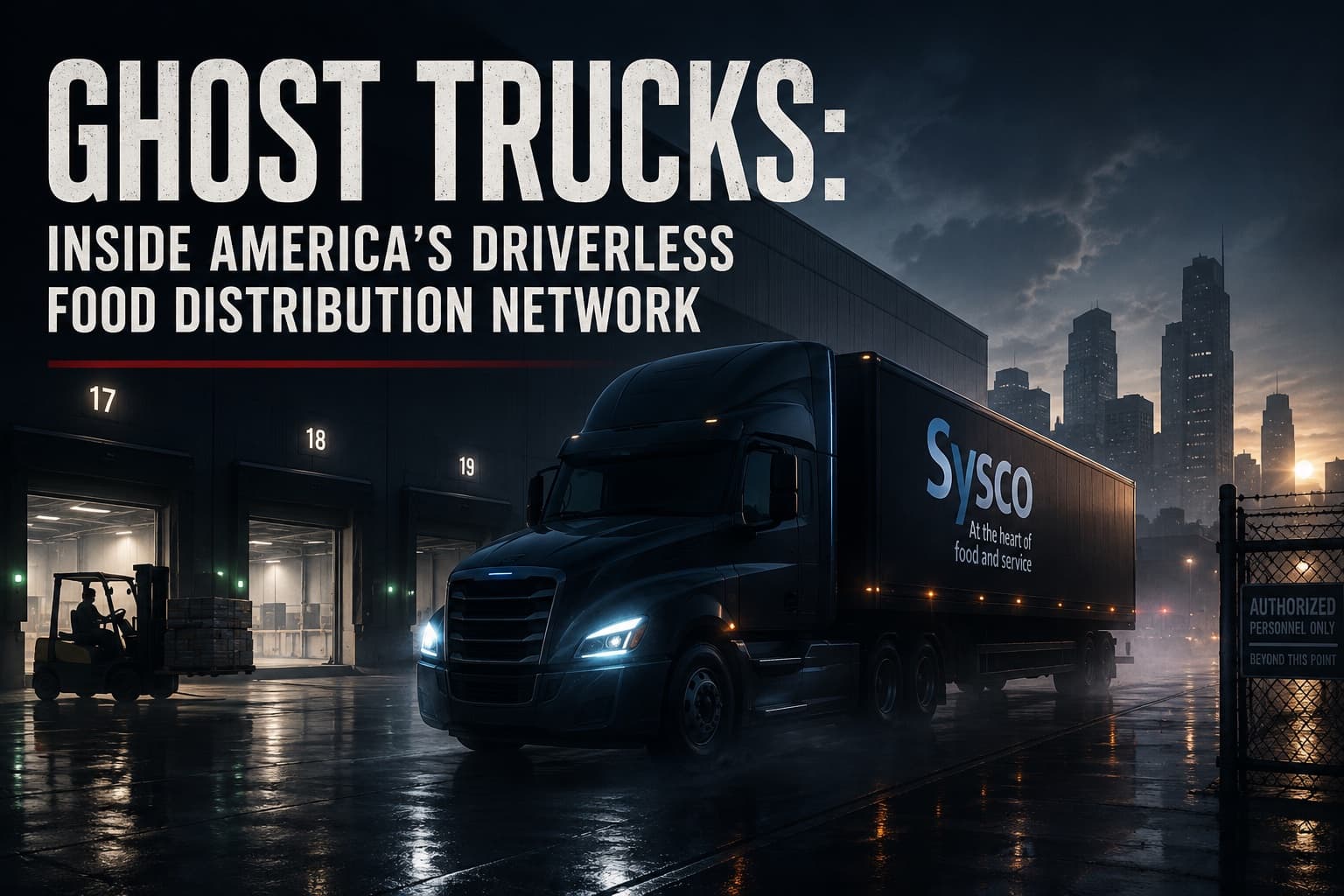

“They didn’t corner the food business with recipes. They cornered it with trucks, warehouses, routes, and the quiet understanding that eventually everybody’s kitchen would run through them anyway.”
The trucks still arrive before sunrise.
Most restaurant owners never think about them beyond the invoice. A pallet of fryer oil. Produce substitutions. Frozen inventory wheeled through the back door before prep cooks clock in. The driver is gone before the morning shift starts. The order was already decided somewhere else.
But the trucks have been changing. Quietly. And the companies behind them have been changing faster.
Sysco Corporation operates one of the largest private trucking fleets in the United States. Not one of the largest food distribution fleets. One of the largest private fleets — across any industry, in any sector. According to Transport Topics rankings, as of 2021 Sysco was the largest foodservice fleet and second largest private fleet in the country, behind only PepsiCo. 8,745 tractors. 10,593 trailers. (ttnews)
Most people in the restaurant industry know Sysco as a vendor.
That framing stopped being accurate a while ago.
The groundwork started earlier than most people noticed.
In October 2020, Sysco began testing an all-electric Freightliner eCascadia Class 8 tractor from Daimler Trucks North America out of its San Francisco site. According to Sysco’s October 2020 press release, the company joined the Freightliner Electric Vehicle Council — a working group of major fleet operators collaborating directly with Freightliner to explore large-scale commercial EV deployment. It was announced as a sustainability initiative.
It was also the beginning of a technical relationship with the manufacturer of a vehicle platform that Sysco would commit to at scale two years later.
In May 2022, according to a Letter of Intent announced by Sysco and Daimler Truck North America, the companies outlined plans to deploy up to nearly 800 battery-electric Freightliner eCascadia Class 8 tractors by 2026. The agreement represented one of the largest commercial EV fleet commitments in the foodservice industry at the time. The stated objective was to electrify 35% of Sysco’s U.S. tractor fleet by 2030.
In November 2022, the first production eCascadia was handed over at the Daimler plant in Portland. Sysco’s own language in the press release was direct: the company operates one of the largest private fleets in the United States.
Nobody in the restaurant industry was paying attention.
Here is what matters about that truck.
Daimler is simultaneously developing autonomous vehicle technology through Torc Robotics — a company Daimler moved toward full ownership of after an initial majority stake. Torc’s autonomous program is built around the Freightliner Cascadia platform. The same platform underneath the eCascadia now rolling into Sysco’s fleet.
This is not a conspiracy. It is a product roadmap.
The trucks Sysco is deploying today are the generation immediately before the autonomous-capable version built on the same bones. Operators who standardize on a platform, build charging infrastructure for it, and run their logistics through its data systems do not walk away from that easily. The electrification commitment also happens to be a lock-in strategy. Whether it is described that way publicly is a different question.
The trucks did not expand alone.
In December 2021, Sysco acquired The Coastal Companies — Coastal Sunbelt Produce, Lancaster Foods, and East Coast Fresh — adding significant distribution and cold-chain infrastructure to its network. Coastal Sunbelt operated a 330,000-square-foot facility in Maryland and a 123,000-square-foot facility in Virginia. Lancaster Foods brought a 220,000-square-foot cold warehouse in Maryland with 28 shipping doors and 15 receiving doors. Sysco integrated these assets into FreshPoint, strengthening its mid-Atlantic specialty produce and cold-chain capacity. (Truckingdive)
Before that: Greco and Sons. Paragon Foods. Edward Don and Company. Each one added routes, warehouses, trucks, and regional relationships built over years by operators who had no reason to think of themselves as part of a national network.
Until they were.
There used to be a person in between.
Older drivers knew which restaurants were struggling before the owners said it out loud. They knew who paid late. Which chef was about to walk. Which kitchen needed an extra case held quietly without it showing on the invoice.
That knowledge was not in a system. It lived in the driver.
The newer systems carry something different. Route optimization. Demand forecasting. Automated substitution logic. Delivery confirmations logged into platforms the restaurant operator cannot see. Sales reps who once had actual authority over an account have been replaced, slowly and without announcement, by ordering portals.
The relationship became a portal. The portal became the relationship.
Most operators adapted. They did not have much choice.
The labor side is where people get uncomfortable.
Autonomous trucking does not need to arrive everywhere at once. It only needs to arrive slowly enough that nobody notices the transition while it is happening. The infrastructure required to support it — standardized vehicles, AI routing, depot-based charging, warehouse automation — is being assembled now. Not as a pilot. As present reality.
It will not announce itself when it completes. It will show up in quarterly earnings notes. Driver cost ratios. Efficiency gains. The slow disappearance of the kind of driver who held product for a struggling restaurant and never put it on paper.
Most independent restaurants still believe they are choosing vendors.
Different logos. Different trucks. Different sales reps. The illusion of a competitive market held together for a long time.
What they are increasingly buying is access. Access to routes. To cold-chain stability. To a system large enough to absorb the volatility that closes smaller operations. The truck at the back door is not just delivering food anymore. It is the visible edge of an infrastructure system that now runs underneath the entire industry.
Related Articles on IMFounder
- How Sysco Corporation Consolidated the Middle Layer of Food Distribution
- How Big Tech Is Quietly Taking Control of the Food Supply
- The Restaurant Industry: The Fastest Way Into the Economy Is Closing
- Not Gold, Not Diamond. 7 Shocking Reasons Trees Are the Rarest Resource on Earth
- GLP-1 Is Eating the Food Industry From the Inside Out The End of Excess Appetite
- $11,000 World Cup Tickets. $30 Wages. Why SoFi Stadium Workers Are Ready to Strike