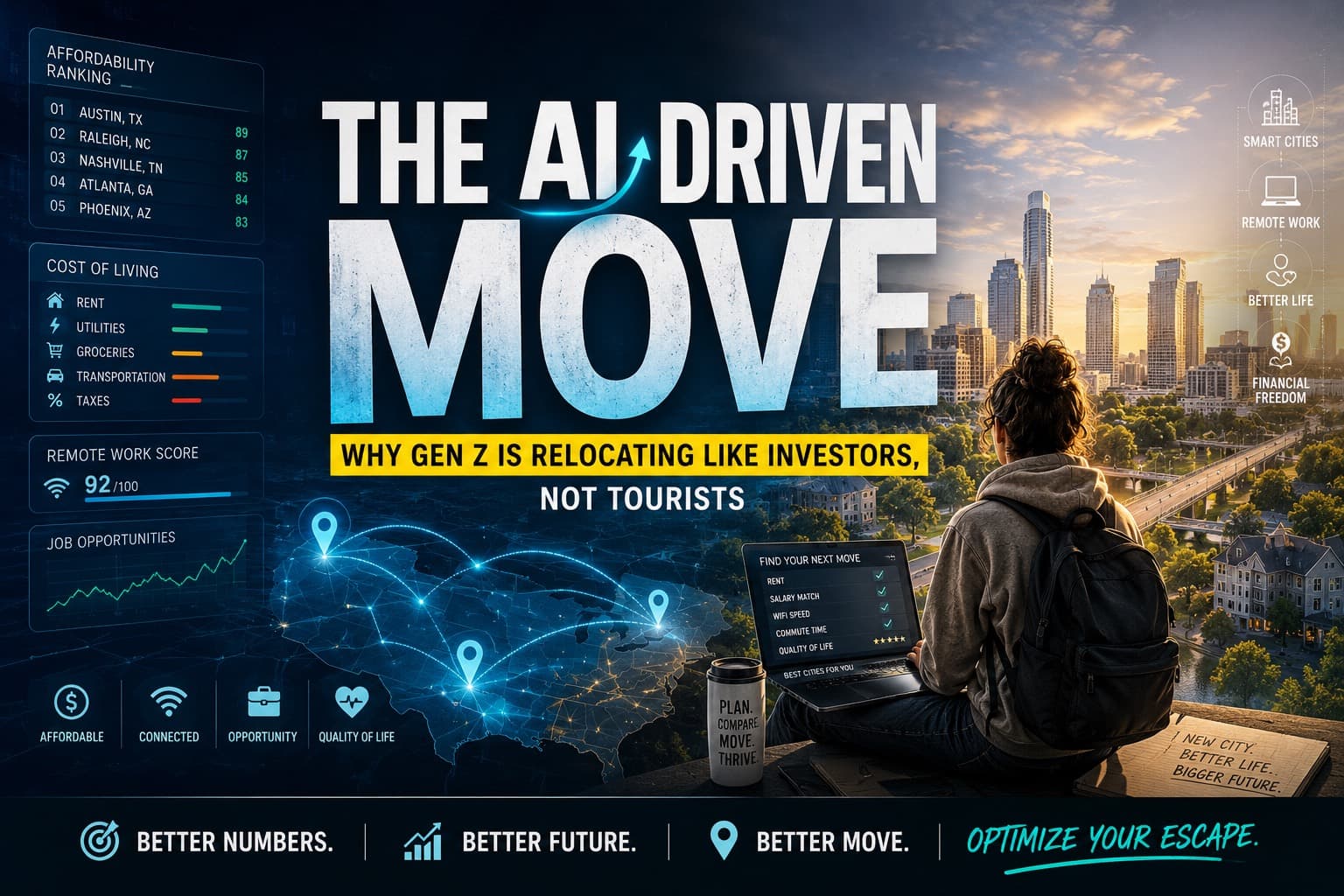

The villain is the machine that turns affordability into opportunity, then turns opportunity into an asset class.
Affordability rankings, AI search tools, remote-work economics, and smart-city infrastructure are turning relocation from a lifestyle choice into a calculated market move.
Young professionals used to move for culture. Now they move for math. Rent, salary, Wi-Fi, utilities, car insurance, taxes, commute time, grocery costs, job postings, home prices, and whether a city has enough momentum to build a life without getting financially humiliated by the zip code. That is the AI-driven move.
The next migration wave will not be driven by vibes alone. It will be driven by dashboards. AI tools, real estate platforms, affordability rankings, remote-work filters, and smart-city infrastructure are teaching Gen Z and younger professionals to treat relocation like a market scan. The city is no longer just a place to live. It is a financial strategy.
That changes everything. Once AI finds the affordable city, the city stops being hidden.
The cheap map is moving inland
For decades, the American ambition script was coastal: New York, Los Angeles, San Francisco, Seattle, Boston, Miami. Move where the culture is. Move where the companies are. Move where the status is. The problem is that status now comes with a rent bill large enough to turn a full-time salary into a group project.
That is why younger workers are looking harder at the South, Midwest, and smaller growth markets. A recent GOBankingRates report, citing a Seven Seas Worldwide study ranking all 50 states by affordability for people moving in 2026, placed Arkansas at No. 1, followed by Mississippi and Nebraska. The study weighed rent, median home price, utilities, car registration, driver’s license fees, and moving labor wages. Arkansas stood out with average rent around $1,093 and a median home price around $255,300.
That does not mean everyone is packing for Arkansas tomorrow. It means the affordability map is becoming searchable, comparable, and easier to act on. Oklahoma, Iowa, Louisiana, Missouri, Kansas, New Mexico, and South Dakota also appeared in the affordability conversation because young workers are not just asking, “Where is cool?” They are asking, “Where can I live without losing every dollar to housing?”
That is a different kind of migration. It is not aspirational relocation. It is defensive relocation.
AI turns relocation into a search engine for survival
The old relocation process was messy. You searched listings, watched a few city videos, checked Reddit, asked friends, compared salaries badly, and hoped the neighborhood was not secretly a nightmare. Now AI can compress that research into minutes. A young professional can ask a chatbot to compare Little Rock, Tulsa, Omaha, Chattanooga, Kansas City, Greenville, Fayetteville, Raleigh, and Pittsburgh by rent, wages, taxes, broadband access, job postings, walkability, crime, home prices, and commute time.
That does not make AI perfect. It can miss local nuance, outdated listings, neighborhood reality, transportation issues, flood zones, and the simple human fact that a cheap city is useless if it does not have the life or work a person needs. But AI changes the behavior. It makes moving feel less like a leap and more like a filtered decision.
Bank of America’s 2026 Homebuyer Insights Report found that one in five prospective buyers and homeowners had used AI in the homebuying process. That number matters because AI is no longer sitting outside real estate. It is entering the search, planning, affordability, mortgage, and market-analysis process itself. Younger buyers and renters are not waiting for a perfect market. They are learning how to scan the imperfect one faster.
The platforms are becoming relocation engines
This is where the story gets bigger than Gen Z. Real estate platforms are no longer just listing sites. They are becoming relocation engines. Zillow has pushed AI-powered search that lets users look for homes and rentals using everyday language, including queries tied to commute time, affordability, schools, and nearby points of interest. That matters because natural-language search turns a vague life desire into a housing filter: “homes under $2,500 near downtown,” “rentals with a short commute,” “houses near good schools,” or “apartments near restaurants and nightlife.”
Renters are being pulled into the same system. Apartments.com has been moving toward AI-powered apartment search and renter tools, including voice and smart-search features designed to help renters find properties faster. That does not only help renters. It helps platforms capture intent: budget, location, amenities, timing, lifestyle, urgency, and the price point where a person becomes ready to move.
For buyers, Realtor.com remains one of the major search portals shaping how people compare homes, neighborhoods, price changes, mortgage estimates, and market inventory. Put these platforms together and the relocation economy becomes obvious: the search box is no longer passive. It is teaching people where to go.
That is the AI-driven move. The user thinks they are searching for a city. The city is being ranked, filtered, scored, and sold back to them through data.
The next boom cities may be discovered by algorithms
The phrase “next boom city” used to come from magazines, developers, chambers of commerce, travel writers, and people who moved early and then posted about it until the rent doubled. Now the boom city can be surfaced by a stack of signals: low rent, rising job postings, new infrastructure, remote-work compatibility, broadband, lower taxes, climate risk, housing supply, walkability, migration trends, and social content.
That is powerful. It is also dangerous.
Cheap places do not stay cheap once everyone can find them. Affordability becomes content. Content becomes migration. Migration becomes demand. Demand attracts investors. Investors raise prices. Then the “hidden gem” becomes another market where locals and young workers are told they should have bought earlier.
This is the part young professionals understand because they watched it happen to Austin, Nashville, Denver, Asheville, Boise, Raleigh, Tampa, Phoenix, and parts of the Carolinas. The internet finds the place. Remote workers arrive. Investors follow. Apartments rebrand. Coffee shops multiply. The local economy gets “discovered.” Then the people who made the place interesting get priced into the next search query.
Smart cities are not just shiny tech projects
The smart-city conversation is usually sold through sensors, traffic systems, broadband, digital permits, energy grids, transit apps, public data, and connected infrastructure. But for young professionals, the real smart city is simpler: a place where the numbers work. Can someone earn, rent, connect, move, eat, build, and eventually buy without being punished for not already being rich?
That is why the “smart city” label is changing. The future young-professional city does not have to be the flashiest. It has to be usable. Affordable housing, reliable internet, job access, transportation, healthcare, safety, climate resilience, food access, and public infrastructure matter more than another luxury apartment lobby with fake plants and a podcast room nobody asked for.
This connects directly to the larger AI economy. In Food Is Being Diamonded, the question was what happens when technology turns craft into scalable inventory. In The New Beauty Standard Is Not Born. It Is Rendered., the issue was how AI turns identity, desire, and visual culture into optimized outputs. Relocation is moving into the same machine. Cities are being compared, ranked, filtered, and marketed through data until place itself becomes a product.
The employers should be nervous
Employers in expensive cities have a problem. Young professionals can now calculate whether the opportunity is real. A job paying more in a high-cost city may still be worse than a lower-paying job in a cheaper market if the rent, commute, taxes, and daily costs erase the difference. AI makes that gap easier to see.
That means “competitive salary” is losing power as a phrase. Competitive against what? Rent? Groceries? Student loans? Car insurance? Mortgage rates? Moving costs? If a worker can use AI to compare the real lifestyle value of a job across ten cities, employers in overpriced markets lose some of the mythology they used to sell.
This is not about young professionals giving up ambition. It is about rejecting bad math. The next generation is not necessarily less career-driven. They are less willing to be financially humiliated by a zip code that no longer offers enough in return.
The bottom line
The AI-driven move is not just a housing trend. It is a market shift. Young professionals are learning to search for cities the way companies search for opportunity: by comparing inputs, costs, risks, infrastructure, and upside. The new relocation map will not be written only by travel magazines, real estate agents, or lifestyle influencers. It will be shaped by AI search, housing platforms, affordability rankings, remote-work economics, and a generation trying to find the next place before the algorithm makes it expensive.
The dream city had its run. The next flex is a place where the rent clears, the Wi-Fi works, the salary stretches, the groceries do not require financing, and nobody has to pretend financial survival is a lack of ambition.
Young professionals are not just moving.
They are optimizing the escape.
Related Articles on IMFounder
- Startup Ideas Rejected by Investors That Became Unicorns
- Canada Startup Visa 2026: Shocking Truth for 43,000 Trapped Founders
- The Founder’s Complete Guide to Visas, Grants & Funding in Canada and the USA
- AI Took the Jobs, Housing Took the Future, and Loneliness Became an Industry
- The Best Coworking Spaces for Founders in Canada in 2026 — Ranked by City
- Canada’s $3.2 Billion Housing Bailout