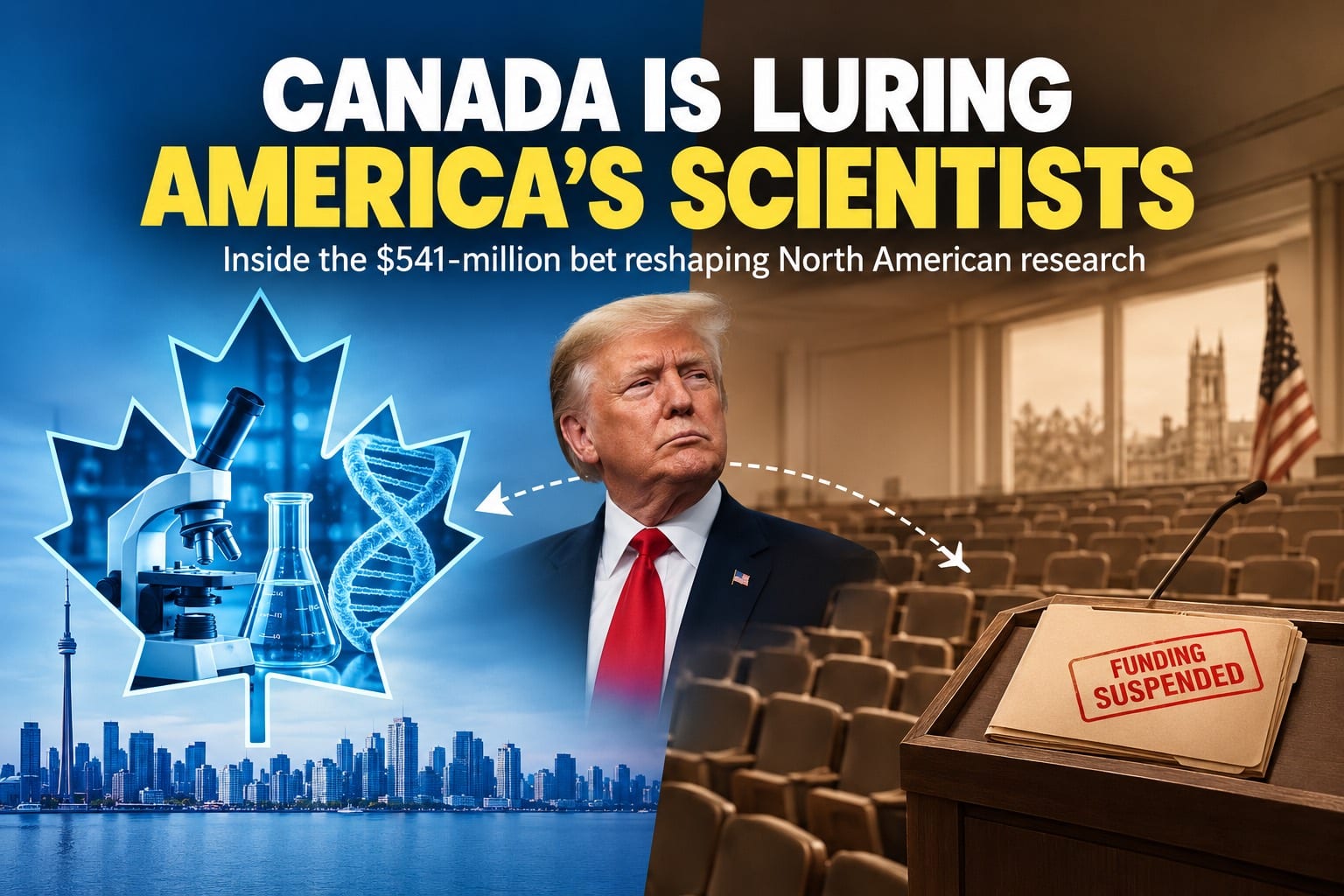

As Trump slashes university funding and renames a Great Lake out of spite, Ottawa is spending big to bring America’s best scientists north — and it’s working.
Quick Facts
- 64 scholars recruited into Canadian universities as of late August 2026, backed by $541 million CAD over eight years
- 48 of the 64 — three-quarters — are coming from American institutions, including Harvard, Cornell and MIT
- The hires are the first cohort of Canada’s $1.7-billion, 12-year Global Impact+ Research Talent Initiative, launched in December 2025
- The announcement landed the same day President Trump signed an executive order renaming Lake Ontario “Lake America”
- Canada’s next round of retaliatory tariffs on roughly $27.6 billion in US goods takes effect September 8, 2026
Canada luring American scientists away from the United States is no longer a quiet trend playing out one lab at a time — it is now official government policy, backed by hundreds of millions of dollars, and it just had its biggest week yet. On August 27, 2026, Canadian Industry Minister Mélanie Joly stood in front of cameras and announced that 64 leading researchers had been recruited into universities across the country, three-quarters of them poached directly from American institutions. Hours later, and a few hundred kilometres away in the Oval Office, President Donald Trump signed an executive order renaming Lake Ontario “Lake America.” The timing was not a coincidence anyone in Ottawa seemed eager to downplay.
Two announcements. One country each. Both landing on the same Thursday. If you wanted a single day that captured the strange, personal, high-stakes state of the Canada-US relationship in the late summer of 2026, this was it: a trade war spilling into cartography on one side of the border, and a full-scale academic recruitment campaign on the other.
This is the story of how that happened, why it’s working, and what it says about where the smartest people in North America are choosing to build their careers.
Why Canada Is Luring American Scientists Right Now
The short answer is opportunity meeting necessity. Since returning to office, the Trump administration has waged a sustained campaign against elite American higher education, framing large parts of academia as ideologically captured and unaccountable. Executive orders and funding reviews have targeted Columbia, Harvard, Brown, Cornell, Princeton, Penn, Northwestern and UCLA, among others, with the administration citing complaints ranging from unchecked antisemitism on campus to diversity, equity and inclusion policies it considers discriminatory to what officials have called ideologically driven research.
The dollar figures are not small. Columbia had roughly $400 million in federal funding cut in March 2025 after the administration moved against the school over its handling of campus protests. Weeks later, Harvard had $2.2 billion in grants and $60 million in contracts frozen after refusing a list of federal demands around governance, admissions and campus conduct; by that May, additional cuts pushed the total value of Harvard’s frozen or terminated funding toward $3 billion. Independent trackers estimate the National Institutes of Health and National Science Foundation alone had more than $3 billion in previously approved research grants frozen or cancelled across 2025, with roughly $1.4 billion of that still tied up heading into 2026. Some universities — Penn, Cornell, Northwestern and Brown among them — eventually settled with the administration to get money flowing again. Harvard chose to fight in court instead, and the dispute was still working its way through appeals as of late 2025.
For a working scientist, the practical effect of all this has been the same regardless of which side of a settlement their university landed on: grants paused mid-experiment, staff laid off, multi-year studies interrupted, and a pervasive sense that federal science funding had become contingent on political compliance rather than peer-reviewed merit. That is the exact vacuum Canada luring American scientists was designed to fill.
Inside the $541-Million Bid for America’s Best Minds
Ottawa didn’t improvise this. The recruitment drive traces back to Budget 2025 and a December 9, 2025 announcement in Montréal, where the federal government unveiled the Canada Global Impact+ Research Talent Initiative — a $1.7-billion, 12-year commitment designed to attract more than 1,000 leading international and expatriate researchers to Canadian institutions. The centrepiece of that initiative is the Canada Impact+ Research Chairs program, worth roughly $1 billion over 12 years, which funds both researcher salaries and the infrastructure — labs, equipment, graduate assistants — needed to actually do the work once someone arrives.
The 64 scholars announced in August are the first wave, delivered through what several outlets have referred to as the Eddie Goldenberg Research Chairs of Canada stream. Each recruit is set to receive either $500,000 or $1 million annually for eight years, adding up to the $541 million in committed funding Joly announced. It is, by design, real money — enough to relocate a lab, not just a person.
Joly was candid about the strategic thinking behind the aggressive pricing. Canada wasn’t recruiting in a vacuum; France and the European Union have launched comparable programs aimed at the same pool of unsettled American talent, and Ottawa concluded it needed to sweeten the offer to actually win the competition rather than simply participate in it.
Which Universities Are Winning
The recruits are being distributed across institutions nationwide rather than concentrated in one or two flagship schools — part of the point being to build research capacity broadly rather than just deepen it in Toronto or Montreal. The University of British Columbia landed nine of the new researchers; UBC’s president, Dr. Benoit-Antoine Bacon, called the group an important and meaningful addition to the university’s work. The University of Toronto brought in six, with president Melanie Woodin describing the funding as helping Canada build research strength during an uncertain period internationally. Recruits are working across medicine, engineering and climate science, among other fields — precisely the disciplines that have been hit hardest by the American funding freezes.
How the Numbers Compare
To put the American professors moving to Canada trend in perspective: 48 recruits from a handful of announcements is small next to the scale of the American research enterprise, which employs tens of thousands of principal investigators. But symbolism matters as much as scale here. These aren’t obscure hires — they include researchers recruited directly from Harvard, Cornell and MIT, institutions that sit at the very top of the global research hierarchy. Every one of those 48 departures is also a story that gets told at conferences, in lab group chats, and in the kind of informal networks that shape where the next generation of PhD students decides to apply.
The Same-Day Snub: Trump Renames Lake Ontario “Lake America”
If the academic recruitment news was Ottawa’s quiet flex, what happened later that same Thursday was Washington’s loud one. Trump signed an executive order directing Interior Secretary Doug Burgum and the U.S. Board on Geographic Names to rename Lake Ontario “Lake America” within 30 days — instructing agencies to update the Geographic Names Information System and scrub official references to the lake’s 400-year-old name. Standing in the Oval Office beside a map labelled “Making the Great Lakes Even Greater,” Trump said the change was effective immediately and that he’d been considering it for a long time. He floated, half-jokingly, that the Atlantic and Pacific oceans might be next.
The move wasn’t spontaneous. Trump had been threatening it for days amid an escalating war of words with Ontario Premier Doug Ford, after Ford publicly called the president a bully. The executive order itself leans on the argument that because the deepest parts of the lake sit within U.S. territorial waters, the United States effectively claims most of its volume — a legal and geographic claim that has zero bearing on what the lake is called outside U.S. federal documents, since Trump cannot force Canada, international bodies, or anyone else to adopt the new name.
Prime Minister Mark Carney’s response landed within hours, delivered not through a formal statement but a pointed post on social media: the name Lake Ontario descends from the Wendat word Ontari’io, meaning roughly “the lake is beautiful, the lake is big,” and predates both Canadian Confederation and the U.S. Declaration of Independence by more than four centuries. It was a reminder, gently delivered, that some things don’t reset with an executive order — even as, within days, Google Maps had begun displaying “Lake America” to users browsing from inside the United States, and the U.S. Geological Survey confirmed the name change had already been applied across its official electronic documents.
Whatever else it accomplished, the lake renaming didn’t ease the actual trade dispute — analysts were quick to note that changing a name on a map does nothing to resolve tariffs, and some described the move as a distraction from more consequential economic friction. But as a piece of political theatre landing on the same day Canada was celebrating its research recruitment win, it read as almost too on-the-nose: one country picking a fight over a name, the other quietly picking up the talent.
What’s Actually Pushing American Professors North
Money explains part of the American professors moving to Canada story, but not all of it. For many of the recruited scientists, the deciding factor wasn’t simply “who’s offering the bigger grant” — it was uncertainty about whether their work in the United States would be allowed to continue at all.
Phillip Zamore, an RNA biology researcher at the University of Massachusetts, is one of the more visible examples. Zamore told a Boston-area NPR affiliate that he ultimately decided to leave his American institution after recruitment efforts made clear that the security and stability he needed to run a long-term research program simply weren’t there anymore. He is far from alone; researchers across the affected institutions have described a common thread — grants paused without warning, project timelines thrown into chaos, and a growing sense that federal science funding had become entangled with political compliance in ways that made long-range planning nearly impossible.
That uncertainty compounds in fields where research takes years to bear fruit. A biologist can’t simply pause a multi-year climate study or a clinical trial and resume it cleanly eighteen months later once funding politics settle down — cell lines die, field seasons are missed, postdocs move on to other jobs, and momentum is difficult to rebuild. For scientists in that position, an eight-year, guaranteed funding commitment from a foreign government starts to look less like an opportunity and more like the only realistic way to keep their research alive at all.
The Institutions Caught in the Middle
It’s worth noting that not every American university responded to the funding pressure the same way. Penn, Columbia, Cornell, Northwestern and Brown eventually reached settlements with the federal government to restore at least some of their targeted funding, while Harvard chose to sue rather than negotiate, with a federal court initially restoring the university’s funding before the government appealed the decision in December 2025. That split has effectively created two tracks within American academia — schools that made concessions to keep the money flowing, and schools still fighting in court a year and a half after the pressure campaign began. Both tracks have produced researchers willing to consider Canadian offers, for slightly different reasons: some out of accumulated frustration with the settlement terms themselves, others simply exhausted by the prolonged uncertainty of ongoing litigation.
A Trade War That’s Turned Personal
None of this — the recruitment drive, the lake renaming, the pointed statements from both governments — is happening in isolation. It’s unfolding against the backdrop of the most serious Canada-US trade rupture in years. Negotiations between the two countries collapsed on August 21, 2026, with each side blaming the other for introducing last-minute demands. Within hours, the United States imposed 50 percent tariffs on roughly $20 billion worth of Canadian exports annually, hitting an eclectic mix of goods — wine, cement, furniture, dairy products, clothing, fishing rods, hockey equipment, even tongue depressors.
Prime Minister Carney responded by announcing Canada would match the American tariffs dollar for dollar, while stressing the decision was being made reluctantly, given that it would raise costs and reduce choice for Canadian consumers too. Ottawa’s Department of Finance subsequently published a retaliation list covering roughly $27.6 billion in American goods, split across several proclamations targeting motor vehicles, alcohol, dairy, cement, furniture, seeds, clothing and hockey equipment. Those tariffs are scheduled to take effect on September 8, 2026 — even as Canada simultaneously moved to de-escalate on a narrower front, lifting its own retaliatory tariffs on U.S. goods that qualify under the CUSMA trade agreement, effective September 1.
It’s the latest chapter in a fight that’s been simmering, on and off, for more than a year and a half. Since early 2025, Canadian provinces — Ontario’s LCBO among the most visible — have periodically pulled American liquor brands, Kentucky bourbon included, from store shelves in response to earlier rounds of U.S. tariffs, part of a broader “elbows up” consumer movement that turned buying Canadian into something close to a patriotic act. Hockey sticks, dairy products, wine: the targets keep changing, but the underlying message from Ottawa has stayed remarkably consistent — every tariff gets answered, dollar for dollar, publicly, and often with a pointed line about who started it.
Framed against that backdrop, Canada luring American scientists reads less like an isolated science-policy initiative and more like one additional front in a broader contest — a subtler one, fought not with tariff schedules but with eight-year funding commitments and university press releases, but no less deliberate for it.
Why Canada Luring American Scientists Is a Long-Term Bet, Not a One-Off
It would be easy to read the 64-scholar announcement as a one-time publicity win timed for maximum political effect. The bigger picture suggests something more structural. The $1.7-billion Global Impact+ Research Talent Initiative behind this cohort runs for 12 years and is explicitly designed to bring in more than 1,000 researchers over that span — meaning the 64 names announced in August represent an opening chapter, not the whole story.
There’s also a compounding effect worth watching. Every senior researcher who relocates typically brings a lab’s worth of infrastructure decisions with them — where graduate students apply, which conferences get hosted where, which journals and collaborative networks a research group anchors itself to. Recruit enough senior people in a field like climate science or RNA biology, and Canada doesn’t just gain individual scientists; it starts to gain the gravitational pull that keeps the next cohort of PhD students and postdocs looking north by default, rather than as a fallback.
Canada is also not recruiting in isolation, which cuts both ways. France and the European Union have launched comparable programs targeting the same pool of unsettled American talent, meaning Ottawa isn’t just competing against American funding uncertainty — it’s competing against other well-funded suitors making similar pitches. That competitive pressure is part of why the per-researcher funding packages ended up as generous as they did; a smaller offer risked losing top candidates to Brussels or Paris instead.
What Happens Next
A few things are worth watching as this story develops. First, whether the pace of recruitment holds up: 64 hires in the initiative’s first visible wave is a strong opening number, but the real test is whether Canada can sustain that rate across a 12-year, 1,000-researcher target without diluting the quality of who it’s bringing in. Second, whether the American funding freeze itself eases — court rulings, further settlements, or a change in federal posture could all reduce the push factor that’s currently doing a lot of the work on Canada’s behalf. Third, the trade relationship itself: with retaliatory tariffs landing September 8 and a Great Lake now carrying two different names depending on which side of the border you’re standing on, there’s little sign either government is looking to lower the temperature in the immediate term.
What does seem durable is the underlying logic driving Canada’s approach. Research talent is mobile in a way that manufacturing jobs or agricultural exports are not — a scientist can, in principle, relocate a career in the time it takes to pack a lab and sign a new contract. Countries that recognize that mobility as an opportunity, and are willing to pay for it, stand to benefit disproportionately from any period of instability elsewhere. Canada, for the moment, has positioned itself as exactly that kind of country.
Frequently Asked Questions
How many American academics has Canada recruited? As of the August 27, 2026 announcement, 48 of the 64 researchers newly recruited into Canadian universities — about three-quarters — are coming from American institutions, including Harvard, Cornell and MIT.
How much money is Canada spending to recruit American scientists? The federal government has committed $541 million CAD over eight years to this first cohort of 64 researchers, with each scholar receiving either $500,000 or $1 million annually. That funding sits within a larger $1.7-billion, 12-year Global Impact+ Research Talent Initiative aimed at recruiting more than 1,000 international researchers in total.
Why did Trump rename Lake Ontario “Lake America”? Trump signed the executive order amid an escalating war of words with Ontario Premier Doug Ford and a broader trade dispute with Canada, arguing that because the deepest parts of the lake lie in U.S. territorial waters, the U.S. claims most of its volume. The order directs U.S. federal agencies to use the new name; it has no legal effect on how Canada, or the rest of the world, refers to the lake.
Which universities in Canada are hiring the most American researchers? The University of British Columbia hired nine of the newly recruited researchers, and the University of Toronto hired six, with additional recruits spread across universities nationwide as part of the recruitment initiative.
How much federal funding has the Trump administration cut from American universities? Columbia had roughly $400 million in federal funding cut in March 2025. Harvard had $2.2 billion in grants and $60 million in contracts frozen that April, with additional cuts pushing the total closer to $3 billion by that May. Independent estimates put total NIH and NSF funding frozen or cancelled across 2025 at more than $3 billion.
Related Articles on IMFounder
- India Paper Leak Scandal: 70+ Shattered Dreams, Student Suicides & Modi Govt 10-Year Shameful Failure
- Google’s $15 Billion AI Data Centre Raises Water Concerns in a Country Where over 600 Millions Already Face Water Stress
- Trump Canada Tariffs Explode to 50%: Inside the Trade War Rewriting North America’s Economy
- Bill C-9 Canada: The Truth Behind the New Hate Crime Law
- Strait of Hormuz Crisis: Why Founders and Businesses Are in Serious Danger
- Shocking Fire Emergency Pushes Northern Communities to the Edge
Sources
- Canada will impose retaliatory tariffs on US goods beginning Sept 8 — Business Standard / AP
- As U.S.-Canada trade talks collapse, Carney says retaliatory tariffs will start Sept. 8 — CNBC
- Government of Canada launches new initiative to recruit world-leading researchers — Government of Canada
- The Cost of the Trump Administration’s Attacks on Research Funding — Brennan Center for Justice
- Trump Threatened Harvard’s and Columbia’s Funding. A Year Later, Only Harvard Is Still Fighting — Columbia Daily Spectator